


How Alfa Healthcare Supports Patients Across Queens & Long Island
Access to reliable medical equipment can significantly improve comfort, mobility, and independence. Patients and caregivers across Queens and Long Island need trusted partners who can supply home-care essentials quickly and reliably. Alfa Healthcare Supply Inc has become a dependable resource for these communities by offering a wide range of high-quality medical supplies, excellent service, and personalized support.
Patients looking for a reliable medical supplier in Queens or Long Island often prefer providers who offer clear guidance, easy ordering, and dependable delivery—especially for long-term medical supplies.
Here’s how Alfa Healthcare helps patients every day.
1. Wide Range of Home-Care Medical Equipment
Alfa Healthcare offers an extensive catalog of DME products, including:
- Orthopedic Supports
Knee braces
Back braces
Ankle braces
Shoulder & wrist braces
Night splints
- Mobility Equipment
Wheelchairs
Walkers
Transport chairs
- Diabetic Supplies
Glucose monitors
Test strips
Lancets
Diabetic shoes
- Respiratory Care Products
Nebulizers
CPAP & BiPAP supplies
- Incontinence & Personal Care
Bed pads
Pull-ups
Adult diapers
This ensures caregivers and patients always find exactly what they need.
2. Helping Patients Recover Comfortably at Home
Healing often happens outside hospitals—inside homes. Alfa plays a key role by ensuring:
- Patients have the right equipment for daily activities
- Caregivers get tools that make assistance easier
- Seniors can move safely and comfortably
- Individuals managing long-term conditions have consistent supplies
A supportive home environment is essential for dignity and quality of life.
3. Serving the Entire Queens & Long Island Region
Patients from:
Floral Park , New Hyde Park , Jamaica , Hicksville , Garden City , Valley Stream , Mineola , Nassau County and nearby areas , depend on Alfa Healthcare for fast, reliable supply.
The location is convenient for both Queens residents and Long Island communities.
4. Fast Access to Essential Supplies
When patients need urgent items like:
- Nebulizer kits
- Braces
- Incontinence supplies
- Mobility aids
Alfa Healthcare offers quick ordering and easy pickup. No need to wait for long delivery times.
5. Friendly Support & Product Guidance
Choosing the right medical equipment can be confusing. Alfa helps patients by:
- Explaining product features
- Guiding in sizes and fit
- Suggesting alternatives if needed
- Providing clear usage instructions
This level of support makes a difference, especially for seniors or first-time buyers.
6. Strong Commitment to Community Care
Beyond selling products, Alfa Healthcare contributes by:
- Supporting long-term patient needs
- Providing compassionate service
- Offering medical essentials at accessible prices
- Ensuring local families have the resources they need
This dedication builds long-term trust within the communities they serve.
Conclusion
Across Queens and Long Island, Alfa Healthcare Supply Inc stands as a dependable partner for patients, caregivers, and families. With a wide selection of medical supplies, expert support, and quick service, Alfa helps individuals manage their daily health needs comfortably and safely.
Whether it’s orthopedic braces, respiratory care devices, diabetic supplies, or home-care essentials, Alfa Healthcare ensures patients receive the quality and reliability they deserve.
Where to Buy Medical Supplies in Queens, NY – A Complete Patient Guide
When you or a loved one needs medical supplies, the first priority is finding a trusted, reliable, and easily accessible medical equipment supplier. Whether you’re searching for mobility aids, orthopedic braces, respiratory equipment, diabetic care products, or maternity supplies, choosing the right provider can make everyday life more comfortable and safe.
Queens, NY, is home to a large community of seniors, families, and patients recovering from surgeries or managing long-term conditions. The need for quality durable medical equipment (DME) continues to grow—yet many people still wonder:
“Where can I buy medical supplies in Queens that I can trust?”
1. Why Buying Medical Supplies Locally in Queens Matters
Ordering online is convenient, but medical equipment often requires guidance from experts. A local supplier provides:
- Faster access to essential equipment
- Product demonstrations
- Sizing help for braces, shoes, and mobility devices
- Immediate support if something doesn’t fit or needs replacement
- Personalized recommendations
Local stores also understand the needs of nearby hospitals, clinics, rehabilitation centers, and senior communities across Queens and Nassau County.
2. Types of Medical Supplies Available in Queens
A good medical supply store in Queens should offer a complete range of DME products, including:
- Orthopedic Supplies
Knee braces
Back braces
Ankle, wrist, elbow, and shoulder braces
Night splints
- Respiratory Care Equipment
Nebulizers
CPAP / BiPAP machines
Disposable tubing and accessories
- Mobility Equipment
Wheelchairs
Walkers
Transport chairs
Crutches
- Diabetic Supplies
Test strips
Lancets
Blood glucose monitors
Diabetic shoes & inserts
- Incontinence Products
Pads
Pull-ups
Underpads
Adult diapers
- Maternity & OBGYN Supplies
Maternity belts
Breast pumps
Postpartum support
- Urinary Care Supplies
Catheters
Drainage bags
- Home-Care Essentials
BP monitors
Pulse oximeters
Compression stockings
Therapeutic shoes
Queens residents benefit from having immediate access to these essentials—especially when recovery depends on the right equipment.
3. What to Consider When Choosing a Medical Supply Store
When purchasing medical supplies in Queens, look for:
- Certified, high-quality products
Durable equipment that meets safety standards is essential. - Clear product guidance
Suppliers should help you choose the right size and type of product. - A wide inventory
You shouldn’t need to visit multiple stores to find what you’re looking for. - Local pickup availability
For urgent needs, waiting for delivery is not an option. - Responsive customer support
A good supplier answers your questions clearly and quickly.
4. Alfa Healthcare Supply Inc – A Reliable Medical Supply Store in Queens, NY
Located in Floral Park, NY, Alfa Healthcare Supply Inc is one of the most trusted providers of medical supplies in Queens and Long Island.
Why patients prefer Alfa Healthcare Supply:
- Wide selection of DME & orthopedic products
- Quick and easy ordering & pickup
- Friendly staff that helps you understand what product suits your needs
- High-quality products for daily medical care
- Convenient location near Queens, Long Island, and Brooklyn
Whether you need diabetic shoes, braces, incontinence supplies, or respiratory equipment, Alfa provides dependable solutions for home-care patients and caregivers.
Conclusion
Finding the right place to buy medical supplies in Queens, NY ensures better comfort, safer recovery, and reliable long-term support. Whether you’re a caregiver, patient, or family member, choosing a trusted supplier like Alfa Healthcare Supply Inc gives you peace of mind knowing you’re getting dependable, high-quality products.
Where to Buy Medical Supplies in Queens, NY – A Complete Patient Guide
When you or a loved one needs medical supplies, the first priority is finding a trusted, reliable, and easily accessible medical equipment supplier. Whether you’re searching for mobility aids, orthopedic braces, respiratory equipment, diabetic care products, or maternity supplies, choosing the right provider can make everyday life more comfortable and safe.
Queens, NY, is home to a large community of seniors, families, and patients recovering from surgeries or managing long-term conditions. The need for quality durable medical equipment (DME) continues to grow—yet many people still wonder:
“Where can I buy medical supplies in Queens that I can trust?”
1. Why Buying Medical Supplies Locally in Queens Matters
Ordering online is convenient, but medical equipment often requires guidance from experts. A local supplier provides:
- Faster access to essential equipment
- Product demonstrations
- Sizing help for braces, shoes, and mobility devices
- Immediate support if something doesn’t fit or needs replacement
- Personalized recommendations
Local stores also understand the needs of nearby hospitals, clinics, rehabilitation centers, and senior communities across Queens and Nassau County.
2. Types of Medical Supplies Available in Queens
A good medical supply store in Queens should offer a complete range of DME products, including:
- Orthopedic Supplies
Knee braces
Back braces
Ankle, wrist, elbow, and shoulder braces
Night splints
- Respiratory Care Equipment
Nebulizers
CPAP / BiPAP machines
Disposable tubing and accessories
- Mobility Equipment
Wheelchairs
Walkers
Transport chairs
Crutches
- Diabetic Supplies
Test strips
Lancets
Blood glucose monitors
Diabetic shoes & inserts
- Incontinence Products
Pads
Pull-ups
Underpads
Adult diapers
- Maternity & OBGYN Supplies
Maternity belts
Breast pumps
Postpartum support
- Urinary Care Supplies
Catheters
Drainage bags
- Home-Care Essentials
BP monitors
Pulse oximeters
Compression stockings
Therapeutic shoes
Queens residents benefit from having immediate access to these essentials—especially when recovery depends on the right equipment.
3. What to Consider When Choosing a Medical Supply Store
When purchasing medical supplies in Queens, look for:
- Certified, high-quality products
Durable equipment that meets safety standards is essential. - Clear product guidance
Suppliers should help you choose the right size and type of product. - A wide inventory
You shouldn’t need to visit multiple stores to find what you’re looking for. - Local pickup availability
For urgent needs, waiting for delivery is not an option. - Responsive customer support
A good supplier answers your questions clearly and quickly.
4. Alfa Healthcare Supply Inc – A Reliable Medical Supply Store in Queens, NY
Located in Floral Park, NY, Alfa Healthcare Supply Inc is one of the most trusted providers of medical supplies in Queens and Long Island.
Why patients prefer Alfa Healthcare Supply:
- Wide selection of DME & orthopedic products
- Quick and easy ordering & pickup
- Friendly staff that helps you understand what product suits your needs
- High-quality products for daily medical care
- Convenient location near Queens, Long Island, and Brooklyn
Whether you need diabetic shoes, braces, incontinence supplies, or respiratory equipment, Alfa provides dependable solutions for home-care patients and caregivers.
Conclusion
Finding the right place to buy medical supplies in Queens, NY ensures better comfort, safer recovery, and reliable long-term support. Whether you’re a caregiver, patient, or family member, choosing a trusted supplier like Alfa Healthcare Supply Inc gives you peace of mind knowing you’re getting dependable, high-quality products.
Gaining Ground: How Braces Empower Seniors to Stay Active and Mobile
Modern orthopedic braces are rapidly changing this narrative. Far from being restrictive, these carefully engineered supports are proving to be powerful tools for empowerment, helping millions of older adults overcome discomfort, regain confidence, and truly stay active in old age.
If you or a loved one are struggling with joint discomfort or a growing fear of falling, read on to discover how the right brace can be the key to unlocking a healthier, more independent chapter of life.
The Mobility Challenge: Why Seniors Slow Down
Understanding the challenges is the first step toward overcoming them. Mobility loss in seniors is rarely caused by a single factor; rather, it’s a culmination of age-related changes:
- Arthritis and Joint Degeneration: Conditions like osteoarthritis cause the protective cartilage in joints (especially the knees and hips) to wear down. This leads to bone-on-bone friction, inflammation, and chronic pain. Finding effective managing arthritis pain solutions becomes crucial for movement.
- Muscle Weakness (Sarcopenia): As we age, muscle mass naturally declines. Weaker muscles provide less stability and support for joints, forcing the skeletal system to bear more load and increasing fatigue.
- Balance Issues: Changes in the inner ear, vision, and nerve sensitivity can compromise balance and coordination, leading to a crippling fear of falling. This fear, ironically, often causes people to avoid movement, which further exacerbates muscle weakness—a vicious cycle.
- Old Injuries: A decades-old back injury or a knee sprain can flare up later in life, demanding external support to maintain proper alignment during activity.
These factors combined can turn simple daily tasks—like gardening, climbing stairs, or a morning walk—into major obstacles. The result is often a sedentary lifestyle, leading to further decline in health and independence.
The Bracing Advantage: Stability, Pain Relief, and Confidence
This is where expertly designed braces for seniors step in. They serve multiple critical functions that directly counter the effects of aging on the musculoskeletal system.
1. Engineered Stability and Support
The primary role of an orthopedic brace is to provide external, mechanical support to a compromised joint.
- For the Knees: A high-quality knee brace (like a hinged or unloader brace) works by relieving pressure on the most damaged part of the joint, redistributing the weight and load to healthier areas. This mechanical offloading can significantly reduce the pain and instability associated with walking or bearing weight, offering real knee pain solutions for elderly individuals.
- For the Back: Lumbar back supports for seniors provide compression and rigid or semi-rigid reinforcement to the lower spine. This helps stabilize the core muscles, encourages proper posture, and reduces the strain often caused by bending, lifting, or prolonged sitting.
2. Reduction in Pain and Inflammation
By limiting excessive, painful movements and providing compression, braces help reduce swelling and inflammation in the affected joint. This allows the senior to move more comfortably, often without relying as heavily on oral pain medications. The ability to move without anticipating a sharp burst of pain is perhaps the greatest benefit, encouraging more frequent, smaller movements that keep the joints lubricated and the muscles engaged.
3. Enhancing Proprioception and Confidence
Proprioception is the body’s unconscious sense of where its limbs are in space. Arthritis and nerve changes can dull this sense, contributing to balance issues. A well-fitting brace creates a constant, gentle pressure signal around the joint. This enhances proprioception, meaning the brain receives clearer information about the joint’s position, leading to better balance and coordination.
Crucially, this physical security translates directly into psychological confidence. When seniors feel stable, the crippling fear of falling subsides, allowing them to participate in activities—whether it’s exercising, playing with grandchildren, or simply navigating their home—with greater enthusiasm and a renewed sense of independent living.
Specialized Support: More Than Just Braces
While knee and back braces are foundational for mobility, other support products can complement an active lifestyle:
Compression Stockings for Circulation
For older adults who spend time on their feet or experience leg swelling (edema), compression stockings are invaluable. They work to gently squeeze the legs, promoting better blood flow back to the heart. This reduces tired, achy legs and lowers the risk of developing deep vein thrombosis (DVT). Wearing these during travel, long periods of standing, or even just daily activity can make a huge difference in comfort and energy levels, contributing to overall well-being and the ability to stay active in old age.
Wrist and Ankle Supports
Simple, well-designed wrist braces can provide much-needed relief for arthritis or carpal tunnel syndrome, allowing seniors to continue activities requiring fine motor skills, like knitting, writing, or cooking. Similarly, light ankle supports can offer extra confidence on uneven terrain.
Key Considerations for Choosing Braces for Seniors
Selecting the correct brace is critical to its success. A brace that is too restrictive, uncomfortable, or ill-fitting will simply gather dust in a drawer.
Here are three quick tips:
- Prioritize Comfort and Fit: The material should be breathable and non-irritating, and the fit must be snug but not painfully tight. Use sizing guides carefully.
- Match the Function: Choose a brace specifically designed for your condition (e.g., an unloader brace for unicompartmental osteoarthritis, or a hinged brace for ligament instability).
- Consult a Professional: Always speak with a physical therapist, orthopedic specialist, or primary care physician. They can provide a definitive diagnosis and recommend the specific level and type of support required for your injury or chronic condition.
Orthopedic Recovery Plans: What Supplies You Need After ACL/Meniscus Surgery
ACL or meniscus surgery can be life‑changing — but the real work starts during recovery. Having the right medical supplies at home helps reduce pain, prevent complications, and speed up healing. From cold therapy to mobility devices, each tool plays a role in ensuring you recover comfortably and safely.
1. Essential Recovery Supplies After Knee Surgery
A) Knee Braces
Your surgeon may recommend a brace depending on your procedure and stability needs.
Most common braces:
- Post‑op hinged knee brace: Limits movement to protect healing ligaments
- Functional ACL brace: Helps stabilize the joint during rehab
- Compression sleeve: Reduces swelling once you’re allowed to transition
Why you need it:
- Protects surgical repair
- Helps with controlled movement
- Reduces risk of reinjury
B) Cold Therapy & Ice Packs
Swelling control is one of the biggest keys to recovery.
Options include:
- Reusable gel ice packs
- Cryotherapy machines
- Ice wraps with straps
Why you need it:
- Reduces inflammation
- Decreases pain without medication
- Helps increase range of motion
C) Mobility Aids
Depending on your procedure, you may need:
- Crutches
- Walker
- Rollator
- Cane (typically later in recovery)
Why you need it:
- Helps you move safely
- Reduces weight‑bearing stress
- Supports balance and stability
D) Elevation Pillows & Wedges
Special knee elevation pillows help position your leg properly.
Why you need it:
- Reduces swelling
- Supports the knee without strain
- Helps maintain comfort during sleep or rest
E) Wound Care Supplies
- Sterile gauze
- Medical tape
- Antibacterial ointment
- Compression wrap (if recommended)
Why you need it:
- Keeps incision clean
- Prevents infection
- Helps manage light drainage
2. Week-by-Week Recovery Timeline
Week 1: Rest, Ice, Elevation & Protection
Focus: controlling swelling + protecting the repair
- Brace locked in extension
- Use crutches/walker
- Ice every 1–2 hours
- Sleep with knee elevated
- Light ankle pumps to prevent blood clots
- Keep incision dry
Helpful supplies:
- Post‑op brace
- Ice machine or gel packs
- Walker or crutches
- Elevation pillow
Week 2–3: Gentle Range of Motion
Focus: improving mobility + reducing swelling
- Start physical therapy (if prescribed)
- Gradual bending of knee to 70–90°
- Continue icing 2–3x daily
- Begin partial weight‑bearing (if approved)
Helpful supplies:
- PT‑safe exercise bands
- Compression sleeve (if cleared)
- Rollator for short distances
- Shower chair
Week 4–6: Strengthening Phase
Focus: rebuilding muscle
- Increase range of motion to 110–120°
- Begin quadriceps and hamstring strengthening
- Walking becomes easier
- Swelling should decrease significantly
Helpful supplies:
- Functional knee brace
- Light resistance bands
- Cane (transition phase)
- Foam roller
Week 6–12: Return to Daily Activities
Focus: normal walking + advanced rehab
- Walk without devices
- Moderate strengthening exercises
- Stairs become easier
- Swelling minimal or gone
Helpful supplies:
- Compression sleeve for comfort
- Regular cold therapy post‑exercise
- Roller & stretching tools
3. Warning Signs — When to Call Your Surgeon
Seek medical attention if you notice:
⚠ Severe or increasing pain
⚠ Fever or chills
⚠ Redness around incision
⚠ Large increase in swelling
⚠ Loss of sensation
⚠ Calf pain (possible blood clot)
4. Home Setup Tips for a Smooth Recovery
- Remove loose rugs and obstacles
- Keep essentials within reach
- Use a small backpack or crossbody pouch when using crutches
- Set up a comfortable recovery space (pillows, charger, meds organizer)
- Install grab bars if balance is a concern
Conclusion
The right supplies — combined with a smart, structured recovery plan — can make the difference between a slow, painful healing process and a comfortable, confident recovery.
Whether you’re recovering from ACL repair, meniscus surgery, or a combined procedure, having the correct equipment at home ensures safety, reduces pain, and helps you get back to normal life faster.
Preparing for knee surgery or currently recovering?
At Alfa Healthcare Supply, we carry knee braces, mobility aids, wound care supplies, elevation pillows, and more.
- Shop orthopedic recovery supplies
- Call us for brace fitting or mobility assistance
Choosing the Right Mobility Aid: Cane vs Walker vs Rollator vs Power Chair
Choosing the right mobility aid can transform daily life — making movement safer, reducing pain, and improving independence. But with so many options (cane, walker, rollator, power chair), it can be confusing to know which one is right for your needs.
1. Canes
Best for:
- Mild balance issues
- Minor weakness on one side
- People who only need occasional support
- Recovering from small injuries (knee, ankle, hip)
Types of Canes:
- Standard cane: Light support for mild balance issues
- Quad cane (four‑prong): More stability for people who need stronger support
- Offset cane: Ergonomic handle for wrist comfort
Pros:
- Lightweight
- Inexpensive
- Easy to use
- Good for short distances or quick errands
Cons:
- Limited support
- Not ideal for major balance issues or unsteadiness
Good for customers who say:
“I just need a little support while walking.”
2. Walkers
Best for:
- People who need maximum stability
- Unsteady gait
- Post‑surgery patients (hip, knee, spine)
- Seniors prone to falls
Types of Walkers:
- Standard walker: No wheels; lifted with each step
- Two‑wheel walker: Front wheels for easier movement
- Hemi‑walker: Great for stroke patients with one‑side weakness
Pros:
- Most stable option for walking
- Excellent for rehab or home recovery
- Helps prevent falls
Cons:
- Slower movement
- Requires arm strength
- Not ideal for outdoor use or long distances
Good for customers who say:
“I feel unsteady and need the most support possible.”
3. Rollators
Best for:
- People with moderate balance problems
- Those who want more mobility and speed
- People who need rest breaks (built‑in seat)
- Outdoor use, shopping, longer walks
Types:
- 3‑wheel rollator: Lighter and easier to turn
- 4‑wheel rollator: Most stable; usually includes seat, hand brakes, basket
Pros:
- Smooth movement
- Comes with seat & storage
- Great for active users
- Ideal for errands, outdoor walking, and independence
Cons:
- Less stable than a walker
- Not ideal for people with severe balance issues
- Requires hand strength for brakes
Good for customers who say:
“I want more independence and like to stay active.”
4. Power Chairs
Best for:
- People with limited walking ability
- Severe mobility limitations
- Long‑distance use
- Conditions like MS, ALS, stroke, severe arthritis, or paralysis
Pros:
- Maximum mobility with minimal effort
- Can be used indoors & outdoors
- Excellent for long distances
- Improves independence for those who can’t walk safely
Cons:
- More expensive
- Requires battery charging
- Not suitable for very tight spaces
Good for customers who say:
“I can’t walk safely without support” or “I get tired very quickly.”
Comparison Chart: Which Mobility Aid Fits Your Needs?
| Need / Condition | Cane | Walker | Rollator | Power Chair |
|---|---|---|---|---|
| Mild balance issues | ⭐⭐⭐ | ⭐ | ⭐ | — |
| Significant balance issues | ⭐ | ⭐⭐⭐⭐⭐ | ⭐⭐ | ⭐⭐⭐ |
| Post-surgery (knee/hip) | ⭐⭐ | ⭐⭐⭐⭐⭐ | ⭐⭐ | ⭐⭐⭐ |
| Outdoor mobility | ⭐⭐ | ⭐ | ⭐⭐⭐⭐⭐ | ⭐⭐⭐⭐ |
| Indoor small spaces | ⭐⭐⭐⭐ | ⭐⭐⭐ | ⭐⭐ | ⭐⭐ |
| Long distances | ⭐ | ⭐ | ⭐⭐⭐⭐ | ⭐⭐⭐⭐⭐ |
| Severe mobility limitation | — | ⭐⭐ | ⭐⭐⭐ | ⭐⭐⭐⭐⭐ |
How to Choose the Right Mobility Aid
Here are the key factors customers should consider when selecting a mobility aid:
- Level of Balance Support Needed
- Mild → Cane
- Moderate → Rollator
- Severe → Walker
- Unable to walk long distances → Power chair
- Hand Strength
Rollators require brake strength; power chairs need joystick control.
- Environment
- Indoors → Cane or walker
- Outdoors → Rollator or power chair
- Lifestyle
- Active seniors → Rollators
- Rehab patients → Walkers
- Very limited mobility → Power chair
Safety Tips for All Mobility Aids
- Adjust height properly — handle should align with wrist crease.
- Wear supportive shoes.
- Keep the home free of clutter or area rugs.
- Practice using brakes (for rollators).
- Check rubber tips on canes/walkers regularly.
Conclusion
The right mobility aid is more than a product — it’s a tool for comfort, confidence, and independence. Whether someone needs light support from a cane or full mobility from a power chair, choosing correctly makes daily life safer and easier.
Need help choosing the right mobility aid?
Our team at Alfa Healthcare Supply can walk you through the best option for your needs — from canes and walkers to rollators and power chairs.
Top 5 Rehab Centers in Queens & Long Island (And What to Bring With You)
Recovering from a major surgery, stroke, or fall is a journey that doesn’t end when you leave the hospital. For many seniors, the next step is a short-term stay at a rehabilitation center. This transition can feel overwhelming, but choosing the right facility makes all the difference in how fast and comfortably you get back on your feet.
Top 5 Rehab Centers in Queens & Long Island
Finding the “best” facility often depends on your specific needs, but these five centers consistently rank high for their quality of care, cleanliness, and specialized therapy programs.
- Glen Cove Hospital (Northwell Health)
Location: Glen Cove, Long Island Best For: High-tech acute rehabilitation Ranked among the best in the nation, Glen Cove Hospital is a powerhouse for acute rehab. It is one of the few facilities in the country to offer the G-EO System Robotic Assisted Gait Trainer, a futuristic device that helps patients relearn to walk and climb stairs. They also have a renowned Parkinson’s rehabilitation program, making this a top choice for complex neurological recovery. - Cliffside Rehabilitation & Residential Health Care Center
Location: Flushing, Queens Best For: Culturally sensitive care and specialized units Consistently earning 5-star ratings, Cliffside is a standout among rehab centers Queens NY has to offer. They are known for their specialized sub-acute care, including a dedicated ventilator unit and an amputee recovery program. They also feature a unique Asian Cultural Unit with bilingual staff and culturally specific cuisine, ensuring patients feel at home during their recovery. - Stern Family Center for Rehabilitation
Location: Manhasset, Long Island Best For: Short-term post-surgical recovery Another gem in the Northwell Health network, the Stern Family Center frequently appears on U.S. News & World Report’s “Best Nursing Homes” list. It is located on the campus of North Shore University Hospital, providing seamless access to emergency medical care if needed. Their short-term rehab wing is specifically designed for high-intensity physical and occupational therapy to get you home faster. - Gurwin Jewish Nursing & Rehabilitation Center
Location: Commack, Long Island Best For: Comprehensive amenities and complex care Gurwin is more than just a rehab center; it is a massive healthcare campus. They offer a 5-star rated facility with an on-site dialysis center, which is a game-changer for patients who would otherwise need medical transport for treatment 3 times a week. Their “holistic” approach includes art therapy, pastoral care, and beautiful grounds that encourage mental well-being alongside physical recovery. - Margaret Tietz Nursing and Rehabilitation Center
Location: Jamaica Hills, Queens Best For: A homelike environment with deep community roots Founded to care for Holocaust survivors, Margaret Tietz has a deep legacy of compassionate care. Today, it serves a diverse population with excellent short-term rehab services. They are particularly praised for their kosher kitchen and Shabbos elevator, accommodating the observant Jewish community while providing top-tier physical therapy for all residents.
What to Pack for Rehab: The Essential Checklist
When you are transferring from the hospital to a rehab center, you usually only have a few hours to prepare. Many families panic and overpack, or worse, forget the essentials.
Here is the definitive guide on what to pack for rehab to ensure your loved one is comfortable and safe.
- Clothing (Think “Comfort & Access”)
You will be doing physical therapy daily, so leave the hospital gown behind.
- 5-7 days of loose-fitting outfits: Sweatpants or elastic-waist shorts are best. Avoid zippers or buttons if you have arthritis or limited dexterity.
- Sneakers with Velcro: Laces can be a tripping hazard and difficult to tie. Sturdy, rubber-soled sneakers are mandatory for gym work.
- Socks with grips: To prevent slips on tile floors.
- Undergarments: Pack plenty—laundry services can sometimes take a few days.
- Toiletries (The Comforts of Home)
While the center provides basics, industrial soap can be harsh on aging skin.
- Electric razor: Safer than standard blades for patients on blood thinners.
- Denture care kit: Cup, adhesive, and cleaner.
- Your own shampoo and body wash: The scent of your own products can be incredibly grounding.
- Lip balm and moisturizer: Hospitals and rehab centers often have dry air.
- Health & Tech Essentials
- Current list of medications: Even though the doctor sends records, having a printed list prevents errors.
- Hearing aid batteries: These are rarely stocked by the facility.
- Phone and EXTRA long charger: Outlets are often located far behind the hospital bed. A 6-10 foot cable is a lifesaver.
- Insurance and ID cards: Copies of Medicare/Medicaid cards and Power of Attorney documents.
- What NOT to Bring
- Large amounts of cash or jewelry: Rehab centers are busy places; don’t risk losing valuables.
- Area rugs or throw pillows: These can clutter the room and become fall hazards.
Coming Home
A successful stay at a rehab center is just the first step. When it is time to transition home, you may need your own durability medical equipment—like a walker, shower chair, or hospital bed—to maintain the progress you made.
Alfa Healthcare Supply Inc. is here to bridge that gap. We serve Queens and Long Island with the high-quality medical supplies you need to stay safe at home. Contact us today to prepare your home for a safe return.
Will Medicaid NY Pay for My Shower Chair? DME Coverage Rules Explained
If you or a loved one is struggling with balance or mobility, a shower chair is not just a “convenience”—it is a safety essential. A simple slip in the bathroom can lead to hospitalizations that no one wants.
However, when you look at the price tag of high-quality bathroom safety equipment, the first question is almost always: “Will my insurance pay for this?”
If you have New York Medicaid, the answer is yes, but with strict conditions.
The Big Difference: Medicare vs. Medicaid
Before we dive into New York specific rules, it is vital to understand a common confusion.
- Medicare (Federal): generally does NOT cover shower chairs. They classify them as “environmental convenience items” rather than medical equipment.
- Medicaid (New York State): DOES cover shower chairs, but only if you can prove they are “medically necessary.”
This means if you have “dual eligibility” (both Medicare and Medicaid), you will likely be relying on your Medicaid benefit to get this item covered.
NY Medicaid Rules for Shower Chairs
New York Medicaid classifies shower chairs under Durable Medical Equipment (DME). To get one covered, you must meet specific criteria outlined in the state’s DME fee schedule.
- The “Medical Necessity” Requirement
You cannot simply ask for a chair because you are tired of standing. Your doctor must document that the patient has a specific medical condition that makes showering without a chair dangerous or impossible. Common qualifying reasons include:
- Extreme weakness or high risk of falls.
- Inability to stand for more than a few minutes due to heart or respiratory issues.
- Poor balance or vertigo.
- Recent surgery (like hip or knee replacement) requiring restricted movement.
- The Specific Codes
When your doctor writes a prescription (known as a “fiscal order” in NY Medicaid terms), they cannot just scribble “shower chair.” They should ideally use the correct medical codes.
- HCPCS Code E0240: Standard Bath/Shower Chair (with or without wheels).
- HCPCS Code E0247/E0248: Transfer Bench (for those who cannot step over a bathtub wall).
- Prior Approval (The “PA” Hurdle)
Here is the tricky part. In the New York Medicaid fee schedule, Code E0240 often carries a “PA” indicator. This stands for Prior Approval.
- This means your DME supplier (like us) cannot just hand you the chair and bill Medicaid later.
- We must submit a request to the Department of Health first, proving why you need it.
- Note for Managed Care Patients: If you have a Medicaid Managed Care plan (like Fidelis, Healthfirst, or UnitedHealthcare Community Plan), they have their own internal authorization teams. They often approve these items faster than strict Fee-for-Service Medicaid, provided the doctor’s note is strong.
Step-by-Step: How to Get Your Shower Chair Covered
If you want to use your shower chair insurance coverage, follow this checklist to ensure the process goes smoothly.
Step 1: Visit Your Doctor
You need a face-to-face visit. Tell your doctor you are having difficulty bathing safely. Ask for a prescription for a “Shower Chair” (Code E0240) or “Transfer Bench” (Code E0247).
- Crucial Tip: Ask the doctor to include a diagnosis code (ICD-10) on the prescription that explains why you need it (e.g., “Osteoarthritis,” “History of Falls,” “Gait Abnormality”).
Step 2: Find an Enrolled DME Provider
Not every pharmacy or medical supply store accepts NY Medicaid. You must find an enrolled provider.
- Alfa Healthcare Supply Inc. is experienced in handling DME claims. We can review your prescription to see if it meets the state’s strict formatting rules.
Step 3: The Waiting Game (Prior Approval)
Once you bring us the prescription and your Medicaid card, we submit the paperwork.
- Timeframe: Approval can take anywhere from a few days (for Managed Care) to a few weeks (for straight Medicaid).
- Frequency Limit: NY Medicaid typically covers one shower chair every 5 years. If you received one 3 years ago and it broke, getting a new one covered will be very difficult without proof of “irreparable damage” or a change in your medical condition.
What If I Get Denied?
Denials usually happen for two reasons:
- “Convenience” Ruling: The state decides you could shower without it, and you just want one. (Solution: Your doctor needs to write a stronger letter of medical necessity).
- Same or Similar Equipment: You already received a similar item (like a commode that can go in the shower) recently.
The “Out-of-Pocket” Option
Because the Prior Approval process can be slow, many families choose to purchase a shower chair out-of-pocket to ensure safety immediately.
- Basic shower chairs are often affordable (ranging from $40–$80).
- Buying one privately allows you to choose a premium model (like one with padded seats or a higher weight capacity) that Medicaid might not cover.
Need Help Navigating the Rules?
At Alfa Healthcare Supply Inc., we know that Medicaid NY DME coverage rules are confusing. We are here to help you understand your benefits and find the right equipment to keep you safe.
Do not wait for a fall to make your bathroom safe. Contact us today to discuss your options for shower chairs and transfer benches.
The “Hip Kit” Explained: 5 Tools You Need After Hip Replacement Surgery
After surgery, your doctor or physical therapist will likely give you a strict rule: The 90-Degree Rule. You must not bend your hip past a 90-degree angle, cross your legs, or twist your hip inward. This precaution is vital to prevent your new hip joint from dislocating while it heals.
But if you can’t bend past 90 degrees, how do you put on your socks? How do you pick up the remote control you dropped? How do you wash your feet?
Enter the “Hip Kit.”
Here is a breakdown of the 5 essential tools found in a standard Hip Kit and why you can’t recover without them.
1. The Reacher Grabber
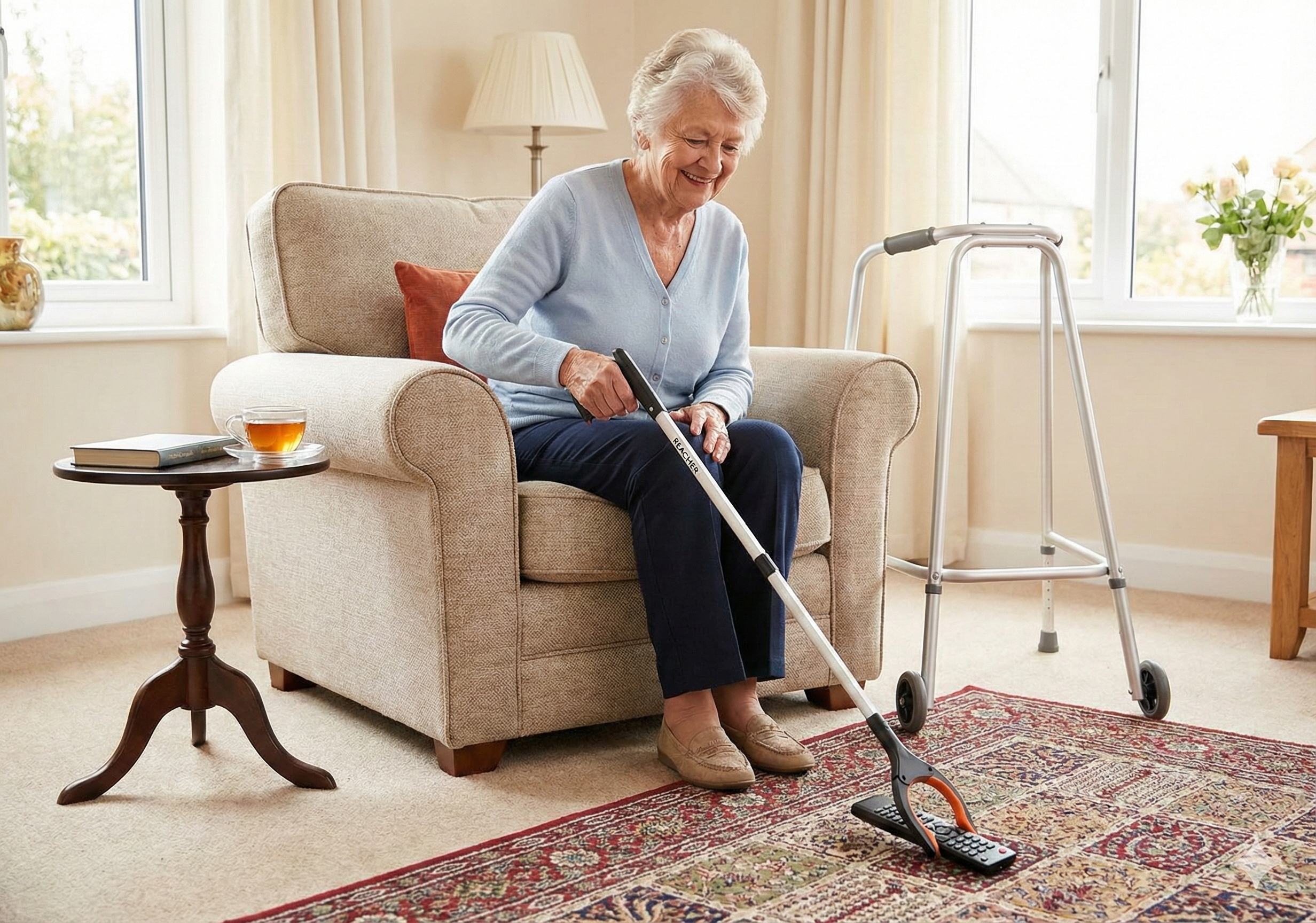
The MVP (Most Valuable Player) of your recovery will undoubtedly be the reacher. This is a lightweight pole with a handle at one end and a mechanical jaw at the other.
- Why you need it: Bending over to pick up objects from the floor is the #1 way patients accidentally break the 90-degree rule.
- How to use it: Use it to pick up dropped items, reach books on low shelves, or even pull your pants up to your knees before you stand.
- Tip: Many of our clients buy two—one for the bedroom and one for the living room/kitchen—so they never have to walk around looking for it.
2. The Sock Aid
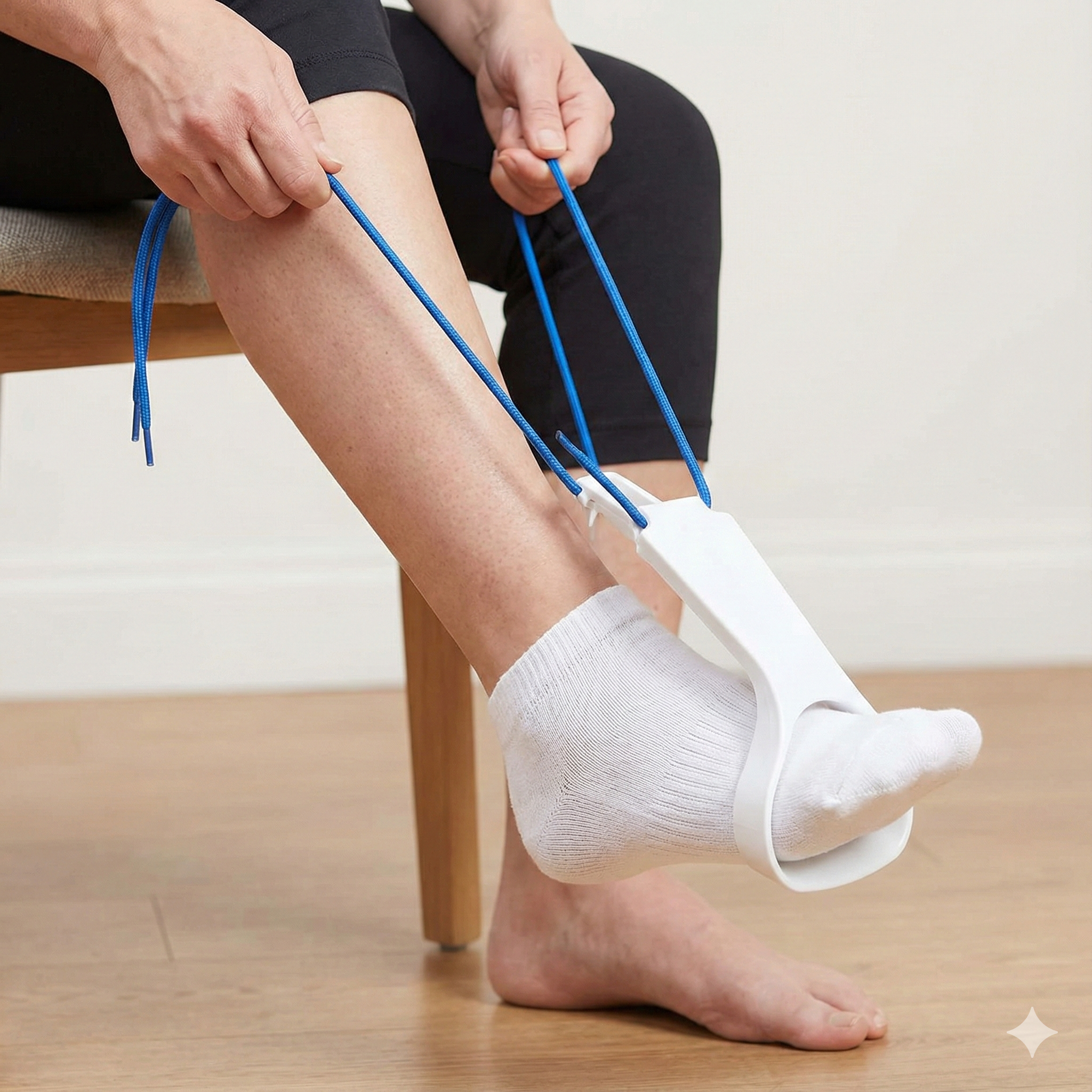
Ask anyone who has had hip surgery what their biggest frustration is, and they will likely say, “Putting on socks.” It is physically impossible to put on a sock without bending your hip too far unless you have help or the right tool.
- Why you need it: Independence. You don’t want to have to call a caregiver every time your feet get cold.
- How it works: The reacher grabber sock aid combo is often talked about, but the sock aid is a specific device. You slide your sock over a flexible plastic tube attached to long cords. You drop the tube to the floor (holding the cords), slide your foot in, and pull. The sock slides perfectly onto your foot without you bending an inch.
3. Long-Handled Shoe Horn
Once your socks are on, you need shoes. Sturdy, non-slip shoes are crucial for learning to walk again, but jamming your heel into a sneaker requires force and bending.
- Why you need it: To protect your heels and your new hip. A standard shoe horn is too short. A long-handled version (usually 18-24 inches) allows you to guide your foot into the shoe while standing upright or sitting safely.
4. Long-Handled Bath Sponge
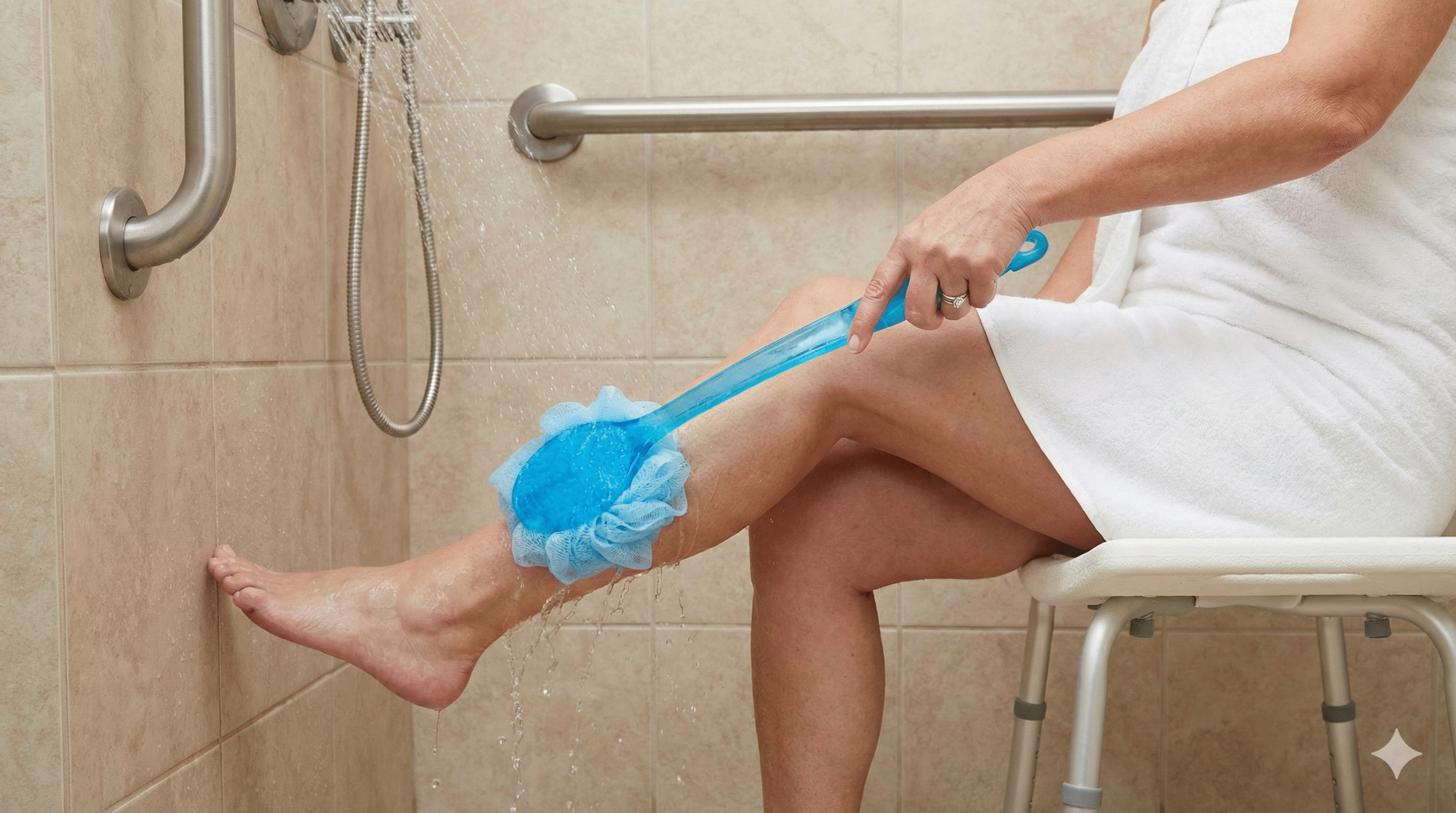
Hygiene is important for preventing infection and feeling like yourself again. However, reaching your lower legs, feet, and back in the shower can be dangerous on a slippery surface.
- Why you need it: Safety in the shower.
- How to use it: These sponges are mounted on a long, often curved handle. They allow you to scrub your feet and back without twisting your torso or bending down, significantly reducing the risk of a slip-and-fall accident in the bathroom.
5. The Dressing Stick
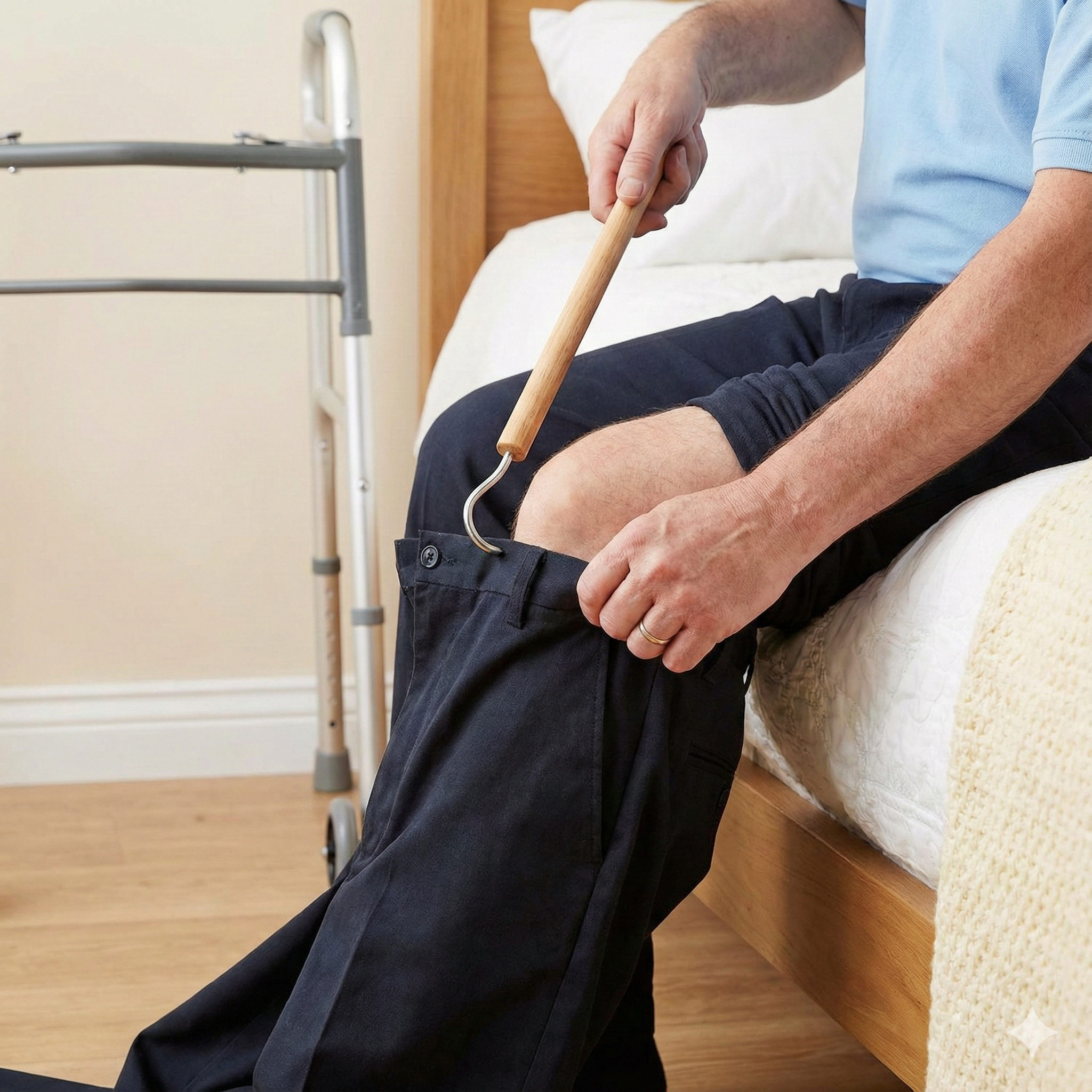
This looks like a simple wooden dowel with hooks on both ends, but it is a versatile tool for getting dressed.
- Why you need it: Dressing your lower body is tricky.
- How to use it: The hooks help you pull up trousers, straighten skirts, or push down socks that are bunched up. It acts as an extension of your arm, handling the fabrics that are just out of reach.
Why Buy a Kit Instead of Separate Items?
While you can purchase these items individually, buying a pre-packaged “Hip Kit” from a medical supply provider like Alfa Healthcare Supply Inc. is usually more cost-effective. Furthermore, these kits are curated by experts who know exactly what quality of hip replacement recovery equipment is required for daily hospital-grade use.
Recovery Tip: Practice using these tools before your surgery. It takes a little coordination to master the sock aid or the reacher. If you practice while you are mobile, you will be a pro by the time you get home from the hospital.