


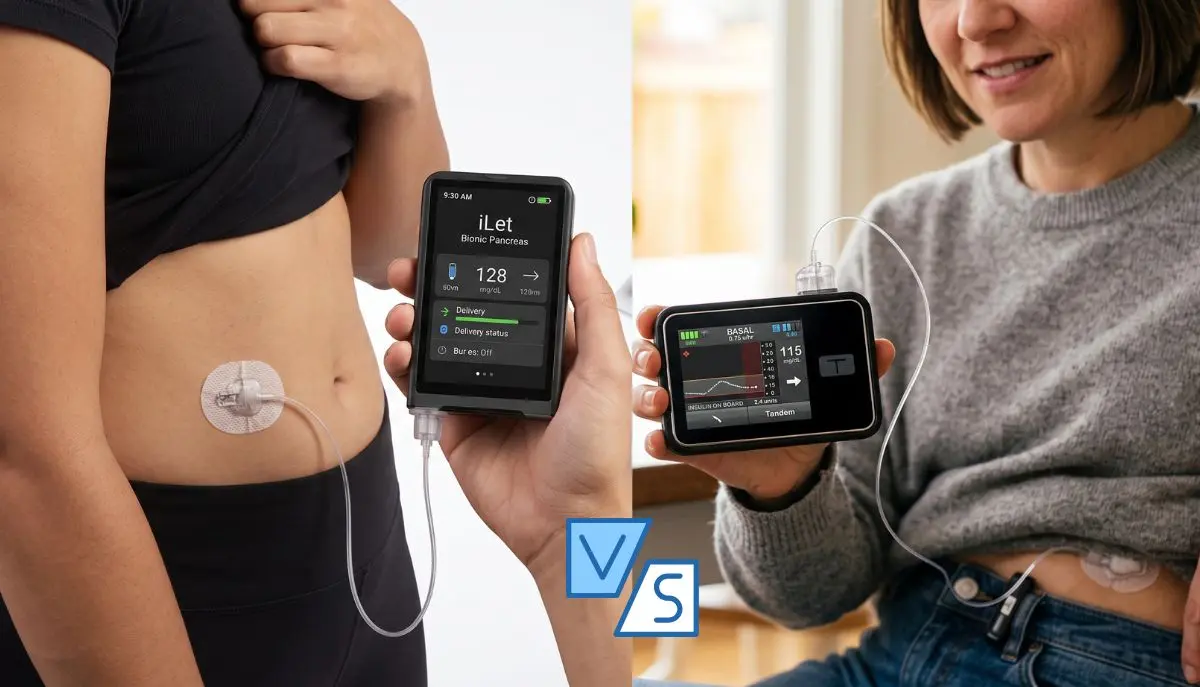
Choosing an insulin pump is a deeply personal decision. For many people living with insulin-dependent diabetes, the goal is not simply to find a device that delivers insulin. It is to find a system that can fit into everyday life—during meals, at work, while sleeping, during exercise, and on those unpredictable days when blood glucose does not behave as expected.
When comparing iLet Bionic Pancreas vs Tandem insulin pump, two different approaches to automated insulin delivery become especially important. The iLet Bionic Pancreas is designed to reduce the number of settings a user must manage, while Tandem systems such as the t:slim X2 with Control-IQ+ emphasize personalization through programmed profiles and automated insulin adjustments.
This guide explains the major differences in simple language so patients and families can have a more informed conversation with their diabetes care team.
The iLet Bionic Pancreas is an automated insulin delivery system developed by Beta Bionics. The FDA cleared the iLet system in 2023 for people ages 6 and older with type 1 diabetes. It combines an iLet ACE Pump, iLet Dosing Decision Software, and a compatible integrated continuous glucose monitor (iCGM).
One of the most noticeable differences is how the system approaches insulin dosing.
Traditional insulin pump therapy can require users or healthcare professionals to manage settings such as basal rates, insulin-to-carbohydrate ratios, and correction factors. The iLet uses an adaptive algorithm that is initialized with the user’s body weight rather than requiring the user to enter those conventional insulin-dosing parameters.
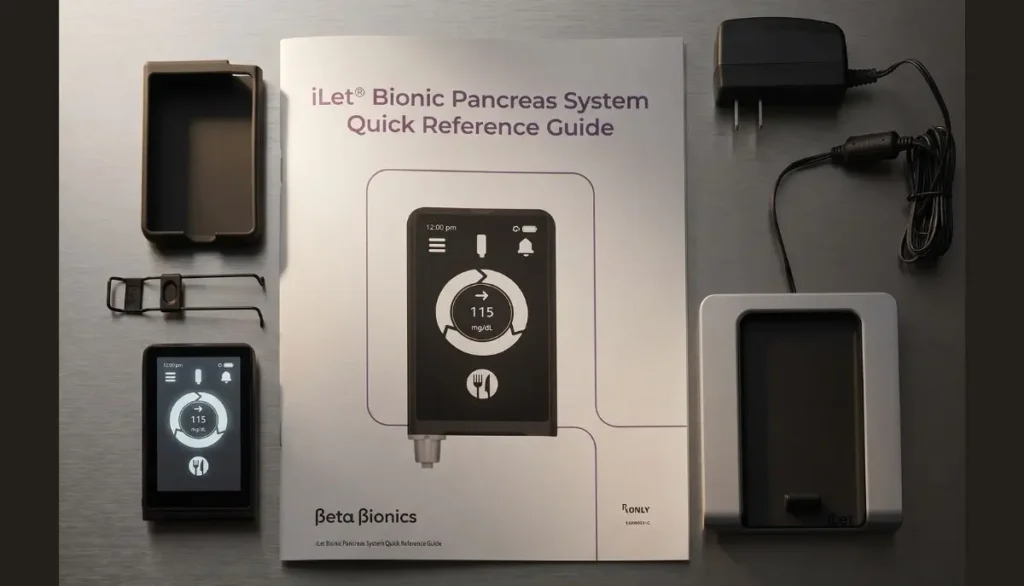
The system also uses meal announcements rather than requiring conventional carbohydrate counting. Users estimate a meal as usual, more, or less relative to their typical meal, allowing the algorithm to adapt over time.
That can be appealing to someone who finds detailed carbohydrate calculations and frequent pump-setting adjustments stressful.
Tandem Diabetes Care offers insulin pumps including the t:slim X2 and Tandem Mobi systems.
The t:slim X2 uses a color touchscreen and can work with Control-IQ+ automated insulin delivery technology. Control-IQ+ uses compatible CGM readings to predict glucose levels and automatically adjust insulin delivery. It can increase, decrease, or suspend basal insulin and can provide automated correction boluses when appropriate.
The Tandem approach provides considerable personalization. Users can create Personal Profiles containing settings such as basal rates, correction factors, and carbohydrate ratios.
Tandem also offers the smaller Tandem Mobi, which uses Control-IQ+ and can be controlled through a compatible smartphone app.
| Feature | iLet Bionic Pancreas | Tandem t:slim X2 with Control-IQ+ |
| Main approach | Adaptive automated insulin delivery | Personalized automated insulin delivery |
| Conventional basal settings | Designed to reduce the need for user-entered basal settings | Uses programmed Personal Profiles |
| Carb counting | Meal-size announcements instead of traditional carb counting | Meal bolusing generally involves carbohydrate information |
| Automated insulin adjustment | Yes | Yes |
| Automated correction bolus | Yes, based on its algorithm | Yes, through Control-IQ+ |
| CGM required for automated operation | Compatible iCGM required | Compatible CGM required |
| Personalization | Algorithm learns from insulin needs | Multiple programmable settings and profiles |
| Touchscreen pump | Yes | Yes |
| Intended age | FDA-cleared for ages 6+ with type 1 diabetes | Control-IQ+ supports indicated users ages 2+ depending on system and indication |
| Best-known design philosophy | Simplify dosing decisions | Provide automation with greater user customization |
The exact compatibility, insulin, CGM, age indication, and software features can change. Always check the manufacturer’s current labeling and discuss the system with your healthcare provider before making a decision.
The most important difference in an iLet Bionic Pancreas vs Tandem insulin pump comparison is not necessarily the physical pump. It is the philosophy behind insulin management.
The iLet is designed to simplify the initial setup and ongoing dosing decisions. According to the FDA, its adaptive algorithm is initialized using body weight and does not require the same additional insulin-dosing parameters used by conventional pump therapy.
For some users, this can mean less time worrying about whether a basal rate or correction factor needs to be changed.
Tandem’s Control-IQ+ works with Personal Profile settings. These profiles define important insulin-delivery parameters and can be personalized for different periods or needs.
For an experienced pump user who likes having more control over settings, this approach may feel familiar.
In simple terms:
Neither approach is automatically better for everyone.
Meals are one of the most challenging parts of diabetes management.
The iLet was designed to simplify this process. Instead of requiring traditional carbohydrate counting, users announce meals according to their relative size. The system then uses its adaptive algorithm to determine the meal dose.
This can be attractive for people who feel overwhelmed by weighing food, reading nutrition labels, and calculating carbohydrates at every meal.
Tandem’s Control-IQ+ system is more traditionally structured around individualized pump settings and meal boluses. Tandem itself notes that users still need to actively manage diabetes and bolus for meals.
For someone who dislikes carbohydrate calculations, the iLet may feel more straightforward.
For someone who prefers detailed control over meal dosing, Tandem may feel more familiar.
Both systems use automated insulin delivery technology, but they approach automation differently.
The iLet’s dosing software uses CGM information to determine insulin delivery and continuously adapts to the user’s insulin needs.
Tandem Control-IQ+ predicts glucose levels 30 minutes ahead and automatically adjusts insulin delivery every five minutes. It can increase or decrease insulin, suspend delivery when appropriate, and deliver automated correction boluses under specified conditions.
This predictive automation is particularly useful because glucose levels are constantly changing.
However, automated insulin delivery does not mean diabetes management becomes completely hands-off.
Users still need to:
A modern automated insulin delivery system depends heavily on its CGM.
The iLet system requires a compatible integrated CGM as part of the overall system.
Tandem’s current systems support compatible CGM options, and Tandem states that the t:slim X2 can work with Dexcom G7 and FreeStyle Libre 3 Plus under supported configurations.
Because compatibility can depend on pump software, CGM model, age, region, and other requirements, it is important to verify the current combination before purchasing or switching systems.
This is where individual experience matters.
The “easier” pump is not necessarily the same for everyone.
A person who loves customization may find Tandem easier. Another person may feel more comfortable with the simplified philosophy of iLet.
An insulin pump is something you may wear every day. Comfort and lifestyle therefore matter just as much as technical specifications.
Think about your normal routine.
Consider:
Tandem Control-IQ+ includes activity options such as Sleep and Exercise settings designed for different treatment ranges.
Consider carrying:
A simpler dosing approach may feel attractive. However, the system still requires regular maintenance and attention.
Overnight glucose management is one of the reasons automated insulin delivery systems are appealing.
Tandem says Control-IQ+ predicts glucose levels and adjusts insulin automatically, and its Sleep Activity is designed around a narrower treatment range. Tandem reports real-world overnight time-in-range results for its system, although individual outcomes vary.
The iLet also continuously uses CGM information to adapt insulin dosing.
For many families, the emotional benefit of automated overnight insulin management can be significant. Waking up repeatedly to check glucose or worrying about nighttime highs and lows can be exhausting.
Still, no pump can guarantee that every overnight glucose value will remain within range.
This is another major decision point.
The iLet’s strength is its adaptive approach. Rather than asking users to manually optimize numerous insulin parameters, the system is designed to learn and adjust dosing based on the individual’s insulin needs.
Tandem offers more traditional personalization through Personal Profiles. Users can have different profiles with different basal and bolus-related settings.
This can be useful when insulin requirements vary significantly throughout the day.
For example, a person might need different insulin settings during:
The ability to customize can be helpful—but it also means more settings to understand.
The technology inside the pump is only part of the experience.
The t:slim X2 has a touchscreen interface and holds up to 300 units of insulin according to Tandem’s current product information.
Tandem Mobi is a smaller automated insulin delivery option that holds 200 units and offers multiple ways to wear the pump.
The iLet is also a wearable insulin pump system designed to work with its dosing software and CGM.
When comparing devices, look beyond appearance. Consider:
Automated insulin delivery can make diabetes management easier, but these are still medical devices delivering insulin.
That means users need to understand what happens if:
Tandem notes that Control-IQ+ is not intended to eliminate all highs and lows and that users must continue actively managing diabetes.
There have also been FDA-posted safety and recall records involving diabetes devices, which is an important reminder to keep pump software and device instructions current and to respond to manufacturer or FDA safety communications. For example, an FDA recall notice posted in 2026 addressed certain iLet software versions involving Dexcom G7 sensor readings and possible changes to insulin delivery behavior.
This does not mean a particular pump is unsafe for everyone. It means users should stay informed and follow current manufacturer instructions.
The iLet may be worth discussing with a healthcare professional if someone:
The FDA specifically describes the iLet’s adaptive dosing and meal-announcement approach as features intended to simplify insulin pump therapy.
A Tandem system may be worth discussing if someone:
Tandem’s current Control-IQ+ technology provides automated insulin adjustment based on predicted glucose levels and compatible CGM data.
There is no universal winner.
The better question is:
Which system matches the person’s diabetes-management style, clinical needs, comfort level, and lifestyle?
Someone who wants to reduce the number of traditional pump settings may be attracted to the iLet.
Someone who wants a high degree of personalization may prefer Tandem.
Someone who is already comfortable with detailed insulin settings may appreciate Tandem’s flexibility. Someone who feels exhausted by carbohydrate calculations and pump adjustments may prefer the iLet’s simplified approach.
This is why an endocrinologist or certified diabetes care and education specialist can be extremely valuable when choosing an automated insulin delivery system.
Before making a decision, consider asking your healthcare team:
These questions can turn a confusing technology decision into a much more manageable conversation.
The iLet Bionic Pancreas vs Tandem insulin pump comparison is ultimately about two different philosophies of diabetes technology.
The iLet focuses heavily on adaptive automation and simplifying insulin management. Its meal-announcement system and reduced reliance on conventional pump settings may be attractive to people who want fewer dosing decisions.
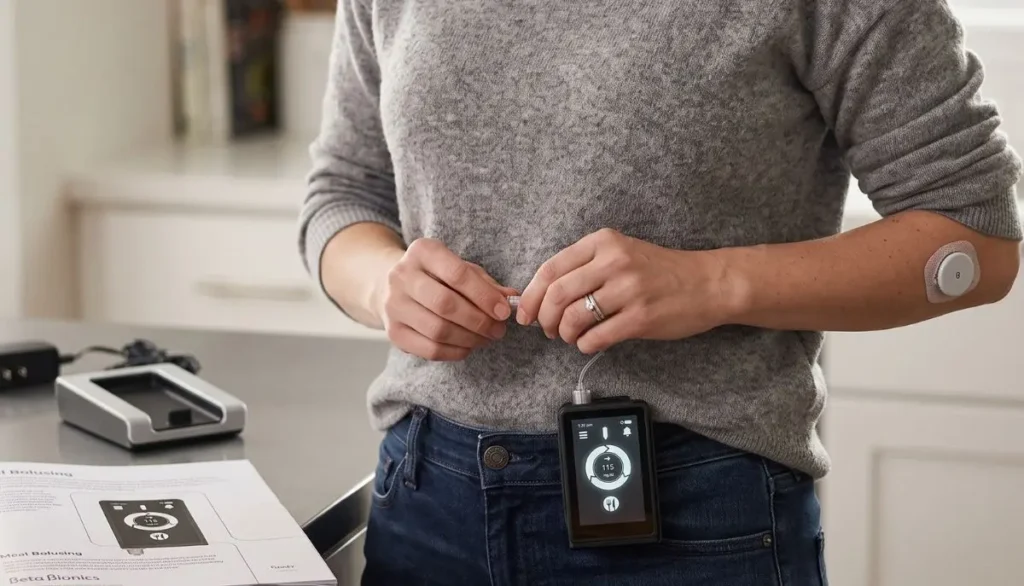
Tandem’s Control-IQ+ systems combine automation with greater customization. Predictive glucose management, automated insulin adjustments, correction boluses, Personal Profiles, and activity settings can appeal to people who want technology while retaining more control over their pump settings.
Most importantly, an insulin pump should not be chosen based only on a feature comparison chart. Your diabetes type, age, insulin requirements, CGM compatibility, lifestyle, comfort with technology, insurance coverage, and healthcare team’s recommendations all matter.
For patients and families researching diabetes-management products, Alfa Healthcare Supply Inc. provides medical supply resources and information to help people explore available healthcare equipment and supplies.
The iLet Bionic Pancreas is designed to automate insulin dosing with minimal user input and uses an integrated CGM and dosing algorithm to continually adjust insulin delivery. FDA documentation describes the iLet as intended for people age 6 and older with diabetes.
Tandem offers insulin pumps such as the t:slim X2 and Tandem Mobi, which can work with Control-IQ+ technology and compatible CGMs to automatically adjust insulin delivery. Current Tandem labeling includes use for type 1 diabetes from age 2 and type 2 diabetes in adults.
The iLet is designed to automate much of insulin dosing and continually adapt to changing insulin needs. However, users still need to interact with the system, including announcing meals and following the manufacturer’s instructions. It should not be considered a system that eliminates all diabetes management.
Yes. When used with compatible CGM technology and Control-IQ+ technology, Tandem pumps can automatically increase, decrease, or suspend basal insulin and can deliver correction boluses when glucose is predicted to exceed a specified threshold.
Ease of use depends on the person’s preferences and diabetes-management needs. The iLet is designed to reduce the amount of information users must enter for insulin dosing, while Tandem provides more settings and controls for users who want greater ability to customize pump therapy.
Yes. Both systems can work with compatible continuous glucose monitoring technology. The iLet system uses CGM information as an input for its automated dosing system, while Tandem’s automated insulin delivery systems use compatible iCGMs to guide insulin adjustments.
The iLet ACE Pump is indicated for people 6 years of age and older with diabetes, according to FDA documentation.
Tandem’s current Control-IQ+ labeling has expanded indications to people 2 years and older with type 1 diabetes, while use for type 2 diabetes is indicated for adults 18 and older.
Generally, Tandem systems provide users with more configurable settings and options for managing insulin delivery. The iLet takes a different approach by using its automated dosing algorithm to reduce the amount of manual insulin calculation and adjustment required from the user.
The best choice depends on the patient’s treatment plan, insulin needs, technology preferences, and healthcare provider’s recommendations.
Yes. Both systems use CGM information as part of automated insulin delivery. The specific algorithms, settings, compatible components, and user interactions are different between the systems.
There is no single pump that is best for everyone. The iLet may appeal to people who prefer a highly automated approach with less manual dosing information. Tandem may be attractive to people who want more control and customization of their insulin-pump settings.
A healthcare professional can help determine which system is appropriate based on individual needs.
Tandem systems offer multiple programmable settings and automated features through Control-IQ+ technology. This can be useful for people who and their healthcare teams want greater ability to tailor pump therapy.
Important factors include:
A person may be able to switch insulin-pump systems, but the decision should be made with their healthcare provider. Switching systems can require new training, different supplies, and changes to the diabetes-management routine.
Yes. The iLet system uses meal announcements as part of its dosing approach. Users should follow the manufacturer’s instructions and training for how and when to announce meals.
No. Automated insulin delivery does not eliminate the need for active diabetes management. Tandem specifically states that Control-IQ+ is not a substitute for active diabetes management. Users still need to follow their treatment plan and use the pump, CGM, and other components according to their instructions.
Patients can review the manufacturers’ current product information and discuss the available options with their diabetes healthcare team. For medical supplies and diabetes equipment, Alfa Healthcare Supply Inc. can also provide information about available products and ordering options.