


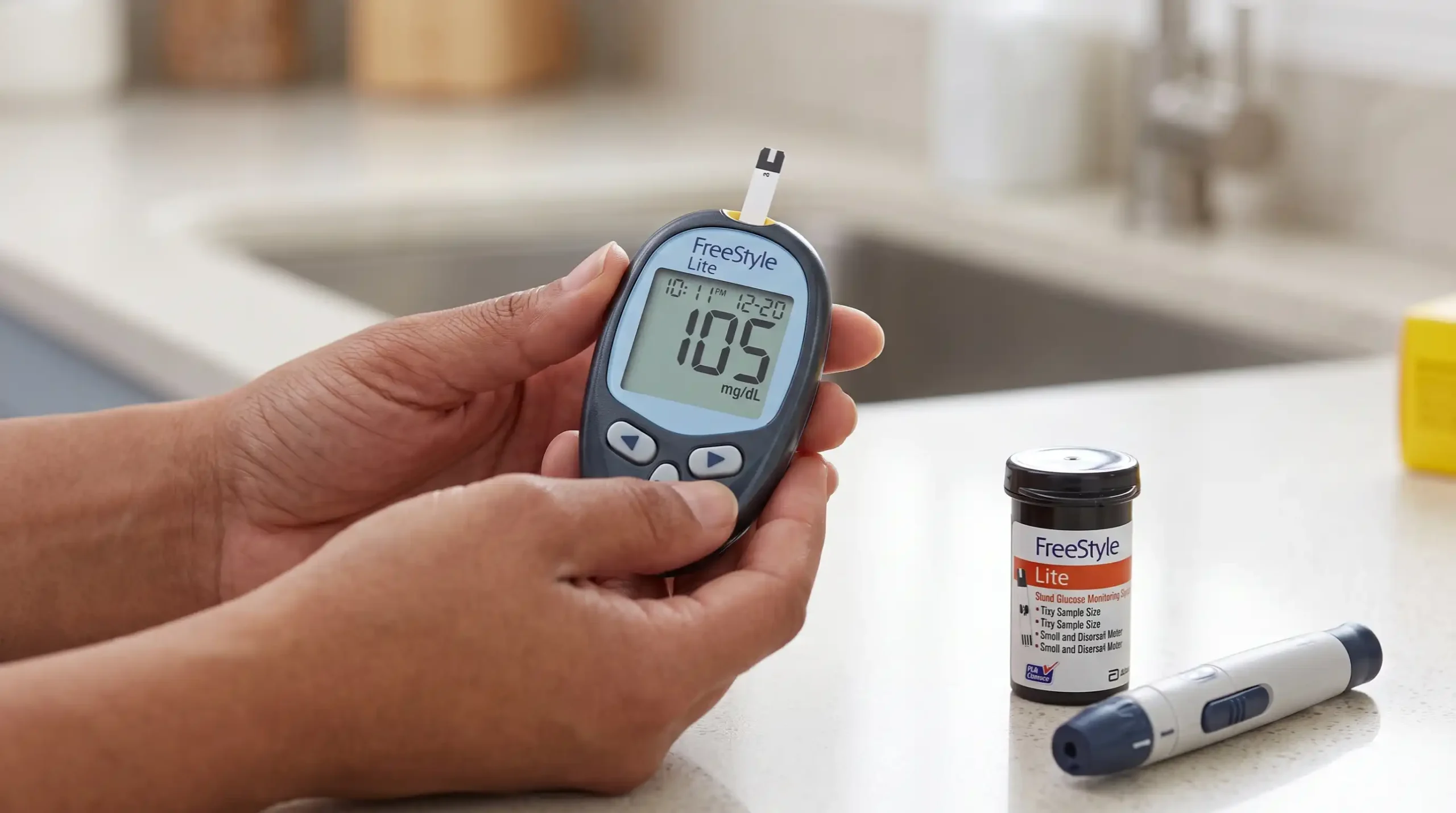
If you use a blood glucose meter at home, one of the most important questions is simple: how accurate is the FreeStyle Lite glucose meter?
For people managing diabetes, a glucose number is more than just a number on a screen. It can influence meals, exercise, medication decisions, and conversations with a healthcare professional. That is why accuracy matters.
The FreeStyle Lite Blood Glucose Monitoring System, made by Abbott Diabetes Care, is an FDA-cleared over-the-counter blood glucose monitoring system. FDA records identify the FreeStyle Lite system as a blood glucose monitoring device for home use.
Available evidence suggests that the FreeStyle Lite can provide reliable blood glucose measurements when it is used correctly with the appropriate FreeStyle Lite test strips. However, like every blood glucose meter, it is not expected to produce exactly the same number as a laboratory test every time.
This guide explains how accurate is the FreeStyle Lite glucose meter, what can affect its readings, how to improve testing accuracy, and what to do when a result does not seem right.
The FreeStyle Lite has demonstrated good analytical and clinical performance in published evaluations. One study of the FreeStyle Lite reported good precision and accuracy, including repeatability and strong linearity across its measuring range.
An independent SKUP evaluation also found that the FreeStyle Lite achieved the applicable ISO 15197 quality goal under standardized testing conditions and produced accurate results when used by people with diabetes.
A separate multicenter study comparing several blood glucose meters found that the FreeStyle Lite met the ISO requirements used in that study, with 95% or more of its results falling within the specified combined accuracy limits.
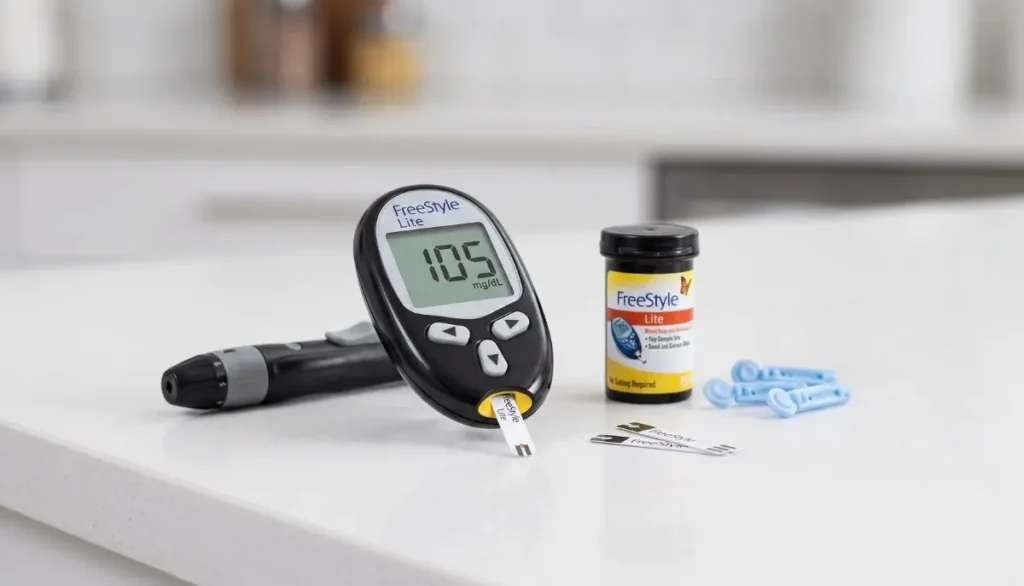
So, the FreeStyle Lite is generally considered an accurate home blood glucose meter when properly maintained and used according to its instructions.
But accuracy is not only about the meter itself.
The test strip, blood sample, storage conditions, hand cleanliness, temperature, testing technique, and other factors can all affect the final reading.
Before discussing the FreeStyle Lite specifically, it helps to understand what glucose-meter accuracy means.
Many people assume that if their actual blood glucose is 120 mg/dL, the meter should display exactly 120 mg/dL.
In real-world glucose monitoring, that is not how meter accuracy is evaluated.
Home blood glucose meters are compared with reference laboratory methods. International standards establish acceptable limits for differences between meter readings and reference values.
For example, the older ISO 15197 criteria used in evaluations of glucose meters required a large majority of measurements to fall within specified limits of the comparison method. The SKUP evaluation describes the ISO requirement as 95% of individual results being within ±0.83 mmol/L at lower glucose concentrations or within ±20% at higher concentrations.
This means that small differences between a home meter and a laboratory result do not automatically mean the meter is malfunctioning.
For example, if one test produces 120 mg/dL and another method produces a somewhat different result, that difference needs to be interpreted in context.
Several pieces of evidence help answer the question, “How accurate is the FreeStyle Lite glucose meter?”
A published evaluation of the FreeStyle Lite found good analytical performance.
The study reported:
The researchers concluded that the system demonstrated good analytical performance and clinical accuracy.
That is useful information because repeatability matters. A meter should not produce dramatically different results every time you perform a properly conducted test under the same conditions.
The FreeStyle Lite has also been evaluated independently.
The SKUP evaluation found that the FreeStyle Lite achieved the relevant ISO 15197 quality goal under standardized and optimal measurement conditions. It also reported that the meter produced accurate results when operated by people with diabetes.
This is particularly relevant for home users because testing in a person’s home can be different from testing under laboratory conditions.
Real-world users may have:
Correct technique therefore remains important.
The FreeStyle Lite is designed to make blood glucose testing relatively simple.
FDA documentation for the FreeStyle Lite/Freedom Lite system lists several specifications, including:
The American Diabetes Association’s consumer guide also lists the FreeStyle Lite as requiring no coding, using a small blood sample, and providing results in approximately five seconds.
These features can make the system convenient for regular home monitoring.
Even an accurate glucose meter can produce a result that differs from a laboratory blood glucose measurement.
There are several reasons.
Glucose is not a fixed number.
Your blood glucose can change because of:
If you test your blood glucose at home and then have a laboratory test later, the two measurements may not represent exactly the same moment.
This is one reason why comparing a home reading with a laboratory result requires context.
One of the simplest causes of inaccurate glucose readings is contaminated fingers.
If you have recently handled:
residue can potentially affect the blood sample.
For the most reliable result, wash your hands with soap and water and dry them thoroughly before testing.
Clean hands are one of the easiest ways to improve the quality of your blood glucose measurements.
The meter and test strips work together.
Using the wrong test strips, damaged strips, improperly stored strips, or expired strips can affect results.
The FreeStyle Lite documentation specifically states that the meter should be used with FreeStyle Lite test strips and the appropriate FreeStyle control solution. Other products may produce inaccurate results.
Always check:
Blood glucose meters have specified operating temperature ranges.
FDA documentation for the FreeStyle Lite system lists an operating temperature range of approximately 4°C to 40°C (40°F to 104°F).
Very hot or very cold environments may affect testing.
For example, leaving your meter in a hot vehicle or exposing test strips to unsuitable temperatures may compromise testing performance.
When possible, keep the meter and strips within their recommended storage and operating conditions.
The FreeStyle Lite uses a very small blood sample.
That is convenient, but the sample still needs to be sufficient for the test strip.
If there is not enough blood, the test may produce an error or an unreliable result.
Follow the instructions supplied with your meter and test strip. Allow the strip to properly draw in the blood rather than trying to force additional blood onto it.
A glucose meter can only measure the sample that you give it.
Good testing technique includes:
Small mistakes can sometimes create confusing readings.
It is difficult to say that one glucose meter is universally “the most accurate.”
Different meters may perform differently depending on:
A multicenter study comparing several commercially available blood glucose systems found that the FreeStyle Lite performed well against the study’s reference criteria.
However, this does not mean every reading will match another meter or laboratory test exactly.
The more useful question is:
Is the FreeStyle Lite sufficiently accurate and consistent for appropriate home blood glucose monitoring when used correctly?
The available evidence indicates good performance.
If you are concerned about your meter, a control-solution test can be useful.
Control solution testing checks whether the meter and test strips are functioning together as expected.
The FreeStyle Lite user documentation describes control-solution testing as a way to check the meter and strips.
You may consider performing a control-solution test when:
Compare the control-solution result with the acceptable range printed on the test-strip packaging or supplied documentation.
If the result is outside the expected range, do not simply assume that your blood glucose has changed.
Investigate the testing system first.
Sometimes the most important question is not whether the meter is generally accurate, but whether your specific reading makes sense.
Suppose you normally see readings around 100–140 mg/dL but suddenly receive an unexpected result.
Before reacting, consider:
If the reading does not match how you feel or seems inconsistent with your usual results, follow the manufacturer’s troubleshooting instructions and consider repeating the test with a new strip.
A repeat test may be reasonable when:
However, do not repeatedly test simply to obtain a number you prefer.
If you receive a result that is dangerously low or high, follow the diabetes management plan provided by your healthcare professional rather than delaying appropriate care while repeatedly checking the meter.
One useful feature of the FreeStyle Lite is that it is designed as a no-coding meter.
The American Diabetes Association consumer guide lists “No Coding Required” as a key specification.
No-coding technology can simplify testing because the user does not have to manually enter a code for each new strip lot.
That may also reduce one possible source of user error.
The documented FreeStyle Lite system uses approximately 0.3 microliters of blood.
That is a very small sample.
For many people, a smaller blood requirement can make routine testing more comfortable and convenient.
The important point, however, is not to focus only on the sample size.
A correct sample is still essential.
The FreeStyle Lite is designed to provide a glucose result in approximately five seconds.
Fast results can be helpful during everyday testing because users do not have to wait long to see the measurement.
But speed should never replace correct technique.
A fast incorrect test is less useful than a properly performed test.
No.
A home glucose meter is intended to help people monitor blood glucose; it should not be used as the sole method for diagnosing diabetes.
The FreeStyle Lite documentation states that the system is intended for self-testing and monitoring and is not intended for diagnosis or screening of diabetes.
If you are concerned about diabetes or have repeatedly abnormal glucose readings, speak with a qualified healthcare professional.
Here is a simple overview:
| Factor | Possible Effect |
| Dirty hands | May interfere with the sample |
| Expired strips | May produce inaccurate results |
| Improper strip storage | May affect performance |
| Extreme temperatures | May affect testing |
| Insufficient blood | Can cause errors or unreliable testing |
| Incorrect testing technique | Can affect the result |
| Damaged strips | May affect accuracy |
| Meter problems | May cause inconsistent readings |
| Rapidly changing glucose | Different tests may naturally differ |
| Certain medical or chemical factors | May interfere with some glucose systems |
This is why glucose-meter accuracy depends on both device performance and user technique.
Test strips deserve special attention.
According to FreeStyle Lite documentation, test strips should be stored within their specified temperature range and protected from unsuitable environmental conditions.
Do not leave the strip container open unnecessarily.
Moisture and environmental exposure can damage glucose test strips.
A simple habit can help:
Take out one strip, use it, and close the container promptly.
That small step helps protect the remaining strips.
Accuracy and consistency are related, but they are not exactly the same thing.
Imagine a meter that produces:
under similar testing conditions.
Those results are reasonably consistent.
Now imagine:
with the same blood sample and similar conditions.
That would raise more questions.
Published research on FreeStyle Lite has reported good repeatability and precision, supporting its ability to provide consistent measurements under appropriate conditions.
Yes.
Blood glucose itself can change, and measurement variation is also possible.
For example, if you test before eating and then test again after eating, you should not expect the numbers to be identical.
Even two measurements taken close together may not match perfectly.
The goal of a glucose meter is not to provide a laboratory-perfect number to the last digit. Its purpose is to provide useful information about blood glucose for diabetes management.
Some versions of the FreeStyle Lite system support testing from locations other than the fingertip.
FDA documentation for the system lists capillary and venous whole blood and identifies alternative sites such as the upper arm and palm for the documented system.
However, alternative-site testing may not always be appropriate.
For example, when glucose is changing quickly or when low blood glucose is suspected, fingertip testing may be preferred according to the manufacturer’s instructions. The user manual specifically advises finger testing when testing for hypoglycemia or when a person has hypoglycemia unawareness.
Always follow the instructions applicable to your particular meter and test strips.
A reliable glucose monitoring system combines several things:
The FreeStyle Lite has been evaluated for analytical and clinical performance.
Use the test strips specified for the meter.
Protect strips from inappropriate temperature, moisture, and environmental exposure.
Wash your hands, use an appropriate blood sample, and follow the instructions.
Control-solution testing can help identify problems with the meter or strips.
A glucose number should be considered alongside symptoms, medications, meals, activity, and your healthcare professional’s guidance.
The FreeStyle Lite offers several practical features:
These features can make regular blood glucose monitoring easier.
No home glucose meter is perfect.
Potential limitations include:
Therefore, a good meter still requires good testing habits.
Here is a simple routine you can follow.
Use soap and water and dry thoroughly.
Make sure it is the correct strip and has not expired.
Make sure the meter is being used within its specified operating conditions.
Insert the test strip according to the manufacturer’s instructions.
Use the lancing device correctly.
Allow the strip to absorb the appropriate sample.
Do not remove the strip prematurely.
Think about when you last ate, exercised, took medication, or used insulin.
If the reading seems unexpectedly abnormal or inconsistent, follow the manufacturer’s troubleshooting guidance.
Especially if readings are repeatedly outside your expected range or do not match how you feel.
For many people, the answer is yes, when used correctly.
The FreeStyle Lite has FDA clearance and published evaluations showing good analytical performance and compliance with applicable accuracy criteria used in those studies.
But it is important to understand what “accurate” means.
A glucose meter is not a substitute for a laboratory analyzer.
Instead, it is a practical tool designed to provide useful blood glucose information at home.
That information can help people recognize trends, understand how meals and activity affect glucose, and follow a diabetes-management plan.
You should consider contacting your healthcare professional if:
Do not make major medication changes based solely on an unexpected home meter reading unless your healthcare professional has given you specific instructions for doing so.
So, how accurate is the FreeStyle Lite glucose meter?
The evidence indicates that the FreeStyle Lite has good accuracy and analytical performance when used correctly. Published evaluations have reported good precision, clinical accuracy, and performance against applicable ISO criteria.
At the same time, no home glucose meter should be expected to produce exactly the same result as a laboratory test every time.
The biggest difference often comes down to proper testing habits.
Clean hands.
Fresh, properly stored test strips.
Correct blood sampling.
Appropriate storage and temperature.
Following the manufacturer’s instructions.
These simple habits can make your results more dependable.
For people living with diabetes, a glucose meter is not simply another piece of medical equipment. It can become part of the daily routine—something you rely on before breakfast, after meals, during exercise, or whenever you want to understand what your blood glucose is doing.
Choosing a reliable system and using it correctly can make that routine easier and more useful.
Alfa Healthcare Supply Inc. provides medical supplies and durable medical equipment for patients, caregivers, and healthcare needs. The company offers products across categories such as diabetes supplies, home care, orthopedic products, incontinence supplies, and other medical equipment.
For customers looking for blood glucose monitoring products and related diabetes supplies, you can visit the Alfa Healthcare Supply Inc. website for available products and purchasing information.
The FreeStyle Lite has demonstrated good analytical and clinical performance in published evaluations. Independent testing has also found that it met applicable ISO accuracy criteria used in those evaluations.
Any blood glucose meter can produce an inaccurate or misleading result if the test is performed incorrectly or if the test strips are expired, damaged, contaminated, or improperly stored. Environmental conditions and other factors can also affect results.
Use the appropriate FreeStyle control solution according to the manufacturer’s instructions. Compare the result with the acceptable range provided with the test strips or control solution.
No. The FreeStyle Lite is designed as a no-coding blood glucose meter.
The documented system uses approximately 0.3 µL of blood.
The meter provides results in approximately five seconds.
You should not use expired test strips. The FreeStyle Lite documentation warns that expired or unsuitable strips can produce inaccurate results.
Different meters can produce somewhat different readings because they use different systems, strips, calibration methods, and measurement technologies. Your blood glucose may also be changing between tests.
A home meter and laboratory analyzer use different measurement systems. In addition, glucose can change between the time of the two tests. A difference does not automatically mean your meter is defective.
No. The system is intended for blood glucose monitoring rather than diagnosing or screening for diabetes.
Medical Disclaimer: This article is intended for general educational purposes and is not a substitute for professional medical advice, diagnosis, or treatment. Always follow the instructions supplied with your specific FreeStyle Lite meter and test strips and speak with your healthcare professional about questions concerning your blood glucose results or diabetes treatment.