


Managing blood glucose can become an important part of everyday life for people with diabetes. Whether you are checking your blood sugar once a day or several times according to your healthcare professional’s instructions, having a blood glucose meter that is simple to understand can make the routine feel easier.
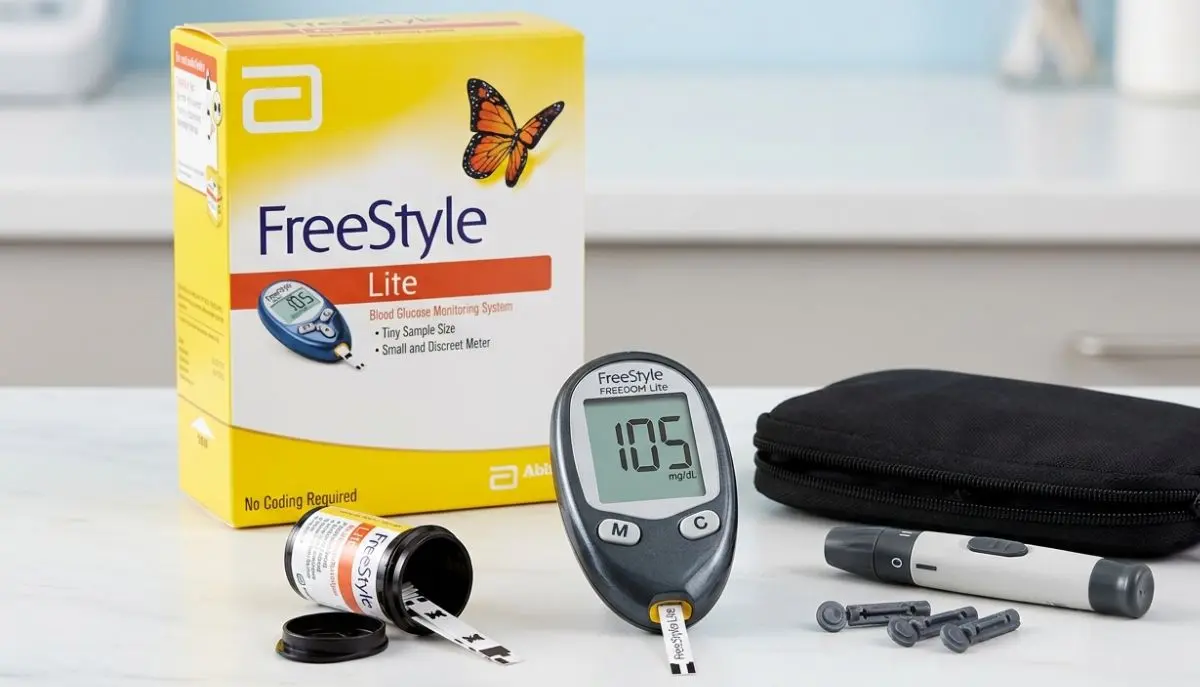
The FreeStyle Lite blood glucose monitoring system is a traditional blood glucose meter system designed to measure glucose from a small blood sample. The system uses compatible FreeStyle Lite test strips and is designed around a small blood sample requirement, quick testing, and straightforward operation.
For someone who is new to blood glucose monitoring, terms such as “test strip,” “lancing device,” “blood sample,” “coding,” and “control solution” can initially sound complicated. In reality, the basic testing process is quite simple once you understand what each component does.
This guide explains what the freestyle lite blood glucose monitoring system is, how it works, what supplies you need, how testing generally works, how to handle test strips, common mistakes to avoid, and what to consider when purchasing the system and replacement strips.
Alfa Healthcare Supply Inc. lists the FreeStyle Lite Blood Glucose Monitoring System among its diabetic supplies. The current Alfa product listing should be checked for the latest availability and pricing.
Medical information notice: This article is for general educational purposes. It does not replace the instructions supplied with your specific meter, test strips, or lancing device, or the advice of your doctor, pharmacist, diabetes educator, or other qualified healthcare professional. Always follow the current manufacturer’s instructions and your individual diabetes-care plan.
The FreeStyle Lite blood glucose monitoring system is a blood glucose monitoring device manufactured by Abbott Diabetes Care.
Unlike a continuous glucose monitor (CGM), the FreeStyle Lite system is a traditional blood glucose meter. It requires a small blood sample for each test.
The meter analyzes the blood sample and displays a glucose reading on the screen.
The FDA currently lists the FreeStyle Lite Blood Glucose Monitoring System as an over-the-counter blood glucose testing system, with Abbott Diabetes Care Inc. identified in the device listing. The FDA record also identifies the system under the blood glucose testing device classification.
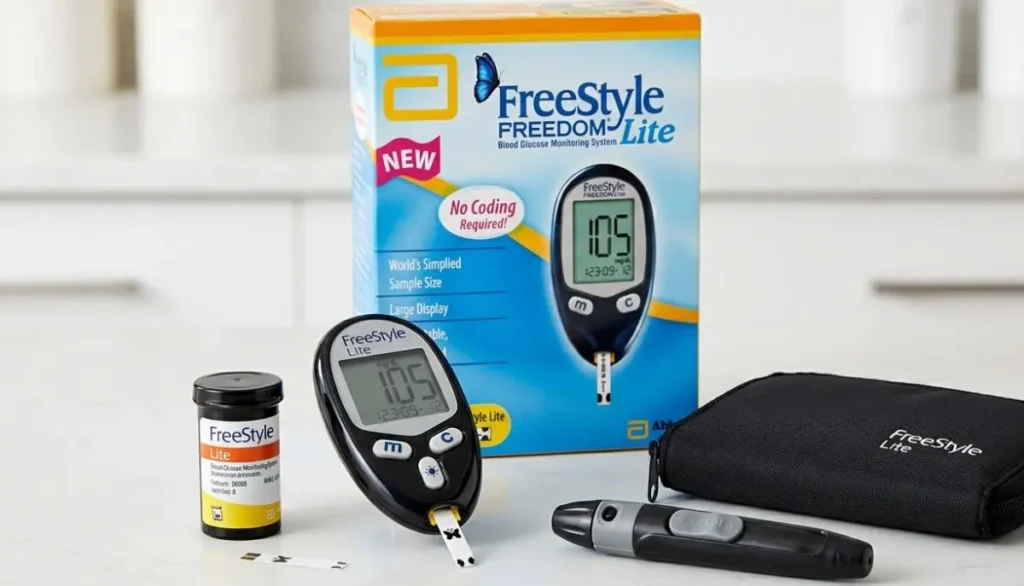
This is important because the FreeStyle Lite system and FreeStyle Libre systems are different types of glucose monitoring technology.
A FreeStyle Lite meter uses a blood sample and test strip.
A CGM such as FreeStyle Libre uses a sensor to measure glucose in interstitial fluid.
So, if you are searching for the freestyle lite blood glucose monitoring system, you are looking for a blood glucose meter rather than a continuous glucose monitoring sensor.
The system uses several components that work together.
The basic setup includes:
The test strip is an important part of the system.
When a small blood sample is applied to the test strip, the meter analyzes the sample and calculates the glucose concentration.
FDA documentation describes the FreeStyle Lite system as using coulometric biosensor technology to quantitatively measure glucose in whole blood. The FDA documentation also identifies a 0.3 µL sample volume and an average measurement time of about five seconds for the system described in its regulatory documentation.
You do not need to understand the chemistry behind the meter to use it.
For everyday use, the basic idea is:
Blood sample → test strip → meter analyzes sample → glucose result appears on screen.
That simple process is what makes a traditional blood glucose meter useful for routine monitoring.
Blood glucose testing can become a regular part of life.
For some people, the process may happen before meals, after meals, before exercise, at bedtime, or at other times recommended by their healthcare professional.
When testing happens regularly, convenience matters.
People may prefer a system that:
The FreeStyle Lite system was designed around several of these practical considerations.
FDA documentation reports a 0.3 µL sample volume, an average measurement time of approximately five seconds, and no calibration/coding requirement for the documented system.
Understanding the major features can help you decide whether this type of blood glucose meter fits your testing routine.
One of the notable features of the FreeStyle Lite system is its small blood sample requirement.
The documented sample volume is approximately 0.3 microliters (µL).
That is a very small amount of blood.
For someone who tests regularly, a smaller sample requirement may make the testing process feel more manageable.
Remember, however, that the lancing device still makes a small puncture in the skin. A small sample requirement does not mean that blood glucose testing is completely painless.
Using the lancing device correctly and following the manufacturer’s instructions can help create a consistent testing routine.
Nobody wants to wait a long time for a blood glucose result.
FDA documentation for the FreeStyle Lite system identifies an average measurement time of approximately five seconds.
A short testing time can be helpful when blood glucose testing is part of a busy daily schedule.
For example, imagine getting ready for work in the morning.
You may already be thinking about breakfast, medications, transportation, school, appointments, or other responsibilities.
A quick meter reading can fit more naturally into that routine.
Older blood glucose meters sometimes required users to enter a code or calibrate the meter for a particular batch of test strips.
The documented FreeStyle Lite system does not require manual calibration/coding.
This can simplify the testing process.
There are fewer setup steps to remember before each test.
Even small conveniences can matter when glucose testing is something you do regularly.
The meter is designed to work with the appropriate FreeStyle Lite test strips.
This point is extremely important.
Not every glucose test strip is compatible with every glucose meter.
Abbott’s instructions state that the FreeStyle Lite meter should be used with FreeStyle Lite test strips and the appropriate FreeStyle control solution. Using incompatible supplies may result in inaccurate readings.
Therefore, always verify the exact meter and test-strip compatibility before purchasing replacement supplies.
Abbott documentation for the FreeStyle Lite system identifies testing from several areas, including the fingers, forearm, upper arm, hand, thigh, and calf.
However, alternative-site testing is not appropriate for every situation.
Abbott’s instructions specifically recommend finger testing when testing for possible hypoglycemia or when a person has hypoglycemia unawareness.
This is one reason it is important to read the instructions for your specific meter and discuss testing-site choices with your healthcare professional.
The exact contents can vary by package and seller, so always check the product listing before ordering.
A blood glucose monitoring setup generally involves:
This is the electronic device that analyzes the blood sample.
The test strip receives the blood sample and works with the meter to produce a glucose reading.
The lancing device is used to obtain a small blood sample.
A lancet is a sterile, pointed component used with the lancing device.
Control solution can be used to check whether the meter and test strips are working together properly under the conditions specified by the manufacturer.
Depending on the package, some of these supplies may be included while others may need to be purchased separately.
Always check the exact product contents before ordering.
This is one of the most common points of confusion.
Both products use the FreeStyle name, but they are different technologies.
The FreeStyle Lite system is a traditional blood glucose monitoring system.
You obtain a blood sample and apply it to a compatible test strip.
The meter then provides a blood glucose result.
FreeStyle Libre is a continuous glucose monitoring technology that uses a sensor to measure glucose in interstitial fluid.
That means the testing experience is different.
A traditional blood glucose meter requires a blood sample each time you test.
A CGM uses a sensor worn on the body to collect glucose information.
Neither description should be confused with the other.
If you are searching for the freestyle lite blood glucose monitoring system, make sure you are specifically looking for a traditional blood glucose meter and compatible test strips.
The exact instructions supplied with your particular system should always take priority.
However, understanding the general process can make the first test less intimidating.
Before testing, gather:
Having everything nearby helps prevent interruptions.
Clean hands are an important part of blood glucose testing.
Wash your hands with soap and water and dry them thoroughly.
Food residue, sugar, lotion, moisture, and other substances on the skin can potentially affect a glucose sample.
Do not begin testing with wet hands.
Follow the instructions supplied with your lancing device.
Use a fresh sterile lancet according to the manufacturer’s directions.
Never share a lancing device or lancet with another person.
If you regularly have difficulty obtaining an adequate blood sample, speak with your healthcare professional about your technique.
Take one FreeStyle Lite test strip from its original container.
Close the container promptly after removing the strip.
Protecting test strips from moisture and other environmental conditions is important.
Abbott instructions recommend keeping FreeStyle Lite test strips in their original container and keeping the container tightly closed when not removing a strip.
Insert the test strip into the appropriate port of the meter according to the manufacturer’s instructions.
Do not force the strip.
The meter should indicate that it is ready for a blood sample.
Use the lancing device as directed.
A small blood drop is generally sufficient for a system designed around a 0.3 µL sample requirement.
Avoid unnecessary repeated punctures.
If you have difficulty getting enough blood, review the manufacturer’s instructions or ask a healthcare professional for help.
Follow the instructions for the specific FreeStyle Lite test strip.
Apply the blood sample to the designated area of the strip.
The strip and meter work together to analyze the sample.
The meter analyzes the blood sample.
The documented FreeStyle Lite system has an average measurement time of approximately five seconds.
The glucose result then appears on the meter.
Some people keep a glucose log.
Depending on your diabetes-care plan, you may record:
A record can help you and your healthcare professional recognize patterns.
Accuracy is one of the first questions people often ask about a glucose meter.
The FreeStyle Lite system has undergone FDA regulatory review. The FDA’s records identify the device as an over-the-counter blood glucose testing system, with the original 510(k) submission receiving a substantially equivalent determination.
However, no glucose meter should be treated as completely independent of user technique.
The quality of a glucose result can be affected by factors such as:
That is why proper technique matters.
If your meter result seems unusual, do not automatically assume that the meter is wrong.
Review your testing process and follow the instructions for your system.
If the result does not match your symptoms or expectations, follow your healthcare professional’s instructions regarding repeat testing and medical care.
Test strips are sensitive medical supplies.
They should be handled according to the manufacturer’s instructions.
A common mistake is leaving the test-strip container open.
Moisture and environmental exposure can affect test-strip performance.
For this reason:
These habits are simple, but they can help protect the reliability of your testing routine.
FreeStyle Lite test strips are disposable strips designed for compatible FreeStyle Lite blood glucose meters.
The strips are an essential part of the monitoring system.
Without compatible test strips, the meter cannot perform the normal blood glucose test.
Alfa Healthcare Supply currently lists FreeStyle Lite Blood Glucose Test Strips 50 Count as a diabetic-supply product. The product information notes the small sample requirement and compatibility with FreeStyle Lite meters.
When buying replacement strips, always confirm:
A 50-count package contains 50 individual test strips.
How long those strips last depends on how often you test.
For example:
| Testing frequency | Approximate number of days from 50 strips |
| 1 test per day | 50 days |
| 2 tests per day | 25 days |
| 3 tests per day | 16–17 days |
| 4 tests per day | 12–13 days |
| 5 tests per day | 10 days |
These are simple mathematical estimates.
Your actual testing schedule should be based on your healthcare professional’s recommendations.
Some people need to test more frequently than others.
Do not change your testing schedule simply to make a box of strips last longer.
Even a simple meter can produce confusing results if the testing process is not followed correctly.
Never assume that all FreeStyle-branded test strips are interchangeable.
Check compatibility.
Always check the expiration date printed on the package.
Do not use expired strips.
Close the container after removing a strip.
This helps protect the remaining strips from environmental exposure.
Water can dilute the blood sample.
Always wash and thoroughly dry your hands.
Food or other substances on the skin may interfere with the sample.
Clean hands are an important part of reliable testing.
Test strips are designed for single use.
Do not reuse them.
Lancets and lancing devices should not be shared.
Use appropriate infection-control practices.
A surprising number deserves attention.
If a result is significantly different from what you expected, follow the instructions for your system and your healthcare professional’s recommendations.
If you have symptoms of a serious glucose problem or feel acutely unwell, seek appropriate medical care.
The FreeStyle Lite system may be used by people who need a traditional blood glucose meter and have a compatible testing setup.
It may appeal to people who want:
However, choosing a glucose meter is an individual decision.
Your healthcare professional can help determine which type of monitoring system is appropriate for your needs.
No.
The FreeStyle Lite system is not a continuous glucose monitor.
It is a blood glucose monitoring system.
This means the user obtains a blood sample for each individual test.
A CGM, on the other hand, uses a sensor to collect glucose information over time.
This difference matters when searching online.
Someone looking for “FreeStyle Lite meter” is generally looking for a blood glucose meter.
Someone looking for “FreeStyle Libre sensor” is generally looking for a CGM product.
The names may sound similar, but the technology and testing process are different.
For many people, diabetes care is not about one big moment.
It is about small routines repeated day after day.
Checking glucose.
Taking medication.
Planning meals.
Staying active.
Keeping supplies available.
Going to appointments.
Talking with healthcare professionals.
A blood glucose meter becomes one part of that larger routine.
The purpose of testing is not simply to collect numbers. Blood glucose results can provide information that may help a person and their healthcare team understand glucose patterns and manage diabetes according to an individualized care plan.
That is why consistent technique matters.
If you test under similar conditions and follow your healthcare professional’s recommendations, your glucose records can become more useful for discussions about your diabetes care.
If you are looking for the freestyle lite blood glucose monitoring system, Alfa Healthcare Supply Inc. lists the product among its diabetic supplies.
The current Alfa product listing shows the FreeStyle Lite Blood Glucose Monitoring System as a product available through its online medical supply store. Product availability and pricing can change, so customers should check the current product page before ordering.
Alfa Healthcare Supply focuses on medical and DME supplies and provides diabetic products alongside other healthcare categories.
For replacement testing needs, Alfa also lists FreeStyle Lite Blood Glucose Test Strips 50 Count.
This can be convenient for customers who need both the meter and compatible testing supplies.
When ordering, make sure the test strips match your exact meter.
Before purchasing a freestyle lite blood glucose monitoring system, consider these practical points.
If you already have FreeStyle Lite strips, confirm that they are compatible with the meter you are purchasing.
A meter is only useful if you can obtain the correct replacement strips.
Check the availability of compatible strips.
Do not assume that every package contains the same accessories.
Read the product description carefully.
Medical supply prices can change.
Check the current product listing before placing an order.
When purchasing test strips, pay attention to expiration information.
Your healthcare professional may recommend a specific glucose monitoring method based on your individual circumstances.
No.
A glucose meter provides information.
It does not diagnose your overall health condition, replace your healthcare professional, or independently determine your diabetes treatment.
Your glucose readings should be understood in the context of your medical history and diabetes-care plan.
Do not make major changes to insulin, medication, diet, or other treatment solely because of an isolated meter reading unless your healthcare professional has given you a plan for doing so.
Sometimes a result may not match what you expected.
For example, perhaps you feel normal but the number is unexpectedly high.
Or perhaps you feel symptoms that do not seem consistent with the reading.
When this happens, review the basics:
Follow the troubleshooting instructions supplied with your meter.
If the result remains concerning or does not match your symptoms, contact your healthcare professional.
For potentially serious symptoms, seek appropriate medical attention rather than relying only on a home glucose meter.
One glucose result is a snapshot.
A series of results can show a pattern.
For example, someone may notice that their readings consistently change around:
This is why keeping a glucose record can be useful when recommended by your healthcare professional.
The purpose is not to become obsessed with individual numbers.
Instead, the goal is to provide useful information that can support conversations about your diabetes management.
A complicated routine can become difficult to maintain.
A few simple habits may help.
Store your meter, test strips, and lancing supplies in an organized location.
Do not wait until you have only one strip left before checking whether you need another box.
Keep them in their original container and follow storage instructions.
If your healthcare plan requires testing away from home, make sure you have the supplies you need.
Use the meter’s available memory or a glucose log according to your needs.
Blood glucose testing involves a lancet and blood, so basic safety is important.
Always:
If you are uncertain about any part of the testing process, ask your healthcare professional or pharmacist for guidance.
The FreeStyle Lite blood glucose monitoring system is a traditional blood glucose meter system designed to measure glucose from a small blood sample using compatible FreeStyle Lite test strips. FDA records identify it as an over-the-counter blood glucose testing system.
FDA documentation identifies a sample volume of approximately 0.3 µL for the FreeStyle Lite system.
The documented system has an average measurement time of approximately five seconds.
The documented FreeStyle Lite system does not require manual calibration or coding.
No. FreeStyle Lite is a blood glucose meter that requires a blood sample and test strip. FreeStyle Libre is a separate glucose-monitoring technology using a sensor.
The FreeStyle Lite meter is designed to use compatible FreeStyle Lite blood glucose test strips. Abbott documentation warns against using incompatible test strips because they may result in inaccurate readings.
Do not assume that another FreeStyle-branded test strip is compatible. Check the exact meter and test-strip specifications before use.
A 50-count package contains 50 individual test strips.
It depends on how often you test. At one test per day, 50 strips could last about 50 days. At four tests per day, they could last about 12–13 days. Your healthcare professional’s recommended testing schedule should determine how frequently you test.
No. Test strips are intended for single use.
Follow the current manufacturer instructions. Abbott documentation recommends keeping the strips in their original container and closing the container after removing a strip.
Abbott documentation identifies several testing areas, including the forearm, upper arm, hand, thigh, calf, and fingers. However, testing-site recommendations can depend on the situation. Abbott specifically recommends finger testing when testing for possible hypoglycemia or when a person has hypoglycemia unawareness.
Review your testing technique, including hand cleanliness, strip expiration, strip storage, compatibility, and sample application. Follow the meter’s instructions and contact your healthcare professional when appropriate.
No. It is a blood glucose meter that requires a blood sample for each test.
Alfa Healthcare Supply Inc. currently lists the FreeStyle Lite Blood Glucose Monitoring System in its diabetic supplies collection. Check the current product page for availability and pricing.
Alfa Healthcare Supply Inc. currently lists FreeStyle Lite Blood Glucose Test Strips 50 Count.