


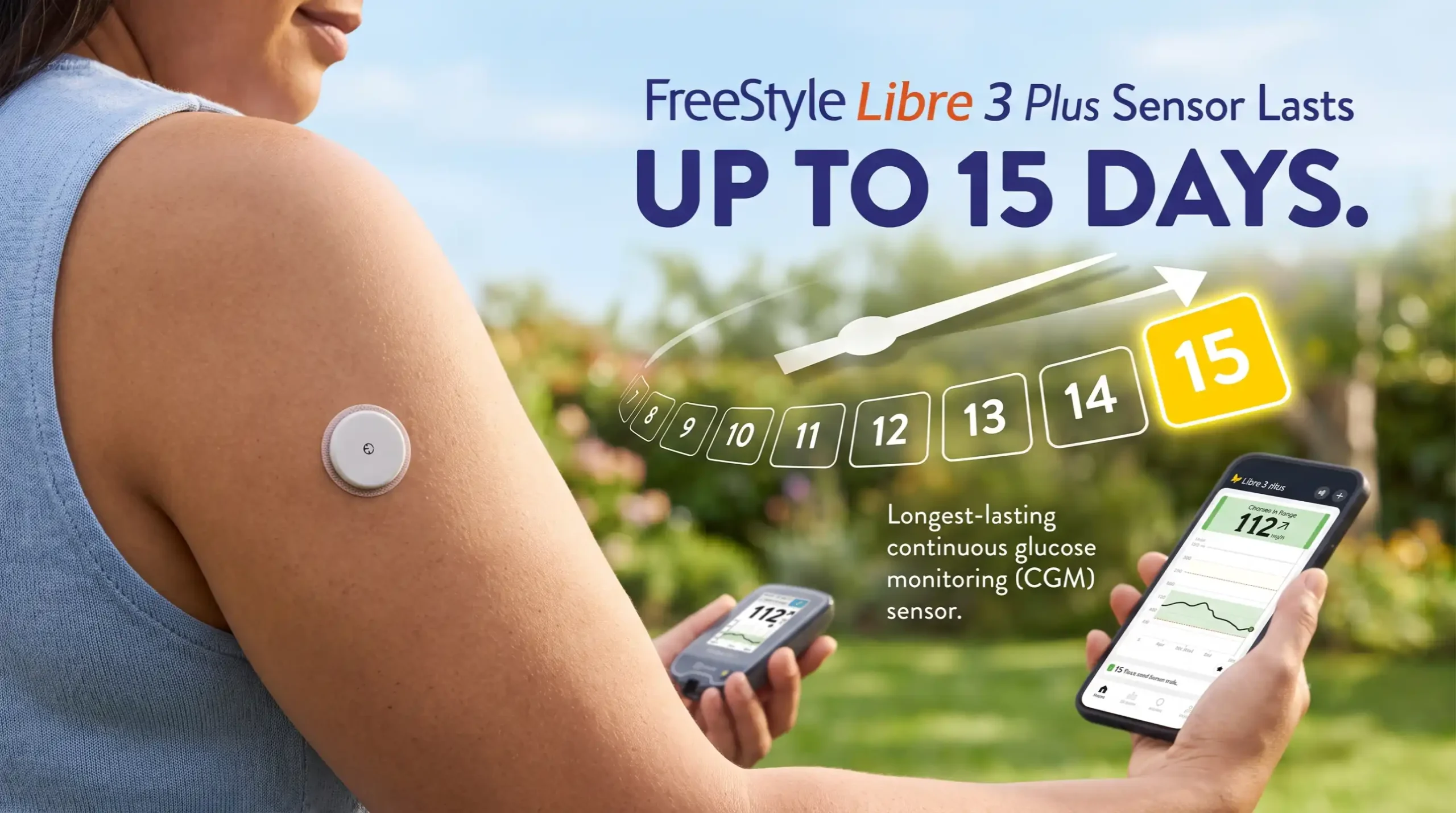
If you use a continuous glucose monitor (CGM), changing your sensor regularly is an important part of keeping your glucose information reliable and easy to follow. One common question from people considering or already using the FreeStyle Libre 3 Plus system is: how long does FreeStyle Libre 3 Plus sensor last?
The answer is simple: the FreeStyle Libre 3 Plus sensor is designed to be worn for up to 15 days. After that period, the sensor should be removed and replaced with a new one. Abbott describes the FreeStyle Libre 3 Plus as a 15-day real-time CGM sensor that automatically sends glucose readings to a compatible smartphone or reader.
For someone managing diabetes every day, a 15-day sensor can make glucose monitoring feel more convenient because you do not have to change the sensor every few days. However, understanding what happens during those 15 days—and what to do if the sensor comes off early—can make the experience much easier.
The FreeStyle Libre 3 Plus sensor lasts up to 15 days when used according to the manufacturer’s instructions.
That means one sensor is intended to provide glucose monitoring for approximately two weeks. Abbott’s instructions state that after 15 days, the sensor should be removed or replaced. The app or compatible reader can notify you when it is time to change the sensor.
FreeStyle Libre 3 Plus sensor wear time: Up to 15 days
During this period, the sensor can continuously provide glucose information when properly connected to a compatible device. Unlike the original FreeStyle Libre 3 sensor, which has a 14-day wear period, the Libre 3 Plus extends the intended wear time to 15 days.
This extra day may sound small, but over several months it can mean fewer sensor changes and fewer interruptions to your routine.
Not exactly.
Both sensors belong to the FreeStyle Libre family, but their intended wear periods are different.
| Feature | FreeStyle Libre 3 | FreeStyle Libre 3 Plus |
| Wear time | Up to 14 days | Up to 15 days |
| Continuous glucose monitoring | Yes | Yes |
| Automatic glucose readings | Yes | Yes |
| Intended application area | Back of upper arm | Back of upper arm |
| Age indication in the U.S. | 4+ | 2+ |
| Compatible with certain AID systems | No | Yes |
Abbott states that the FreeStyle Libre 3 Plus can be used by people age 2 and older and can work with compatible automated insulin dosing systems. Always confirm device and treatment compatibility with your healthcare professional.
The sensor is designed for extended wear so users can receive continuous glucose information without frequently applying a new sensor.
For many people, fewer sensor changes can make daily diabetes management feel simpler. Instead of thinking about sensor replacement every week, users can generally plan around a roughly 15-day cycle.
The sensor automatically sends glucose readings to a compatible smartphone, helping users view their glucose information without repeatedly scanning the sensor. Abbott says readings can be sent automatically every minute when the system is properly connected.
Of course, individual experiences can differ. Skin condition, adhesive performance, physical activity, and how well the sensor is applied can affect whether someone gets the full intended wear period.
Once the 15-day wear period is complete, the sensor should be removed and replaced.
The FreeStyle Libre system can notify you when it is time to remove the sensor. Abbott’s setup guidance recommends removing the old sensor and applying a new one to a different location on the back of the upper arm.
Do not attempt to extend the sensor beyond its intended wear period or reuse an old sensor.
A simple replacement routine can help you stay prepared:
The current Abbott setup information indicates that the FreeStyle Libre 3 Plus requires a 60-minute warm-up after activation.
The sensor is designed for up to 15 days of wear. Once the 15-day period is complete, it should be removed and replaced.
Trying to keep a sensor on beyond its intended wear period is not a good way to get additional use from it. Instead, follow the manufacturer’s replacement instructions.
It is also important to distinguish between a sensor physically staying attached to your skin and the sensor being approved for continued use. Even if the adhesive still feels secure after the intended wear period, that does not mean the sensor should continue to be used.
Sometimes a sensor may loosen or come off before the full 15-day period.
This can be frustrating, especially when you expected to get two weeks of glucose monitoring from one sensor. If your FreeStyle Libre 3 Plus sensor comes off early, do not attempt to reinsert it or reuse it.
Abbott advises users to replace a sensor that falls off before the end of the intended wear period and contact its customer support or use the sensor support process for assistance.
Several everyday factors can contribute to sensor adhesion problems, including:
Proper skin preparation can help improve adhesion.
Getting the full intended wear period can depend partly on how the sensor is applied.
Abbott recommends choosing the appropriate area on the back of the upper arm, cleaning the skin properly, and allowing it to dry before application.
Here are some practical tips:
Wash the application area with plain soap and water and dry it thoroughly.
Moisture can interfere with adhesion. Give the skin enough time to dry completely before applying the sensor.
Skin-care products, oils, and lotions may make it harder for an adhesive to stick properly.
The FreeStyle Libre 3 Plus sensor is designed to be worn on the back of the upper arm.
Heavy sweating and repeated friction can sometimes make a sensor more likely to loosen.
Taking a few extra moments during application can make a difference in how comfortably the sensor stays in place.
The FreeStyle Libre 3 Plus is designed to remain on during normal activities such as bathing, swimming, and exercise.
However, it is important to follow the manufacturer’s water-resistance instructions. Abbott states that the sensor can be exposed to water up to 1 meter (3 feet) for up to 30 minutes.
That does not mean you should intentionally keep the sensor submerged for extended periods.
If you enjoy swimming or exercising regularly, taking reasonable care of the sensor can help reduce the chance of accidentally loosening it.
The sensor is designed to provide continuous glucose monitoring throughout its intended wear period.
Abbott says the FreeStyle Libre 3 Plus automatically sends glucose readings to a compatible smartphone, with readings updated every minute.
However, your phone, reader, Bluetooth connection, sensor placement, and other system requirements can affect the information you receive.
If you experience a signal-loss message, check that your compatible device is within the recommended range and that the required connection settings are enabled. Abbott recommends keeping the reading device within 33 feet of the sensor for communication.
A signal-loss notification does not necessarily mean that your sensor has stopped working.
It can mean that the sensor has not communicated with the compatible smartphone or reader for a period of time.
If you see this message, Abbott recommends checking the connection between your sensor and device. Depending on your setup, you may need to confirm that Bluetooth is enabled, the app has not been force-closed, and your device is within the appropriate range.
If signal loss continues before the 15-day wear period ends, contacting Abbott support can help determine the next step.
The FreeStyle Libre 3 Plus sensor is intended to be worn on the back of the upper arm.
Selecting an appropriate application area is important for both comfort and proper sensor use. The skin should be clean and dry before application.
If you are unsure about the correct placement or have concerns about your skin, speak with your healthcare professional and follow the manufacturer’s instructions.
Many people appreciate the small size of the FreeStyle Libre 3 Plus sensor because it is designed to be discreet and worn continuously.
Abbott describes it as a small, discreet CGM sensor that can be worn during everyday activities.
Still, comfort can vary from person to person. If you experience significant skin irritation, pain, swelling, or other concerning symptoms around the sensor site, remove the sensor and contact your healthcare professional before continuing use.
One of the practical benefits of a 15-day sensor is that it reduces how often you need to apply a new sensor.
For example, a 30-day period generally requires about two 15-day sensors when each sensor completes its full intended wear period.
That can make planning your supplies easier. It also means fewer application days, which may be especially helpful for people who find sensor replacement inconvenient.
The key is to plan ahead so you have your replacement sensors available when needed.
The FreeStyle Libre 3 Plus is a continuous glucose monitoring system designed to provide glucose information throughout the day.
Instead of checking glucose only at individual moments, CGM technology can help users see glucose trends and patterns over time.
This information can help people and their healthcare professionals better understand how glucose levels may change around meals, physical activity, medication, sleep, and other daily factors.
However, a CGM is a monitoring tool—not a replacement for personalized medical advice.
Although the FreeStyle Libre 3 Plus provides continuous glucose information, there can be situations where a blood glucose test may be appropriate.
Abbott states that fingerstick testing is required for treatment decisions when the system displays a Check Blood Glucose symbol or when glucose readings and alarms do not match symptoms or expectations.
If your symptoms do not match what the sensor reports, do not simply ignore how you feel. Follow the manufacturer’s guidance and speak with your healthcare professional when appropriate.
Another important point for users is vitamin C.
Abbott’s current safety information states that taking more than 1,000 mg of vitamin C per day may falsely raise FreeStyle Libre 3 Plus sensor readings.
This is important because a falsely high glucose reading could affect how someone interprets their glucose information.
Always tell your healthcare professional about supplements and medications you use, particularly if you have questions about how they may affect CGM readings.
Because each FreeStyle Libre 3 Plus sensor is designed for up to 15 days, a typical 30-day period would require approximately two sensors if each sensor completes its full wear period.
This is one reason the 15-day wear time can be convenient for people planning their diabetes supplies.
However, actual supply requirements can depend on your prescription, insurance coverage, replacement policies, and whether you experience early sensor failures.
A little planning can prevent last-minute stress.
Consider keeping track of:
Having a replacement sensor available before the current one expires can make the transition smoother.
The biggest advantage is convenience.
Living with diabetes already involves many daily decisions. Having a CGM sensor designed to last up to 15 days can reduce the number of times you need to think about sensor replacement.
A longer wear period can mean:
For many users, these small conveniences can make diabetes management feel a little less complicated.
Here is an easy way to think about the sensor cycle:
Day 1: Apply and activate a new sensor.
Day 1–15: Wear the sensor and monitor glucose information through your compatible device.
Before Day 15 ends: Make sure you have a replacement sensor available.
Day 15: Remove the sensor when instructed and replace it according to the manufacturer’s directions.
Next cycle: Apply the new sensor to an appropriate location on the back of the upper arm.
This routine can make sensor changes easier to remember.
So, how long does FreeStyle Libre 3 Plus sensor last? The straightforward answer is up to 15 days.
That 15-day wear period is one of the practical features that can make continuous glucose monitoring easier to manage. Instead of changing a sensor every few days, users can generally plan for a new sensor about twice a month.
Still, getting the best experience means using the sensor according to the manufacturer’s instructions, applying it correctly, paying attention to alerts, and replacing it when the intended wear period ends.
If you are looking for diabetes supplies, CGM-related products, or other home healthcare equipment, Alfa Healthcare Supply Inc. provides medical supply products and equipment for patients and caregivers.
The FreeStyle Libre 3 Plus sensor is designed to last up to 15 days. After 15 days, it should be removed and replaced with a new sensor.
No. The FreeStyle Libre 3 Plus is designed for up to 15 days of wear. The original FreeStyle Libre 3 sensor has a 14-day wear period.
The sensor is intended for up to 15 days of wear. After that, follow the manufacturer’s instructions to remove and replace it.
If the sensor falls off before 15 days, do not attempt to reinsert or reuse it. Replace the sensor and contact Abbott’s support team or use its sensor support process for assistance.
Yes, the sensor is designed to be worn during activities such as swimming and bathing, subject to Abbott’s water-resistance limitations. Abbott states that it can be exposed to water up to 1 meter (3 feet) for up to 30 minutes.
The sensor is designed to be worn on the back of the upper arm. Follow the manufacturer’s application instructions carefully.
The system can automatically send glucose readings to a compatible smartphone when properly connected, so routine scanning is not required in the same way as older flash glucose monitoring systems.
Abbott states that a 60-minute warm-up is required after starting a new sensor.
Important: This article is for general educational purposes and should not replace advice from your physician, diabetes educator, pharmacist, or other qualified healthcare professional. Always follow the current FreeStyle Libre manufacturer’s instructions and your healthcare provider’s recommendations.