


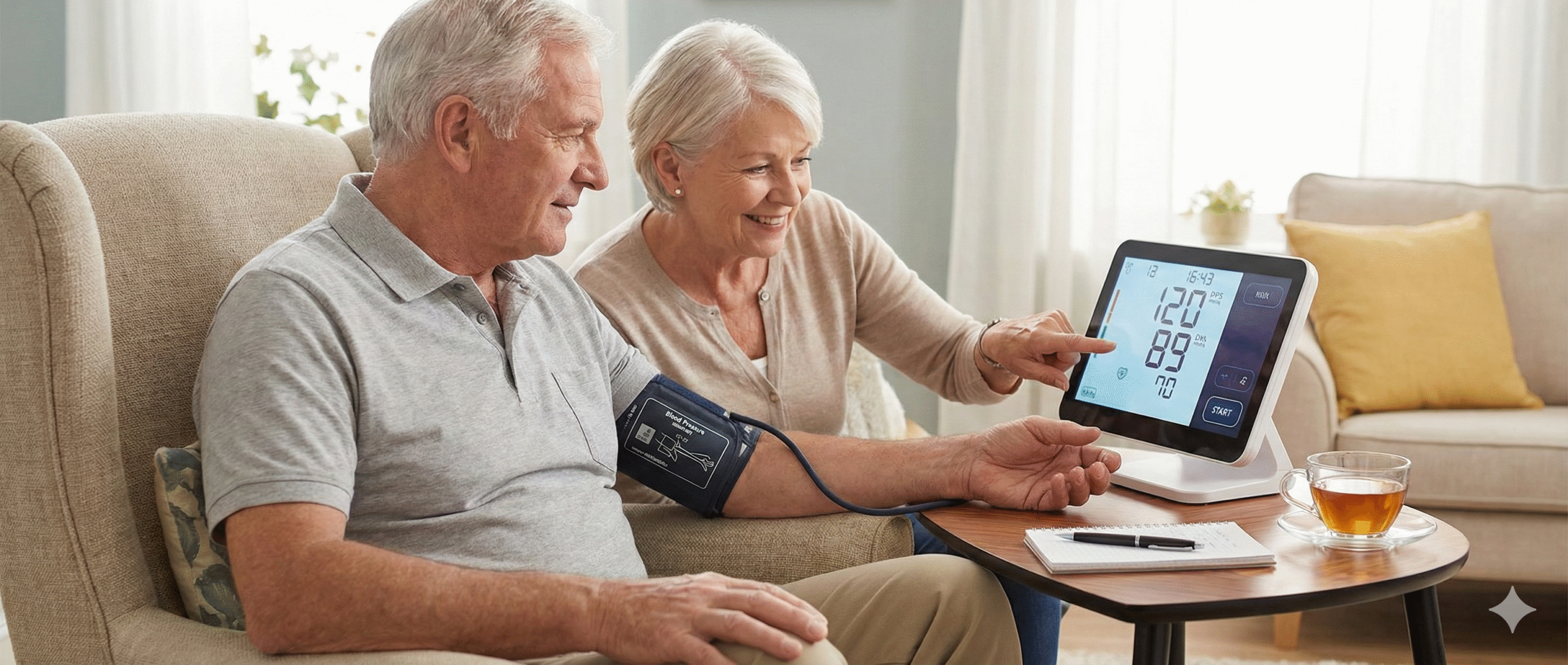
If you or a loved one has been diagnosed with hypertension, your doctor has likely given you a simple homework assignment: “Monitor your blood pressure at home.”
It sounds easy enough until you start shopping. You are immediately faced with a choice between the classic manual cuff (the kind with the squeezing bulb and stethoscope) and the modern automatic (digital) monitor. The big question on everyone’s mind is usually, “Which one can I trust?”
At Alfa Healthcare Supply Inc., we know that accuracy isn’t just a technical detail—it’s peace of mind. In this guide, we’ll settle the debate between automatic and manual monitors and help you find the best BP cuff for seniors managing their health at home.
To understand accuracy, we have to look at how these two devices work.
Manual Monitors (Aneroid Sphygmomanometers)
These are the devices you see in most doctor’s offices. You wrap the cuff, pump the bulb, and listen to the pulse through a stethoscope as the needle on the gauge drops.
Automatic (Digital) Monitors
These devices use oscillometric technology to detect vibrations in your arterial wall as the cuff deflates.
The Bottom Line: Unless you are a trained nurse or doctor, an automatic monitor is usually more accurate for home use simply because it leaves less room for user error.
When looking for the best BP cuff for seniors, “ease of use” is just as important as raw technical accuracy. A device that is difficult to use causes frustration and skipped readings.
Here is why we generally recommend automatic upper-arm monitors for our elderly customers:
Even the most expensive machine will give you wrong numbers if used incorrectly. “User error” is the #1 reason for inaccurate readings at home. Follow this 4-step checklist to ensure clinical precision:
One size does not fit all. If a cuff is too small, your reading will be artificially high. If it’s too loose, it will be too low. Measure your upper arm circumference and check the sizing guide on the box before you buy.
Your arm must be resting at the same level as your heart.
Never rush in from a walk or carrying groceries and immediately test your BP. Sit quietly for five minutes before pressing the button. Your body needs to return to a “resting” state.
Sit in a sturdy chair with your back supported and both feet flat on the floor. Crossing your legs can temporarily raise your blood pressure by 2–8 points!
At Alfa Healthcare Supply Inc., we stock a curated selection of clinically validated blood pressure monitors. Whether you need a simple one-touch device or a monitor with Bluetooth connectivity to track your health on your phone, we have options that fit your lifestyle.
Take control of your heart health today. Browse our selection of home diagnostic supplies and find the perfect monitor for your needs.