


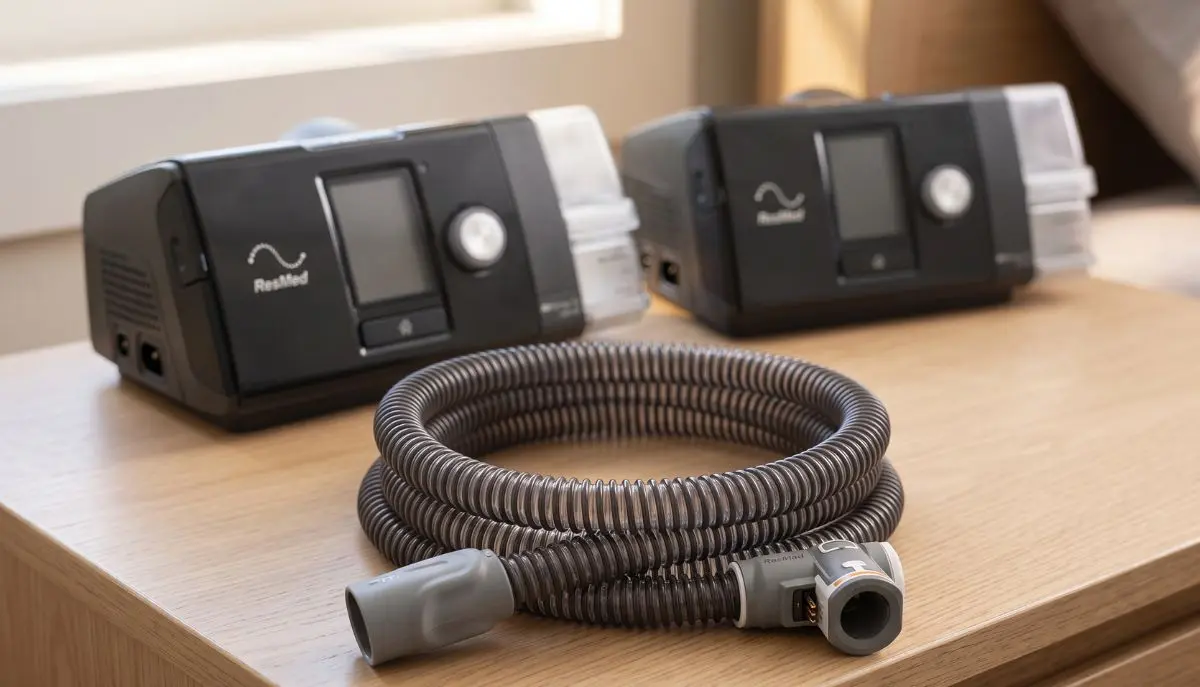
Using a CPAP or bilevel machine every night can become a comfortable part of your routine when your equipment is set up correctly. While people often focus on the mask or the machine itself, one small component deserves more attention than it usually gets: the air tubing.
For users of ResMed AirSense 10 CPAP and AirCurve 10 bilevel machines, ClimateLineAir heated tubing is designed to do more than simply move air from the machine to the mask. It helps maintain the temperature of humidified air as it travels through the tubing and can help reduce condensation, commonly called CPAP rainout.
If you have ever woken up to water inside your CPAP tube, heard a gurgling sound during the night, or felt that the airflow was too cold or uncomfortable, you may already understand why tubing matters.
The ClimateLineAir heated tubing for AirSense 10 CPAP & AirCurve 10 bilevel machines is part of ResMed’s Climate Control system. When used with compatible equipment, it can help create a more controlled and comfortable humidification experience.
At Alfa Healthcare Supply Inc., we understand that replacement CPAP supplies are part of everyday home healthcare. A tube may look like a simple accessory, but choosing the correct model can make a difference in how your entire PAP setup works.
This guide explains what ClimateLineAir heated tubing is, how it works, compatibility with AirSense 10 and AirCurve 10 machines, installation, cleaning, common problems, replacement signs, and what to check before purchasing.
What is ClimateLineAir Heated Tubing?
ClimateLineAir is a heated air tube designed for compatible ResMed Air10 therapy devices.
Unlike ordinary CPAP tubing, which simply carries air, ClimateLineAir has heating technology that helps maintain the temperature of humidified air as it travels from the machine toward the mask.
ResMed describes ClimateLineAir as part of its Climate Control solution. When paired with the appropriate HumidAir humidifier, the system is designed to help maintain temperature and humidity for a more comfortable therapy experience.
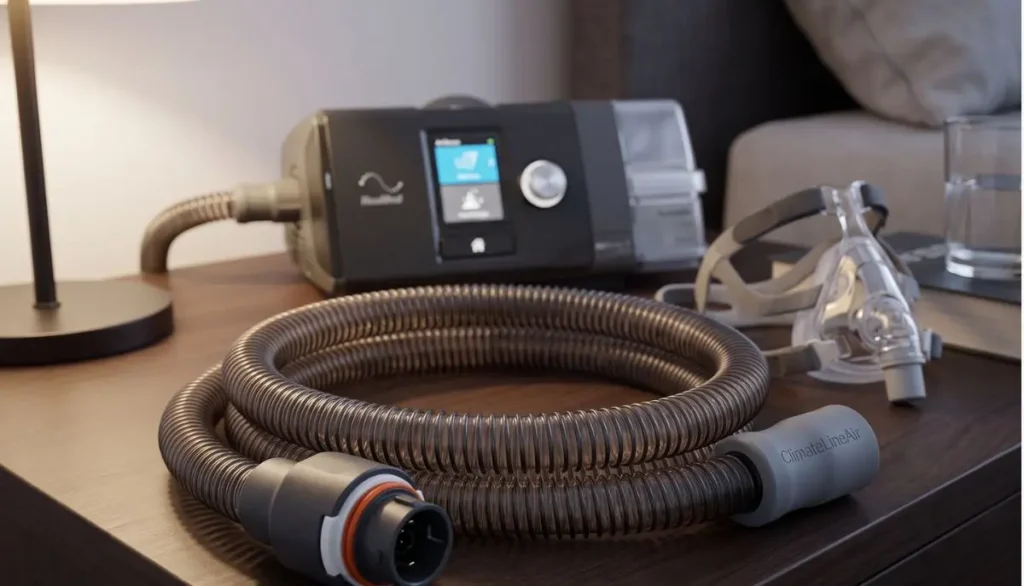
In simple terms, the process looks like this:
CPAP or bilevel machine → humidifier → heated tubing → mask → user
The humidifier adds moisture to the airflow, while the heated tube helps maintain the temperature as that air travels toward your mask.
This can be particularly helpful in a cool bedroom, where humidified air may lose heat as it moves through standard tubing.
Why Does CPAP Tubing Need to Be Heated?
At first, heated tubing can seem unnecessary.
After all, isn’t the tubing simply a hose?
It does carry air, but temperature can affect what happens to humidified air inside that hose.
When warm, humidified air travels through a cooler tube or cold bedroom environment, the air can cool. As the air cools, moisture may condense inside the tubing.
That condensation is often called CPAP rainout.
You might notice:
- Water droplets inside the tubing
- A damp CPAP mask
- Gurgling or bubbling sounds
- Water reaching your face
- Moisture around the mask
- Interrupted or uncomfortable sleep
ResMed designed ClimateLineAir heated tubing to help maintain the temperature of humidified air as it travels through the tube, helping reduce condensation.
The goal is not to make the air excessively hot.
Instead, the heated tube is designed to help provide a more consistent and comfortable airflow temperature.
ClimateLineAir Heated Tubing for AirSense 10 and AirCurve 10
One of the most important things to understand before ordering replacement CPAP tubing is machine compatibility.
The ClimateLineAir heated tube for Air10 devices is designed for compatible ResMed AirSense 10 and AirCurve 10 machines.
ResMed specifically lists ClimateLineAir heated tubing for AirSense 10 and AirCurve 10 systems.
This includes compatible AirSense 10 models such as:
- AirSense 10 AutoSet
- AirSense 10 AutoSet for Her
- AirSense 10 Elite
Compatible AirCurve 10 systems include models such as:
- AirCurve 10 VAuto
- AirCurve 10 S
- AirCurve 10 ASV
- Other compatible AirCurve 10 configurations
ResMed’s product documentation also lists AirSense 10 and several AirCurve 10 configurations with ClimateLineAir tubing.
AirSense 10 vs. AirSense 11
This is an important distinction.
AirSense 10 and AirSense 11 do not use the same ClimateLineAir version.
For AirSense 10 and AirCurve 10, look for the Air10-compatible ClimateLineAir tubing.
For AirSense 11 and AirCurve 11, the appropriate product is ClimateLineAir 11.
| ResMed Machine | Compatible ClimateLineAir Family |
| AirSense 10 | ClimateLineAir for Air10 |
| AirCurve 10 | ClimateLineAir for Air10 |
| AirSense 11 | ClimateLineAir 11 |
| AirCurve 11 | ClimateLineAir 11 |
ResMed’s current documentation distinguishes the Air10 and Air11 tubing families.
Always check the exact model printed on your machine before purchasing replacement tubing.
How Does ClimateLineAir Heated Tubing Work?
The basic concept is easy to understand.
Your CPAP or bilevel machine creates the prescribed airflow. If a compatible humidifier is being used, moisture is added to that airflow. The heated tube then helps maintain the temperature of the humidified air as it travels toward the mask.
This is especially useful because the air can cool while moving through the tubing.
A simplified example:
Without heated tubing
Warm humidified air leaves the machine → travels through a cool tube → air temperature drops → condensation may develop.
With ClimateLineAir
Warm humidified air leaves the machine → heated tubing helps maintain temperature → air reaches the mask with less temperature change → condensation may be reduced.
This is why ClimateLineAir should not be thought of as simply a more advanced hose.
It is part of a larger humidification and temperature-control system.
What Is CPAP Rainout?
CPAP rainout is condensation that forms when humidified air cools inside the CPAP tubing or mask.
Imagine taking a cold drink outside on a warm day. Moisture can form on the outside of the glass because of temperature differences.
A similar principle can occur inside CPAP tubing.
Humidified air contains moisture. When that air cools, some of the moisture can condense into water droplets.
For a CPAP user, this may result in:
- Water inside the tube
- A wet mask
- Gurgling noises
- Water splashing toward the face
- An uncomfortable sleeping environment
ResMed identifies ClimateLineAir heated tubing as a way to help manage condensation and rainout when used with compatible Air10 equipment.
How ClimateLineAir Helps Reduce Condensation
ClimateLineAir uses heated tubing to help keep humidified airflow at a more consistent temperature.
This matters because warmer air can hold more moisture than cooler air.
When humidified air stays warmer while traveling through the tubing, there is less opportunity for condensation to form because of temperature loss.
ResMed describes ClimateLineAir as being designed to maintain the temperature of humidified air as it passes through the tube.
However, heated tubing does not mean condensation is impossible under every condition.
Your bedroom temperature, humidity level, tube temperature, and other therapy settings can affect condensation.
If you continue to experience rainout, adjusting the Climate Control settings may help.
ClimateLineAir and the AirSense 10 Humidifier
The AirSense 10 can be used with the HumidAir heated humidifier.
When compatible ClimateLineAir tubing is connected, the tubing becomes part of the overall Climate Control system.
ResMed explains that the AirSense 10 can use ClimateLineAir with its humidification system to help manage temperature and humidity.
This can be useful for people who need humidification but also experience condensation.
Without heated tubing, increasing humidity may sometimes make rainout worse because more moisture is being introduced into the airflow.
With ClimateLineAir, the system is designed to better manage the relationship between humidity and temperature.
ClimateLineAir With AirCurve 10 Bilevel Machines
ClimateLineAir is not limited to traditional CPAP therapy.
It is also designed for compatible AirCurve 10 bilevel machines.
AirCurve 10 systems provide bilevel therapy, and ResMed lists configurations of AirCurve 10 devices with ClimateLineAir tubing.
For users of AirCurve 10 VAuto, AirCurve 10 S, AirCurve 10 ASV, and other compatible configurations, the correct ClimateLineAir tubing can become an important part of the humidification setup.
The same basic principle applies:
The machine provides therapy airflow → the humidifier adds moisture → ClimateLineAir helps maintain temperature → airflow reaches the mask.
Because bilevel therapy can involve different pressure settings and configurations, always make sure that the tubing is the correct product for your specific device.
Key Features of ClimateLineAir Heated Tubing
The exact product specifications should always be checked against the current manufacturer’s information, but ResMed’s Air10 ClimateLineAir product information identifies several useful characteristics.
Heated airflow
The tubing is designed to help maintain the temperature of humidified air.
Climate Control compatibility
When used with compatible ResMed equipment and humidification, ClimateLineAir works as part of the Climate Control system.
Helps reduce rainout
Maintaining the temperature of humidified air can help reduce condensation inside the tubing.
Flexible design
The tubing is designed to provide flexibility around the bed while helping reduce unnecessary pulling on the mask.
Approximately 6.5 feet long
ResMed lists the Air10 ClimateLineAir heated tube at approximately 6.5 feet.
15 mm inner diameter
ResMed lists the Air10 ClimateLineAir tubing with a 15 mm inner diameter and 22 mm cuffs/connectors.
ClimateLineAir Heated Tubing vs. Standard CPAP Tubing
It is helpful to understand the difference before deciding which replacement tube you need.
Standard CPAP tubing
Standard tubing is designed primarily to transport air between the machine and mask.
It does not actively heat the airflow.
It can be appropriate for many PAP setups.
ClimateLineAir heated tubing
ClimateLineAir adds temperature-control functionality.
It is designed to help maintain the temperature of humidified air and works with compatible ResMed Climate Control systems.
Simple comparison
| Feature | Standard Tubing | ClimateLineAir |
| Carries airflow | Yes | Yes |
| Heated | No | Yes |
| Designed for Climate Control | No | Yes, with compatible equipment |
| Helps manage condensation | Limited | Designed to help reduce rainout |
| Compatible with AirSense 10 | Depends on tubing | Yes, compatible Air10 version |
| Compatible with AirCurve 10 | Depends on tubing | Yes, compatible Air10 version |
Neither type is automatically right for every person.
The important thing is matching the tubing to your machine and therapy setup.
Do You Need Heated Tubing for CPAP?
Not everyone needs heated tubing.
Some people use standard tubing without experiencing condensation or temperature discomfort.
However, heated tubing may be worth considering if you:
- Use a humidifier
- Experience water inside your CPAP tubing
- Wake up with moisture in your mask
- Sleep in a cold room
- Feel that the airflow is too cool
- Want to use compatible Climate Control features
- Need a replacement for an existing ClimateLineAir tube
The decision should be based on your equipment and comfort needs.
If your healthcare provider or DME supplier has recommended a specific tubing configuration, follow that recommendation.
How to Install ClimateLineAir Tubing on an AirSense 10
Installing the tube is generally straightforward, but you should always follow the instructions supplied with your specific equipment.
A simple setup process is:
Step 1: Turn off the machine
Before disconnecting tubing, make sure the therapy device is not actively delivering therapy.
Step 2: Locate the air outlet
The air outlet is located at the back of the compatible ResMed device.
Step 3: Connect the ClimateLineAir tube
Align the tubing connector with the machine’s air outlet.
Step 4: Push the connector into place
Make sure the connection is secure.
Step 5: Connect your mask
Attach the other end of the tubing to your CPAP mask or mask assembly.
Step 6: Check the tubing
Make sure the tube is not twisted, pinched, crushed, or stretched.
ResMed’s ClimateLineAir instructions emphasize properly connecting the tubing and arranging it so that it does not wrap around the head or neck.
How to Position CPAP Tubing at Night
Correct tubing placement can make your setup feel much more comfortable.
Try to position the tube so it can move naturally when you turn during sleep.
Avoid placing heavy objects on the tubing.
Do not sharply bend or crush it.
You can route the tube:
- Along the side of the bed
- Above the headboard
- Beside the pillow
- Through a suitable CPAP hose-management system
The goal is simple:
The tubing should provide enough movement without pulling on your mask.
If the tube repeatedly pulls your mask sideways, changing its position may improve comfort.
ClimateLineAir Temperature Settings
Your ResMed machine may allow you to adjust temperature and humidity settings depending on the configuration.
ResMed explains that Climate Control can be used in automatic or manual modes on compatible Air10 equipment.
If the air feels too cool, the temperature may need adjustment.
If you are experiencing excessive moisture, humidity or temperature settings may need to be changed.
A useful approach is to make one adjustment at a time rather than changing several settings at once.
If you experience dryness
Dry nose or mouth may indicate that the humidity level needs adjustment, although there can be other causes.
If you experience water in the mask
Condensation may be occurring.
ResMed recommends using the Climate Control settings appropriately and, when needed, adjusting tube temperature or humidity to address condensation.
If you are unsure about your settings, contact your healthcare provider or equipment supplier.
How to Clean ClimateLineAir Heated Tubing
Regular cleaning is an important part of CPAP equipment care.
ResMed’s product information recommends washing the tubing in warm water with mild detergent, rinsing it thoroughly, and allowing it to dry away from direct sunlight and heat.
Simple cleaning routine
- Disconnect the tubing from the machine and mask.
- Wash the tubing using warm water and mild detergent.
- Rinse thoroughly.
- Allow the tubing to air dry.
- Keep it away from direct sunlight and excessive heat.
- Reconnect it after it is completely dry.
Avoid harsh cleaning methods
Do not place the heated tubing in a dishwasher or washing machine.
Also avoid exposing the electrical connector to unnecessary moisture.
Follow the cleaning instructions provided by ResMed for your particular equipment.
How Often Should ClimateLineAir Tubing Be Checked?
You do not need to wait until the tube completely stops working before inspecting it.
A quick visual check can become part of your regular CPAP routine.
Look for:
- Small cracks
- Holes
- Tears
- Damaged cuffs
- Loose connectors
- Unusual wear
- Excessive moisture
- Changes in flexibility
ResMed recommends regularly checking air tubing and replacing it if there are holes, tears, or cracks.
A damaged tube can interfere with the intended airflow and should not simply be patched with tape.
Signs You May Need Replacement CPAP Tubing
Your ClimateLineAir tube may need replacement if you notice visible deterioration or repeated problems.
Common warning signs include:
1. Cracks or holes
Even a small opening can affect the tubing.
2. Damaged connectors
The ends should connect securely to the machine and mask.
3. Persistent air leaks
If the tubing is damaged, air may escape.
4. Physical deterioration
If the tube has become unusually brittle, worn, or damaged, replacement may be appropriate.
5. Electrical or heated-tube problems
If the machine does not recognize the heated tubing or the system is displaying an error, check the connections and consult the manufacturer’s troubleshooting information.
Do not attempt to repair the internal heating components yourself.
What If Your ClimateLineAir Tube Does Not Feel Hot?
This is a common question.
A heated CPAP tube does not necessarily feel very hot to the touch.
The purpose is not to turn the tube into a heating element that feels hot against your hand.
Instead, the system is designed to maintain an appropriate temperature for the airflow.
If your machine recognizes the tubing and the Climate Control features are available, that can be a useful indication that the tubing is connected correctly.
If you believe the tube is not functioning properly:
- Stop therapy.
- Check the connection.
- Inspect the tube for visible damage.
- Confirm that you have the correct tubing for your machine.
- Restart the system.
- Check the device settings.
- Consult the user guide or your DME provider if the problem continues.
Avoid opening or modifying the tube yourself.
Common ClimateLineAir Problems and Simple Checks
Problem: Water inside the tube
Possible causes include excessive humidity, a cold room, or temperature settings.
What to check: Review your humidity and tube-temperature settings.
Problem: Water inside the mask
This can be another sign of condensation.
What to check: Confirm that the heated tubing is connected correctly and review Climate Control settings.
Problem: Air feels too cold
What to check: Review the tube-temperature setting on your compatible ResMed machine.
Problem: Air feels too warm
What to check: Consider reducing the tube temperature according to your device instructions.
Problem: Tube is not recognized
What to check: Turn the machine off and inspect the connector. Confirm that the tubing is designed for your exact ResMed machine.
Problem: Mask is being pulled
What to check: Reposition the tube so that it has enough slack and is not pulling against the mask.
ClimateLineAir Air10 Tubing Dimensions
For users who need replacement tubing, dimensions can help confirm that they are looking at the correct product.
ResMed’s current product information lists the ClimateLineAir heated tubing for Air10 devices as:
- Approximately 6.5 feet long
- 15 mm inner diameter
- 22 mm cuffs/connectors
ResMed’s AirSense 10 documentation similarly identifies ClimateLineAir tubing as approximately 2 meters in length with a 15 mm inner diameter.
Always use the manufacturer’s current specifications when comparing replacement parts.
ClimateLineAir for AirSense 10: What to Check Before Ordering
Buying CPAP tubing online can be easy, but compatibility should come first.
Before ordering, check these details:
1. Machine model
Look carefully at the name of your machine.
Is it AirSense 10 or AirSense 11?
Is it AirCurve 10 or AirCurve 11?
2. Tubing family
For AirSense 10 and AirCurve 10, you need the appropriate Air10-compatible ClimateLineAir tubing.
3. Humidifier
If you are using Climate Control, make sure your humidification setup is compatible.
4. Oxygen requirements
If supplemental oxygen is part of your therapy, verify whether you need a ClimateLineAir Oxy configuration instead of standard ClimateLineAir tubing.
5. Prescription or supplier requirements
ResMed’s U.S. product listing currently identifies ClimateLineAir heated tubing as prescription-required. Requirements can vary by location and supplier, so verify what applies when ordering.
ClimateLineAir Oxy vs. Standard ClimateLineAir
ResMed also offers ClimateLineAir Oxy tubing.
The primary difference is that the Oxy version includes an integrated oxygen connector.
This version may be appropriate for compatible PAP setups involving prescribed supplemental oxygen.
It is important not to select the Oxy version simply because it sounds like an upgraded product.
If you do not use supplemental oxygen, standard ClimateLineAir may be the appropriate tubing for your AirSense 10 or AirCurve 10 setup.
If oxygen is part of your prescribed therapy, ask your healthcare provider or DME supplier which tubing configuration is appropriate.
Why the Correct Tubing Matters
CPAP accessories can look surprisingly similar.
That is one reason people sometimes order the wrong tube.
A ClimateLineAir tube for one ResMed device generation should not automatically be assumed to work with another generation.
For example:
AirSense 10 → Air10 ClimateLineAir
AirCurve 10 → Air10 ClimateLineAir
AirSense 11 → ClimateLineAir 11
AirCurve 11 → ClimateLineAir 11
Checking the model before buying can save time and prevent an unnecessary return.
Buying ClimateLineAir Heated Tubing From Alfa Healthcare Supply Inc.
At Alfa Healthcare Supply Inc., we understand that medical equipment is part of someone’s everyday life.
For a CPAP user, replacing a worn tube is not simply a shopping decision. It is about maintaining a familiar therapy setup.
Alfa Healthcare Supply currently lists ClimateLineAir Heated Tubing for AirSense 10 CPAP & AirCurve 10 BiLevel Machines among its respiratory and COPD/Asthma supplies.
When ordering, having your exact machine model available is helpful.
If you have an AirSense 10 or AirCurve 10, confirm that you are selecting the Air10-compatible ClimateLineAir tubing rather than a ClimateLineAir 11 product intended for newer Air11 devices.
You can visit the Alfa Healthcare Supply website to review current product information and availability.
Why Replacement CPAP Accessories Matter
The CPAP machine gets most of the attention, but your therapy setup includes several components.
Depending on your equipment, these may include:
- CPAP or bilevel machine
- Heated humidifier
- Heated or standard tubing
- CPAP mask
- Mask cushion
- Headgear
- Air filters
- Water chamber
- Other accessories
Each component has a purpose.
A damaged tube, worn cushion, clogged filter, or poorly fitting mask can make your nightly routine less comfortable.
That is why routine equipment inspection is worth making part of your CPAP care routine.
Tips for Getting More Comfortable With ClimateLineAir
A few simple habits can make your setup easier to manage.
Keep the tubing clean
Follow the manufacturer’s cleaning instructions and allow the tube to dry fully.
Avoid sharp bends
A crushed or sharply bent tube can interfere with airflow.
Keep the tube positioned comfortably
Avoid routing it in a way that pulls your mask.
Monitor condensation
If you see water inside the tubing, review your humidity and temperature settings.
Check the tubing regularly
Look for cracks, holes, or damaged connectors.
Confirm compatibility before replacement
Air10 and Air11 tubing are not interchangeable simply because both products use the ClimateLineAir name.
Ask when you are uncertain
Your healthcare provider, respiratory therapist, or DME supplier can help verify equipment compatibility.
Is ClimateLineAir Worth Considering for AirSense 10 Users?
For people who are comfortable with standard tubing and do not experience condensation or temperature-related discomfort, heated tubing may not be necessary.
For others, it can be a useful part of their CPAP setup.
The potential advantages include:
- Better temperature control of humidified airflow
- Reduced condensation
- Less rainout
- A more comfortable humidification experience
- Compatibility with ResMed Climate Control features
The right choice depends on your individual therapy setup.
It is not about choosing the most expensive or most advanced accessory. It is about choosing the correct component for your machine and needs.
A Simple AirSense 10 ClimateLineAir Checklist
Before you order replacement tubing, use this quick checklist:
✓ I have a ResMed AirSense 10 or compatible AirCurve 10 machine.
✓ I confirmed that I need ClimateLineAir tubing for the Air10 platform.
✓ I checked whether I use a HumidAir humidifier.
✓ I inspected my existing tube for damage.
✓ I know whether I need standard ClimateLineAir or an Oxy version.
✓ I have checked current supplier and prescription requirements.
✓ I am purchasing from a reliable medical equipment supplier.
This takes only a few minutes and can help prevent ordering the wrong replacement part.
Final Thoughts
The ClimateLineAir heated tubing for AirSense 10 CPAP & AirCurve 10 bilevel machines may look like a simple accessory, but it plays an important role in a comfortable humidified PAP setup.
Its main purpose is to help maintain the temperature of humidified air as it moves from the machine toward the mask. By helping limit temperature loss, the heated tube can also help reduce condensation and CPAP rainout.
For AirSense 10 and AirCurve 10 users, selecting the correct Air10-compatible ClimateLineAir tubing is important. Do not assume that a ClimateLineAir tube made for AirSense 11 or AirCurve 11 will be the correct replacement.
Before ordering, check your machine model, tubing type, humidifier setup, and whether supplemental oxygen is part of your therapy.
And remember: if something about your CPAP setup does not feel right, you do not have to figure it out alone. Your healthcare provider, respiratory therapist, or DME supplier can help you determine whether the issue is related to tubing, humidification, mask fit, settings, or another part of your equipment.
At Alfa Healthcare Supply Inc., our goal is to make medical supplies easier to understand and easier to access. Whether you need replacement CPAP tubing or other home medical equipment, starting with the exact machine model is one of the simplest ways to find the right accessory.
A comfortable night of PAP therapy is built from many small details. The right tubing is one of them.
Frequently Asked Questions
What is ClimateLineAir heated tubing?
ClimateLineAir is heated CPAP tubing designed for compatible ResMed Air10 devices. It helps maintain the temperature of humidified air as it travels from the machine to the mask.
Is ClimateLineAir heated tubing compatible with AirSense 10?
Yes. ResMed identifies ClimateLineAir heated tubing as compatible with AirSense 10 devices.
Does ClimateLineAir work with AirCurve 10?
Yes. ClimateLineAir tubing is designed for compatible AirCurve 10 devices as well. ResMed’s product documentation lists multiple AirCurve 10 configurations with ClimateLineAir tubing.
Does ClimateLineAir help stop rainout?
It is designed to help reduce condensation by helping maintain the temperature of humidified air as it travels through the tube.
What is rainout in CPAP therapy?
Rainout is condensation that occurs when humidified air cools inside the tubing or mask.
Can ClimateLineAir help with dry air?
ClimateLineAir works with compatible humidification systems to help provide controlled temperature and humidity. If you experience dryness, your humidity settings may need adjustment.
Is ClimateLineAir the same as regular CPAP tubing?
No. ClimateLineAir is heated tubing designed to work with compatible ResMed Climate Control systems.
Can I use ClimateLineAir on AirSense 11?
AirSense 11 uses the ClimateLineAir 11 version rather than the Air10 ClimateLineAir tubing. Always match the tubing to the exact machine generation.
Can AirCurve 11 use Air10 ClimateLineAir tubing?
No. AirCurve 11 belongs to the Air11 platform and requires the appropriate ClimateLineAir 11 tubing.
How long is ClimateLineAir tubing for AirSense 10?
ResMed lists the Air10 ClimateLineAir heated tube at approximately 6.5 feet, with a 15 mm inner diameter.
How often should I clean ClimateLineAir tubing?
Follow the manufacturer’s cleaning instructions. ResMed recommends washing the tubing with warm water and mild detergent, rinsing thoroughly, and allowing it to dry away from direct sunlight and heat.
Can ClimateLineAir tubing go in a dishwasher?
No. ResMed’s product care instructions state that the tubing should not be washed in a dishwasher or washing machine.
How do I know if my ClimateLineAir tube needs replacement?
Look for cracks, holes, tears, damaged connectors, or other visible deterioration. ResMed recommends replacing damaged tubing.
Why is there still water in my CPAP tubing?
Condensation can still occur because of bedroom temperature, humidity, and tube-temperature settings. Check your Climate Control settings and follow the instructions for your specific machine.
Does the ClimateLineAir tube need to feel hot?
No. The purpose is controlled temperature management rather than making the tube feel hot to your hand.
What is ClimateLineAir Oxy?
ClimateLineAir Oxy is a heated tubing option with an integrated oxygen connector for compatible supplemental oxygen setups.
Where can I buy ClimateLineAir tubing for AirSense 10?
Alfa Healthcare Supply Inc. currently lists ClimateLineAir Heated Tubing for AirSense 10 CPAP and AirCurve 10 BiLevel Machines in its respiratory supply selection.
Disclaimer: This article is for general educational purposes and is not a substitute for medical advice or the instructions supplied with your ResMed device. Follow your healthcare provider’s recommendations and the manufacturer’s current user guide for your specific equipment.