


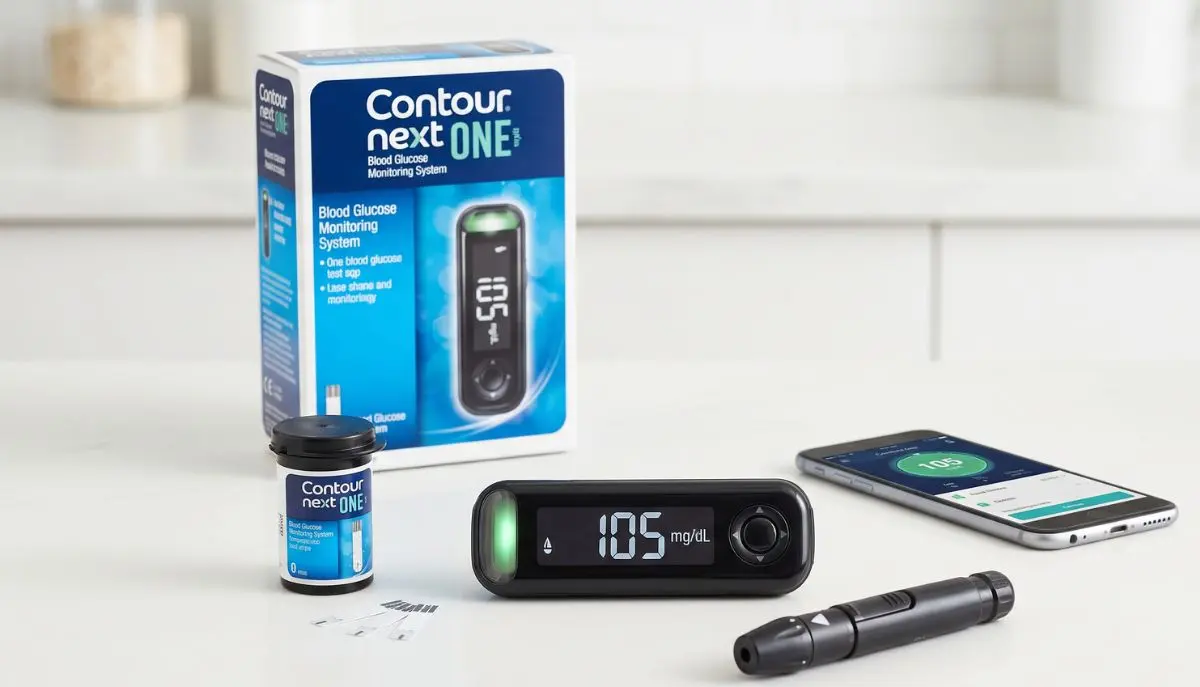
When you are checking your blood glucose regularly, the meter you use becomes part of your daily routine. A blood glucose meter should be easy to use, provide dependable readings, require a reasonable amount of blood, and make it simple to keep track of your results.
That is why many people searching for a home glucose meter come across the CONTOUR NEXT ONE Blood Glucose Monitoring System.
In this detailed guide, we take a closer look at CONTOUR NEXT ONE blood glucose monitoring system reviews, including its accuracy, ease of use, test strips, Bluetooth connectivity, smartLIGHT feature, Second-Chance Sampling, advantages, limitations, and what real-world users say.
The CONTOUR NEXT ONE is manufactured by Ascensia Diabetes Care and is an FDA-cleared over-the-counter blood glucose monitoring system. The FDA’s records identify the CONTOUR NEXT ONE as a blood glucose monitoring system, and an updated 2026 FDA submission continues to list the CONTOUR NEXT ONE among the manufacturer’s blood glucose monitoring systems.
For people comparing glucose meters, the most important question is simple:
Is the CONTOUR NEXT ONE a good blood glucose meter?
For many users, it can be a strong option, particularly if accuracy, a small blood sample, straightforward testing, and smartphone connectivity are important. However, no meter is perfect for every person. Test-strip cost, app preferences, battery issues, and individual experiences can affect whether it is the right choice.
The CONTOUR NEXT ONE is a blood glucose meter designed to measure glucose from a small capillary blood sample.
Unlike a continuous glucose monitor (CGM), it does not continuously measure glucose under the skin. Instead, you use a CONTOUR NEXT test strip and a finger-stick blood sample to obtain an individual glucose reading.
The meter can also connect wirelessly to a compatible smartphone or tablet through Bluetooth and transfer readings to the CONTOUR Diabetes app. The FDA documentation describes this wireless communication and app integration as one of the system’s key features.
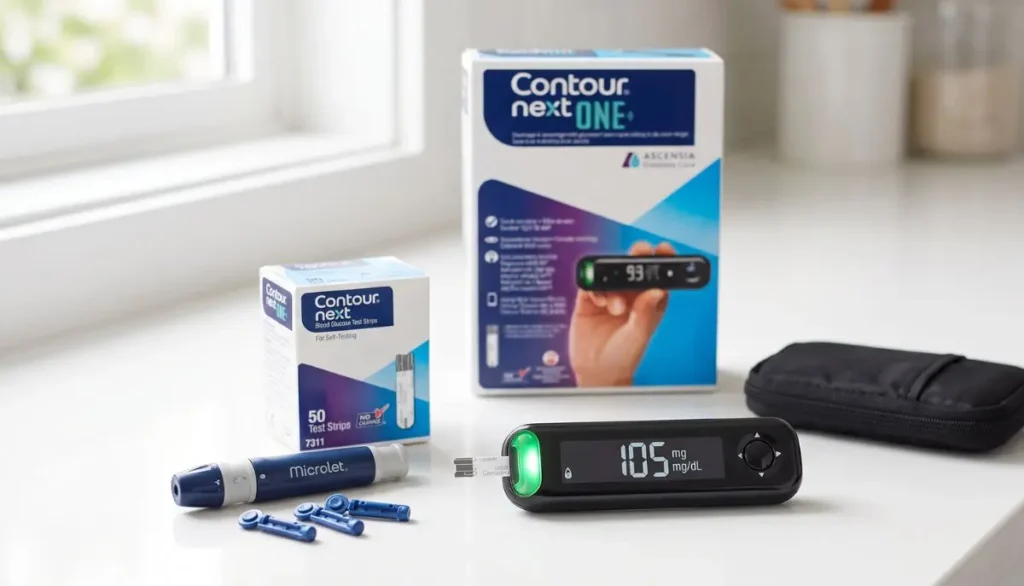
This makes the meter useful for people who want a traditional finger-stick glucose meter while also having the option of digital record keeping.
The CONTOUR NEXT ONE offers several features that distinguish it from a basic glucose meter:
The current manufacturer’s information specifically describes smartLIGHT as a feature that provides immediate color-based feedback and Second-Chance Sampling as a way to add more blood to the same strip when the first sample is insufficient.
When looking at CONTOUR NEXT ONE blood glucose monitoring system reviews, it is important not to judge the meter based on one positive or negative review.
A better approach is to look at several areas:
On those points, the CONTOUR NEXT ONE has several meaningful strengths.
Its biggest advantage is its combination of established glucose-meter technology with useful digital features. It can work as a straightforward standalone meter, but users who enjoy smartphone tracking can connect it to the CONTOUR Diabetes app.
That flexibility is valuable.
Some people simply want to test their blood sugar and see the number. Others want to track readings over time, identify patterns, and share information with their healthcare team.
The CONTOUR NEXT ONE can support both approaches.
Accuracy is probably the most important part of any CONTOUR NEXT ONE blood glucose monitoring system review.
A meter can have a beautiful screen and a convenient app, but if its readings are not sufficiently accurate, those features mean very little.
The CONTOUR NEXT ONE has undergone formal accuracy testing.
A published clinical evaluation examined the system using multiple CONTOUR NEXT test-strip lots. In laboratory testing, 600 out of 600 combined results met the ISO 15197:2013 analytical accuracy criteria. In the clinical study involving people with diabetes, 99.4% of subject self-test results met the ISO criteria, while 99.7% of results obtained by study staff met the criteria.
These results are important because they are based on structured testing rather than customer opinions.
The manufacturer’s technical information also describes testing involving 372 lay users and comparisons against a laboratory reference method.
It means the meter has demonstrated strong performance under controlled testing conditions.
However, it is important to remember that no home blood glucose meter should be expected to produce exactly the same number as a laboratory blood test every time.
Your result can be affected by factors such as:
So, if you occasionally see a small difference between two glucose readings, that does not automatically mean that the meter is defective.
Real-world reviews are useful because they show what happens outside a controlled clinical environment.
Overall, online feedback about the CONTOUR NEXT ONE is mixed but includes many positive comments about ease of use, portability, accuracy, and the small amount of blood required.
For example, recent customer feedback includes users describing the meter as easy to use and accurate, while another customer reported being satisfied with its small blood requirement and comfortable use. At the same time, some reviewers have reported concerns about inconsistent readings, error messages, or reliability over time.
This is a useful reminder:
A product can perform well in clinical testing while individual customers can still experience problems.
That is true for almost every home medical device.
A 2026 community discussion also praised the CONTOUR NEXT ONE for accuracy while criticizing the ongoing cost of test strips.
Another diabetes forum discussion described the meter as repeatable and accurate from the user’s experience but raised concerns about the cost of strips and dissatisfaction with the companion app.
Therefore, when reading reviews, consider the entire picture rather than focusing only on five-star or one-star ratings.
One feature that has helped the CONTOUR NEXT family develop a reputation for accuracy is its test-strip technology and glucose calculation system.
FDA documentation for the CONTOUR NEXT ONE describes a revised glucose calculation algorithm intended to improve accuracy compared with the earlier CONTOUR NEXT system.
The system is also designed to work specifically with CONTOUR NEXT blood glucose test strips.
That last point is important.
The CONTOUR NEXT ONE meter is designed for use with CONTOUR NEXT test strips.
The manufacturer’s quick-reference guide specifically states that the meter uses CONTOUR NEXT blood glucose test strips.
Do not assume that any glucose test strip will work with the meter.
Using the correct strip is essential for proper testing.
One of the most recognizable features of the CONTOUR NEXT ONE is smartLIGHT.
Instead of showing only a number, the meter can provide a color indication related to the user’s configured target range.
According to the manufacturer:
The smartLIGHT feature can also be switched off if the user does not want to use it.
Imagine that you test your blood glucose early in the morning.
Instead of having to remember a target range immediately, the meter gives you an additional visual indication.
For some users, that makes glucose monitoring easier to understand.
It is especially helpful for people who prefer visual information instead of relying only on numbers.
However, the light is not a substitute for understanding your personal glucose targets. Your healthcare professional should help determine what ranges are appropriate for you.
Another practical feature discussed in CONTOUR NEXT ONE blood glucose monitoring system reviews is Second-Chance Sampling.
Sometimes a person inserts a test strip and does not apply enough blood.
With some traditional meters, an insufficient sample means throwing away the strip and starting again.
The CONTOUR NEXT ONE offers Second-Chance Sampling, which allows the user to apply additional blood to the same test strip when the initial sample is insufficient.
Test strips can become expensive, especially for people who test several times every day.
If the system lets you add more blood to the same strip instead of immediately discarding it after an insufficient sample, it can reduce unnecessary strip waste.
It can also make testing less frustrating.
For most users, one of the strongest points of the system is its relatively straightforward testing process.
The general process involves:
The meter’s quick-reference materials show the strip port, sample tip, control buttons, and smartLIGHT indicator.
One of the simplest ways to improve glucose-testing technique is also one of the easiest to overlook.
Before testing, wash your hands and dry them completely.
If your fingers contain food residue, particularly sugary substances, the result can potentially be affected.
Good testing technique matters just as much as choosing a quality meter.
If you like tracking your health information on your phone, the CONTOUR NEXT ONE has an important advantage.
The meter can automatically transfer glucose results to a compatible smartphone or tablet through Bluetooth using the CONTOUR Diabetes app.
The idea is simple:
Test → transfer → track → review.
Instead of manually writing every result in a notebook, connected data can make long-term tracking easier.
This can be useful when you want to look for patterns related to:
However, smartphone connectivity is not necessary to use the meter as a traditional glucose monitor.
That is another advantage.
After reviewing the available clinical information, manufacturer documentation, and user feedback, here are some of the main advantages.
Clinical and laboratory evaluations have demonstrated strong compliance with ISO 15197:2013 accuracy criteria.
The color-based indicator gives users an additional visual way to understand whether a reading is inside, above, or below their configured target range.
The ability to add more blood to the same strip after an insufficient initial sample can help reduce wasted strips.
Users can transfer readings wirelessly to a compatible smartphone or tablet using the CONTOUR Diabetes app.
The small meter is convenient for people who need to carry glucose-monitoring supplies during the day.
The system uses no-coding technology, reducing one step that was required with some older glucose meters.
The CONTOUR NEXT ONE has been reviewed through the FDA’s 510(k) process, with the original CONTOUR NEXT ONE 510(k) decision dating to 2016.
A fair review should also discuss the limitations.
One of the most frequently mentioned concerns in user discussions is the ongoing cost of test strips.
The meter itself may not be the biggest long-term expense.
If you test multiple times every day, test strips can become the larger recurring cost.
Some users enjoy smartphone connectivity, while others have reported frustration with the companion app or prefer using the meter without Bluetooth.
If you do not care about digital tracking, you can simply use the meter as a standalone device.
Some recent customer reviews mention error messages or concerns about inconsistent readings.
These reports should not automatically override controlled accuracy evidence, but they are still worth considering.
If you repeatedly receive unexpected results, follow the manufacturer’s troubleshooting guidance and speak with your healthcare professional when appropriate.
Unlike a CGM, the CONTOUR NEXT ONE does not continuously monitor glucose.
You must obtain a blood sample whenever you want a reading.
It is easy to compare a blood glucose meter with a CGM, but they serve different purposes.
Neither approach is automatically better for everyone.
Some people use a CGM as their primary glucose-monitoring method and keep a traditional blood glucose meter available for situations where they need or prefer a finger-stick measurement.
Your healthcare professional can help determine which approach fits your diabetes management plan.
The CONTOUR NEXT ONE may be a good choice for people who want:
It may be particularly appealing to people who want a balance between simple testing and modern digital tracking.
The CONTOUR NEXT ONE may not be ideal for everyone.
You may prefer another system if:
The best glucose meter is not necessarily the one with the most features.
It is the one you can use correctly and consistently.
Even an accurate meter depends on proper testing technique.
Here are several practical habits that can help.
Wash with soap and water and dry thoroughly before testing.
Keep strips properly stored and follow the manufacturer’s storage instructions.
Do not use strips that are damaged or otherwise unsuitable.
Pay attention to the expiration information provided for your test strips.
Follow the instructions for obtaining and applying the appropriate sample.
If the first sample is insufficient, Second-Chance Sampling may allow you to add more blood to the same strip.
Read the user guide before beginning if you are new to the device.
If a result does not match how you feel or seems unusually different from your typical readings, consider repeating the test using proper technique and consult your healthcare professional when necessary.
Do not make medication changes solely because of one unexpected home meter reading unless your healthcare plan specifically instructs you to do so.
The answer is more nuanced than simply saying “yes.”
There are many positive user experiences, especially around:
At the same time, negative reviews exist.
Some customers report:
Recent customer reviews demonstrate this range of experiences, with some users calling the meter easy and accurate while others report significant frustrations.
That is why CONTOUR NEXT ONE blood glucose monitoring system reviews should be read as part of a larger evaluation, not as a substitute for clinical evidence.
Yes.
The FDA database lists the CONTOUR NEXT ONE Blood Glucose Monitoring System under the over-the-counter blood glucose monitoring system classification. The original CONTOUR NEXT ONE 510(k) record shows a decision date of November 17, 2016.
More recently, an FDA 510(k) record dated August 27, 2026 lists the CONTOUR NEXT ONE alongside other CONTOUR blood glucose monitoring systems in a newer submission from Ascensia Diabetes Care.
FDA clearance does not mean a device will produce identical results to a laboratory analyzer in every situation. It means the device has gone through the applicable regulatory review process for its intended use.
Choosing a glucose meter is only one part of diabetes care.
You may also need:
A medical supply company can make it easier to find related products in one place.
Alfa Healthcare Supply Inc. provides medical equipment and healthcare supplies and serves customers looking for diabetes-related products and other home medical supplies.
For people comparing glucose-monitoring products, it is useful to consider not only the meter price but also the availability and ongoing cost of compatible supplies.
After looking at clinical evidence, manufacturer information, FDA records, and real-world reviews, the CONTOUR NEXT ONE Blood Glucose Monitoring System has a compelling combination of accuracy evidence, ease-of-use features, and digital connectivity.
Its strongest points include:
The biggest considerations are the recurring cost of compatible test strips, the fact that it requires finger-stick testing, and the fact that individual experiences with the meter and app can differ.
For someone who wants a traditional glucose meter with modern features, the CONTOUR NEXT ONE is certainly worth considering.
But remember one important point:
A glucose meter is a tool, not a replacement for professional diabetes care.
Use your readings as part of your overall diabetes-management plan, follow your healthcare professional’s recommendations, and discuss unusual or concerning readings with them.
If you are comparing diabetes supplies, Alfa Healthcare Supply Inc. can also be a useful place to explore blood glucose monitoring products and other medical supplies.
The CONTOUR NEXT ONE has strong clinical and laboratory accuracy evidence and offers useful features such as smartLIGHT, Second-Chance Sampling, no coding, and Bluetooth connectivity.
Whether it is the right meter for you depends on your testing needs, preferred features, insurance coverage, and ongoing test-strip cost.
Clinical evaluations found that a very high percentage of tested results met ISO 15197:2013 accuracy criteria. In one published study, 99.4% of patient self-test results met the specified criteria.
No. The system is designed as a no-coding blood glucose meter. The manufacturer’s quick-reference guide identifies the meter as “NO CODING.”
The CONTOUR NEXT ONE uses CONTOUR NEXT blood glucose test strips.
Yes. It can wirelessly transfer glucose readings to a compatible smartphone or tablet through the CONTOUR Diabetes app.
The smartLIGHT gives color feedback based on the configured target range. Green indicates within target, amber indicates above target, and red indicates below target.
It allows the user to apply additional blood to the same test strip if the first blood sample is insufficient, potentially helping reduce strip waste.
Yes. Bluetooth and the app are optional features. The meter can be used for traditional blood glucose testing without relying on smartphone tracking.
No. It is a blood glucose meter. It requires a blood sample for each test rather than continuously monitoring glucose through a wearable sensor.
Different glucose meters can produce somewhat different readings within their accepted performance ranges. Testing technique, hand cleanliness, strip condition, sample size, and other factors can also influence results.
If you repeatedly receive unexpected results, review your testing technique and contact your healthcare professional.
The cost varies by package size, retailer, insurance coverage, location, and other factors. Some users specifically mention test-strip cost as a disadvantage in reviews.
The best device is ultimately the one that fits your testing routine, your budget, your healthcare plan, and your ability to use it consistently.
This article is intended for general educational and informational purposes. It is not medical advice and does not replace guidance from a physician, diabetes educator, pharmacist, or other qualified healthcare professional. Blood glucose targets vary from person to person. Do not change insulin, medication, diet, or treatment based solely on information in this article. Always follow the instructions supplied with your glucose meter and test strips and consult your healthcare professional with questions about your diabetes care.