


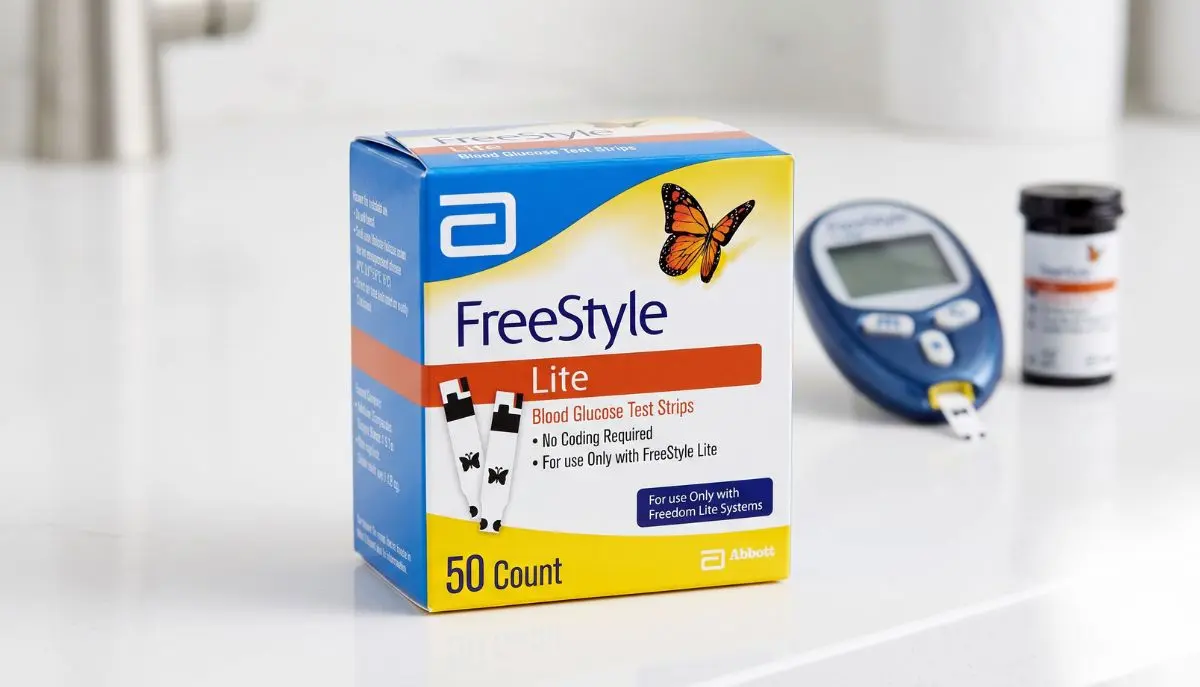
Managing blood glucose is often part of everyday life for people living with diabetes. While checking blood sugar may become a familiar routine over time, having the right supplies can make testing feel much easier and more comfortable.
The FreeStyle Lite blood glucose test strips 50 count package is designed for use with compatible FreeStyle Lite blood glucose meters. These strips require a very small blood sample and use ZipWik™ technology to help draw blood into the test strip. The FreeStyle Lite system is also designed without manual coding, which can simplify the testing process.
For someone who checks blood glucose regularly, a 50-count box can be a convenient supply size. It gives you multiple testing opportunities without requiring you to purchase a new package after only a few tests.
This guide explains what FreeStyle Lite test strips are, how they work, how to use them correctly, how to store them, common mistakes to avoid, and what to consider when choosing a blood glucose testing supply.
Medical note: This article is for general educational information and does not replace instructions from your healthcare professional or the product’s official instructions for use. Follow your meter’s instructions and your healthcare provider’s recommendations for blood glucose testing.
FreeStyle Lite blood glucose test strips are disposable strips designed to work with compatible FreeStyle Lite blood glucose meters. They are used to measure glucose in a small sample of whole blood.
The strip works together with the meter. After a small blood sample is applied, the meter analyzes the sample and displays a glucose reading.
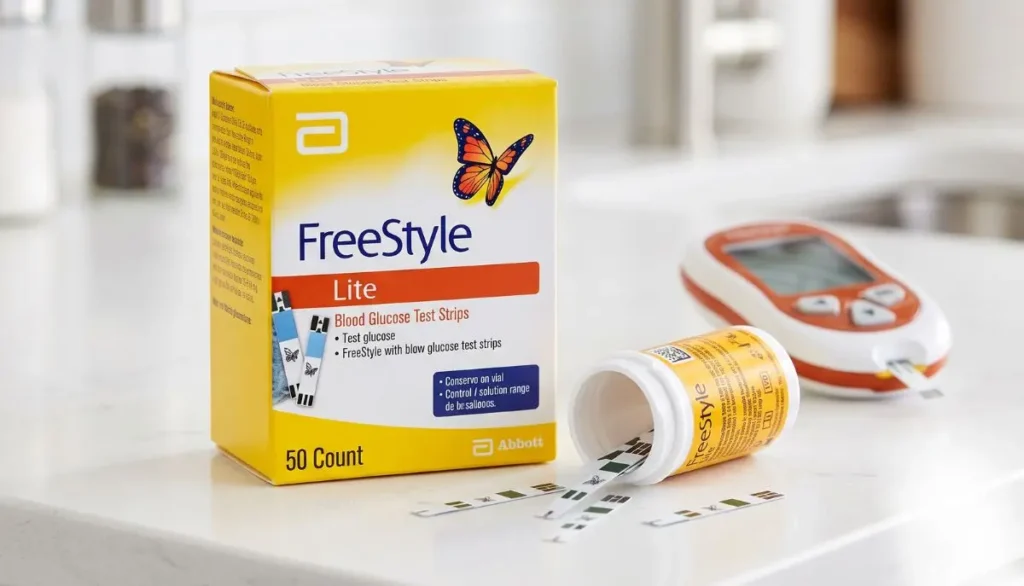
Abbott describes the FreeStyle Lite system as a compact blood glucose monitoring option designed for convenient everyday testing. The compatible strips use ZipWik™ tabs that help the blood enter the strip quickly when the tab touches the blood drop.
One of the most useful features is the small blood sample requirement. FreeStyle Lite strips require approximately 0.3 µL of blood, which can be helpful for people who prefer a smaller sample during routine testing.
The strips are intended for use with compatible FreeStyle Lite meters, so it is important to confirm compatibility before purchasing.
The phrase FreeStyle Lite blood glucose test strips 50 count simply refers to the number of test strips included in the package.
A 50-count box contains 50 individual testing strips.
If you test once per day, 50 strips could represent approximately 50 individual tests. If you test several times per day, the supply will naturally be used more quickly.
For example:
These are simple estimates. Your actual usage depends on the testing schedule recommended by your healthcare professional.
For people who test regularly, buying an appropriately sized package can help avoid unexpectedly running out of strips.
Several features make FreeStyle Lite test strips convenient for routine blood glucose testing.
FreeStyle Lite test strips require a minimum blood sample of approximately 0.3 µL.
A small sample can be helpful for people who test frequently or are sensitive to finger-prick testing.
The FreeStyle Lite system does not require traditional manual coding. The American Diabetes Association’s consumer guide lists the FreeStyle Lite meter as requiring no coding.
This can make setup easier because there is no separate code number that needs to be entered before testing.
The test strips feature ZipWik™ tabs. Abbott explains that the tabs help break the surface tension of the blood and wick the blood into the strip.
This design can make applying the blood sample easier when the user positions the strip correctly.
The FreeStyle Lite system is designed to provide a blood glucose result in approximately five seconds. Abbott documentation and FDA-cleared system information identify an average test time of about five seconds.
Fast results can be useful when testing is part of a busy daily routine.
The FreeStyle Lite system can support testing from certain approved alternative sites, depending on the circumstances and the instructions for the specific system. Abbott’s documentation identifies areas including the forearm, upper arm, hand, thigh, calf, and fingers.
However, fingertip testing may be recommended in situations where glucose may be changing quickly or when low blood sugar is suspected. Always follow your meter’s instructions and your healthcare professional’s advice.
Understanding the basic process can make testing less intimidating.
First, the meter and test strip work together to analyze glucose in a blood sample.
When blood reaches the designated area of the strip, the strip interacts with glucose in the sample. The meter measures the resulting electrical signal and converts it into a blood glucose reading.
FreeStyle Lite strips use a small sample and ZipWik™ technology to help draw blood into the test strip.
The result is then displayed on the compatible meter.
This may sound technical, but for everyday users the process is simple: prepare the meter, insert the strip, obtain the blood sample, apply the sample correctly, and wait for the reading.
Always read the instructions supplied with your specific meter and test strips before use.
A general testing routine includes the following steps.
Before starting, have your supplies nearby.
You may need:
Having everything ready can make the testing process quicker.
Wash your hands with soap and water and dry them thoroughly.
This step is important because moisture, food residue, lotions, or other substances on the fingers can potentially affect a blood glucose test.
Clean, dry hands provide a better starting point for testing.
Insert a fresh lancet into the lancing device according to its instructions.
Avoid sharing lancets or lancing devices with another person.
Using a fresh lancet can also help make finger-prick testing more comfortable.
Take one FreeStyle Lite test strip from its container.
Insert the strip into the compatible meter as directed.
Do not force the strip into the meter.
Once the meter is ready for a blood sample, proceed with obtaining the sample.
Use the lancing device according to its instructions.
A small blood drop is generally enough because the FreeStyle Lite system requires approximately 0.3 µL of blood.
Avoid excessively squeezing the finger, unless your meter instructions specifically tell you otherwise.
Bring the appropriate part of the FreeStyle Lite strip to the blood sample.
The ZipWik™ design helps draw the blood into the strip when positioned correctly.
Make sure you follow the instructions for applying the sample rather than placing blood on an incorrect area of the strip.
The meter analyzes the sample and displays the blood glucose result.
The FreeStyle Lite system is designed to provide results in approximately five seconds.
Record the result if your healthcare professional has recommended keeping a glucose log.
After testing, dispose of the used lancet according to local sharps-disposal requirements.
Test strips are also single-use supplies and should not be reused.
One of the most noticeable characteristics of FreeStyle Lite test strips is the small blood sample requirement.
The strip requires approximately 0.3 µL of blood.
For someone testing regularly, the size of the required blood sample can influence the overall testing experience.
A smaller sample requirement does not mean that testing is completely painless. A lancet still makes a small puncture in the skin. However, using the appropriate lancing technique and changing lancets regularly may help make testing more comfortable.
If obtaining enough blood is difficult, review the meter instructions and speak with a healthcare professional rather than repeatedly squeezing or puncturing the skin.
Accuracy is one of the most important considerations when selecting blood glucose testing supplies.
FreeStyle Lite test strips have been evaluated through laboratory and clinical testing. The available instructions for use report accuracy comparisons against a YSI glucose analyzer. In a study involving fingertip capillary blood samples from 137 lay users, the reported results were 100% within ±15 mg/dL of the reference for glucose concentrations below 100 mg/dL and 97.3% within ±15% for concentrations at or above 100 mg/dL.
However, a glucose meter result is only useful when the testing procedure is performed correctly.
Factors such as contaminated hands, incorrect strip storage, expired strips, an insufficient blood sample, or using an incompatible strip can contribute to inaccurate or unexpected readings.
If your result does not match how you feel, follow the instructions provided with your glucose monitoring system and contact your healthcare professional when appropriate.
FreeStyle Lite test strips are designed for compatible FreeStyle Lite blood glucose meters.
The American Diabetes Association lists the FreeStyle Lite meter as compatible with FreeStyle Lite blood glucose test strips featuring ZipWik Tabs.
Abbott’s documentation also states that the FreeStyle Lite meter should only be used with FreeStyle Lite test strips and the appropriate FreeStyle control solution. Using other strips or control solution can produce inaccurate results.
This is why checking compatibility before ordering is extremely important.
Do not assume that every test strip carrying the FreeStyle name will work with every FreeStyle meter.
FreeStyle is a product family with multiple meter and testing-strip systems.
One common source of confusion is the difference between various FreeStyle-branded strips.
For example, FreeStyle Lite strips are not automatically interchangeable with FreeStyle Precision Neo or other FreeStyle testing strips.
Abbott’s product information identifies different FreeStyle strips for different meters and systems.
Before purchasing, check:
Choosing the correct strip is more important than simply choosing a strip from the same brand family.
Proper storage is an important part of maintaining test-strip performance.
Test strips should be kept according to the storage instructions supplied with the product.
Protect strips from:
Do not leave the test-strip container open unnecessarily.
After removing a strip, close the container securely according to the manufacturer’s instructions.
The available Abbott information for FreeStyle Lite identifies a shelf life of up to 24 months for the strips under specified conditions.
Always check the expiration date on your own package rather than relying only on a general shelf-life statement.
Expired test strips should not be used simply because they look normal.
The chemicals inside a test strip are part of the measurement process. Over time, storage conditions and aging can affect performance.
Before testing:
If you receive an unexpected result, consider whether your strips have expired or been stored improperly.
Even a high-quality test strip cannot compensate for an incorrect testing process.
Here are several common mistakes to avoid.
This is one of the most important issues.
Always confirm that your strips are compatible with your specific meter.
Food, sugar, lotions, and other substances on the skin can potentially affect a blood glucose result.
Wash and dry your hands before testing.
If the strip does not receive enough blood, the meter may display an error or provide an unreliable result.
Follow the instructions for applying the blood sample.
Always check the expiration date before use.
Repeated exposure to environmental conditions may affect test strips.
Keep the container properly closed when strips are not being used.
Test strips are designed for single use.
Use a new strip for each test.
A surprising result does not automatically mean that the meter or strip is defective.
Consider your testing technique, hand cleanliness, strip storage, expiration date, and whether the result matches your symptoms and expectations.
If you continue receiving unexpected results, consult your healthcare professional and follow the manufacturer’s troubleshooting instructions.
The answer depends on how often you test.
For example, if your healthcare professional recommends:
One test per day:
50 strips may last about 50 days.
Two tests per day:
50 strips may last about 25 days.
Four tests per day:
50 strips may last about 12 days.
Five tests per day:
50 strips may last about 10 days.
Your personal testing schedule may be different.
Some people need more frequent testing depending on their diabetes treatment plan, medication, insulin use, illness, pregnancy, exercise, or other factors.
There is no universal testing schedule that is right for everyone. Follow the schedule recommended by your healthcare professional.
FreeStyle Lite test strips may be useful for people who already use a compatible FreeStyle Lite meter and need replacement strips for routine blood glucose testing.
They can be particularly convenient for users who appreciate:
However, the best glucose monitoring system depends on the person’s medical needs, meter compatibility, testing habits, insurance coverage, and healthcare provider recommendations.
When searching for freestyle lite blood glucose test strips 50 count, it is important to look beyond the package quantity.
Before purchasing, confirm:
Make sure the strips are designed for your meter.
A 50-count package contains 50 test strips.
Choose strips with an appropriate remaining shelf life.
Check that the package is intact and has been stored appropriately.
Purchasing from a reputable medical supply company can make it easier to verify the product information and obtain appropriate customer support.
Alfa Healthcare Supply currently lists FreeStyle Lite Blood Glucose Test Strips 50 Count in its diabetic supplies category.
The listed product should be checked on the website for current availability and pricing before ordering because product information and pricing can change.
For people looking for diabetes testing supplies, finding a medical supply provider that offers a range of products can make routine shopping more convenient.
Alfa Healthcare Supply Inc. offers diabetic supplies and other home medical products through its online store.
Its diabetic supplies category includes blood glucose monitoring products such as the FreeStyle Lite Blood Glucose Monitoring System and FreeStyle Lite Blood Glucose Test Strips 50 Count.
When purchasing diabetes supplies, customers should always verify product compatibility and follow the manufacturer’s instructions.
A blood glucose test strip may look like a small piece of plastic, but for someone managing diabetes, it can become part of an important daily routine.
The goal is not simply to collect numbers.
Blood glucose readings can help people and their healthcare teams understand patterns and make informed decisions about diabetes management.
For example, glucose monitoring may help someone recognize patterns related to meals, physical activity, medication, insulin, illness, stress, or other daily factors.
The numbers should always be interpreted in the context of the individual’s diabetes care plan.
A single reading does not necessarily tell the entire story.
Keeping consistent records, following the recommended testing schedule, and discussing unusual patterns with a healthcare professional can make glucose monitoring more meaningful.
If blood glucose testing is part of your daily routine, small habits can make the process easier.
If your healthcare professional has approved alternative testing sites for your meter, rotating locations may help reduce repeated irritation in one area.
Using a fresh lancet may improve comfort and help maintain good testing technique.
Store your meter, strips, lancets, and other supplies in an organized location.
Clean, dry hands provide a better testing starting point.
Take a few seconds to prepare the meter and sample properly. Rushing can lead to errors or wasted strips.
If recommended by your healthcare professional, maintain a glucose log or use your meter’s memory features.
A consistent record can help identify patterns over time.
Sometimes a reading may seem unexpected.
For example, the number may be much higher or lower than you anticipated.
Do not immediately assume the test strip is defective.
First, review the basics:
If the result does not seem consistent with your symptoms or expectations, follow the instructions for your glucose monitoring system and seek professional medical advice when appropriate.
If you suspect severe hypoglycemia or hyperglycemia or are experiencing concerning symptoms, seek appropriate medical care promptly.
Choosing the right blood glucose testing supplies can make everyday diabetes care feel more manageable.
The FreeStyle Lite blood glucose test strips 50 count package provides 50 disposable test strips designed for compatible FreeStyle Lite meters. With a small approximately 0.3 µL blood sample requirement, no manual coding, ZipWik™ technology, and a testing time of approximately five seconds, the system is designed to make routine blood glucose testing straightforward.
The most important step is making sure the strips are compatible with your meter and using them according to the manufacturer’s instructions. Proper hand washing, correct strip storage, checking expiration dates, and following good testing technique can all contribute to a more reliable testing routine.
If you’re searching for freestyle lite blood glucose test strips 50 count, Alfa Healthcare Supply offers this product through its diabetic supplies collection. Always check the current product listing for availability, pricing, and ordering information.
Most importantly, remember that blood glucose numbers are one part of diabetes care. Your healthcare professional can help you understand your readings and determine how often you should test based on your individual needs.
There are 50 FreeStyle Lite blood glucose test strips in a 50-count package.
FreeStyle Lite test strips require a minimum blood sample of approximately 0.3 µL.
The FreeStyle Lite system does not require manual coding.
The FreeStyle Lite system provides a result in approximately five seconds under the specified testing conditions.
FreeStyle Lite test strips are intended for compatible FreeStyle Lite blood glucose meters. Always verify compatibility with your specific meter before purchasing.
No. Different FreeStyle meters can use different test strips. Do not assume that all FreeStyle-branded strips are interchangeable. Check the manufacturer’s compatibility information.
No. Blood glucose test strips are intended for single use.
Store the strips according to the manufacturer’s instructions and protect them from inappropriate environmental conditions. Keep the test-strip container properly closed when not in use.
The available Abbott product information identifies a shelf life of up to 24 months under specified conditions, but users should always follow the expiration date printed on their own packaging.
Check that the strip is compatible with your meter, has not expired, has been stored correctly, and has been inserted and used according to the instructions. If problems continue, consult the manufacturer’s support information or your healthcare professional.
No. The test strip works as part of the compatible blood glucose monitoring system and requires the appropriate meter to read the result.
Alfa Healthcare Supply currently lists FreeStyle Lite Blood Glucose Test Strips 50 Count among its diabetic supplies. Check the product page for current availability and pricing.
This article provides general educational information about FreeStyle Lite blood glucose test strips. It is not medical advice and should not replace the instructions supplied with your meter or test strips, or guidance from your physician, diabetes educator, pharmacist, or other qualified healthcare professional. Always use diabetes testing products according to their approved instructions.