


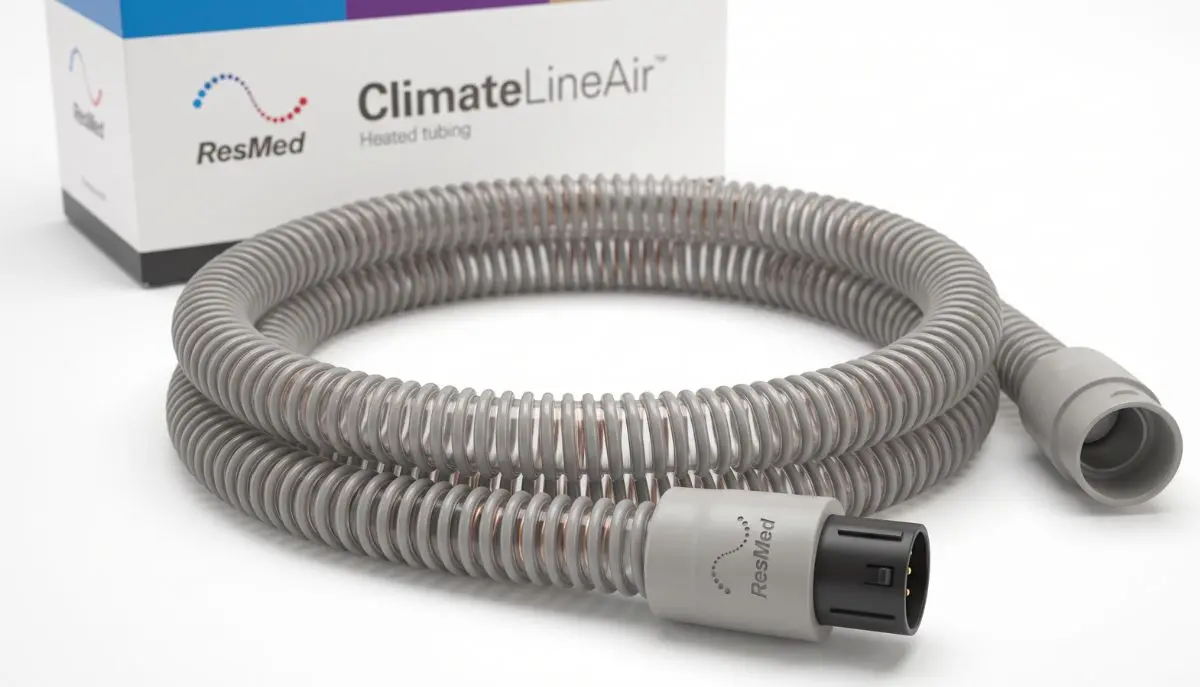
If you use a ResMed CPAP or bilevel machine, the tubing may look like one of the simplest parts of your setup. But the right tubing can make a meaningful difference in how comfortable your therapy feels each night.
The ResMed ClimateLineAir tubing is a heated air tube designed to carry air from a compatible ResMed device to your CPAP mask while helping maintain a comfortable temperature and humidity level. Unlike ordinary CPAP tubing, heated ClimateLineAir tubing works with ResMed’s humidification and Climate Control features to help reduce condensation, commonly called CPAP rainout.
For patients who wake up with water inside their mask or tubing, experience a cold stream of air, or simply want a more comfortable humidified CPAP experience, heated tubing can be an important accessory.
At Alfa Healthcare Supply Inc., we understand that CPAP equipment is not just about buying a machine or mask. Small replacement parts such as tubing, cushions, filters, and other accessories also matter because they become part of your everyday therapy routine.
This guide explains what ResMed ClimateLineAir tubing is, how it works, which ResMed machines it fits, how to install and clean it, when replacement may be appropriate, and what to consider before ordering.
ResMed ClimateLineAir tubing is heated CPAP air tubing designed to transport air from a compatible ResMed therapy device to the patient’s mask while helping maintain the temperature of humidified air.
The heated design is different from standard, non-heated CPAP tubing.
With ordinary tubing, humidified air can cool as it travels from the humidifier toward the mask. Depending on the room temperature, humidity, and therapy settings, this cooling can cause moisture to collect inside the tube or mask. ResMed refers to this condensation as “rainout.”
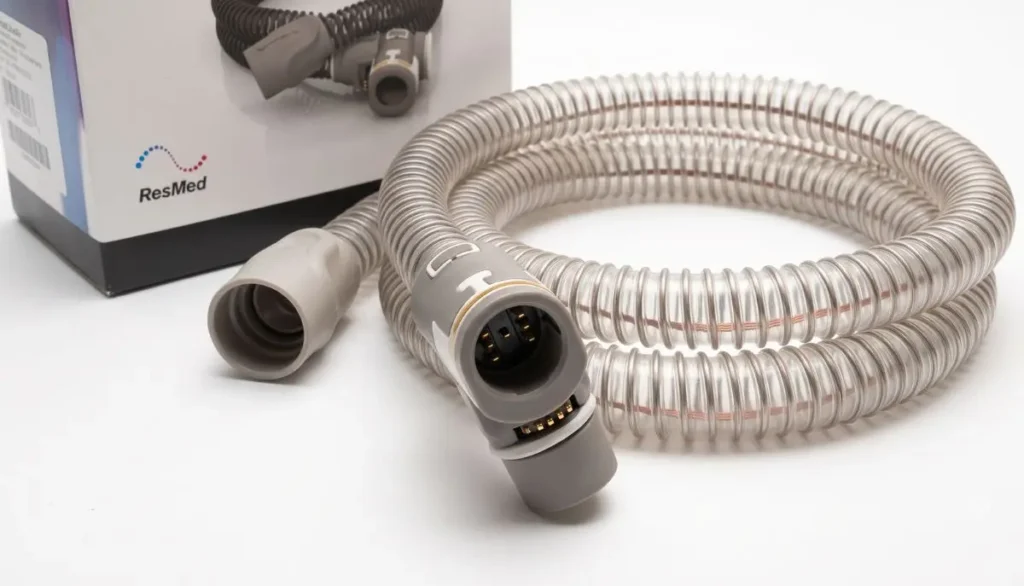
ClimateLineAir tubing is designed to help keep humidified air at a more consistent temperature as it travels through the tube.
When used with the appropriate ResMed humidifier and compatible machine, the tubing can also work with Climate Control features designed to help manage temperature and humidity during therapy.
In simple terms:
The machine produces the therapy air → the humidifier adds moisture → the heated ClimateLineAir tubing helps maintain the air temperature → the air reaches the mask.
That simple process can make the overall CPAP experience more comfortable for some users.
CPAP therapy should fit into your nightly routine as comfortably as possible.
A patient may have the correct pressure setting and a properly fitted mask but still have an uncomfortable experience because the air feels too cold or because condensation develops in the tubing.
This is where heated tubing can be useful.
One of the main purposes of heated tubing is to help reduce condensation in the tube.
When warm, humidified air travels through a cooler environment, water can form inside the tubing. This may eventually reach the mask.
The result can be:
ClimateLineAir tubing is designed to help keep the humidified air warmer as it moves toward the mask, helping to virtually eliminate rainout when used as intended.
Humidification can be helpful for people who experience dryness during CPAP therapy.
ResMed explains that its humidification system is designed to help make therapy more comfortable and can be useful for symptoms such as dry mouth and nasal congestion.
ClimateLineAir tubing works as part of this system.
Depending on the compatible ResMed device and setup, Climate Control settings can allow temperature and humidity to be managed automatically or manually.
With compatible Air11 equipment, for example, Climate Control Auto is available when ClimateLineAir 11 tubing is connected with the appropriate HumidAir humidifier.
This can reduce the need to constantly adjust settings manually.
One of the most important things to understand before purchasing replacement CPAP tubing is machine compatibility.
Not every ResMed heated tube fits every ResMed machine.
There are different ClimateLineAir versions for different ResMed device families.
According to ResMed, ClimateLineAir 11 heated tubing is designed for Air11 devices, including the AirSense 11 and AirCurve 11. ClimateLineAir tubing for Air10 devices is designed for compatible AirSense 10 and AirCurve 10 machines.
The standard ClimateLineAir heated tubing is compatible with ResMed Air10 devices, including:
ResMed lists the ClimateLineAir heated tube as compatible with AirSense 10 and AirCurve 10 devices.
The ClimateLineAir 11 heated tube is designed for the newer Air11 platform.
Compatible machines include:
ResMed’s documentation specifically states that ClimateLineAir 11 is the heated tubing compatible with AirSense 11.
Do not choose tubing only because it says “ResMed ClimateLineAir.”
Look at the exact machine model first.
For example:
| ResMed Device | Appropriate Heated Tubing |
| AirSense 10 | ClimateLineAir for Air10 |
| AirCurve 10 | ClimateLineAir for Air10 |
| AirSense 11 | ClimateLineAir 11 |
| AirCurve 11 | ClimateLineAir 11 |
ResMed also offers ClimateLineAir Oxy versions with an integrated oxygen connector for compatible applications.
If you are uncertain about compatibility, check the model printed on your machine or consult your healthcare provider or DME supplier before ordering.
The AirSense 10 is one of the ResMed machines commonly used with ClimateLineAir heated tubing.
The ClimateLineAir tube is designed to work with the AirSense 10 humidification system and help maintain the temperature of humidified air as it moves toward the mask.
ResMed lists the Air10 ClimateLineAir tubing as a 6.5-foot tube with 22 mm cuffs/connectors and a 15 mm inner diameter.
For an AirSense 10 user, heated tubing may be particularly useful when:
The goal is not simply to make the air “hot.” The purpose is to help maintain an appropriate temperature as humidified air travels through the tubing.
If you use an AirSense 11, compatibility becomes especially important.
ResMed states that ClimateLineAir 11 is the heated tubing compatible with the AirSense 11.
The AirSense 11 can use its integrated HumidAir humidifier with ClimateLineAir 11 tubing to provide Climate Control functionality.
When properly connected, the AirSense 11 recognizes the heated tubing. ResMed’s user guide explains that “ClimateLine connected” briefly appears on the device screen when the tubing is connected correctly.
This is useful because it gives the user confirmation that the machine has recognized the heated tube.
The basic idea is straightforward.
Inside the ClimateLineAir tubing is technology designed to help control the temperature of the air traveling through the tube.
The system works together with compatible ResMed humidification technology.
A simplified process looks like this:
Step 1: The CPAP device generates pressurized therapy air.
Step 2: The humidifier adds moisture to the airflow.
Step 3: The heated tubing helps maintain the air temperature as it travels.
Step 4: The humidified air reaches the mask.
Step 5: The user receives therapy with a more controlled temperature and humidity environment.
ResMed describes ClimateLineAir 11 as having a built-in temperature sensor and explains that, when paired with a compatible HumidAir humidifier and Climate Control Auto, the system can automatically manage humidity and temperature.
This is why the tube should be viewed as part of a larger humidification system rather than simply a plastic hose.
“Rainout” is a common term used to describe condensation that forms when warm, humidified air cools inside CPAP tubing.
Imagine a glass of cold water on a hot summer day. Due to the temperature difference, moisture condenses on the outer surface of the glass.
A similar principle can occur inside CPAP tubing.
If humidified air cools while traveling from the humidifier to the mask, water can condense inside the tube.
This may create:
ResMed designed ClimateLineAir heated tubing to help keep the temperature of humidified air more consistent and reduce this problem.
ClimateLineAir tubing does not simply move air from one location to another.
Its heating function is designed to maintain the temperature of the humidified airflow.
This is important because the amount of moisture air can hold depends on temperature.
When humidified air cools, it can reach the point where moisture condenses.
Maintaining the air temperature as it moves through the tubing can therefore help reduce condensation.
ResMed describes ClimateLineAir heated tubing as helping to “virtually eliminate rainout” when used as intended.
If condensation continues even after using heated tubing, your humidity and temperature settings may need adjustment.
ResMed notes that, for compatible AirSense 10 and AirCurve 10 systems, Climate Control Manual can be used to adjust tube temperature when condensation remains an issue.
Humidification is one of the reasons many people choose heated tubing.
CPAP therapy involves a continuous stream of air. Some users may experience:
A humidifier adds moisture to the airflow.
However, adding moisture also introduces the possibility of condensation.
This creates a balance:
Too little humidity → air may feel dry.
Too much humidity combined with cooling → condensation may occur.
ClimateLineAir tubing is designed to help manage this balance by maintaining the temperature of the humidified airflow.
With compatible ResMed systems, Climate Control can help manage temperature and humidity automatically.
Depending on the ResMed machine, Climate Control may be available in automatic or manual modes.
Automatic Climate Control is designed to simplify humidification management.
With compatible AirSense 11 equipment, ResMed explains that Climate Control Auto automatically presets temperature and humidity levels designed for comfortable therapy when a ClimateLineAir heated tube is connected.
This can be convenient for users who do not want to make frequent adjustments.
Manual control gives the user more flexibility.
ResMed’s AirSense 11 documentation states that Manual mode allows temperature and humidity to be adjusted independently.
If you are experiencing dryness or condensation, adjustments should be made according to your device instructions and, when appropriate, with guidance from your healthcare professional.
Here are some of the important characteristics that make ClimateLineAir tubing different from standard tubing.
The tube is designed to maintain the temperature of humidified air as it travels toward the mask.
When paired with the appropriate compatible ResMed humidifier and machine, ClimateLineAir tubing enables Climate Control functionality.
The heated design helps reduce condensation inside the tubing.
ResMed describes ClimateLineAir tubing as having a slim design intended to offer flexibility and sleeping comfort.
ClimateLineAir 11 incorporates a built-in sensor designed to monitor temperature.
ResMed describes the ClimateLineAir design as incorporating a swivel connection intended to support freedom of movement and comfort.
The biggest difference is temperature management.
Standard CPAP tubing transports air from the machine to the mask without active heating.
It can be a perfectly appropriate option depending on the patient’s machine, environment, and therapy needs.
Heated tubing actively helps maintain the temperature of humidified air.
This can be useful when:
The choice should be based on your machine and therapy setup rather than simply choosing the most advanced-looking accessory.
The ResMed ClimateLineAir products commonly listed for Air10 and Air11 devices are approximately 6.5 feet long.
ResMed’s product information lists:
These specifications are listed for both the Air10 and Air11 ClimateLineAir heated tubing products.
The slim design can also make the tubing easier to position around the bed compared with some bulkier tubing designs.
Replacing your CPAP tubing should be straightforward, but it is important to connect the tube correctly.
For ClimateLineAir 11, ResMed provides the following basic setup process.
Make sure the CPAP machine is properly connected.
The end with the electrical connection belongs at the device.
Align the tube with the air outlet at the back of the compatible ResMed device.
Push the cuff firmly into position.
On compatible AirSense 11 devices, “ClimateLine connected” may briefly appear when the tube is recognized.
Attach the free end of the tubing to the assembled mask.
The electrical connector end is designed for the machine side. ResMed specifically warns that this end should not be connected to the mask.
Good cleaning habits help keep your CPAP equipment in better condition.
ResMed recommends regular cleaning of its heated tubing.
For ClimateLineAir 11, ResMed’s product guidance states that the tubing should be washed using warm water and household dishwashing liquid. It should not be washed at temperatures above 131°F (55°C), and it should not be placed in a dishwasher or washing machine.
A simple cleaning routine is:
Avoid harsh chemicals and aggressive cleaning methods unless specifically recommended by the manufacturer.
It is a good idea to inspect your CPAP tubing regularly.
Look for:
ResMed recommends regularly checking the tubing for damage and replacing it if holes, tears, or cracks are found.
A damaged tube can interfere with the intended airflow path.
There is no single replacement date that applies equally to every patient.
The condition of the tubing matters.
Consider replacement when:
Do not continue using visibly damaged tubing simply because the machine still turns on.
A CPAP system depends on its components working together correctly.
Even with quality equipment, users may experience occasional tubing problems.
This is often associated with condensation or rainout.
Possible factors include:
A heated tube and properly adjusted Climate Control settings may help.
This can occur when the air is too dry.
Humidity settings may need adjustment.
ResMed’s AirSense 11 guidance explains that users experiencing dry nose or mouth may increase humidity, while users experiencing moisture in the mask may reduce humidity.
A damaged tube or loose connection can contribute to air leakage.
Check both ends of the tube and inspect the tubing for damage.
The tubing can sometimes pull on the mask if it is positioned poorly.
Try routing the tube in a way that allows comfortable movement while sleeping.
The slim design and swivel connection of ClimateLineAir tubing are intended to support flexibility and comfort.
No.
This is one of the most important points when purchasing replacement tubing.
For example:
ClimateLineAir for Air10 is designed for compatible Air10 devices.
ClimateLineAir 11 is designed for Air11 devices.
ResMed specifically identifies ClimateLineAir 11 as the heated tubing compatible with AirSense 11.
Older ResMed S9 systems use different tubing technology, and ResMed states that ClimateLineAir is not compatible with S9 devices.
Always match the tubing to the exact machine model.
ResMed also offers ClimateLineAir Oxy versions.
The primary difference is the built-in oxygen connector.
ResMed describes ClimateLineAir Oxy as a variation of the heated tubing that incorporates an oxygen connector for patients who use supplemental oxygen.
This can simplify the oxygen connection without requiring a separate oxygen tubing arrangement.
However, oxygen use should always follow the instructions of the prescribing healthcare professional.
If you do not require supplemental oxygen, the standard ClimateLineAir tube may be the appropriate product for your compatible device.
Heated tubing can be particularly useful for people who notice problems related to cold air or condensation.
You may want to discuss heated tubing with your healthcare provider or DME supplier if:
That does not mean every CPAP user needs heated tubing.
The appropriate accessory depends on the machine, therapy setup, environment, and individual needs.
Before ordering, check these five things.
Look at the device name.
Is it:
Air10 and Air11 use different ClimateLineAir versions.
If supplemental oxygen is part of your therapy, ask your healthcare provider or supplier whether ClimateLineAir Oxy is appropriate.
If your current tube has cracks, holes, or damaged connectors, replacement may be necessary.
ResMed’s U.S. product pages currently identify ClimateLineAir heated tubing as prescription-required products.
Requirements can vary by location and supplier, so confirm the applicable requirements before ordering.
Buying a CPAP tube may seem simple.
But compatibility matters.
A medical supply provider can help you identify the correct replacement based on your device model and therapy setup.
At Alfa Healthcare Supply Inc., our focus is on helping patients and caregivers find appropriate medical equipment and supplies.
As a DME and medical supply provider serving Floral Park, Queens, Long Island, and surrounding New York communities, Alfa Healthcare Supply offers a range of products for home medical care, respiratory needs, diabetes care, mobility, orthopedic care, and other healthcare requirements.
When ordering a replacement CPAP tube, it is useful to have the exact machine model available.
If you are unsure whether you need ClimateLineAir for Air10 or ClimateLineAir 11 for Air11, confirming the model before purchasing can help prevent ordering the wrong accessory.
At Alfa Healthcare Supply Inc., we understand that replacement equipment is an important part of maintaining a reliable home-care routine.
A CPAP system includes more than the main machine.
Over time, patients may need replacement:
The correct replacement part can help keep your equipment functioning as intended.
For patients looking for ResMed ClimateLineAir tubing, checking the exact machine model is the first step.
Alfa Healthcare Supply can help patients and caregivers identify the appropriate product category and understand the differences between compatible tubing options.
For current availability, product details, pricing, and ordering information, visit Alfa Healthcare Supply Inc..
The ResMed ClimateLineAir tubing may be a small component of a CPAP setup, but it has an important role in humidified therapy.
By helping maintain the temperature of humidified air as it moves from the machine to the mask, ClimateLineAir tubing is designed to improve comfort and reduce condensation. ResMed offers different versions for different device families, making compatibility an important part of the buying process.
For AirSense 10 and AirCurve 10, look for the appropriate Air10 ClimateLineAir tubing. For AirSense 11 and AirCurve 11, look for ClimateLineAir 11.
Before ordering, check your machine model, confirm the tubing version, inspect your existing tube for damage, and verify any prescription or supplier requirements that apply to your location.
At Alfa Healthcare Supply Inc., we believe medical supplies should be practical, understandable, and easy to access. If you need replacement CPAP tubing or other respiratory equipment, having your exact machine model ready can make the process much easier.
A comfortable CPAP setup is not only about the machine. The right tubing, mask, humidification system, and replacement accessories all work together as part of your nightly routine.
ResMed ClimateLineAir tubing is heated CPAP air tubing designed to carry air from a compatible ResMed device to a mask while helping maintain the temperature of humidified air.
Yes. ClimateLineAir is heated tubing. Its purpose is to help maintain the temperature of humidified airflow as it travels through the tube.
It transports therapy air while helping maintain temperature and humidity conditions and reducing condensation or “rainout” when used with compatible equipment.
Yes. ResMed lists ClimateLineAir heated tubing as compatible with AirSense 10 devices.
AirSense 11 requires the ClimateLineAir 11 heated tubing. ResMed identifies ClimateLineAir 11 as the compatible heated tubing for AirSense 11.
No. The Air10 and Air11 versions are designed for their respective device families. Confirm your machine model before purchasing.
It is designed to help reduce condensation and virtually eliminate rainout when used appropriately. However, environmental conditions and therapy settings can affect condensation.
It may help create a more comfortable humidification experience, but dry mouth can have several causes. ResMed recommends adjusting humidity settings on compatible systems when appropriate.
The Air10 and Air11 ClimateLineAir products listed by ResMed are approximately 6.5 feet long.
Yes. ResMed recommends washing the tubing with warm water and mild dishwashing liquid, rinsing thoroughly, and allowing it to dry. Heated tubing should not be placed in a dishwasher or washing machine.
Inspect it regularly. Holes, cracks, tears, damaged connectors, or other visible deterioration are reasons to replace the tubing.
No. ClimateLineAir is heated tubing designed to work with compatible ResMed humidification and Climate Control features.
ClimateLineAir Oxy is a heated tubing version that includes an integrated oxygen connector for compatible supplemental oxygen applications.
No. Compatibility depends on the device model. Always verify the exact ResMed machine before purchasing replacement tubing.