


ClimateLineAir Heated Tubing for AirSense 10 CPAP:
Using CPAP every night is about more than simply turning on the machine and putting on a mask. Small details—such as the type of tubing you use—can make a noticeable difference in how comfortable your therapy feels.
The ClimateLineAir heated tubing for AirSense 10 CPAP is designed specifically for ResMed AirSense 10 systems with the HumidAir humidifier. Unlike ordinary CPAP tubing, this heated tube helps maintain the temperature of humidified air as it travels from the machine toward your mask. It is also an important part of ResMed’s Climate Control system.
For many CPAP users, the biggest benefit becomes noticeable on nights when condensation collects inside the tube or mask. That moisture, often called CPAP rainout, can be annoying and may interrupt an otherwise comfortable night of sleep. The ClimateLineAir system is designed to help reduce this problem by keeping the air temperature more consistent as it moves through the tubing.
This guide explains what ClimateLineAir tubing is, how it works, who may benefit from it, how to connect and clean it, and what to check before replacing your existing CPAP tube.
What is ClimateLineAir Heated Tubing for AirSense 10 CPAP?
ClimateLineAir heated tubing for AirSense 10 CPAP is a specialized heated air tube made for ResMed Air10 devices, including the AirSense 10 and AirCurve 10 series.
The tube contains electrical components and a temperature sensor. When connected correctly to a compatible AirSense 10 device and HumidAir humidifier, it works with the machine’s Climate Control system to help maintain comfortable temperature and humidity during therapy.
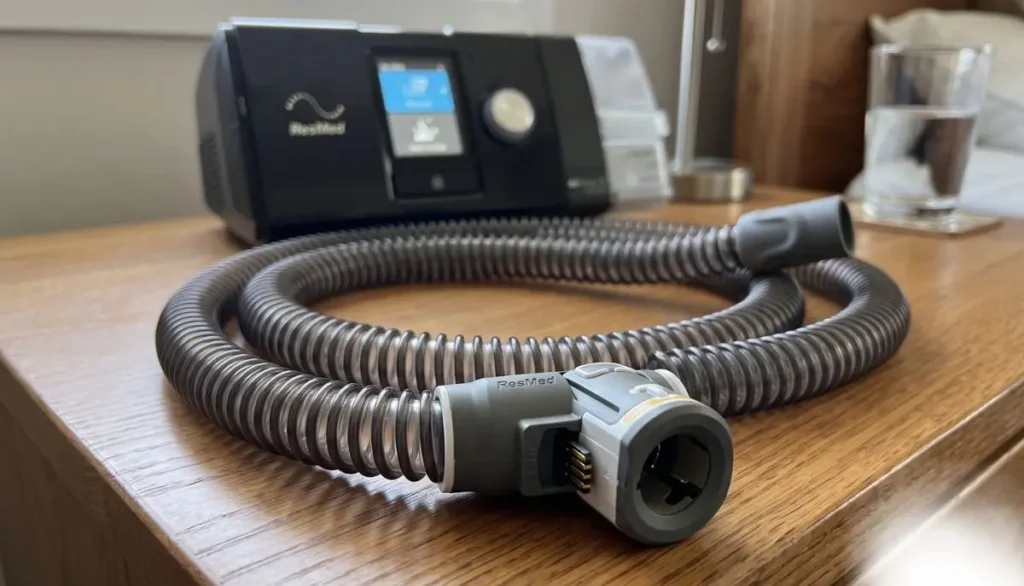
ResMed lists the standard ClimateLineAir tubing at approximately 6 feet 6 inches (2 meters) in length, with a 15 mm inner diameter.
This is different from standard, non-heated CPAP tubing. A conventional tube simply carries air from the CPAP machine to the mask. ClimateLineAir adds temperature control to help maintain the conditions of the humidified airflow.
In simple words
Think of the tube as the final part of the humidification system.
Your AirSense 10 humidifier adds moisture to the air. The heated ClimateLineAir tube then helps keep that warm, humidified air at a more consistent temperature while it travels toward your mask.
That can be especially useful if you notice:
- Water droplets inside your CPAP tubing
- Moisture collecting in your mask
- Air becoming uncomfortably cool
- Dryness despite using humidification
- Condensation during colder nights
Why Does CPAP Tubing Need to Be Heated?
It is natural to wonder why a CPAP tube needs heating in the first place.
The AirSense 10 HumidAir humidifier adds moisture to the pressurized air. As that air travels through tubing, the surrounding room temperature can affect it.
If warm, humidified air moves through a cooler tube, some of the moisture can condense into water droplets.
This is commonly called rainout.
You might notice:
- Water inside the tube
- A damp CPAP mask
- Droplets reaching your face
- Gurgling sounds
- Water collecting around the mask connection
ResMed explains that ClimateLineAir is designed to maintain the temperature of humidified air as it passes through the tube, helping reduce condensation.
The goal isn’t simply to make the tubing warm. The larger goal is to help create a more consistent therapy environment.
How ClimateLineAir Works With AirSense 10
The AirSense 10 can work with several types of tubing, including heated and non-heated options. When ClimateLineAir is connected with the HumidAir humidifier, the system can use ResMed’s Climate Control technology.
The ClimateLineAir tube includes a temperature sensor. The system uses information from the tube to help manage temperature during therapy. ResMed describes the tube as having a built-in sensor that supports temperature control at the mask.
Climate Control Auto
Climate Control Auto is designed to automatically balance temperature and humidity for comfortable therapy.
For many users, this is the easiest option because it minimizes the need to adjust individual settings.
Climate Control Manual
Manual mode gives users more control over temperature and humidity.
This can be useful when environmental conditions or personal comfort preferences change.
For example, if condensation continues despite using ClimateLineAir, ResMed recommends using Climate Control Manual and increasing the tube temperature. If the air becomes too warm and condensation continues, reducing humidity may help.
Always make changes gradually, and follow the instructions provided with your device.
ClimateLineAir vs. Standard CPAP Tubing
One of the most common questions is whether heated tubing is actually necessary.
The answer depends on your equipment and comfort needs.
| Feature | ClimateLineAir Heated Tubing | Standard CPAP Tubing |
| Heated | Yes | No |
| Temperature sensor | Yes | No |
| Designed for Climate Control | Yes | No |
| Helps manage condensation | Yes | Less direct control |
| Designed for AirSense 10 | Yes | Some standard tubes are compatible |
| Humidification support | Works with HumidAir | Can carry humidified air |
| Temperature adjustment | Supported through Climate Control | Not available through the tube |
The heated tube is not simply a replacement for ordinary tubing with a heating element added. It is part of the AirSense 10 Climate Control system.
Key Features of ClimateLineAir Heated Tubing
1. Designed for ResMed Air10 Devices
ClimateLineAir tubing is designed for compatible ResMed Air10 devices, including AirSense 10 and AirCurve 10 machines. It is not intended for AirSense 11 devices. ResMed specifically separates Air10 ClimateLineAir tubing from ClimateLineAir 11 tubing.
This is important when ordering a replacement.
If you own an AirSense 10, make sure the replacement tubing is intended for the Air10 platform.
2. Helps Maintain Air Temperature
The heated tube helps maintain the temperature of humidified air as it travels toward the mask.
This can be particularly helpful when the bedroom is cool.
Instead of warm humidified air cooling significantly as it moves through a conventional tube, ClimateLineAir is designed to help maintain a more consistent temperature.
3. Helps Reduce CPAP Rainout
Rainout is one of the most frustrating problems associated with CPAP humidification.
ClimateLineAir is designed to help prevent humidified air from cooling enough to create excessive condensation inside the tube.
It may not eliminate every possible condensation problem, because room temperature, humidity, CPAP settings, mask design, and sleeping environment can all affect condensation.
4. Supports Climate Control
ClimateLineAir is a key component of the Climate Control system when used with compatible AirSense 10 equipment and HumidAir.
The combination allows the machine to manage temperature and humidity more effectively.
5. Slim and Flexible Design
ClimateLineAir uses a relatively slim 15 mm internal diameter design. ResMed describes its heated tubing as slim and flexible, with features intended to improve comfort and reduce mask drag.
That flexibility can matter when you change sleeping positions during the night.
ClimateLineAir Heated Tubing Specifications
Here are some important specifications for the AirSense 10 ClimateLineAir tube:
- Product: ClimateLineAir heated tubing
- Compatible platform: ResMed Air10
- AirSense compatibility: AirSense 10
- Length: approximately 6 feet 6 inches / 2 meters
- Inner diameter: 15 mm
- Construction: flexible plastic and electrical components
- Temperature sensor: built into the tubing
- Use: compatible with the AirSense 10 Climate Control system when used with the appropriate HumidAir setup
ResMed’s documentation lists a heated-tubing temperature cut-out of 106°F (41°C) or lower.
Specifications can vary by product version and region, so it is always a good idea to check the manufacturer’s current documentation before purchasing a replacement.
Is ClimateLineAir Compatible With AirSense 10?
Yes.
This is one of the main reasons people search for ClimateLineAir heated tubing for AirSense 10 CPAP.
ResMed identifies ClimateLineAir as compatible with AirSense 10 devices. Its official support documentation also states that ClimateLineAir is part of the Climate Control solution for AirSense 10 and AirCurve 10 devices.
However, compatibility should always be checked before ordering.
Important distinction
ClimateLineAir for AirSense 10 is not the same as ClimateLineAir 11 for AirSense 11.
AirSense 10 uses the Air10 version.
AirSense 11 uses the Air11 version.
The connectors and system designs are different, so do not assume that tubing for one generation will work with the other.
How to Connect ClimateLineAir to an AirSense 10
Connecting the tube is straightforward when using the correct equipment.
Step 1: Position the AirSense 10
Place your AirSense 10 on a stable surface near your bed.
If you are using the HumidAir humidifier, make sure it is properly installed.
Step 2: Locate the air outlet
The air tubing connects to the air outlet on the device.
Step 3: Align the connector
Hold the tubing by its cuff and line up the connector with the machine’s air outlet.
Step 4: Push it into place
Push the connector into the outlet until it is properly seated.
ResMed’s ClimateLineAir user guide describes aligning the tubing connector with the device port and pushing it into position until it clicks into place.
Step 5: Connect the mask
Attach the other end of the tubing to your compatible CPAP mask.
Step 6: Check the tubing
Before starting therapy, make sure the tubing is not twisted, sharply bent, or positioned where it could become wrapped around your head or neck.
ResMed specifically warns users to arrange the tubing so that it does not twist around the head or neck.
How Do You Know ClimateLineAir Is Connected?
When the AirSense 10 recognizes the heated tubing, the device can display a ClimateLineAir connection message during setup.
If your machine does not appear to recognize the tube:
- Stop therapy.
- Check the tube connection at the machine.
- Disconnect and reconnect it firmly.
- Inspect the connector for visible damage.
- Make sure you have the correct AirSense 10 ClimateLineAir tube.
- Restart the device.
- Consult the AirSense 10 user guide or your equipment provider if the problem continues.
Do not attempt to repair damaged electrical components inside the tubing.
How to Use Climate Control With AirSense 10
The Climate Control system is designed to make humidification easier.
When ClimateLineAir is connected, the AirSense 10 can use Climate Control Auto or Manual settings depending on your equipment configuration.
If the air feels too dry
ResMed recommends increasing humidity when you experience a dry nose or mouth.
If you notice water in the mask
Excess humidity can contribute to condensation.
ResMed recommends lowering humidity when moisture appears in the mask.
If you have condensation in the tubing
With ClimateLineAir, Climate Control Manual mode can be used to adjust tube temperature. ResMed recommends increasing tube temperature when condensation remains a problem; if the air becomes too warm and condensation continues, humidity may need to be reduced.
Small adjustments are usually better than making large changes all at once.
What Is CPAP Rainout?
CPAP rainout happens when humidified air cools and moisture condenses into water droplets.
Imagine breathing through a warm, humidified stream of air while the tubing sits in a cooler bedroom.
As the air cools, it may no longer hold the same amount of moisture. That moisture can become water inside the tube.
You might hear:
“Gurgle… gurgle…”
Or wake up and find tiny droplets inside your mask.
That is the type of problem ClimateLineAir is designed to help reduce.
ResMed explains that heated tubing helps maintain the temperature of humidified air as it travels toward the mask, reducing the likelihood of condensation.
Does ClimateLineAir Completely Prevent Rainout?
Not necessarily.
ClimateLineAir is designed to help reduce condensation, but no tubing system can guarantee that condensation will never occur.
Factors that can affect rainout include:
- Bedroom temperature
- Bedroom humidity
- Humidifier setting
- Tube temperature
- Mask type
- Tube position
- Individual comfort preferences
- Changes in weather
If you continue experiencing condensation, use the AirSense 10 Climate Control settings according to the manufacturer’s guidance.
How to Clean ClimateLineAir Heated Tubing
Proper cleaning is an important part of maintaining CPAP equipment.
ResMed’s product information recommends weekly cleaning of ClimateLineAir tubing using warm water and mild detergent. The tube should then be rinsed thoroughly and allowed to dry away from direct sunlight and heat.
Simple cleaning routine
- Disconnect the tube from the CPAP machine.
- Disconnect the tube from the mask.
- Wash the tubing in warm water with mild detergent.
- Rinse thoroughly.
- Allow it to air-dry.
- Keep it away from direct sunlight and heat while drying.
- Inspect it before reconnecting.
Avoid
- Dishwashers
- Washing machines
- Strong cleaning chemicals
- Bleach unless specifically directed by the manufacturer
- Excessive heat
- Pulling forcefully on the electrical connector
ResMed specifically advises against washing the tubing in a dishwasher or washing machine.
When Should You Replace ClimateLineAir Tubing?
There isn’t one universal replacement date that applies to every user.
Instead, inspect the tubing regularly.
Replace the tube if you notice:
- Cracks
- Holes
- Tears
- Visible damage
- Damaged connectors
- Persistent problems with the tubing
- Signs that the heated function is no longer operating correctly
ResMed advises regularly checking the tube for damage and replacing it if holes, tears, or cracks are found.
A damaged tube can affect the integrity of your CPAP system.
Signs Your ClimateLineAir Tube May Need Attention
Sometimes the tube does not look obviously damaged, but your therapy experience changes.
You may notice:
More condensation than usual
If rainout suddenly becomes a regular problem, check the tube and Climate Control settings.
The tubing feels different
Cracks, stiffness, unusual wear, or damaged cuffs are reasons to inspect the tube carefully.
Your AirSense 10 does not recognize the tubing
Check the electrical connector and connection point.
Air leakage
Listen for unusual hissing and inspect the tubing for small holes or splits.
Unusual heating behavior
If you suspect the heated function is not working correctly, stop using the damaged tube and contact your CPAP equipment provider or ResMed support.
Do not try to open or electrically repair the tubing yourself.
ClimateLineAir Heated Tubing and Dry Air
Some CPAP users assume that a heated tube is designed only to prevent rainout.
It does more than that.
ClimateLineAir works together with the humidifier and Climate Control system to help maintain comfortable temperature and humidity conditions during therapy. ResMed notes that humidification can help with discomfort such as dry nose, throat, and mouth.
However, heated tubing should not be considered a medical treatment for every cause of dryness.
If you regularly experience severe dryness, nasal blockage, discomfort, or other persistent symptoms, discuss them with your healthcare professional or CPAP provider.
Who May Benefit From ClimateLineAir?
ClimateLineAir may be particularly useful for AirSense 10 users who:
- Use the HumidAir humidifier
- Experience CPAP rainout
- Sleep in a cool bedroom
- Prefer warm humidified airflow
- Want to use Climate Control
- Experience discomfort from cold airflow
- Frequently find moisture inside standard tubing
Not every AirSense 10 user necessarily needs heated tubing.
If standard tubing is comfortable and condensation is not an issue, you may not notice a major difference.
The decision can depend on your equipment configuration and personal comfort.
ClimateLineAir in Cold Weather
Cold bedrooms can make CPAP humidification more challenging.
The air leaving the humidifier may be warm and humid, but the tubing can be exposed to much cooler room air.
That temperature difference can encourage condensation.
ResMed recommends Climate Control with ClimateLineAir as a way to help manage temperature and humidity during changing room conditions.
For people who live in colder climates or keep their bedroom cool at night, heated tubing can therefore become an especially useful comfort accessory.
Can You Use ClimateLineAir Without the HumidAir Humidifier?
ClimateLineAir is designed as part of ResMed’s Climate Control solution and is intended to be used with the appropriate compatible humidification setup.
ResMed’s user guide specifically describes ClimateLineAir used with the HumidAir humidifier to enable Climate Control.
If you want to operate your AirSense 10 without the humidifier, consult the AirSense 10 documentation and your equipment provider for the appropriate tubing configuration.
ClimateLineAir vs. ClimateLineAir Oxy
Another common source of confusion is the difference between standard ClimateLineAir and ClimateLineAir Oxy.
ClimateLineAir
The standard ClimateLineAir is designed for compatible Air10 devices.
ClimateLineAir Oxy
ClimateLineAir Oxy includes a built-in oxygen connector for users who require supplemental oxygen. ResMed lists ClimateLineAir Oxy as a 19 mm diameter tube, compared with the 15 mm inner diameter of standard ClimateLineAir.
If you do not require supplemental oxygen, don’t automatically choose the Oxy version simply because it has a similar name.
Always match the tubing to your specific equipment configuration.
Is ClimateLineAir the Same as ClimateLineAir 11?
No.
This distinction is especially important when shopping for replacement tubing.
AirSense 10
Use the ClimateLineAir tubing designed for the Air10 platform.
AirSense 11
Use the ClimateLineAir 11 tubing designed for the Air11 platform.
ResMed’s current product information specifically identifies ClimateLineAir for AirSense 10 and ClimateLineAir 11 for AirSense 11.
If your CPAP machine says AirSense 10, look for Air10-compatible ClimateLineAir tubing.
How Long Is ClimateLineAir Tubing for AirSense 10?
The standard ClimateLineAir tube is approximately 6 feet 6 inches (2 meters) long.
ResMed’s AirSense 10 documentation lists:
- Length: 2 m / 6’6″
- Inner diameter: 15 mm
This length provides enough reach for typical bedside CPAP setups while maintaining a relatively slim design.
Is ClimateLineAir Tubing Flexible?
Yes.
The ClimateLineAir is designed using flexible materials and electrical components. ResMed describes the tubing as slim and flexible, with the design intended to support sleeping comfort and reduce mask drag.
Still, avoid sharply folding or crushing the tubing.
A smooth path from the CPAP machine to your mask is preferable.
Tips for a More Comfortable AirSense 10 Setup
A heated tube is only one part of a comfortable CPAP setup.
Keep the CPAP machine on a stable surface
A bedside table or suitable CPAP stand can help keep the tubing path organized.
Avoid unnecessary bends
Sharp bends can interfere with airflow.
Keep the tube away from your neck
Arrange it so it does not wrap around your head or neck.
Keep the humidifier at the correct level
Follow the AirSense 10 instructions for your humidifier.
Make small setting changes
If you need to adjust humidity or temperature, small changes can make it easier to find a comfortable setting.
Inspect the tube regularly
A few seconds of inspection can help identify cracks, tears, or connector damage before they become bigger problems.
Buying ClimateLineAir Heated Tubing for AirSense 10
When purchasing replacement tubing, don’t choose based only on the words “heated CPAP tube.”
Check the following:
1. Machine compatibility
Confirm that the tubing is designed for ResMed AirSense 10/Air10 devices.
2. Heated tubing type
Make sure it is actually ClimateLineAir heated tubing if you need Climate Control compatibility.
3. Connector compatibility
The connector must match the AirSense 10 device.
4. Tube length
Standard ClimateLineAir tubing is approximately 2 meters long.
5. Oxygen requirements
If supplemental oxygen is part of your therapy, confirm whether you need the ClimateLineAir Oxy version.
6. Condition
For replacement tubing, choose a new, undamaged tube from a reputable medical equipment supplier.
ResMed currently lists ClimateLineAir heated tubing for Air10 devices as a replacement accessory and identifies it as compatible with AirSense 10 and AirCurve 10 machines.
Why Buy CPAP Supplies From a Medical Supply Company?
CPAP equipment is part of an ongoing healthcare routine.
A medical supply company can help customers identify compatible replacement parts rather than simply choosing an item based on a product photo.
At Alfa Healthcare Supply Inc., customers can explore CPAP and DME supplies through a medical equipment supplier serving customers in New York and surrounding communities.
For a product such as ClimateLineAir, compatibility is particularly important because AirSense 10 and AirSense 11 use different tubing generations.
Before ordering, it is helpful to have your exact CPAP model available.
ClimateLineAir AirSense 10 Troubleshooting Checklist
If your heated tubing is not working as expected, go through this simple checklist:
Tube not recognized?
→ Check the connection at the machine.
Water in the tube?
→ Check Climate Control and humidity settings.
Water in the mask?
→ Consider reducing humidity.
Air feels too warm?
→ Review temperature settings.
Air feels too cold?
→ Check the tube temperature setting if using Manual mode.
Tube has cracks?
→ Replace it.
Connector looks damaged?
→ Stop using the damaged tubing and contact your equipment supplier.
Still having problems?
→ Consult your AirSense 10 user guide, healthcare professional, equipment provider, or ResMed support.
A Simple Way to Think About ClimateLineAir
CPAP comfort can sometimes feel like solving a small puzzle.
You have the machine.
You have the humidifier.
You have the tubing.
You have the mask.
And then there are the settings.
If the air is too dry, you may notice irritation.
If there is too much moisture, you may notice water.
If the room is cold, the air inside the tubing can cool as it travels toward the mask.
ClimateLineAir is designed to help bring these pieces together.
It isn’t a replacement for your CPAP machine or humidifier. Instead, it acts as an important connection between the humidification system and your mask.
Final Thoughts
The ClimateLineAir heated tubing for AirSense 10 CPAP is more than an ordinary replacement tube. It is a purpose-built accessory designed to work with ResMed AirSense 10 and AirCurve 10 systems and the Climate Control humidification system.
Its heated design helps maintain the temperature of humidified air as it travels toward your mask. This can help reduce condensation, support comfortable humidification, and make nightly CPAP therapy more pleasant for users who experience cold airflow or rainout.
The most important thing when replacing your tubing is compatibility. If you have an AirSense 10, look specifically for ClimateLineAir tubing made for the Air10 platform. Do not confuse it with ClimateLineAir 11 tubing for the AirSense 11.
Regular cleaning and inspection also matter. Wash the tube as recommended, allow it to dry properly, and replace it if you find cracks, holes, tears, or other damage.
For CPAP users, comfort often comes down to small improvements. The right tubing may be one of those small changes that makes your nightly routine feel simpler and more comfortable.
About Alfa Healthcare Supply Inc.
Alfa Healthcare Supply Inc. is a medical equipment and DME supplier serving customers with a range of home medical equipment and healthcare supplies. For CPAP replacement parts, customers should verify their exact machine model before ordering to ensure the accessory is appropriate for their equipment.
Visit Alfa Healthcare Supply Inc.
Frequently Asked Questions About ClimateLineAir Heated Tubing for AirSense 10 CPAP
1. What is ClimateLineAir heated tubing for AirSense 10 CPAP?
ClimateLineAir is heated CPAP tubing designed for compatible ResMed Air10 devices, including AirSense 10. It helps maintain the temperature of humidified air traveling from the machine to the mask and works with the Climate Control system.
2. Does ClimateLineAir fit AirSense 10?
Yes. ResMed identifies ClimateLineAir as compatible with AirSense 10 devices.
3. Is ClimateLineAir compatible with AirSense 11?
The AirSense 11 uses ClimateLineAir 11 tubing. ClimateLineAir for Air10 is designed for AirSense 10 and should not be treated as interchangeable with Air11 tubing.
4. Does heated CPAP tubing help prevent rainout?
It is designed to help reduce condensation by maintaining the temperature of humidified air as it moves through the tube.
5. How long is AirSense 10 ClimateLineAir tubing?
The standard ClimateLineAir tube is approximately 6 feet 6 inches, or 2 meters, long.
6. What is the inner diameter of ClimateLineAir?
The standard ClimateLineAir has a 15 mm inner diameter.
7. How often should I clean ClimateLineAir?
ResMed’s product information recommends weekly cleaning with warm water and mild detergent, followed by thorough rinsing and air drying away from direct sunlight and heat.
8. Can I put ClimateLineAir in a dishwasher?
No. ResMed specifically advises against cleaning the tubing in a dishwasher or washing machine.
9. What should I do if there is water inside my CPAP tube?
Check your Climate Control settings and room conditions. ResMed recommends using Climate Control Manual and increasing tube temperature if condensation continues; if the air becomes too warm and condensation remains, humidity may need to be reduced.
10. What if my ClimateLineAir tube has a crack?
Replace damaged tubing. ResMed recommends replacing the tube when holes, tears, or cracks are found.
11. Does ClimateLineAir make the air hot?
The system is designed to provide a comfortable temperature rather than simply making the air as hot as possible. The tube’s temperature sensor works with Climate Control to manage temperature.
12. Is ClimateLineAir the same as regular CPAP tubing?
No. ClimateLineAir contains electrical components and a temperature sensor and is designed to work with ResMed’s Climate Control system.
13. Can I use ClimateLineAir with an AirCurve 10?
Yes. ResMed identifies ClimateLineAir as compatible with AirCurve 10 as well as AirSense 10 devices.
14. Does ClimateLineAir Oxy have the same design?
ClimateLineAir Oxy is a related heated tube with a built-in oxygen connector for supplemental oxygen. It has different specifications, including a 19 mm diameter.
15. Do I need ClimateLineAir if I don’t have rainout?
Not necessarily. Some users are comfortable with standard tubing. ClimateLineAir may be useful if you want heated tubing, Climate Control functionality, or better control of condensation and humidified airflow.
Medical note: This article is for general product and equipment information and does not replace instructions from your healthcare professional, CPAP equipment provider, or ResMed documentation.
Using a CPAP or bilevel machine every night can become a comfortable part of your routine when your equipment is set up correctly. While people often focus on the mask or the machine itself, one small component deserves more attention than it usually gets: the air tubing.
For users of ResMed AirSense 10 CPAP and AirCurve 10 bilevel machines, ClimateLineAir heated tubing is designed to do more than simply move air from the machine to the mask. It helps maintain the temperature of humidified air as it travels through the tubing and can help reduce condensation, commonly called CPAP rainout.
If you have ever woken up to water inside your CPAP tube, heard a gurgling sound during the night, or felt that the airflow was too cold or uncomfortable, you may already understand why tubing matters.
The ClimateLineAir heated tubing for AirSense 10 CPAP & AirCurve 10 bilevel machines is part of ResMed’s Climate Control system. When used with compatible equipment, it can help create a more controlled and comfortable humidification experience.
At Alfa Healthcare Supply Inc., we understand that replacement CPAP supplies are part of everyday home healthcare. A tube may look like a simple accessory, but choosing the correct model can make a difference in how your entire PAP setup works.
This guide explains what ClimateLineAir heated tubing is, how it works, compatibility with AirSense 10 and AirCurve 10 machines, installation, cleaning, common problems, replacement signs, and what to check before purchasing.
What is ClimateLineAir Heated Tubing?
ClimateLineAir is a heated air tube designed for compatible ResMed Air10 therapy devices.
Unlike ordinary CPAP tubing, which simply carries air, ClimateLineAir has heating technology that helps maintain the temperature of humidified air as it travels from the machine toward the mask.
ResMed describes ClimateLineAir as part of its Climate Control solution. When paired with the appropriate HumidAir humidifier, the system is designed to help maintain temperature and humidity for a more comfortable therapy experience.
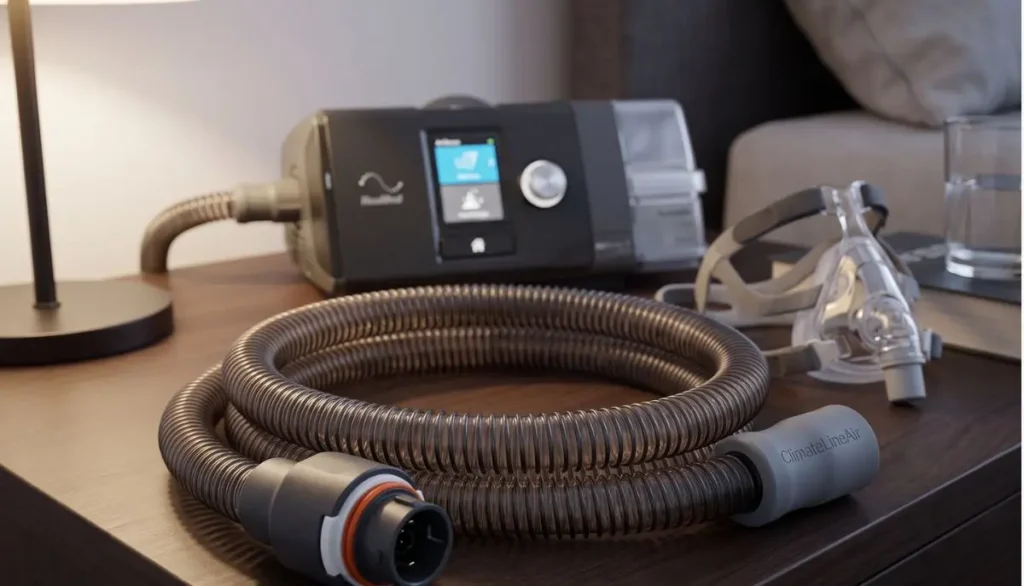
In simple terms, the process looks like this:
CPAP or bilevel machine → humidifier → heated tubing → mask → user
The humidifier adds moisture to the airflow, while the heated tube helps maintain the temperature as that air travels toward your mask.
This can be particularly helpful in a cool bedroom, where humidified air may lose heat as it moves through standard tubing.
Why Does CPAP Tubing Need to Be Heated?
At first, heated tubing can seem unnecessary.
After all, isn’t the tubing simply a hose?
It does carry air, but temperature can affect what happens to humidified air inside that hose.
When warm, humidified air travels through a cooler tube or cold bedroom environment, the air can cool. As the air cools, moisture may condense inside the tubing.
That condensation is often called CPAP rainout.
You might notice:
- Water droplets inside the tubing
- A damp CPAP mask
- Gurgling or bubbling sounds
- Water reaching your face
- Moisture around the mask
- Interrupted or uncomfortable sleep
ResMed designed ClimateLineAir heated tubing to help maintain the temperature of humidified air as it travels through the tube, helping reduce condensation.
The goal is not to make the air excessively hot.
Instead, the heated tube is designed to help provide a more consistent and comfortable airflow temperature.
ClimateLineAir Heated Tubing for AirSense 10 and AirCurve 10
One of the most important things to understand before ordering replacement CPAP tubing is machine compatibility.
The ClimateLineAir heated tube for Air10 devices is designed for compatible ResMed AirSense 10 and AirCurve 10 machines.
ResMed specifically lists ClimateLineAir heated tubing for AirSense 10 and AirCurve 10 systems.
This includes compatible AirSense 10 models such as:
- AirSense 10 AutoSet
- AirSense 10 AutoSet for Her
- AirSense 10 Elite
Compatible AirCurve 10 systems include models such as:
- AirCurve 10 VAuto
- AirCurve 10 S
- AirCurve 10 ASV
- Other compatible AirCurve 10 configurations
ResMed’s product documentation also lists AirSense 10 and several AirCurve 10 configurations with ClimateLineAir tubing.
AirSense 10 vs. AirSense 11
This is an important distinction.
AirSense 10 and AirSense 11 do not use the same ClimateLineAir version.
For AirSense 10 and AirCurve 10, look for the Air10-compatible ClimateLineAir tubing.
For AirSense 11 and AirCurve 11, the appropriate product is ClimateLineAir 11.
| ResMed Machine | Compatible ClimateLineAir Family |
| AirSense 10 | ClimateLineAir for Air10 |
| AirCurve 10 | ClimateLineAir for Air10 |
| AirSense 11 | ClimateLineAir 11 |
| AirCurve 11 | ClimateLineAir 11 |
ResMed’s current documentation distinguishes the Air10 and Air11 tubing families.
Always check the exact model printed on your machine before purchasing replacement tubing.
How Does ClimateLineAir Heated Tubing Work?
The basic concept is easy to understand.
Your CPAP or bilevel machine creates the prescribed airflow. If a compatible humidifier is being used, moisture is added to that airflow. The heated tube then helps maintain the temperature of the humidified air as it travels toward the mask.
This is especially useful because the air can cool while moving through the tubing.
A simplified example:
Without heated tubing
Warm humidified air leaves the machine → travels through a cool tube → air temperature drops → condensation may develop.
With ClimateLineAir
Warm humidified air leaves the machine → heated tubing helps maintain temperature → air reaches the mask with less temperature change → condensation may be reduced.
This is why ClimateLineAir should not be thought of as simply a more advanced hose.
It is part of a larger humidification and temperature-control system.
What Is CPAP Rainout?
CPAP rainout is condensation that forms when humidified air cools inside the CPAP tubing or mask.
Imagine taking a cold drink outside on a warm day. Moisture can form on the outside of the glass because of temperature differences.
A similar principle can occur inside CPAP tubing.
Humidified air contains moisture. When that air cools, some of the moisture can condense into water droplets.
For a CPAP user, this may result in:
- Water inside the tube
- A wet mask
- Gurgling noises
- Water splashing toward the face
- An uncomfortable sleeping environment
ResMed identifies ClimateLineAir heated tubing as a way to help manage condensation and rainout when used with compatible Air10 equipment.
How ClimateLineAir Helps Reduce Condensation
ClimateLineAir uses heated tubing to help keep humidified airflow at a more consistent temperature.
This matters because warmer air can hold more moisture than cooler air.
When humidified air stays warmer while traveling through the tubing, there is less opportunity for condensation to form because of temperature loss.
ResMed describes ClimateLineAir as being designed to maintain the temperature of humidified air as it passes through the tube.
However, heated tubing does not mean condensation is impossible under every condition.
Your bedroom temperature, humidity level, tube temperature, and other therapy settings can affect condensation.
If you continue to experience rainout, adjusting the Climate Control settings may help.
ClimateLineAir and the AirSense 10 Humidifier
The AirSense 10 can be used with the HumidAir heated humidifier.
When compatible ClimateLineAir tubing is connected, the tubing becomes part of the overall Climate Control system.
ResMed explains that the AirSense 10 can use ClimateLineAir with its humidification system to help manage temperature and humidity.
This can be useful for people who need humidification but also experience condensation.
Without heated tubing, increasing humidity may sometimes make rainout worse because more moisture is being introduced into the airflow.
With ClimateLineAir, the system is designed to better manage the relationship between humidity and temperature.
ClimateLineAir With AirCurve 10 Bilevel Machines
ClimateLineAir is not limited to traditional CPAP therapy.
It is also designed for compatible AirCurve 10 bilevel machines.
AirCurve 10 systems provide bilevel therapy, and ResMed lists configurations of AirCurve 10 devices with ClimateLineAir tubing.
For users of AirCurve 10 VAuto, AirCurve 10 S, AirCurve 10 ASV, and other compatible configurations, the correct ClimateLineAir tubing can become an important part of the humidification setup.
The same basic principle applies:
The machine provides therapy airflow → the humidifier adds moisture → ClimateLineAir helps maintain temperature → airflow reaches the mask.
Because bilevel therapy can involve different pressure settings and configurations, always make sure that the tubing is the correct product for your specific device.
Key Features of ClimateLineAir Heated Tubing
The exact product specifications should always be checked against the current manufacturer’s information, but ResMed’s Air10 ClimateLineAir product information identifies several useful characteristics.
Heated airflow
The tubing is designed to help maintain the temperature of humidified air.
Climate Control compatibility
When used with compatible ResMed equipment and humidification, ClimateLineAir works as part of the Climate Control system.
Helps reduce rainout
Maintaining the temperature of humidified air can help reduce condensation inside the tubing.
Flexible design
The tubing is designed to provide flexibility around the bed while helping reduce unnecessary pulling on the mask.
Approximately 6.5 feet long
ResMed lists the Air10 ClimateLineAir heated tube at approximately 6.5 feet.
15 mm inner diameter
ResMed lists the Air10 ClimateLineAir tubing with a 15 mm inner diameter and 22 mm cuffs/connectors.
ClimateLineAir Heated Tubing vs. Standard CPAP Tubing
It is helpful to understand the difference before deciding which replacement tube you need.
Standard CPAP tubing
Standard tubing is designed primarily to transport air between the machine and mask.
It does not actively heat the airflow.
It can be appropriate for many PAP setups.
ClimateLineAir heated tubing
ClimateLineAir adds temperature-control functionality.
It is designed to help maintain the temperature of humidified air and works with compatible ResMed Climate Control systems.
Simple comparison
| Feature | Standard Tubing | ClimateLineAir |
| Carries airflow | Yes | Yes |
| Heated | No | Yes |
| Designed for Climate Control | No | Yes, with compatible equipment |
| Helps manage condensation | Limited | Designed to help reduce rainout |
| Compatible with AirSense 10 | Depends on tubing | Yes, compatible Air10 version |
| Compatible with AirCurve 10 | Depends on tubing | Yes, compatible Air10 version |
Neither type is automatically right for every person.
The important thing is matching the tubing to your machine and therapy setup.
Do You Need Heated Tubing for CPAP?
Not everyone needs heated tubing.
Some people use standard tubing without experiencing condensation or temperature discomfort.
However, heated tubing may be worth considering if you:
- Use a humidifier
- Experience water inside your CPAP tubing
- Wake up with moisture in your mask
- Sleep in a cold room
- Feel that the airflow is too cool
- Want to use compatible Climate Control features
- Need a replacement for an existing ClimateLineAir tube
The decision should be based on your equipment and comfort needs.
If your healthcare provider or DME supplier has recommended a specific tubing configuration, follow that recommendation.
How to Install ClimateLineAir Tubing on an AirSense 10
Installing the tube is generally straightforward, but you should always follow the instructions supplied with your specific equipment.
A simple setup process is:
Step 1: Turn off the machine
Before disconnecting tubing, make sure the therapy device is not actively delivering therapy.
Step 2: Locate the air outlet
The air outlet is located at the back of the compatible ResMed device.
Step 3: Connect the ClimateLineAir tube
Align the tubing connector with the machine’s air outlet.
Step 4: Push the connector into place
Make sure the connection is secure.
Step 5: Connect your mask
Attach the other end of the tubing to your CPAP mask or mask assembly.
Step 6: Check the tubing
Make sure the tube is not twisted, pinched, crushed, or stretched.
ResMed’s ClimateLineAir instructions emphasize properly connecting the tubing and arranging it so that it does not wrap around the head or neck.
How to Position CPAP Tubing at Night
Correct tubing placement can make your setup feel much more comfortable.
Try to position the tube so it can move naturally when you turn during sleep.
Avoid placing heavy objects on the tubing.
Do not sharply bend or crush it.
You can route the tube:
- Along the side of the bed
- Above the headboard
- Beside the pillow
- Through a suitable CPAP hose-management system
The goal is simple:
The tubing should provide enough movement without pulling on your mask.
If the tube repeatedly pulls your mask sideways, changing its position may improve comfort.
ClimateLineAir Temperature Settings
Your ResMed machine may allow you to adjust temperature and humidity settings depending on the configuration.
ResMed explains that Climate Control can be used in automatic or manual modes on compatible Air10 equipment.
If the air feels too cool, the temperature may need adjustment.
If you are experiencing excessive moisture, humidity or temperature settings may need to be changed.
A useful approach is to make one adjustment at a time rather than changing several settings at once.
If you experience dryness
Dry nose or mouth may indicate that the humidity level needs adjustment, although there can be other causes.
If you experience water in the mask
Condensation may be occurring.
ResMed recommends using the Climate Control settings appropriately and, when needed, adjusting tube temperature or humidity to address condensation.
If you are unsure about your settings, contact your healthcare provider or equipment supplier.
How to Clean ClimateLineAir Heated Tubing
Regular cleaning is an important part of CPAP equipment care.
ResMed’s product information recommends washing the tubing in warm water with mild detergent, rinsing it thoroughly, and allowing it to dry away from direct sunlight and heat.
Simple cleaning routine
- Disconnect the tubing from the machine and mask.
- Wash the tubing using warm water and mild detergent.
- Rinse thoroughly.
- Allow the tubing to air dry.
- Keep it away from direct sunlight and excessive heat.
- Reconnect it after it is completely dry.
Avoid harsh cleaning methods
Do not place the heated tubing in a dishwasher or washing machine.
Also avoid exposing the electrical connector to unnecessary moisture.
Follow the cleaning instructions provided by ResMed for your particular equipment.
How Often Should ClimateLineAir Tubing Be Checked?
You do not need to wait until the tube completely stops working before inspecting it.
A quick visual check can become part of your regular CPAP routine.
Look for:
- Small cracks
- Holes
- Tears
- Damaged cuffs
- Loose connectors
- Unusual wear
- Excessive moisture
- Changes in flexibility
ResMed recommends regularly checking air tubing and replacing it if there are holes, tears, or cracks.
A damaged tube can interfere with the intended airflow and should not simply be patched with tape.
Signs You May Need Replacement CPAP Tubing
Your ClimateLineAir tube may need replacement if you notice visible deterioration or repeated problems.
Common warning signs include:
1. Cracks or holes
Even a small opening can affect the tubing.
2. Damaged connectors
The ends should connect securely to the machine and mask.
3. Persistent air leaks
If the tubing is damaged, air may escape.
4. Physical deterioration
If the tube has become unusually brittle, worn, or damaged, replacement may be appropriate.
5. Electrical or heated-tube problems
If the machine does not recognize the heated tubing or the system is displaying an error, check the connections and consult the manufacturer’s troubleshooting information.
Do not attempt to repair the internal heating components yourself.
What If Your ClimateLineAir Tube Does Not Feel Hot?
This is a common question.
A heated CPAP tube does not necessarily feel very hot to the touch.
The purpose is not to turn the tube into a heating element that feels hot against your hand.
Instead, the system is designed to maintain an appropriate temperature for the airflow.
If your machine recognizes the tubing and the Climate Control features are available, that can be a useful indication that the tubing is connected correctly.
If you believe the tube is not functioning properly:
- Stop therapy.
- Check the connection.
- Inspect the tube for visible damage.
- Confirm that you have the correct tubing for your machine.
- Restart the system.
- Check the device settings.
- Consult the user guide or your DME provider if the problem continues.
Avoid opening or modifying the tube yourself.
Common ClimateLineAir Problems and Simple Checks
Problem: Water inside the tube
Possible causes include excessive humidity, a cold room, or temperature settings.
What to check: Review your humidity and tube-temperature settings.
Problem: Water inside the mask
This can be another sign of condensation.
What to check: Confirm that the heated tubing is connected correctly and review Climate Control settings.
Problem: Air feels too cold
What to check: Review the tube-temperature setting on your compatible ResMed machine.
Problem: Air feels too warm
What to check: Consider reducing the tube temperature according to your device instructions.
Problem: Tube is not recognized
What to check: Turn the machine off and inspect the connector. Confirm that the tubing is designed for your exact ResMed machine.
Problem: Mask is being pulled
What to check: Reposition the tube so that it has enough slack and is not pulling against the mask.
ClimateLineAir Air10 Tubing Dimensions
For users who need replacement tubing, dimensions can help confirm that they are looking at the correct product.
ResMed’s current product information lists the ClimateLineAir heated tubing for Air10 devices as:
- Approximately 6.5 feet long
- 15 mm inner diameter
- 22 mm cuffs/connectors
ResMed’s AirSense 10 documentation similarly identifies ClimateLineAir tubing as approximately 2 meters in length with a 15 mm inner diameter.
Always use the manufacturer’s current specifications when comparing replacement parts.
ClimateLineAir for AirSense 10: What to Check Before Ordering
Buying CPAP tubing online can be easy, but compatibility should come first.
Before ordering, check these details:
1. Machine model
Look carefully at the name of your machine.
Is it AirSense 10 or AirSense 11?
Is it AirCurve 10 or AirCurve 11?
2. Tubing family
For AirSense 10 and AirCurve 10, you need the appropriate Air10-compatible ClimateLineAir tubing.
3. Humidifier
If you are using Climate Control, make sure your humidification setup is compatible.
4. Oxygen requirements
If supplemental oxygen is part of your therapy, verify whether you need a ClimateLineAir Oxy configuration instead of standard ClimateLineAir tubing.
5. Prescription or supplier requirements
ResMed’s U.S. product listing currently identifies ClimateLineAir heated tubing as prescription-required. Requirements can vary by location and supplier, so verify what applies when ordering.
ClimateLineAir Oxy vs. Standard ClimateLineAir
ResMed also offers ClimateLineAir Oxy tubing.
The primary difference is that the Oxy version includes an integrated oxygen connector.
This version may be appropriate for compatible PAP setups involving prescribed supplemental oxygen.
It is important not to select the Oxy version simply because it sounds like an upgraded product.
If you do not use supplemental oxygen, standard ClimateLineAir may be the appropriate tubing for your AirSense 10 or AirCurve 10 setup.
If oxygen is part of your prescribed therapy, ask your healthcare provider or DME supplier which tubing configuration is appropriate.
Why the Correct Tubing Matters
CPAP accessories can look surprisingly similar.
That is one reason people sometimes order the wrong tube.
A ClimateLineAir tube for one ResMed device generation should not automatically be assumed to work with another generation.
For example:
AirSense 10 → Air10 ClimateLineAir
AirCurve 10 → Air10 ClimateLineAir
AirSense 11 → ClimateLineAir 11
AirCurve 11 → ClimateLineAir 11
Checking the model before buying can save time and prevent an unnecessary return.
Buying ClimateLineAir Heated Tubing From Alfa Healthcare Supply Inc.
At Alfa Healthcare Supply Inc., we understand that medical equipment is part of someone’s everyday life.
For a CPAP user, replacing a worn tube is not simply a shopping decision. It is about maintaining a familiar therapy setup.
Alfa Healthcare Supply currently lists ClimateLineAir Heated Tubing for AirSense 10 CPAP & AirCurve 10 BiLevel Machines among its respiratory and COPD/Asthma supplies.
When ordering, having your exact machine model available is helpful.
If you have an AirSense 10 or AirCurve 10, confirm that you are selecting the Air10-compatible ClimateLineAir tubing rather than a ClimateLineAir 11 product intended for newer Air11 devices.
You can visit the Alfa Healthcare Supply website to review current product information and availability.
Why Replacement CPAP Accessories Matter
The CPAP machine gets most of the attention, but your therapy setup includes several components.
Depending on your equipment, these may include:
- CPAP or bilevel machine
- Heated humidifier
- Heated or standard tubing
- CPAP mask
- Mask cushion
- Headgear
- Air filters
- Water chamber
- Other accessories
Each component has a purpose.
A damaged tube, worn cushion, clogged filter, or poorly fitting mask can make your nightly routine less comfortable.
That is why routine equipment inspection is worth making part of your CPAP care routine.
Tips for Getting More Comfortable With ClimateLineAir
A few simple habits can make your setup easier to manage.
Keep the tubing clean
Follow the manufacturer’s cleaning instructions and allow the tube to dry fully.
Avoid sharp bends
A crushed or sharply bent tube can interfere with airflow.
Keep the tube positioned comfortably
Avoid routing it in a way that pulls your mask.
Monitor condensation
If you see water inside the tubing, review your humidity and temperature settings.
Check the tubing regularly
Look for cracks, holes, or damaged connectors.
Confirm compatibility before replacement
Air10 and Air11 tubing are not interchangeable simply because both products use the ClimateLineAir name.
Ask when you are uncertain
Your healthcare provider, respiratory therapist, or DME supplier can help verify equipment compatibility.
Is ClimateLineAir Worth Considering for AirSense 10 Users?
For people who are comfortable with standard tubing and do not experience condensation or temperature-related discomfort, heated tubing may not be necessary.
For others, it can be a useful part of their CPAP setup.
The potential advantages include:
- Better temperature control of humidified airflow
- Reduced condensation
- Less rainout
- A more comfortable humidification experience
- Compatibility with ResMed Climate Control features
The right choice depends on your individual therapy setup.
It is not about choosing the most expensive or most advanced accessory. It is about choosing the correct component for your machine and needs.
A Simple AirSense 10 ClimateLineAir Checklist
Before you order replacement tubing, use this quick checklist:
✓ I have a ResMed AirSense 10 or compatible AirCurve 10 machine.
✓ I confirmed that I need ClimateLineAir tubing for the Air10 platform.
✓ I checked whether I use a HumidAir humidifier.
✓ I inspected my existing tube for damage.
✓ I know whether I need standard ClimateLineAir or an Oxy version.
✓ I have checked current supplier and prescription requirements.
✓ I am purchasing from a reliable medical equipment supplier.
This takes only a few minutes and can help prevent ordering the wrong replacement part.
Final Thoughts
The ClimateLineAir heated tubing for AirSense 10 CPAP & AirCurve 10 bilevel machines may look like a simple accessory, but it plays an important role in a comfortable humidified PAP setup.
Its main purpose is to help maintain the temperature of humidified air as it moves from the machine toward the mask. By helping limit temperature loss, the heated tube can also help reduce condensation and CPAP rainout.
For AirSense 10 and AirCurve 10 users, selecting the correct Air10-compatible ClimateLineAir tubing is important. Do not assume that a ClimateLineAir tube made for AirSense 11 or AirCurve 11 will be the correct replacement.
Before ordering, check your machine model, tubing type, humidifier setup, and whether supplemental oxygen is part of your therapy.
And remember: if something about your CPAP setup does not feel right, you do not have to figure it out alone. Your healthcare provider, respiratory therapist, or DME supplier can help you determine whether the issue is related to tubing, humidification, mask fit, settings, or another part of your equipment.
At Alfa Healthcare Supply Inc., our goal is to make medical supplies easier to understand and easier to access. Whether you need replacement CPAP tubing or other home medical equipment, starting with the exact machine model is one of the simplest ways to find the right accessory.
A comfortable night of PAP therapy is built from many small details. The right tubing is one of them.
Frequently Asked Questions
What is ClimateLineAir heated tubing?
ClimateLineAir is heated CPAP tubing designed for compatible ResMed Air10 devices. It helps maintain the temperature of humidified air as it travels from the machine to the mask.
Is ClimateLineAir heated tubing compatible with AirSense 10?
Yes. ResMed identifies ClimateLineAir heated tubing as compatible with AirSense 10 devices.
Does ClimateLineAir work with AirCurve 10?
Yes. ClimateLineAir tubing is designed for compatible AirCurve 10 devices as well. ResMed’s product documentation lists multiple AirCurve 10 configurations with ClimateLineAir tubing.
Does ClimateLineAir help stop rainout?
It is designed to help reduce condensation by helping maintain the temperature of humidified air as it travels through the tube.
What is rainout in CPAP therapy?
Rainout is condensation that occurs when humidified air cools inside the tubing or mask.
Can ClimateLineAir help with dry air?
ClimateLineAir works with compatible humidification systems to help provide controlled temperature and humidity. If you experience dryness, your humidity settings may need adjustment.
Is ClimateLineAir the same as regular CPAP tubing?
No. ClimateLineAir is heated tubing designed to work with compatible ResMed Climate Control systems.
Can I use ClimateLineAir on AirSense 11?
AirSense 11 uses the ClimateLineAir 11 version rather than the Air10 ClimateLineAir tubing. Always match the tubing to the exact machine generation.
Can AirCurve 11 use Air10 ClimateLineAir tubing?
No. AirCurve 11 belongs to the Air11 platform and requires the appropriate ClimateLineAir 11 tubing.
How long is ClimateLineAir tubing for AirSense 10?
ResMed lists the Air10 ClimateLineAir heated tube at approximately 6.5 feet, with a 15 mm inner diameter.
How often should I clean ClimateLineAir tubing?
Follow the manufacturer’s cleaning instructions. ResMed recommends washing the tubing with warm water and mild detergent, rinsing thoroughly, and allowing it to dry away from direct sunlight and heat.
Can ClimateLineAir tubing go in a dishwasher?
No. ResMed’s product care instructions state that the tubing should not be washed in a dishwasher or washing machine.
How do I know if my ClimateLineAir tube needs replacement?
Look for cracks, holes, tears, damaged connectors, or other visible deterioration. ResMed recommends replacing damaged tubing.
Why is there still water in my CPAP tubing?
Condensation can still occur because of bedroom temperature, humidity, and tube-temperature settings. Check your Climate Control settings and follow the instructions for your specific machine.
Does the ClimateLineAir tube need to feel hot?
No. The purpose is controlled temperature management rather than making the tube feel hot to your hand.
What is ClimateLineAir Oxy?
ClimateLineAir Oxy is a heated tubing option with an integrated oxygen connector for compatible supplemental oxygen setups.
Where can I buy ClimateLineAir tubing for AirSense 10?
Alfa Healthcare Supply Inc. currently lists ClimateLineAir Heated Tubing for AirSense 10 CPAP and AirCurve 10 BiLevel Machines in its respiratory supply selection.
Disclaimer: This article is for general educational purposes and is not a substitute for medical advice or the instructions supplied with your ResMed device. Follow your healthcare provider’s recommendations and the manufacturer’s current user guide for your specific equipment.
ClimateLineAir 11 Heated Tubing Cleaning Instructions
By using a CPAP machine nightly, your machine becomes a part of your routine. Many people clean their mask and humidifier, but it is possible to forget to clean the tubing. The ClimateLineAir 11 heated tubing is particularly crucial as it transports the air from your compatible AirSense 11 device to your mask and also aids maintain the temperature of humidified air.
It is not difficult to keep the tubing clean. The manufacturer suggests a simple weekly cleaning procedure with warm water and household dishwashing liquid followed by a thorough rinse and air drying away from direct sunlight/heat. The tubing should NOT be placed in the dishwasher or washing machine and the water temperature should NOT exceed 131°F (55°C).
ClimateLineAir 11 heated tubing cleaning instructions are explained step-by-step. It also addresses the types of cleaning products to avoid, safe disconnecting of the tubing, drying procedures, inspection of the tubing for damage and when to replace it.
If you and your caregiver prefer a simpler CPAP care routine, the task is very basic: Clean the CPAP tubing carefully, don’t use any chemicals or heat that aren’t necessary, and follow the manufacturer’s instructions for cleaning.
What is ClimateLineAir 11 Heated Tubing?
ClimateLineAir 11 is a heated breathing tube for use with compatible Air11 devices. It’s heated air tubing which connects air from the device to a compatible mask, ResMed says. Together, it helps to create a Climate Control feature of the therapy system with the humidifier.
ClimateLineAir 11 has electronic components which are NOT found in typical CPAP tubing. The electrical connector should be installed on the device and is designed to fit the appropriate Air11 outlet. The other end is attached to the built mask.
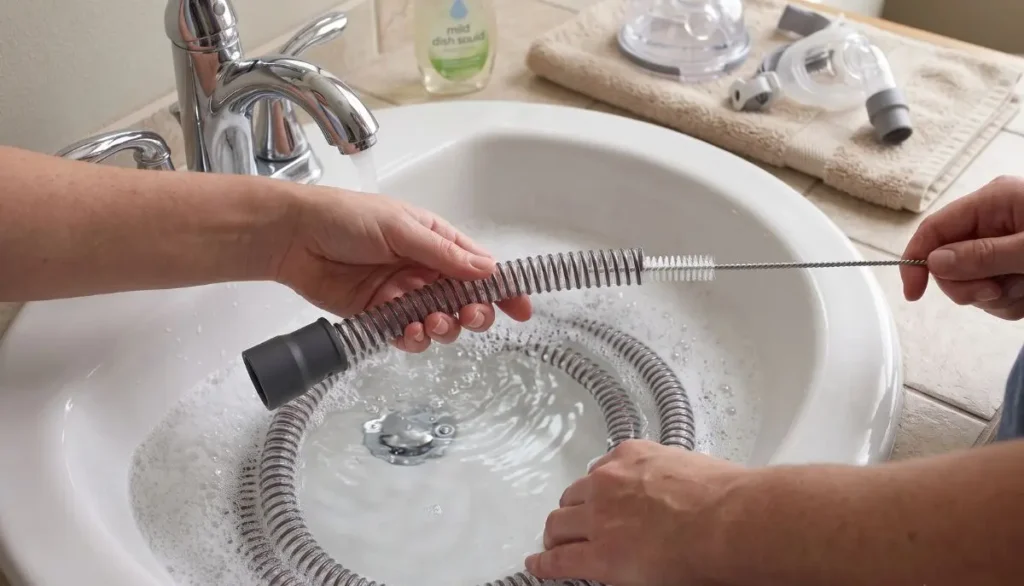
The tubing has an internal diameter of 15mm and is around 6 feet 6 inches (2 meters) long. The air tubing has a design life of 6 months, but may differ based on condition & usage.
Cleaning should be done lightly, as it has electrical components. Heated CPAP tubing must not be used as a typical household hose or subjected to the dishwasher or washing machine.
Why Cleaning Your ClimateLineAir 11 Tubing Matters
The tubing that connects to your CPAP machine is responsible for delivering the air you inhale while using your CPAP machine. Moisture, dust and normal environmental deposits can accumulate in and around the tubing over time.
Thus, regular cleaning is an important aspect of CPAP equipment care.
ResMed recommends tubing the air weekly. The manufacturer’s instructions clearly advise the use of warm water, household dish washing liquid, thorough rinsing and drying from direct sunlight and heat before using the tubing.
Regular housekeeping can also help you to identify issues like:
- Cracks
- Tears
- Holes
- Discoloration
- Visible deterioration
- Damaged connectors
- Unusual wear
The ResMed recommends checking the tubing regularly for holes, tears and cracks and replacing if necessary.
Cleaning is not done to make the tubing look brand new each time. Rather, it’s regarding executing great equipment hygiene while keeping the tubing protected from unneeded harm.
ClimateLineAir 11 Heated Tubing Cleaning Instructions: Step by Step
The following routine follows the manufacturer’s home-cleaning guidance.
Step 1: Turn Off and Unplug the CPAP Machine
Turn off and unplug your CPAP machine before cleaning the tubing.
An important safety measure as ClimateLineAir 11 includes electrical parts.
ResMed’s care guidance advises users to disconnect the air tubing from the CPAP machine prior to cleaning the tubing.
Avoid cleaning the tubing during power up of the CPAP device.
Step 2: Disconnect the Tubing Carefully
Remove the ClimateLineAir 11 tubing from the CPAP device and mask.
Do not pull on the tubing itself when disconnecting the tube, just hold the cuff or connector.
The ClimateLineAir 11 user guide has a section dedicated to the explanation of how to pull the air tubing away from the device by pinching its cuff gently. Gently separate the tubing cuff and mask when removing it from the mask. ResMed does not recommend tubing to be held or pulled as this can damage the tubing.
This little practice over time can make a huge difference.
The golden rule to keep in mind:
Pull the connector instead of the tube.
Do not twist, stretch or sharply bend the tubing as it is being removed.
Step 3: Prepare Warm Water
Fill a clean sink or appropriate basin with warm (drinking) water.
The water should be warm (not very hot).
ResMed says they do not recommend washing the ClimateLineAir 11 tubing above 131°F (55°C).
Boiling water or very hot water is not necessary to clean CPAP tubing.
In fact, you should steer clear of excess heat.
Remember:
Warm water = appropriate.
Very hot water = avoid.
Boiling water = never use for this cleaning routine.
Step 4: Add Household Dishwashing Liquid
Follow manufacturer’s instructions for cleaning with household dishwashing liquid.
ResMed’s ClimateLineAir 11 user guide provides instructions to wash the air tubing in warm water with household dishwashing liquid.
The focus is on soft cleaning, not hard chemical cleaning.
Don’t increase the amount of cleaning chemicals just to get a greater cleaning effect.
For particular care, ResMed advises against using bleach, chlorine-based solutions, the soaps with a scent of aromatics, moisturizing or antibacterial, and scented oils for cleaning the device, humidifier tub or air tubing. These can harm parts or cause product performance issues.
Don’t assume that the stronger the better when it comes to CPAP equipment care.
Step 5: Gently Wash the Tubing
Insert the broken pieces of ClimateLineAir 11 tubing into the warm water and cleaning solution.
Carefully clean the tubing.
Be sure the cleaning solution is in contact with the interior and exterior of the tubing.
No need to scrub, scrub, scrub.
Avoid:
- Bending the tube sharply
- Stretching the tube
- Pulling on the electrical connector
- Scrubbing the tubing with an abrasive brush
- Using harsh chemicals
- Using very hot water
The tubing must be flexible but not too much force will shorten its lifespan.
A regular cleaning of the house is enough to be done by a gentle wash.
Step 6: Rinse the Tubing Thoroughly
Once washed, thoroughly rinse ClimateLineAir 11 tubing with clean water.
This is important because you want to get rid of any excess soap and cleaning solution.
ResMed recommends washing the air tubing and then rinsing it off well.
Don’t rush this step!
Soap left inside the tubing can cause residue not wanted in the airflow path.
It is good practice to keep rinsing until the water is clear and no residue of the soap can be seen.
Step 7: Let the Tubing Air Dry
Rinse and let the tubing dry thoroughly.
Locate in a clean, dry area out of direct sunlight/heat.
ResMed recommends that all ClimateLineAir 11 tubing be kept out of direct sunlight and/or heat to dry.
Do not use:
- A hair dryer
- A clothes dryer
- A heater
- A heat gun
- Direct sunlight
- Another artificial heat source
You might be tempted to increase the drying speed, particularly when you have to have your CPAP machine later that night. But wasting energy isn’t a good short-cut.
The natural air drying is safer one.
Step 8: Make Sure the Tubing Is Completely Dry
Before reconnecting the ClimateLineAir 11 tubing, make sure it is dry.
This is especially significant since the tubing is linked to a CPAP machine that uses an electric power supply.
ResMed’s advice on product guidance is to ensure that parts are dry before reconnecting the system.
Look at both ends of the tubing.
Continue the drying if there is still water visible inside.
With a little patience during the cleaning process you can preserve your equipment.
Step 9: Inspect the Tubing Before Reconnecting
Cleaning is also a good opportunity to inspect your tubing.
Look carefully for:
- Small holes
- Cracks
- Tears
- Discoloration
- Damaged cuffs
- Connector problems
- Visible deterioration
ResMed recommends regularly checking the air tubing and replacing it if holes, tears, or cracks are found.
Do not assume that a small crack is harmless.
The tubing plays an important role in delivering your prescribed airflow, so visible damage should not simply be ignored.
Step 10: Reconnect the Tubing
When the tubing is clean, dry and in good shape, reconnect it.
The end of the electrical connector should connect to the matching Air11 device.
The other end must secure to the completed mask.
It’s described in ResMed’s ClimateLineAir user guide: Attaching the tubing to the rear air outlet and then attaching the free end to the completed mask.
Backed by the AirSense 11, the screen might briefly flash “ClimateLine connected” when the tubing is detected and recognized.
Secure each connection prior to use of CPAP system.
How Often Should ClimateLineAir 11 Tubing Be Cleaned?
ResMed recommends weekly cleaning of the air tubing for use in the home.
It’s really easy to remember a weekly schedule.
These are just some options you may consider:
Every Sunday morning = CPAP tubing cleaning day.
Or pick another day that fits in naturally into your schedule.
ResMed also reports that the air tubing can typically be taken out and stored in a clean, dry area every day until the next time it is used.
What’s most important is to find a schedule that you can stick to.
Should You Clean ClimateLineAir 11 Every Day?
The recommended frequency for washing is once a week, not daily.
If you see any moisture, residue or contamination, though, you may need to check the condition of the tubing and follow your health care provider or manufacturer’s instructions.
According to ResMed’s general advice, the tubing is to be removed every day and washed every week.
The ideal CPAP cleaning regimen is one where the cleaning is regular and done in accordance with the manufacturer’s guidelines.
Can You Put ClimateLineAir 11 Tubing in a Dishwasher?
No.
Do not put ClimateLineAir 11 heated tubing in a dishwasher.
The heated tubing should not be placed in a dishwasher or washing machine according to ResMed.
This is one of the most crucial points in ClimateLineAir 11 heated tubing cleaning instructions.
Dishwasher cleaning is not a good solution since there are electrical parts inside the heated tube.
If there are instructions on how to clean the other parts of the CPAP in the dishwasher, do not assume that this is also true for the heated tubing.
Different components can have different care requirements.
Can You Wash ClimateLineAir 11 Tubing in a Washing Machine?
No.
Do not wash heated tubing in washing machine, use ClimateLineAir 11 heated tubing only.
ResMed specifically says not to wash the tubing in a washing machine or dishwasher.
This component does not need the action of the machine to move, heat, pump water or to compress mechanically, and could be harmed by such machine action.
Washing your hands is the correct cleaning procedure.
Can You Use Bleach to Clean ClimateLineAir 11 Tubing?
No, not as part of routine home cleaning.
ResMed warns against using bleach or chlorine solutions to clean the device, humidifier tub or air tubing. The manufacturer also advises against using aromatic-based solutions, moisturizing or antibacterial soaps, and scented oils.
A more powerful chemical is not necessarily going to make a cleaner tubing.
For routine home cleaning, follow the manufacturer’s recommended method:
- Warm water
- Household dishwashing liquid
- Thorough rinsing
- Air drying away from direct sunlight and heat
If your healthcare facility requires a special reprocessing or disinfection procedure, use the appropriate clinical instructions rather than improvising a home-cleaning method. ResMed notes that clinical reprocessing instructions are separate from its home-cleaning instructions.
Can You Use Vinegar on ClimateLineAir 11 Tubing?
One should be mindful that a cleaning technique that is recommended for one part of the CPAP does not necessarily apply to another.
ResMed will include specific instructions for various components. For instance, the general cleaning information it provides talks about how vinegar can be used in some situations where you need to clean the humidifier water-tub, and the ClimateLineAir 11 humidifier tubing instructions say to use warm water and household dishwashing liquid.
Therefore, use the instructions on the tubing, instead of vinegar as a regular alternative.
To clean a medical device accessory, follow the manufacturer’s guidelines for that particular accessory.
Can You Use Alcohol Wipes on ClimateLineAir 11 Tubing?
Alcohol wipes are not part of the standard ClimateLineAir 11 home-cleaning procedure described by ResMed.
The manufacturer’s recommended home routine is washing the air tubing with warm water and household dishwashing liquid, rinsing thoroughly, and allowing it to dry away from direct sunlight and heat.
Avoid introducing additional chemicals unless they are specifically approved for the component and use situation.
Can You Use a CPAP Cleaning Machine?
You should not assume that an automated CPAP cleaning machine is appropriate for ClimateLineAir 11 heated tubing.
The manufacturer’s cleaning instructions specify manual washing, rinsing, and air drying.
ResMed also warns that exposure to ozone or other gases may damage the device, and such damage may not be covered by the limited warranty.
Following the manufacturer’s cleaning procedure is simpler and avoids unnecessary exposure to unapproved cleaning methods.
Why Direct Sunlight Should Be Avoided
After washing your ClimateLineAir 11 tubing, it may seem convenient to hang it outside in the sun.
However, ResMed specifically recommends drying the tubing away from direct sunlight.
ResMed’s guidance notes that air tubing should not be hung in direct sunlight because it may harden over time and eventually crack.
Instead, allow the tubing to dry naturally in a clean, dry area away from direct sunlight and heat.
This is a small change that can help protect the tubing.
Why You Should Not Use Heat to Dry the Tubing
ClimateLineAir 11 is heated tubing during CPAP therapy, but that does not mean it should be exposed to external heat during cleaning.
The manufacturer’s instructions specifically say to allow the tubing to dry away from direct sunlight and heat.
Avoid trying to dry it quickly with a hair dryer, radiator, heater, or other heat source.
Let the tubing dry naturally.
The fact that the tube is designed to carry heated air during therapy does not make external high-temperature drying appropriate.
What If Water Remains Inside the Tubing?
Small amounts of moisture can sometimes remain inside CPAP tubing after washing.
The appropriate approach is to give the tubing additional time to air dry.
Do not use excessive heat to force the water out.
Place the tubing in a clean, dry location where air can circulate around it. ResMed recommends allowing the tubing to dry away from direct sunlight and heat.
Do not reconnect wet tubing to your CPAP device simply because you are in a hurry.
Make sure it is properly dry first.
What If the Tubing Has a Bad Smell?
An unusual odor may be a sign that the tubing needs cleaning or that residue remains inside.
Start with the standard cleaning process:
- Disconnect the tubing.
- Wash it in warm water with household dishwashing liquid.
- Rinse thoroughly.
- Allow it to air dry completely.
- Inspect it before reconnecting.
Avoid masking odors with perfumes, scented oils, or other chemicals.
ResMed specifically cautions against scented oils and several types of harsh or specialty cleaning products.
If an odor continues after proper cleaning, inspect the tubing for deterioration and consider whether replacement is needed.
What If You See Mold or Heavy Contamination?
If you notice visible contamination that does not come away with the manufacturer’s normal cleaning procedure, do not experiment with increasingly harsh chemicals.
Instead, consider replacing the tubing or contacting your healthcare provider or equipment supplier for appropriate guidance.
The ClimateLineAir 11 user guide says that if visible deterioration such as cracking, discoloration, or tears is present, the component should be discarded and replaced.
When medical equipment looks damaged or significantly deteriorated, replacement can be more appropriate than trying to restore it with aggressive cleaning.
How to Prevent Unnecessary Tubing Damage
Good cleaning is only one part of tubing care.
Your everyday handling also matters.
Avoid pulling on the tubing
Always use the cuff or connector when disconnecting it.
Avoid sharp bends
Do not fold the tube tightly for storage.
Keep it away from heat
Do not place it beside radiators, heaters, or other heat sources.
Avoid direct sunlight
Store and dry the tubing away from direct sunlight.
Keep pets away
Pets may chew or scratch flexible tubing.
Do not use damaged tubing
If you find a hole, tear, or crack, replace the tubing rather than continuing to use it.
These habits can help preserve the tubing and reduce avoidable wear.
ClimateLineAir 11 Cleaning Mistakes to Avoid
Many CPAP cleaning problems come from trying to make the process more complicated than it needs to be.
Here are common mistakes to avoid.
Mistake 1: Using boiling water
The tubing should not be washed at temperatures above 131°F (55°C).
Mistake 2: Using bleach
Bleach and chlorine-based solutions are specifically discouraged by ResMed.
Mistake 3: Putting the tubing in the dishwasher
Do not wash ClimateLineAir 11 in a dishwasher.
Mistake 4: Using a washing machine
The heated tubing should not be washed in a washing machine.
Mistake 5: Drying it in direct sunlight
Direct sunlight can contribute to tubing deterioration over time.
Mistake 6: Using a hair dryer
Artificial heat is unnecessary and should be avoided.
Mistake 7: Pulling on the flexible tubing
Use the cuff when disconnecting the tube.
Mistake 8: Reconnecting it while wet
Allow the tubing to dry fully before reconnecting it.
Mistake 9: Continuing to use visibly damaged tubing
Holes, tears, and cracks are reasons to replace the tubing.
ClimateLineAir 11 Cleaning Checklist
For a simple weekly routine, save this checklist:
Before cleaning
- Turn off the CPAP device.
- Unplug the device.
- Disconnect the tubing from the machine.
- Disconnect the tubing from the mask.
During cleaning
- Use warm water.
- Use household dishwashing liquid.
- Gently wash inside and outside.
- Do not use water above 131°F (55°C).
- Do not use bleach or harsh chemicals.
- Do not use a dishwasher.
- Do not use a washing machine.
After cleaning
- Rinse thoroughly.
- Allow the tubing to air dry.
- Keep it away from direct sunlight.
- Keep it away from direct heat.
- Check for cracks, holes, and tears.
- Reconnect only when completely dry.
This routine closely follows ResMed’s published ClimateLineAir 11 care instructions.
How Long Does ClimateLineAir 11 Tubing Last?
ResMed lists a design life of approximately six months for ClimateLineAir 11 air tubing.
Design life should not be treated as a guarantee that every tube must be replaced on exactly the same date.
Condition matters.
For example, a tube that develops a crack or tear may need replacement earlier.
Regular inspection is therefore important.
A clean-looking tube is not necessarily a safe tube if it has structural damage.
Likewise, a tube that reaches its expected service period should be evaluated according to the manufacturer’s recommendations and its physical condition.
Signs You May Need New ClimateLineAir 11 Tubing
Consider replacing the tubing if you notice:
- Holes
- Tears
- Cracks
- Significant discoloration
- Damaged connectors
- Visible deterioration
- Persistent problems after cleaning
ResMed specifically instructs users to replace tubing when holes, tears, or cracks are found.
Do not try to repair a damaged CPAP tube with tape, glue, or household patches.
A temporary repair may alter the airflow path and does not restore the tubing to its original condition.
A replacement tube is the appropriate solution when the component is damaged.
Is ClimateLineAir 11 the Same as Regular CPAP Tubing?
No.
ClimateLineAir 11 is a heated tube designed for compatible Air11 devices. The tubing includes electrical components and is designed to work with the device’s climate-control system.
This is why cleaning instructions should be followed specifically for the ClimateLineAir 11 rather than treating it like generic tubing.
ResMed states that ClimateLineAir 11 is the heated tubing compatible with the Air11 device.
Before purchasing a replacement, make sure you are selecting tubing compatible with your particular CPAP system.
ClimateLineAir 11 vs. ClimateLineAir Oxy
ClimateLineAir 11 and ClimateLineAir Oxy are related products, but they are not identical.
The ClimateLineAir Oxy version includes an oxygen connector and is intended for compatible Air11 systems when supplemental oxygen is prescribed. ResMed describes ClimateLineAir Oxy as a variant with a built-in oxygen connector.
If you use supplemental oxygen with CPAP therapy, follow the specific equipment instructions provided for your setup.
Do not assume that every tube with a similar appearance has the same configuration.
Cleaning CPAP Tubing vs. Cleaning the Humidifier
Another common mistake is treating every CPAP component the same way.
The ClimateLineAir 11 tubing has its own cleaning instructions.
The humidifier water tub has separate care instructions.
The mask and mask cushion also have their own cleaning requirements.
For example, ResMed provides different cleaning recommendations for the humidifier and air tubing.
Therefore, avoid using one universal cleaning method for every CPAP component.
Instead:
Tubing → Follow tubing instructions.
Humidifier → Follow humidifier instructions.
Mask → Follow mask instructions.
Filter → Follow filter replacement instructions.
This component-by-component approach makes CPAP maintenance easier to manage.
What About the CPAP Filter?
The air filter is another component that should not be treated like the tubing.
ResMed’s healthcare professional support information states that the filter is intended to be replaced rather than cleaned.
So if you are performing your weekly CPAP maintenance, remember that washing the tubing does not mean you should wash the machine’s filter.
Always follow the instructions for the specific component.
A Simple Weekly ClimateLineAir 11 Routine
For many users, the easiest approach is to make tubing cleaning part of a weekly routine.
Sunday
Disconnect the tubing.
Wash
Use warm water and household dishwashing liquid.
Rinse
Rinse thoroughly with clean water.
Dry
Allow it to air dry away from direct sunlight and heat.
Inspect
Check for cracks, holes, tears, or visible deterioration.
Reconnect
Once completely dry, reconnect the tubing to the compatible Air11 device and mask.
That is it.
You do not need an elaborate cleaning station or complicated procedure for routine home cleaning.
The simpler the routine, the easier it is to maintain consistently.
Tips for Caregivers Helping Someone With CPAP
If you help a family member or patient maintain their CPAP equipment, a written cleaning checklist can make the process easier.
Keep the following information near the CPAP setup:
Weekly
- Unplug machine.
- Disconnect tubing.
- Wash with warm water and household dishwashing liquid.
- Rinse thoroughly.
- Air dry.
- Inspect.
- Reconnect when completely dry.
Avoid
- Dishwasher
- Washing machine
- High temperatures
- Direct sunlight
- Harsh chemicals
- Bleach
- Chlorine-based solutions
- Scented oils
- Pulling on the tube itself
The manufacturer’s user guide should remain the primary reference for equipment-specific care.
What If the ClimateLineAir 11 Is Not Recognized After Cleaning?
If the tubing is properly dry and you reconnect it but your AirSense 11 does not recognize the heated tube, first check the connection.
Make sure:
- The device is turned off when appropriate for reconnecting.
- The connector is fully seated.
- The electrical connector is connected to the device side.
- The mask is connected to the opposite end.
- The tubing is not damaged.
The ClimateLineAir 11 user guide states that “ClimateLine connected” may briefly appear on the device screen when the heated tubing is recognized.
If the problem continues, consult the AirSense 11 user guide or contact the appropriate equipment provider or ResMed support rather than attempting to repair the electrical components yourself.
Why Manufacturer Instructions Matter
CPAP equipment is medical equipment, and different accessories can have different cleaning requirements.
A cleaning method that works for one tube may not be appropriate for another.
For ClimateLineAir 11, the manufacturer provides specific instructions regarding:
- Water temperature
- Cleaning solution
- Rinsing
- Drying
- Inspection
- Reassembly
Following those instructions helps reduce unnecessary damage and gives patients a clear routine to follow.
ResMed’s official ClimateLineAir 11 user guide is the best reference when there is uncertainty about cleaning or component care.
ClimateLineAir 11 Heated Tubing Cleaning Instructions: Quick Answer
If you are looking for the shortest version of the ClimateLineAir 11 heated tubing cleaning instructions, here it is:
1. Unplug the CPAP machine.
2. Disconnect the heated tubing from the device and mask by holding the cuffs/connectors.
3. Wash the tubing weekly in warm water using household dishwashing liquid.
4. Keep the water at or below 131°F (55°C).
5. Rinse the tubing thoroughly.
6. Let it dry away from direct sunlight and heat.
7. Do not put the tubing in a dishwasher or washing machine.
8. Do not use bleach, chlorine-based solutions, scented oils, or other harsh cleaning products.
9. Inspect the tubing for holes, tears, cracks, or other deterioration.
10. Reconnect it only after it is completely dry.
These points are based on ResMed’s ClimateLineAir 11 user guidance.
Final Thoughts: Keep CPAP Tubing Care Simple
The best cleaning routine is one you can follow consistently.
The ClimateLineAir 11 heated tubing cleaning instructions are straightforward: clean the tubing weekly with warm water and household dishwashing liquid, rinse it thoroughly, let it dry away from direct sunlight and heat, and inspect it regularly for damage. Do not use a dishwasher or washing machine, and avoid harsh chemicals that can damage the tubing.
There is no need to turn routine CPAP maintenance into a complicated project.
A few minutes of careful cleaning each week can become a simple part of your normal CPAP routine.
At Alfa Healthcare Supply Inc., we understand that CPAP equipment care can raise practical questions. Patients and caregivers often want clear information about tubing, masks, replacement parts, and other home medical equipment. Our goal is to make medical supply information easier to understand so you can make informed decisions about your equipment and discuss questions with your healthcare professional when needed.
If your ClimateLineAir 11 tubing is damaged, worn, or due for replacement, make sure the replacement accessory is compatible with your specific CPAP system before ordering.
For the most current equipment-specific instructions, always refer to the official ResMed user guide supplied with your device and accessories.
About Alfa Healthcare Supply Inc.
Alfa Healthcare Supply Inc. is a medical supply and DME supplier serving patients and caregivers with a range of home medical equipment and healthcare supplies. The company provides products across categories including CPAP/DME equipment, diabetic supplies, incontinence supplies, orthopedic supplies, mobility products, and other home healthcare needs.
For CPAP equipment and replacement accessories, patients should confirm product compatibility and follow manufacturer instructions for setup, cleaning, and maintenance.
Frequently Asked Questions About ClimateLineAir 11 Cleaning
How often should I clean ClimateLineAir 11 tubing?
ResMed recommends cleaning the air tubing weekly for home use.
What soap should I use to clean ClimateLineAir 11?
ResMed’s ClimateLineAir 11 instructions specify household dishwashing liquid with warm water. Avoid harsh cleaning products, bleach, chlorine-based solutions, scented oils, and other products that may damage the tubing.
What temperature should the cleaning water be?
The tubing should not be washed in temperatures higher than 131°F (55°C).
Can I put ClimateLineAir 11 in the dishwasher?
No. The manufacturer says not to wash the heated tubing in a dishwasher.
Can I put ClimateLineAir 11 in a washing machine?
No. ResMed says not to wash the air tubing in a washing machine.
Can I use bleach?
No. ResMed cautions against bleach and chlorine-based solutions for cleaning the tubing.
Can I dry the tubing in the sun?
No. Allow it to dry away from direct sunlight.
Can I use a hair dryer to dry it faster?
It is better to let the tubing air dry naturally and keep it away from direct heat.
How do I disconnect ClimateLineAir 11 without damaging it?
Hold the cuff or connector and gently pull it away. Do not pull directly on the flexible tubing.
How do I know if my tubing needs replacement?
Look for holes, tears, cracks, discoloration, or other visible deterioration. ResMed specifically recommends replacing tubing with holes, tears, or cracks.
How long is ClimateLineAir 11 tubing designed to last?
ResMed lists a six-month design life for the air tubing.
Can I repair a cracked ClimateLineAir 11 tube?
It is better to replace damaged tubing rather than attempting a household repair with tape or glue.
Does cleaning the heated tubing turn off its heating function?
Normal cleaning, when performed according to the manufacturer’s instructions, is intended to maintain the tubing. The tubing should be completely dry before being reconnected to the device.
Is ClimateLineAir 11 compatible with AirSense 11?
ClimateLineAir 11 is specifically designed for compatible Air11 devices. ResMed identifies it as the heated tubing compatible with the Air11 device.
Important: This article is for general educational information and does not replace the instructions supplied with your ResMed equipment or advice from your healthcare professional. If you have questions about your prescribed CPAP therapy, equipment settings, oxygen use, or a persistent equipment problem, contact your healthcare provider or qualified medical equipment professional.
ResMed ClimateLineAir 11 Heated Tubing Cleaning
With a ResMed AirSense 11 and ResMed ClimateLineAir 11 heated tubing, cleaning the tubing is a vital component of your CPAP care routine. The tube transports the air you inhale from the CPAP apparatus to the mask, and it needs to be cleaned often and treated with care.
Fortunately, ResMed ClimateLineAir 11 heated tubing cleaning is easy. Normal household cleaning machines and equipment is sufficient for normal domestic use. ResMed recommends that the air tubing be cleaned once a week using warm water and mild household dishwashing liquid, then a further thorough rinse and air drying (away from direct sunlight or heat). Don’t put the tubing in a washing machine or dishwasher.
This informative guide from Alfa Healthcare Supply Inc. covers the use, non-use, inspection and re-connecting of tubing and when it should be replaced in simple terms.
What Is ClimateLineAir 11 Heated Tubing?
ClimateLineAir 11 is a heated air tubing for use with compatible ResMed AirSense 11 therapy systems. The heated tubing is a feature of the device’s climate-control system, unlike standard CPAP tubing which does not have this feature.The heated tubing is a special feature of the device’s climate-control system, as opposed to standard CPAP tubing.
It will be beneficial for those who have condensation or rain-out inside their CPAP tubing.
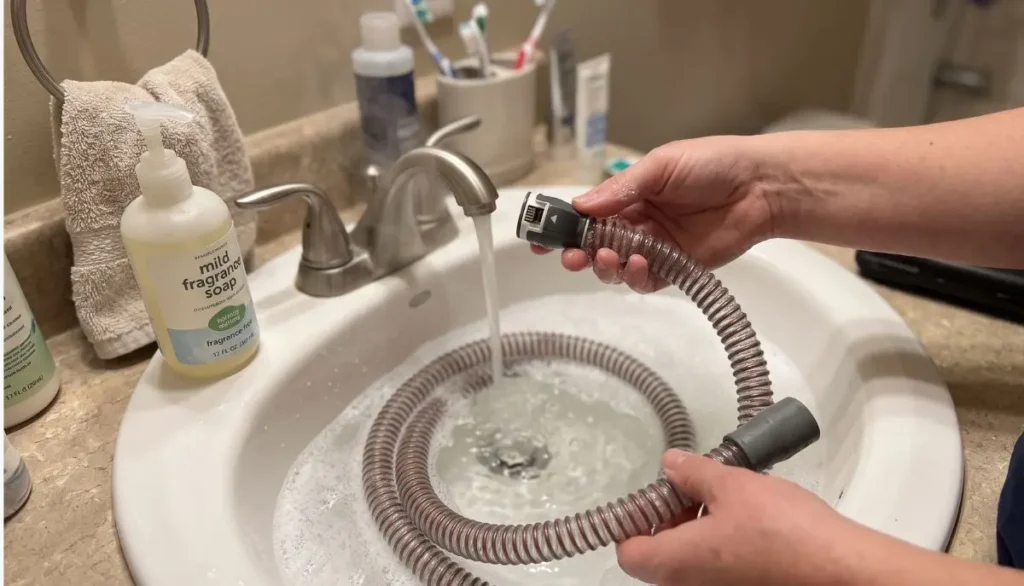
The ClimateLineAir 11 tubing is specifically designed to fit with the AirSense 11 humidification and temperature controls. ResMed’s specifications describe the ClimateLineAir 11 as a 2m heated tube and suggest regularly inspecting it for any holes, tears or cracks.
Cleaning it is similar to an ordinary household hose, but it’s a bit different because of the heating units inside the tube. It should be cleaned per the manufacturer’s recommendations and NOT with extreme chemicals, high temperatures or household appliances.
Why Is ResMed ClimateLineAir 11 Heated Tubing Cleaning Important?
The air pathway between your CPAP machine and mask includes your CPAP tubing. When it is used normally, the inner surface of the tubing may be moistened by humidification and environment.
The cleaning of the tubing promotes good condition of the equipment and hygiene for using the CPAP machine.
The air tubing is specifically recommended for cleaning once a week by ResMed. Other products should not be used in conjunction with the manufacturer’s instructions as they may cause damage to the tubing or interfere with the product.
Think of your tubing as one part of your regular CPAP routine:
Use → Disconnect → Clean → Rinse → Dry → Inspect → Reconnect
Following a simple routine can make CPAP equipment care much easier.
How Often Should You Clean ClimateLineAir 11 Tubing?
If used in a normal home environment, the ClimateLineAir 11 tubing needs to be cleaned weekly.
At present ResMed’s cleaning advice is to clean once a week for ClimateLineAir heated tubing. ResMed also recommends that the tubing is removed and stored in a clean and dry area between uses instead of in direct sunlight.
A simple routine
A simple routine
Every day:
- Disconnect the tubing as appropriate.
- Allow it to dry in a clean, dry area.
- Check for obvious problems.
Once a week:
- Wash the tubing with warm water and mild dishwashing liquid.
- Rinse thoroughly.
- Allow it to dry completely away from direct sunlight and heat.
Regularly:
- Inspect the tube for cracks, holes, tears, discoloration, or other visible deterioration.
- Replace damaged tubing rather than continuing to use it.
Also, the instructions on how the entire CPAP system works should be followed to the letter of the machine’s, mask’s and humidifier’s user guide.
What Do You Need for ClimateLineAir 11 Cleaning?
You do not need an expensive cleaning machine for normal home cleaning.
For routine tubing cleaning, you generally need:
- ClimateLineAir 11 heated tubing
- Warm, drinking-quality water
- Mild household dishwashing liquid
- A clean sink or basin
- A clean towel or drying area
The ResMed recommends using warm water and mild cleaning detergent for home-cleaning. The instruction on its guidance states that it is not recommended to use water that is above 131°F (55°C) for the ClimateLineAir 11 tubing.
You do not need
- A dishwasher
- A washing machine
- Bleach
- Chlorine-based cleaners
- Scented oils
- Harsh chemical cleaners
- Very hot water
Simple is better when caring for CPAP tubing.
Step-by-Step ResMed ClimateLineAir 11 Heated Tubing Cleaning
Step 1: Turn Off and Unplug Your AirSense 11
Turn off and unplug your CPAP machine before cleaning it.
This is a crucial safety measure, since this is a heated tubing and is attached to the CPAP machine.
ResMed’s cleaning instructions advise unplugging the CPAP machine before cleaning the air tubing.
Never start washing the tubing while the machine is running.
Step 2: Disconnect the Tubing Carefully
Remove the ClimateLineAir 11 tubing from the CPAP machine and mask.
When taking it out, be careful not to pull on the flexible tube hard, but be careful of pulling the cuff or connector.
In ResMed’s user guide for the ClimateLineAir, it is clear that the cuff should be removed by gently pulling the tubing away from the device. The guide also advises against the use of hands to hold and pull the tubing, as it could damage the tubing.
This is a small tip to help protect your tube.
Remember:
Pull from the connector—not the tube.
Step 3: Prepare Warm Water and Mild Dishwashing Liquid
Fill a clean sink or basin with warm drinking quality water.
Use a little bit of mild household dishwashing detergent.
The aim is not to make a strong chemical solution. All you need to get rid of the dirt in the tubing is a little mild soap.
The current ResMed cleaning advice is to use mild dishwashing soap and warm, potable water for cleaning the air tubing. It also warns against using more powerful cleaners that might be harmful to the tubing or leave behind an unwanted residue.
Step 4: Wash the Inside and Outside of the Tubing
Put the disconnected ClimateLineAir 11 tubing in the water.
Clean the tubing gently – inside and outside.
Be sure to clean inside the tube with the cleaning solution. The tubing may be slowly passed through the water in such a way that the solution will come into contact with the inside surface.
Strong scrubbing is not necessary.
The ClimateLineAir 11 user guide reads as follows: “Clean the air tubing in warm water with dish washing liquid and do not expose it to temperatures exceeding 131° F (55° C).”
Avoid aggressive handling
Do not:
- Bend the tubing sharply.
- Twist it forcefully.
- Pull on the flexible section.
- Scrub it aggressively.
- Use a stiff brush unless a specific manufacturer-approved procedure calls for it.
For ordinary home cleaning, gentle washing is the appropriate approach.
Step 5: Rinse the Tubing Thoroughly
Thoroughly clean ClimateLineAir 11 tubing with clean water after washing.
This step is crucial because you don’t want any detergent in the air pathway.
Rinse off as long as soap can be seen on the tubing.
ResMed’s instructions specifically call for thoroughly rinsing the air tubing after washing.
One of the simplest steps to miss is a thorough rinse, so take the time to do it.
Step 6: Allow the Tubing to Dry Completely
After rinsing, allow the tubing to dry naturally.
Place it in a clean, dry area away from:
- Direct sunlight
- Direct heat
- Radiators
- Heating vents
- Other strong heat sources
ResMed recommends allowing ClimateLineAir 11 tubing to dry out of direct sunlight and/or heat.
You can place it on a clean towel or in another clean location where air can circulate around it.
Do not rush the drying process
Avoid using a hair dryer, heater, or other direct heat source to speed up drying.
The tubing should be completely dry before you reconnect it to your CPAP system.
Step 7: Inspect the Tubing Before Reconnecting
Once the tubing is dry, inspect it carefully.
Look for:
- Holes
- Cracks
- Tears
- Splits
- Unusual discoloration
- Other visible deterioration
ResMed recommends regularly checking the air tubing and replacing it if holes, tears, or cracks are found.
This inspection only takes a few seconds but can become an important part of your routine.
What if you find damage?
Avoid taped on repair and continued use of damaged section.
A damaged CPAP tube can not work properly. If the tubing is damaged by holes, tears, cracks, or visible damage, it must be thrown away and replaced, according to ResMed.
Step 8: Reconnect the ClimateLineAir 11 Tubing
When the tube is dry and after your inspection, reconnect it.
Tightly attach one end to the air outlet on the AirSense 11.
Then, attach the other end to the finished mask.
ResMed’s ClimateLineAir 11 user guide provides the same simple reconnection process: secure the tubing to the air outlet of the device, and then secure the free end to the mask that is already assembled.
Double-check connections prior to your next therapy session.
ClimateLineAir 11 Cleaning at a Glance
| Step | What to Do |
| 1 | Turn off and unplug the CPAP machine |
| 2 | Disconnect the tubing carefully |
| 3 | Prepare warm drinking-quality water |
| 4 | Add mild household dishwashing liquid |
| 5 | Wash the inside and outside of the tube |
| 6 | Rinse thoroughly |
| 7 | Dry away from direct sunlight and heat |
| 8 | Inspect for damage |
| 9 | Reconnect when completely dry |
This is the basic ResMed ClimateLineAir 11 heated tubing cleaning routine for normal home care.
What Should You NOT Use to Clean ClimateLineAir 11?
Choosing the right cleaning product is just as important as cleaning the tube itself.
The ClimateLineAir 11 user guide warns against using:
- Bleach
- Chlorine-based solutions
- Aromatic-based solutions
- Moisturizing soaps
- Antibacterial soaps
- Scented oils
These products may damage the device or components, affect humidifier performance, or reduce product life.
What about vinegar?
There’s a critical difference here.
Some guidance from ResMed offers separate instructions for cleaning some humidifier parts, such as the humidifier water chamber with vinegar instructions. Usually, vinegar is not the best solution for ClimateLineAir 11 tubing, but this isn’t always the case.
Clean the heated tubing according to the manufacturer’s instructions for cleaning the tubing, not by applying a humidifier cleaning method to the tube.
Can You Put ClimateLineAir 11 Tubing in a Dishwasher?
No.
Do not put the ClimateLineAir 11 heated tubing in the dishwasher.
ResMed’s instructions make it clear not to wash the tubing in the dishwasher or washing machine.
This is a big distinction between some of the elements of CPAP devices.
For instance AirSense 11 humidifier components might also possess their own dishwasher directions. This does not imply that the heated tubing can be treated similarly.
Always refer to the cleaning instructions of the individual component.
Can You Wash ClimateLineAir 11 Tubing in a Washing Machine?
No.
Avoid placing ClimateLineAir 11 heated tubing in washing machines.
A washing machine is subjected to mechanical action, detergent, water pressure, and temperatures which are not suitable to the manufacturer’s recommended home-cleaning procedure.
Rather, do hand wash gently with warm water and gentle household dishwashing liquid.
Can You Use Hot Water?
Don’t use hot water.
According to the ResMed’s ClimateLineAir 11 user guide, the tubing shouldn’t be cleaned at temperatures exceeding 131°F (55°C).
For normal household cleaning, warm water will do.
The tube doesn’t require boiling water or extremely hot water to clean.
Actually, over heating can harm the tubing or its elements.
Can You Use Bleach?
No.
Bleach should not be used to clean ClimateLineAir 11 tubing.
The ResMed user guide specifically cautions against bleach and chlorine-based solutions.
The same applies to several other strong or scented cleaning products.
When cleaning medical equipment at home, stronger does not automatically mean better.
What About CPAP Cleaning Machines?
Many CPAP users have questions about ozone-based or other automated cleaning systems.
For ClimateLineAir 11, it is important not to replace the manufacturer’s cleaning instructions with an unapproved cleaning method.
ResMed’s user guide warns that exposure to ozone or other gases may damage the device, and such damage may not be covered by the manufacturer’s limited warranty.
For routine home cleaning, follow the manufacturer’s recommended manual cleaning procedure.
If you are unsure about a particular cleaning device or disinfectant, check the current ResMed documentation or ask your healthcare provider or equipment supplier before using it.
How Do You Know When ClimateLineAir 11 Tubing Needs Replacement?
Cleaning and replacement are two different things.
Cleaning is designed to help maintain the tubing. It cannot repair physical damage.
Inspect your ClimateLineAir 11 regularly for:
Cracks
Small cracks can become larger with continued use.
Tears
A torn tube should be replaced.
Holes
Any hole in the tubing can affect the air pathway.
Discoloration or deterioration
Visible deterioration is a reason to follow the manufacturer’s replacement guidance.
ResMed specifically says to replace tubing if holes, tears, or cracks are present. Its user guide also says that visible deterioration such as cracking, discoloration, or tears is a reason to discard and replace the component.
How Long Does ClimateLineAir 11 Tubing Last?
The replacement interval can depend on the condition of the tubing and the manufacturer’s recommendations for the particular product.
ResMed’s product information for ClimateLineAir 11 lists a six-month design life for the tubing.
However, do not wait for a calendar date if the tubing becomes damaged.
If you notice cracks, tears, holes, or other visible deterioration, the tubing may need replacement sooner.
Likewise, follow your healthcare provider, DME supplier, insurance requirements, and the manufacturer’s current recommendations when determining replacement needs.
Why Does My ClimateLineAir 11 Tube Get Wet Inside?
Moisture inside CPAP tubing can occur when humidified air cools as it travels through the tube.
This is commonly called rainout.
The heated ClimateLineAir system is designed to help maintain the temperature of humidified air and can help reduce condensation in the tubing.
If you notice excessive water in the tube, check your AirSense 11 climate-control settings and review the device user guide.
Do not attempt to solve condensation problems by using extremely hot water during cleaning or by applying unapproved treatments to the tubing.
Does Cleaning Affect the Heated Function?
Proper cleaning should follow the manufacturer’s instructions.
The ClimateLineAir 11 contains heating components, so it should be handled carefully.
Avoid:
- Excessive heat
- Aggressive pulling
- Sharp bends
- Harsh chemicals
- Washing machines
- Dishwashers
If the tubing appears damaged or if you notice a device or tubing error, consult the appropriate ResMed documentation or a qualified healthcare/equipment professional.
ResMed provides product support and documentation for ClimateLineAir accessories.
What If My ClimateLineAir 11 Tubing Does Not Feel Warm?
Do not assume that a tube is defective simply because it does not feel very hot.
The ClimateLineAir system is intended to control temperature as part of the AirSense climate-control system. Its purpose is not necessarily to make the tubing feel extremely hot to the touch.
If you believe the heated tubing is not functioning correctly:
- Confirm that the tubing is properly connected.
- Check the AirSense 11 settings.
- Review the device’s instructions.
- Look for error messages.
- Inspect the tubing for damage.
- Contact your equipment provider or ResMed support if the problem continues.
ResMed provides specific support resources for questions about heated tubing, including why heated tubing may not feel warm.
ClimateLineAir 11 Cleaning vs. Disinfection
For most people using CPAP at home, routine cleaning is different from clinical disinfection.
The standard home-care instructions call for weekly washing with warm water and mild detergent, followed by rinsing and drying.
ResMed also publishes separate disinfection procedures for specific clinical situations and equipment. Those procedures are not the same as ordinary home cleaning.
For example, ResMed’s AirSense 11 disinfection documentation contains more detailed procedures involving specific detergents, brushing, soaking, rinsing, and validated disinfection processes.
Therefore, do not take a clinical disinfection procedure and assume it is necessary for ordinary single-user home care.
For home use, follow the current user guide supplied with your equipment.
A Simple Weekly ClimateLineAir 11 Cleaning Routine
A routine makes CPAP cleaning easier.
You can use this simple sequence every week:
Sunday — or any convenient day
1. Unplug
Disconnect your AirSense 11 from power.
2. Disconnect
Remove the ClimateLineAir 11 tubing from the machine and mask.
3. Wash
Use warm water and mild household dishwashing liquid.
4. Rinse
Rinse the inside and outside thoroughly.
5. Dry
Place the tubing somewhere clean and dry, away from direct sunlight and heat.
6. Inspect
Look for cracks, holes, tears, and visible deterioration.
7. Reconnect
Once completely dry, reconnect the tubing to your AirSense 11 and mask.
The entire routine can become a normal part of your CPAP care.
Common ClimateLineAir 11 Cleaning Mistakes
Mistake 1: Using Very Hot Water
Hotter is not better.
Stay within the manufacturer’s recommended temperature limit.
Mistake 2: Using Bleach
Bleach can damage CPAP components and is specifically discouraged by ResMed for this tubing.
Mistake 3: Putting the Tube in a Dishwasher
The heated tubing should not go into a dishwasher.
Mistake 4: Washing It in a Machine
ClimateLineAir 11 tubing should be hand-washed.
Mistake 5: Drying It in Direct Sunlight
ResMed recommends drying the tubing away from direct sunlight and heat.
Mistake 6: Pulling the Tube Instead of the Cuff
Repeatedly pulling the flexible section can cause unnecessary stress.
Hold the connector/cuff when disconnecting.
Mistake 7: Reconnecting It While Wet
Allow the tubing to dry before reconnecting it to your CPAP system.
Mistake 8: Ignoring Cracks
Cleaning will not fix physical damage.
If the tubing is cracked, torn, or has holes, replace it.
ClimateLineAir 11 Cleaning Checklist
Save this simple checklist for your CPAP routine:
☐ Unplug AirSense 11
☐ Disconnect ClimateLineAir 11
☐ Use warm drinking-quality water
☐ Add mild household dishwashing liquid
☐ Wash inside and outside
☐ Rinse thoroughly
☐ Do not exceed 131°F / 55°C
☐ Do not use dishwasher
☐ Do not use washing machine
☐ Avoid bleach and chlorine
☐ Avoid scented oils and harsh cleaners
☐ Dry away from direct sunlight and heat
☐ Inspect for cracks, tears, and holes
☐ Reconnect only when completely dry
Practical Tips for Better CPAP Equipment Care
Good CPAP care does not have to become a complicated project.
A few simple habits can make it easier:
Keep your cleaning supplies together
Store your mild dishwashing liquid and cleaning supplies in one place. This makes your weekly routine easier to remember.
Give the tubing enough drying time
Do not clean the tube immediately before you need to use it if you can avoid doing so. Give it enough time to dry naturally.
Check the tube while you clean it
Cleaning provides an excellent opportunity to inspect the tubing.
Follow component-specific instructions
Your mask, humidifier chamber, air filter, and heated tubing may have different cleaning requirements.
Keep manufacturer instructions available
If you are unsure about a cleaning method, check the current ResMed user guide for your equipment.
ResMed provides product documentation and support resources for ClimateLineAir accessories.
Why Manufacturer Instructions Matter
CPAP equipment is medical equipment, and different components can have different care requirements.
For example, the cleaning instructions for a humidifier water chamber are not automatically the same as the instructions for heated tubing.
The ClimateLineAir 11 user guide provides specific instructions for disconnecting, cleaning, checking, and reconnecting the tubing.
Using the correct instructions helps avoid accidental damage.
This is especially important with heated tubing because it is more than just a simple plastic hose.
ResMed ClimateLineAir 11 Heated Tubing Cleaning: The Easy Version
If you only remember five things from this article, remember these:
1. Clean weekly.
ResMed recommends weekly cleaning of the air tubing.
2. Use warm water and mild dishwashing liquid.
3. Rinse thoroughly.
4. Dry away from direct sunlight and heat.
5. Replace the tube if you find cracks, holes, tears, or other visible deterioration.
That is the foundation of proper resmed climatelineair 11 heated tubing cleaning for normal home use.
Get CPAP Supplies From Alfa Healthcare Supply Inc.
At Alfa Healthcare Supply Inc., we understand that CPAP therapy is part of someone’s everyday routine. Small equipment-care questions—such as how to clean tubing, when to inspect a component, or when a replacement may be needed—can make a real difference in maintaining a consistent routine.
Alfa Healthcare Supply Inc. is a medical supply provider serving customers with a range of healthcare and durable medical equipment supplies.
If you need CPAP equipment or replacement supplies, you can explore the available products and resources through the Alfa Healthcare Supply website:
When purchasing replacement CPAP tubing, always verify compatibility with your specific machine. ClimateLineAir 11 tubing is designed for AirSense 11 systems, while other ClimateLineAir products may be designed for different ResMed platforms. ResMed’s product documentation should be checked before purchasing a replacement.
Final Thoughts
Proper resmed climatelineair 11 heated tubing cleaning does not need to be difficult.
A weekly wash with warm water and mild household dishwashing liquid, followed by a thorough rinse and careful air-drying, is the basic home-cleaning routine recommended by ResMed. Avoid dishwashers, washing machines, excessive heat, bleach, chlorine-based products, scented oils, and other unsuitable cleaning solutions.
Most importantly, make tubing inspection part of your routine. A clean tube is important, but a damaged tube should not simply be cleaned and reused. ResMed recommends replacing tubing when holes, tears, cracks, or other visible deterioration are found.
For anyone using an AirSense 11 with ClimateLineAir 11, a few minutes of simple care each week can help keep CPAP equipment organized, clean, and ready for the next night’s therapy.
Frequently Asked Questions
How often should I clean my ClimateLineAir 11 heated tubing?
For normal home use, ResMed recommends cleaning the air tubing weekly.
What should I use to clean ClimateLineAir 11 tubing?
Use warm water and mild household dishwashing liquid. Rinse the tubing thoroughly afterward.
Can I put ClimateLineAir 11 in the dishwasher?
No. ResMed says not to wash the heated tubing in a dishwasher or washing machine.
Can I use bleach on ClimateLineAir 11?
No. ResMed’s user guide specifically advises against bleach and chlorine-based solutions.
Can I use vinegar to clean the heated tubing?
Do not automatically apply vinegar cleaning instructions intended for the humidifier chamber to the heated tubing. Follow the tubing-specific ResMed instructions instead.
What temperature should I use?
Use warm water and do not wash the ClimateLineAir 11 tubing at temperatures above 131°F (55°C).
How should I dry the tubing?
Allow it to air-dry in a clean location away from direct sunlight and heat.
What if I see a crack in my tubing?
Replace damaged tubing. ResMed recommends replacing tubing if you find holes, tears, or cracks.
Can I use a CPAP cleaning machine?
For routine home care, follow ResMed’s recommended manual cleaning instructions. Avoid assuming that an automated ozone or other cleaning system is appropriate for your equipment.
Why is there water inside my ClimateLineAir 11?
Water can occur when humidified air condenses as it travels through the tubing. ClimateLineAir’s heated design is intended to help reduce condensation.
Does ClimateLineAir 11 need to be completely dry before use?
It is good practice to allow the tubing to dry completely before reconnecting it to the CPAP system, consistent with the manufacturer’s cleaning instructions.
How often should I inspect my tubing?
Inspect it regularly, particularly during your cleaning routine. Look for cracks, tears, holes, discoloration, or other visible deterioration.
Medical Note: This article is for general equipment-care information and does not replace the user guide supplied with your ResMed equipment or advice from your healthcare professional. If you experience therapy problems, equipment errors, breathing difficulties, or concerns about your CPAP treatment, contact your healthcare provider or qualified equipment professional.
ClimateLineAir 11 Heated Tubing Length
If you use a ResMed AirSense 11 CPAP machine, you may not think much about the tubing until it becomes difficult to reach your bed, starts collecting condensation, or needs replacement. At that point, one simple question becomes important: What is the ClimateLineAir 11 heated tubing length?
The ResMed ClimateLineAir 11 heated tube is approximately 6.5 feet long, or 2 meters. ResMed’s product information lists the ClimateLineAir 11 at 2 meters in length, while its product specifications also identify a 15 mm internal diameter and 22 mm connector/cuff size.
That length is designed to give most CPAP users enough room to position an AirSense 11 beside the bed while connecting the machine to a compatible mask without unnecessarily restricting movement.
But tubing length is only one part of the picture.
Before replacing your CPAP tube, it is also important to understand compatibility, heated tubing, connector size, cleaning, condensation, installation, replacement signs, and the difference between ClimateLineAir 11 and older ClimateLineAir tubing for AirSense 10.
At Alfa Healthcare Supply Inc., we understand that CPAP equipment can sometimes feel complicated. A replacement tube may look like a simple purchase, but choosing the correct model can make your nightly setup much easier.
This guide explains the climatelineair 11 heated tubing length, what that length means in everyday use, and what you should know before buying a replacement.
What is the ClimateLineAir 11 Heated Tubing Length?
The ClimateLineAir 11 heated tubing length is 2 meters, approximately 6.5 feet.
This is the standard length listed for the ResMed ClimateLineAir 11 heated tube. ResMed’s product information lists the length as 2 m, while Alfa Healthcare Supply’s information describes the ClimateLineAir products as approximately 6.5 feet long.
Quick specifications
| Feature | ClimateLineAir 11 |
| Tubing length | 2 meters |
| Approximate length in feet | 6.5 feet |
| Tubing type | Heated breathing tube |
| Designed for | ResMed Air11 devices |
| Compatible machines | AirSense 11 and AirCurve 11 |
| Inner diameter | 15 mm |
| Connector/cuff size | 22 mm |
| Main purpose | Carries heated, humidified therapy air |
| Heated | Yes |
The exact product configuration can vary by market, so always verify the current manufacturer’s specifications and the tubing model before ordering.
Why Does ClimateLineAir 11 Tubing Length Matter?
At first, 6.5 feet may seem like an ordinary measurement.
However, CPAP tubing length affects how easily you can arrange your equipment.
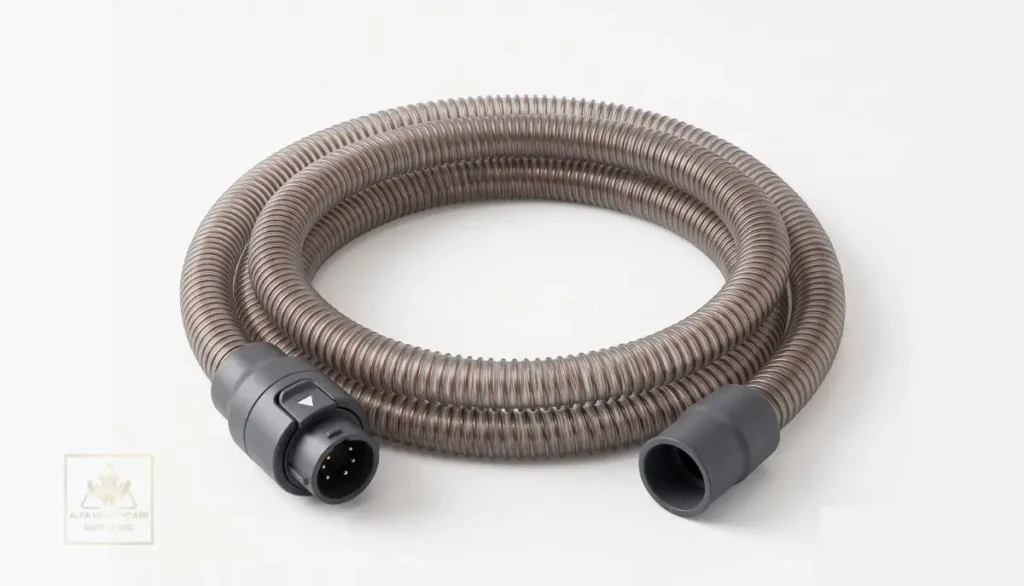
Your CPAP machine is usually placed on a nightstand or another stable surface beside the bed. The tubing then travels from the machine to your mask.
You need enough tubing to:
- Reach your sleeping position
- Allow comfortable head movement
- Keep the CPAP machine in a practical location
- Avoid pulling on your mask
- Allow some flexibility when changing sleeping positions
- Keep the tube from becoming tightly stretched
The 2-meter ClimateLineAir 11 tube provides a practical amount of reach for many standard bedside setups.
However, the tube should not be treated as an extension cord. More length is not automatically better.
The goal is to have enough tubing for comfortable movement without creating unnecessary loops or allowing the tube to become trapped under pillows or bedding.
Is ClimateLineAir 11 Tubing 6 Feet or 6.5 Feet?
You may see different descriptions online.
The manufacturer’s specification is 2 meters. Two meters converts to approximately 6.56 feet, which is commonly rounded to 6.5 feet.
So when you see:
- 2 meters
- Approximately 6.5 feet
- About 78.7 inches
these measurements are describing essentially the same tubing length.
Simple conversion
2 meters ≈ 6.56 feet ≈ 78.7 inches
For everyday shopping, calling the ClimateLineAir 11 tube a 6.5-foot heated CPAP tube is reasonable.
For exact product specifications, however, 2 meters is the manufacturer’s listed length. ResMed’s UK product page specifically lists the ClimateLineAir 11 length as 2 meters.
What Is ClimateLineAir 11 Tubing?
The ClimateLineAir 11 is a heated breathing tube designed to deliver air from a compatible ResMed Air11 device to a compatible mask.
ResMed explains that when the ClimateLineAir 11 is used with the device humidifier, it allows the Climate Control feature to be used.
In simple terms, the tube does more than simply move air.
It is designed to help maintain the temperature of humidified air as it travels from the machine toward your mask.
This can be particularly useful for people who experience condensation inside CPAP tubing.
How Does Heated CPAP Tubing Work?
A regular CPAP tube simply carries air from the machine to your mask.
A heated tube has an additional heating function.
When warm, humidified air travels through a cooler environment, the air can cool down. When this happens, moisture may condense inside the tube.
This is commonly called CPAP rainout.
ClimateLineAir 11 is designed to help maintain the temperature of the humidified air as it travels through the tube.
This can help reduce condensation when the system is used correctly.
ResMed describes ClimateLineAir as part of its Climate Control solution, designed to maintain the temperature of humidified air as it passes through the tubing.
Is 6.5 Feet Long Enough for an AirSense 11?
For many standard bedside CPAP setups, a 2-meter or approximately 6.5-foot tube provides sufficient reach.
For example, imagine your AirSense 11 is sitting on a nightstand next to your bed.
The tubing can travel from:
AirSense 11 → tubing → mask
The approximately 6.5-foot length gives you room to move your head while sleeping without keeping the tube stretched tightly.
Your exact setup will depend on:
- Bed size
- Nightstand location
- Machine position
- Sleeping position
- Mask style
- Bedroom layout
- Whether the machine is placed on the floor or furniture
A person who keeps the machine close to the bed may have plenty of extra tubing.
Someone who places the machine farther away may need to reconsider the equipment arrangement rather than assuming a longer tube is always the answer.
Does the ClimateLineAir 11 Come in Different Lengths?
The standard ClimateLineAir 11 is listed by ResMed at 2 meters.
You may find websites using different measurements in product titles or descriptions, but this does not necessarily mean the manufacturer offers multiple standard lengths.
Before purchasing a replacement, check:
- The exact ResMed model
- The tubing version
- The manufacturer’s specifications
- Your machine compatibility
- The supplier’s product description
Avoid purchasing a tube simply because the listing says “ResMed heated tubing.”
The Air10 and Air11 systems use different ClimateLineAir versions.
ClimateLineAir 11 vs. ClimateLineAir for AirSense 10
This is one of the most important points when searching for replacement tubing.
The names are similar, but the systems are different.
ClimateLineAir 11
Designed for ResMed Air11 devices, including:
- AirSense 11
- AirCurve 11
ClimateLineAir for Air10
Designed for compatible Air10 devices, including:
- AirSense 10
- AirCurve 10
ResMed specifically states that ClimateLineAir 11 and ClimateLineAir 11 Oxy are compatible with Air11 devices, while ClimateLineAir and ClimateLineAir Oxy are associated with Air10 devices.
Therefore, if you have an AirSense 11, look specifically for ClimateLineAir 11.
Can I Use AirSense 10 ClimateLineAir Tubing on AirSense 11?
You should not assume that AirSense 10 ClimateLineAir tubing is compatible with an AirSense 11.
ResMed identifies ClimateLineAir 11 as the heated tubing compatible with the AirSense 11.
The similar product names can make online shopping confusing.
Before ordering, check the machine model printed on your CPAP device.
If it says:
AirSense 11
look for:
ClimateLineAir 11
This simple check can help prevent ordering the wrong replacement.
ClimateLineAir 11 Tubing Dimensions
Length is not the only dimension worth understanding.
The ClimateLineAir 11 is listed with:
- 2-meter length
- Approximately 6.5-foot overall length
- 15 mm internal diameter
- 22 mm connector/cuff dimensions
These measurements are part of the tubing design.
The diameter helps determine how air moves through the tube, while the connectors allow the tubing to attach to compatible equipment.
This is another reason why buying a generic tube based only on length may not be appropriate.
A tube could be approximately 6.5 feet long but still be the wrong accessory for your machine.
Why the 15 mm Tubing Diameter Matters
The ClimateLineAir 11 uses a slim tubing design.
The listed internal diameter is 15 mm.
A smaller-diameter tube can be easier to manage around the bed than some larger traditional CPAP tubing.
For everyday use, this may help keep the setup feeling less bulky.
The important point is that tubing dimensions are engineered as part of the complete therapy system.
You should not modify the tube or attempt to change its internal diameter.
Why the 22 mm Connector Size Matters
The tubing connector/cuff is listed at approximately 22 mm.
The connector is important because it allows the tube to attach correctly to the compatible CPAP equipment.
Even if a replacement tube looks physically similar, the connection and electrical components must be appropriate for the device.
This is especially important with heated tubing because it is not simply a hollow plastic tube.
What Makes ClimateLineAir 11 Different From Standard Tubing?
The primary difference is heating.
Standard CPAP tubing carries airflow.
ClimateLineAir 11 carries airflow while providing heated tubing functionality for compatible ResMed equipment.
This can be particularly useful when humidification is being used.
Standard tubing
A standard tube:
- Carries therapy air
- Does not actively heat the tube
- May be suitable for certain CPAP setups
- Does not provide ClimateLineAir heated tubing functionality
ClimateLineAir 11
ClimateLineAir 11:
- Carries therapy air
- Uses heated tubing technology
- Works with compatible Air11 equipment
- Supports Climate Control when used with the appropriate humidifier
- Is designed to help manage condensation
ResMed identifies the ClimateLineAir 11 as the heated tubing compatible with Air11 devices.
Does ClimateLineAir 11 Help Prevent Rainout?
Heated tubing is designed to help reduce condensation.
Rainout happens when humidified air cools enough for water to condense inside the tubing or mask.
You might notice:
- Water droplets inside the tube
- Gurgling sounds
- Moisture near the mask
- A damp mask
- Water splashing or collecting in the tubing
ClimateLineAir 11 is designed to help maintain the temperature of humidified air and reduce this problem.
However, no tubing can guarantee that condensation will never occur under every environmental condition.
Bedroom temperature, humidity, therapy settings, tube positioning, and other factors can affect condensation.
If you repeatedly experience rainout, review your humidification and temperature settings according to your device instructions or ask your healthcare professional or equipment supplier for help.
Does a Longer CPAP Tube Cause More Condensation?
Tubing length can influence the overall airflow path, but condensation depends on more than length.
Factors can include:
- Room temperature
- Humidity
- Humidifier settings
- Tube temperature
- Mask setup
- Position of the tubing
- Bedroom environment
With ClimateLineAir 11, the heated tubing is specifically designed to help maintain the temperature of humidified air.
Therefore, rather than simply trying to find the longest possible tube, it is better to use the correct compatible tubing and optimize the overall CPAP setup.
How to Connect ClimateLineAir 11 Tubing
Connecting the ClimateLineAir 11 is straightforward when following ResMed’s instructions.
Step 1: Turn on the device
ResMed’s user guide instructs users to make sure the device is connected and turned on.
Step 2: Find the machine-side connector
Hold the cuff of the heated tubing.
Line it up with the air outlet at the rear of the device.
Step 3: Push the tubing into place
Push the cuff firmly onto the machine’s outlet connector.
The AirSense 11 should briefly display “ClimateLine connected.”
Step 4: Connect your mask
Attach the other end of the tubing to the assembled mask.
The electrical connector end belongs at the machine side.
ResMed specifically warns that the electrical connector end should not be attached to the mask.
How Should ClimateLineAir 11 Tubing Be Positioned?
The approximately 6.5-foot length gives you flexibility, but good positioning still matters.
Try to avoid:
- Sharp bends
- Heavy objects sitting on the tube
- Tight loops
- Pinching the tubing
- Running the tube under your body
- Pulling the tube tightly against the mask
A gentle curve is generally better than a sharp bend.
You can also position the tube so that it does not pull directly on your mask when you turn during sleep.
Can ClimateLineAir 11 Tubing Be Placed Over the Headboard?
Some CPAP users route tubing over or around a headboard to keep it out of the way.
Whether this works well depends on the bedroom setup.
The key goal is to avoid:
- Stretching the tubing
- Kinking it
- Creating tension on the mask
- Blocking airflow
- Creating a tripping hazard
The approximately 6.5-foot length may provide enough flexibility for many bedside arrangements.
How Often Should ClimateLineAir 11 Tubing Be Cleaned?
Regular cleaning is an important part of CPAP equipment care.
ResMed’s product information recommends weekly cleaning for ClimateLineAir 11 tubing. The instructions include washing the tubing in warm water with household dishwashing liquid, rinsing thoroughly, and allowing it to dry away from direct heat and sunlight.
A simple routine can be:
Disconnect → Wash → Rinse → Dry → Reconnect
Always follow the manufacturer’s current instructions for your specific equipment.
How to Clean ClimateLineAir 11 Heated Tubing
1. Disconnect the tubing
Remove the tubing from the CPAP machine and mask.
Handle the connectors carefully.
2. Wash with warm water
Use warm water and a mild household dishwashing liquid.
3. Rinse thoroughly
Make sure soap residue is removed.
4. Let the tubing dry
Allow it to dry away from direct sunlight and direct heat.
5. Reconnect only when completely dry
The tubing and connectors should be dry before being connected to the powered device.
ResMed advises against cleaning the heated tubing in a dishwasher or washing machine.
Can I Put ClimateLineAir 11 Tubing in the Dishwasher?
No.
The ResMed product instructions state that the heated tubing should not be placed in a dishwasher or washing machine.
Hand washing is the appropriate approach.
This is especially important because the tubing contains electrical components that distinguish it from ordinary CPAP tubing.
How Long Does ClimateLineAir 11 Tubing Last?
ResMed’s UK product listing gives the ClimateLineAir 11 a six-month design life.
Actual replacement timing can depend on the condition of the tubing and the manufacturer’s instructions applicable to your market.
You should inspect your tube regularly.
Replace it if you notice:
- Holes
- Cracks
- Tears
- Damaged connectors
- Visible deterioration
- Air leaks caused by tubing damage
ResMed specifically advises checking the ClimateLineAir 11 regularly and replacing it if holes, tears, or cracks are found.
Does Tubing Length Change CPAP Pressure?
Users sometimes worry that a 2-meter tube might change their prescribed pressure.
Do not change CPAP pressure simply because you are replacing a tube.
Your therapy pressure is prescribed or configured for your treatment system.
If you have concerns about pressure, airflow, mask leaks, or therapy results, speak with your healthcare provider or qualified equipment professional rather than changing clinical settings on your own.
What If the ClimateLineAir 11 Tube Seems Too Long?
A 6.5-foot tube can seem long when your machine is right beside your pillow.
Do not cut the tube to make it shorter.
The tubing is a purpose-designed heated component, and cutting it could damage the electrical heating system or connectors.
Instead, arrange the tubing with gentle curves and keep excess length positioned safely.
What If the ClimateLineAir 11 Tube Is Not Long Enough?
If the standard 2-meter tube does not reach your desired setup, first consider moving the CPAP machine closer to the bed.
Avoid improvising with extensions unless the equipment manufacturer specifically supports the configuration.
Because heated tubing has electrical and airflow components, adding incompatible accessories may affect the intended system.
If you need a different configuration, ask your DME supplier or healthcare professional about compatible options.
ClimateLineAir 11 vs. ClimateLineAir 11 Oxy
These two products can look similar in name.
ClimateLineAir 11
This is the standard heated tubing for compatible Air11 systems.
ClimateLineAir 11 Oxy
The Oxy version includes an integrated oxygen connector for appropriate supplemental oxygen applications.
ResMed states that ClimateLineAir 11 Oxy is designed for Air11 devices and includes a built-in oxygen connector.
If your prescribed therapy does not include supplemental oxygen, do not assume you need the Oxy version.
If you do use prescribed supplemental oxygen, verify the correct tubing configuration with your healthcare provider or DME supplier.
Is ClimateLineAir 11 Compatible With AirCurve 11?
Yes.
ResMed lists ClimateLineAir 11 as compatible with its Air11 platform, including AirSense 11 and AirCurve 11.
That means the product is not limited only to AirSense 11 users.
However, always verify the exact machine model and accessory requirements before purchasing.
Is ClimateLineAir 11 the Only Heated Tubing for AirSense 11?
ResMed’s user documentation identifies ClimateLineAir 11 as the heated tubing compatible with the AirSense 11 device.
This is an important distinction when shopping online.
You may see generic products described as:
- Heated CPAP tube
- Heated hose
- ResMed heated tubing
- Climate tubing
But those names do not automatically establish compatibility with AirSense 11.
Look specifically for ClimateLineAir 11 when replacing the heated tubing for an AirSense 11.
Common Mistakes When Buying ClimateLineAir 11 Tubing
Mistake 1: Buying based only on length
A 6.5-foot tube is not automatically an AirSense 11 tube.
Compatibility matters.
Mistake 2: Confusing Air10 and Air11
The names are very similar.
Check your machine model before ordering.
Mistake 3: Assuming every ClimateLineAir tube is heated
Check the actual product description.
Mistake 4: Forgetting about the Oxy version
If supplemental oxygen is part of your prescribed setup, make sure you choose the correct configuration.
Mistake 5: Buying an unverified generic replacement
A cheaper tube may not provide the same compatibility or heated functionality.
Mistake 6: Cutting the tube
Do not cut a heated CPAP tube to change its length.
Mistake 7: Washing it incorrectly
Do not put ClimateLineAir 11 tubing in a dishwasher or washing machine.
How to Choose the Right ClimateLineAir 11 Replacement Tube
Before ordering, use this checklist.
Check your machine
Is it:
- AirSense 11?
- AirCurve 11?
- AirSense 10?
- AirCurve 10?
If you have AirSense 11, look specifically for ClimateLineAir 11.
Check the tubing type
Do you need:
- Standard ClimateLineAir 11?
- ClimateLineAir 11 Oxy?
Check the length
The standard ClimateLineAir 11 is listed at 2 meters, approximately 6.5 feet.
Check the condition of your current tube
If your existing tube has cracks, holes, tears, or damaged connectors, replacement may be appropriate.
Check supplier information
A reliable medical equipment supplier should clearly identify the product, compatible machines, and important specifications.
Why Buy CPAP Tubing From a Medical Supply Company?
CPAP tubing may look like a simple accessory.
But it is part of your respiratory therapy equipment.
A medical supply company can help you identify the correct product based on your machine model and equipment setup.
At Alfa Healthcare Supply Inc., our focus is on helping customers understand medical equipment and supplies rather than making the process unnecessarily complicated.
When contacting a supplier, having the following information available can help:
- Machine manufacturer
- Exact machine model
- Current tubing model
- Whether you use humidification
- Whether you use supplemental oxygen
- What problem you are experiencing with your current tube
This can make it easier to identify the appropriate replacement.
ClimateLineAir 11 Heated Tubing Length: What You Really Need to Remember
If you only remember a few points from this guide, remember these:
The ClimateLineAir 11 heated tubing length is 2 meters, or approximately 6.5 feet.
It is designed for compatible ResMed Air11 devices.
For AirSense 11 users, the correct heated tubing is ClimateLineAir 11.
It is not simply the same as the ClimateLineAir tubing used with AirSense 10.
The tube has a 15 mm internal diameter and approximately 22 mm connector/cuff dimensions according to product information.
The heated design works with compatible humidification and Climate Control functions.
Regular cleaning and inspection are important.
And if the tube develops holes, cracks, tears, or damaged connectors, replacement should be considered.
Frequently Asked Questions About ClimateLineAir 11 Heated Tubing Length
How long is ClimateLineAir 11 heated tubing?
ClimateLineAir 11 heated tubing is 2 meters long, which is approximately 6.5 feet.
How many feet is 2 meters?
Two meters is approximately 6.56 feet, commonly rounded to 6.5 feet.
How many inches is ClimateLineAir 11 tubing?
Two meters is approximately 78.7 inches.
Is ClimateLineAir 11 tubing heated?
Yes. It is a heated breathing tube designed for compatible ResMed Air11 devices.
Does ClimateLineAir 11 fit AirSense 11?
Yes. ResMed identifies ClimateLineAir 11 as the heated tubing compatible with AirSense 11.
Does ClimateLineAir 11 fit AirCurve 11?
Yes. ResMed lists ClimateLineAir 11 as compatible with Air11 devices, including AirCurve 11.
Can I use AirSense 10 tubing on AirSense 11?
Do not assume that AirSense 10 ClimateLineAir tubing is compatible with AirSense 11. Air11 devices use ClimateLineAir 11 heated tubing.
What is the diameter of ClimateLineAir 11 tubing?
The listed inner diameter is 15 mm, with a 22 mm connector/cuff specification.
Is ClimateLineAir 11 tubing 6 feet long?
It is approximately 6.5 feet long. The manufacturer’s listed length is 2 meters.
Is ClimateLineAir 11 tubing 6.5 feet long?
Yes. The 2-meter length converts to approximately 6.56 feet, commonly described as 6.5 feet.
Can I cut ClimateLineAir 11 tubing?
No. Do not cut or modify heated CPAP tubing.
Can I extend ClimateLineAir 11 tubing?
Do not add an extension unless the configuration is specifically approved as compatible by the manufacturer or qualified equipment professional.
How often should I clean ClimateLineAir 11 tubing?
ResMed’s product information recommends weekly cleaning with warm water and household dishwashing liquid, followed by thorough rinsing and air drying.
Can I put ClimateLineAir 11 tubing in a dishwasher?
No. ResMed advises against placing the heated tubing in a dishwasher or washing machine.
How long does ClimateLineAir 11 tubing last?
ResMed’s UK product listing identifies a six-month design life. Inspect the tubing regularly and replace it sooner if it becomes damaged.
What should I do if my tube has a crack?
Replace damaged tubing rather than attempting to repair it.
Does ClimateLineAir 11 reduce rainout?
The heated design is intended to help maintain the temperature of humidified air and reduce condensation or rainout.
Does ClimateLineAir 11 work with humidification?
Yes. When used with the compatible humidifier, ClimateLineAir 11 allows the Climate Control feature to be used.
What is ClimateLineAir 11 Oxy?
ClimateLineAir 11 Oxy is a heated tubing version with an integrated oxygen connector for appropriate supplemental oxygen applications.
Where can I buy ClimateLineAir 11 heated tubing?
You can check medical equipment suppliers such as Alfa Healthcare Supply Inc. for compatible CPAP supplies and replacement equipment. Always verify the exact machine model before ordering.
Using a CPAP machine every night can become a normal part of your bedtime routine. But small comfort problems—such as dry air, condensation, or water collecting in your mask—can make that routine frustrating.
For people using a ResMed AirSense 11, the ClimateLineAir 11 heated CPAP tube for AirSense 11 is designed to help create a more comfortable breathing experience. Unlike ordinary CPAP tubing, the ClimateLineAir 11 is heated and works with the AirSense 11 humidification system to help maintain the temperature of the air traveling from the machine toward your mask.
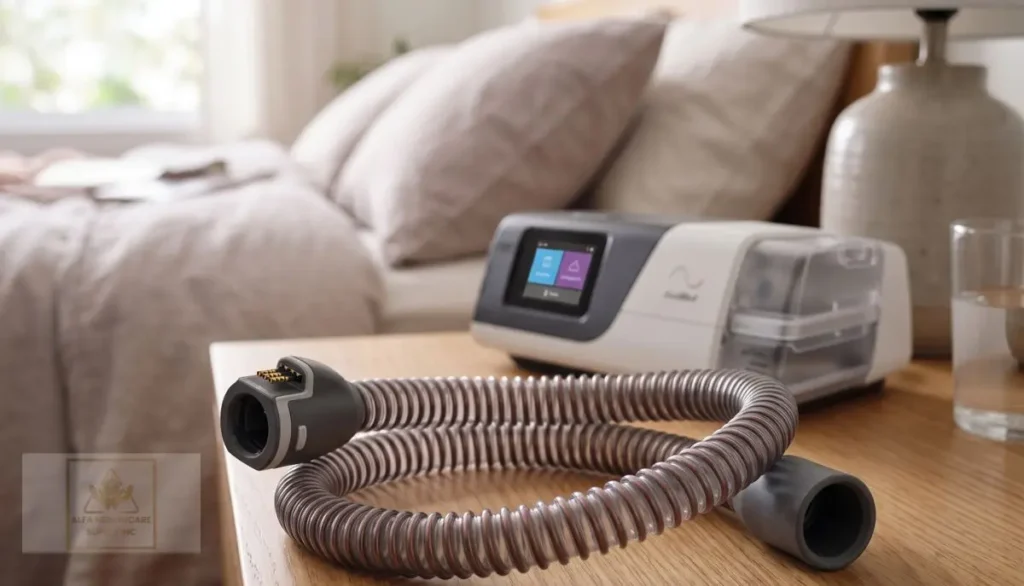
ResMed states that the ClimateLineAir 11 is the heated tubing designed for Air11 devices, including the AirSense 11 and AirCurve 11. When used with the HumidAir 11 humidifier, it also enables the Climate Control feature.
At Alfa Healthcare Supply Inc., we understand that replacing a CPAP tube is not simply about finding a tube that looks similar. Compatibility matters. Your tubing needs to work correctly with your specific CPAP machine and mask setup.
This guide explains what the ClimateLineAir 11 does, how it works, how to install and clean it, how to recognize replacement needs, and what to know before purchasing a new tube.
What Is the ClimateLineAir 11 Heated CPAP Tube for AirSense 11?
The ClimateLineAir 11 heated CPAP tube for AirSense 11 is a heated breathing tube made by ResMed for compatible Air11 devices.
Its basic job is straightforward: it carries air from your CPAP machine to your mask.
The important difference is that the ClimateLineAir 11 contains heating and temperature-sensing technology. This helps the system manage the temperature of humidified air as it travels through the tubing.
ResMed describes ClimateLineAir 11 as a heated breathing tube that delivers air to a compatible mask. When paired with the device humidifier, it allows the Air11 system to use Climate Control.
That can be particularly useful if you use humidification and experience problems such as:
- Dry mouth
- Dry nose
- Uncomfortable airflow
- Condensation inside the tubing
- Water droplets reaching the mask
- Air that feels too cold
- Changes in comfort during different seasons
The heated tube does not replace your humidifier. Instead, it works together with the humidifier and compatible AirSense 11 settings.
Why Does AirSense 11 Use Heated Tubing?
CPAP humidification adds moisture to the air you breathe.
This moisture can make therapy more comfortable, particularly for people who experience dryness while using CPAP. However, there is a simple problem: warm, humid air can cool as it travels through tubing.
When humidified air cools enough, moisture can condense into water droplets.
This is commonly called CPAP rainout.
You may notice:
- Water inside the tubing
- A damp CPAP mask
- Gurgling sounds
- Water droplets around the mask
- An uncomfortable feeling during the night
ResMed explains that Climate Control is designed to help maintain temperature and humidity and reduce the risk of rainout.
The ClimateLineAir 11 helps address this by managing the temperature of the air traveling through the tube.
ClimateLineAir 11 vs. Standard CPAP Tubing
At first glance, standard CPAP tubing and heated CPAP tubing may look similar. They both carry air from the machine to the mask.
The main difference is temperature management.
Standard CPAP tubing
Standard tubing generally carries air without actively heating it.
This can work well for many CPAP users, particularly when humidity and room temperature are comfortable.
ClimateLineAir 11 heated tubing
ClimateLineAir 11 has integrated heating and temperature-sensing technology.
When used with the appropriate AirSense 11 humidification system, the tube works as part of ResMed’s Climate Control system.
This can help provide more consistent temperature and humidity during therapy. ResMed notes that the AirSense 11’s Climate Control Auto feature requires ClimateLineAir heated tubing.
Is ClimateLineAir 11 Compatible With AirSense 11?
Yes.
This is one of the most important points to understand before purchasing replacement tubing.
ResMed identifies the ClimateLineAir 11 as compatible with Air11 devices, including:
- ResMed AirSense 11
- ResMed AirCurve 11
ResMed also states that the ClimateLineAir 11 is the heated tubing compatible with AirSense 11.
This is different from older ClimateLineAir tubing intended for Air10 machines.
Therefore, if you have an AirSense 11, don’t automatically assume that any ResMed heated tube will fit your machine.
The model matters.
ClimateLineAir 11 Is Not the Same as ClimateLineAir for AirSense 10
This is a common source of confusion.
ResMed offers different tubing systems for different generations of machines.
For example:
AirSense 10 / AirCurve 10
→ ClimateLineAir tubing designed for Air10 devices
AirSense 11 / AirCurve 11
→ ClimateLineAir 11 tubing designed for Air11 devices
ResMed specifically identifies ClimateLineAir 11 and ClimateLineAir 11 Oxy as compatible with Air11 devices, while the earlier ClimateLineAir and ClimateLineAir Oxy models are associated with Air10 devices.
So when searching for replacement tubing, look carefully at the model name.
If you have an AirSense 11, searching specifically for “climatelineair 11 heated cpap tube for airsense 11” can help narrow your search to the correct product family.
Key Features of the ClimateLineAir 11 Heated Tube
The ClimateLineAir 11 is designed with several features intended to support CPAP comfort.
1. Heated Air Tubing
The tubing contains heating technology that helps maintain the temperature of the airflow.
This is especially useful when humidification is being used.
2. Temperature Sensor
The tubing includes a temperature sensor near the mask end.
ResMed explains that this sensor helps the system monitor the temperature of air being delivered to the patient.
This is important because the temperature at the machine may not be the same as the temperature closer to your mask.
3. Climate Control Compatibility
When the ClimateLineAir 11 is used with the HumidAir 11 humidifier, AirSense 11 can use Climate Control functionality.
Climate Control is designed to coordinate humidification and tube temperature.
The system can operate in Auto or Manual modes, depending on the device settings.
4. Slim Design
ResMed describes the ClimateLineAir 11 as having a slim design intended to provide flexibility and sleeping comfort.
A flexible tube can be easier to position beside the bed without feeling overly bulky.
5. Designed for Air11 Devices
The ClimateLineAir 11 is specifically designed for the Air11 platform.
That makes compatibility one of its most important characteristics.
What Does Climate Control Do on AirSense 11?
Climate Control is designed to help coordinate temperature and humidity.
With Climate Control Auto, the AirSense 11 can automatically manage humidification and tube temperature based on the system’s settings and operating conditions.
According to ResMed documentation, Auto mode sets the tube temperature to an automatic value of approximately 80°F (27°C), while the user can manually adjust tube temperature within a range of 60°F to 86°F (16°C to 30°C) when appropriate.
The exact comfort setting that works for one person may not work for another.
For example, someone sleeping in a cool bedroom may prefer a different setting from someone sleeping in a warm room.
What If the Air Feels Too Cold?
If CPAP airflow feels unusually cold, several factors may be involved.
Your bedroom temperature can affect how the air feels.
The humidity setting can also affect comfort.
If you’re using a heated tube, the AirSense 11 gives you additional control over tube temperature.
ResMed’s documentation indicates that tube temperature can be adjusted when using appropriate Climate Control settings.
If you are unsure which setting is appropriate for you, start with the machine’s recommended settings and make small adjustments rather than changing multiple settings at once.
If discomfort continues, speak with your healthcare professional or CPAP provider.
What Is CPAP Rainout?
CPAP rainout happens when moisture condenses inside the CPAP tubing or mask.
Think about a cold glass of water on a warm day. Water droplets form on the outside because of condensation.
A similar process can happen inside CPAP equipment.
Humidified air travels through the tubing. If the air cools significantly, moisture can condense.
You may then hear:
- Gurgling
- Popping
- Water movement
Or you may wake up with moisture around your mask.
ResMed describes rainout as moisture that can form when humidified air cools inside tubing.
A heated tube such as ClimateLineAir 11 helps maintain airflow temperature and is designed to work with the AirSense 11 Climate Control system.
How to Set Up the ClimateLineAir 11
Installing the tube is generally straightforward.
ResMed’s user guide provides the following basic setup process.
Step 1: Turn on the device
Make sure your AirSense 11 is connected properly.
Step 2: Locate the machine outlet
The air outlet is located at the rear of the AirSense 11.
Step 3: Connect the heated tube
Hold the cuff of the ClimateLineAir 11 and align it with the machine’s outlet connector.
Push it firmly into place.
The AirSense 11 may briefly display “ClimateLine connected.”
Step 4: Connect your mask
Attach the other end of the tubing to your assembled CPAP mask.
The electrical connector end belongs at the machine end.
ResMed specifically warns that this connector should not be connected to the mask.
How Do You Know the ClimateLineAir 11 Is Connected?
One helpful indication is the AirSense 11 screen.
When the heated tube is connected correctly, the device may briefly display:
ClimateLine connected
This gives you a simple confirmation that the machine has detected the compatible heated tubing.
If the machine does not recognize the tube, check the connection.
Make sure:
- The tubing is fully inserted.
- The correct ClimateLineAir 11 model is being used.
- The machine is powered correctly.
- The tubing connector is not damaged.
If the problem continues, contact your equipment provider or ResMed support.
How to Clean ClimateLineAir 11 Heated CPAP Tubing
Regular cleaning is an important part of CPAP equipment care.
A dirty tube can collect moisture, dust, and residue over time.
ResMed’s guidance recommends washing the ClimateLineAir 11 tubing regularly using warm water and household dishwashing liquid. The manufacturer states that components should not be washed at temperatures above 55°C (131°F).
Basic cleaning process
1. Disconnect the equipment
Unplug the CPAP device before cleaning.
2. Remove the tubing
Carefully disconnect the ClimateLineAir 11 from the AirSense 11 and mask.
3. Wash
Use warm water and mild household dishwashing liquid.
4. Rinse thoroughly
Make sure soap residue is removed.
5. Dry naturally
Allow the tubing to dry away from direct heat and direct sunlight.
6. Reconnect only when completely dry
Do not reconnect wet components to a powered CPAP machine.
ResMed also recommends ensuring components are dry before reconnecting the device to power.
Can You Put ClimateLineAir 11 in Hot Water?
Avoid excessive heat.
ResMed’s cleaning instructions specify that components should not be washed at temperatures above 55°C (131°F).
You do not need extremely hot water to clean CPAP tubing.
Warm water and an appropriate mild dishwashing liquid are sufficient according to the manufacturer’s guidance.
Should You Dry the Heated Tube in Direct Sunlight?
No.
Allow the ClimateLineAir 11 to air dry away from direct heat and sunlight.
This is a simple step, but it matters.
The tubing contains more than just a hollow plastic pathway. It incorporates electrical and sensing components, so treating it carefully is important.
How Often Should You Clean the ClimateLineAir 11?
A regular cleaning routine is recommended.
ResMed’s product guidance provides weekly cleaning information for the ClimateLineAir 11.
A practical routine can include:
Weekly
- Wash the tubing.
- Rinse thoroughly.
- Allow it to air dry.
More frequently when needed
You may need to clean equipment more often if it becomes visibly dirty or contaminated, or if your healthcare provider gives you a different cleaning schedule.
Always follow the current manufacturer’s instructions supplied with your equipment.
When Should You Replace ClimateLineAir 11 Tubing?
A CPAP tube does not necessarily need replacement simply because a certain number of days have passed.
Its condition matters.
Inspect your tubing regularly.
Look for:
- Holes
- Cracks
- Tears
- Damaged connectors
- Loose connections
- Visible deterioration
- Persistent water problems
- Signs that the tube is no longer functioning correctly
ResMed’s product information advises users to regularly inspect ClimateLineAir 11 tubing and replace it if holes, tears, or cracks are found.
Some ResMed product listings specify a six-month design life for ClimateLineAir 11.
However, your healthcare provider, supplier, insurance plan, or equipment replacement schedule may determine when replacement is appropriate.
Signs Your ClimateLineAir 11 May Need Replacement
Sometimes the tube gradually develops problems.
Here are several signs worth checking.
1. Visible Cracks
Cracks can compromise the tubing.
Do not continue using visibly damaged tubing without addressing the problem.
2. Small Holes
Even a small hole can affect the airflow delivered through the system.
3. Damaged Cuff
The cuffs connect the tube to your machine and mask.
If the connection is loose or damaged, replacement may be necessary.
4. Unusual Air Leaks
Not every leak comes from tubing.
A leak can also come from the mask, cushion, connection, or another part of the system.
Inspect the entire setup before deciding that the tube is the cause.
5. Persistent Moisture Problems
If you frequently experience rainout even after appropriate settings and equipment checks, discuss the problem with your CPAP provider.
How Long Is ClimateLineAir 11 Tubing?
The ResMed ClimateLineAir 11 is listed with a 2-meter length in ResMed’s product information. (Resmed Store)
This length is designed for typical bedside CPAP use.
Before purchasing replacement tubing, confirm the product description and model because tubing length and compatibility can vary between products.
ClimateLineAir 11 vs. ClimateLineAir 11 Oxy
These products are related but are not exactly the same.
ClimateLineAir 11
The standard heated tube for compatible Air11 devices.
ClimateLineAir 11 Oxy
A version designed with a built-in oxygen connector for users who require supplemental oxygen.
ResMed describes ClimateLineAir 11 Oxy as a variant of the standard ClimateLineAir 11 with an integrated oxygen connector.
If you do not use supplemental oxygen, you should not assume that you need the Oxy version.
Choose equipment based on your prescribed therapy and equipment requirements.
Does the ClimateLineAir 11 Include Oxygen?
The standard ClimateLineAir 11 is different from the ClimateLineAir 11 Oxy.
The Oxy model has a built-in oxygen connector.
Therefore, when shopping for replacement tubing, carefully check whether the product is:
ClimateLineAir 11
or
ClimateLineAir 11 Oxy
These names describe different configurations.
Can You Use ClimateLineAir 11 Without Humidification?
The tube can carry airflow from the AirSense 11 to a compatible mask, but its Climate Control functionality depends on the appropriate humidification setup.
ResMed states that Climate Control is available when both the ClimateLineAir 11 and HumidAir 11 tub are attached.
Therefore, if your goal is to use the complete AirSense 11 Climate Control system, the humidifier and heated tube work together.
Why Humidification Matters During CPAP Therapy
CPAP airflow can sometimes feel dry.
For some users, this may contribute to:
- Dry mouth
- Dry nose
- Nasal irritation
- Throat discomfort
Humidification adds moisture to the airflow.
ResMed explains that humidification is intended to improve comfort and reduce certain positive-airway-pressure-related side effects.
However, too much humidity can also be uncomfortable.
That’s why the AirSense 11 allows humidity settings to be adjusted.
What If You Have Dry Mouth or Dry Nose?
Dryness can have multiple causes.
It may be related to:
- Humidity settings
- Mouth breathing
- Mask type
- Mask leak
- Bedroom conditions
- Individual sensitivity
ResMed recommends increasing humidity when experiencing dry nose or mouth and decreasing humidity if moisture is appearing in the mask.
If symptoms continue despite adjustments, discuss them with your healthcare professional.
What If There Is Water in the CPAP Mask?
Water inside the mask can be a sign of condensation.
First, check your humidity and tube temperature settings.
If you’re using ClimateLineAir 11, make sure the tubing is properly connected and the Climate Control settings are appropriate.
ResMed explains that Climate Control is designed to help maintain humidity and temperature and protect against rainout.
If the problem continues, your CPAP provider can help determine whether settings, room conditions, tubing position, or another component is responsible.
How to Reduce CPAP Rainout
A few basic practices can help.
Use compatible heated tubing
ClimateLineAir 11 is designed specifically for the Air11 platform.
Check Climate Control
If available and appropriate for your equipment, Climate Control Auto can coordinate temperature and humidity.
Avoid very cold tubing conditions
A cold bedroom can increase the difference between humidified air and the surrounding environment.
Keep tubing positioned comfortably
Avoid placing the tube where it can become extremely cold.
Check humidity
More humidity is not always better.
If water is appearing in your mask, the humidity setting may need adjustment.
How to Choose a Replacement ClimateLineAir 11 Tube
Before purchasing replacement tubing, check these details.
1. Check Your CPAP Machine
Confirm that you have an:
AirSense 11
or another compatible Air11 device.
2. Check the Product Name
Look for:
ClimateLineAir 11
Don’t confuse it with ClimateLineAir tubing for AirSense 10.
3. Check Whether You Need Oxy
If supplemental oxygen is part of your prescribed therapy, discuss the appropriate tubing configuration with your healthcare provider.
The ClimateLineAir 11 Oxy includes an integrated oxygen connector.
4. Inspect Your Existing Tube
If you’re replacing damaged tubing, look for cracks, holes, or connector damage.
5. Confirm Mask Compatibility
The tube connects to a compatible CPAP mask system.
If you’re unsure about a particular mask or adapter, check the manufacturer’s compatibility information or ask your equipment provider.
Common Mistakes When Buying CPAP Tubing
A replacement tube may look correct but still be the wrong model.
Here are common mistakes to avoid.
Mistake 1: Buying based only on appearance
CPAP tubing can look very similar across different machines.
Always check the model.
Mistake 2: Confusing AirSense 10 and AirSense 11
The tubing systems are different.
Mistake 3: Buying Oxy tubing unnecessarily
ClimateLineAir 11 Oxy has a specific oxygen-connector design.
Mistake 4: Ignoring damage
A tube with cracks or holes should not simply be used indefinitely.
Mistake 5: Using damaged connectors
The connection points are important for maintaining the intended airflow path.
ClimateLineAir 11 Heated CPAP Tube: Quick Specifications
| Feature | Details |
| Product | ClimateLineAir 11 |
| Type | Heated breathing/PAP tubing |
| Intended platform | ResMed Air11 devices |
| AirSense 11 compatibility | Yes |
| Length | 2 meters |
| Heated | Yes |
| Temperature sensor | Yes |
| Climate Control | Supported with compatible humidification setup |
| Standard Oxy version | ClimateLineAir 11 Oxy |
| Cleaning | Warm water and mild dishwashing liquid |
| Maximum cleaning temperature stated by ResMed | 55°C / 131°F |
| Design life listed by ResMed | 6 months |
Product specifications should always be confirmed against the current manufacturer’s documentation and the exact item being purchased.
Tips for Better CPAP Comfort
A comfortable CPAP setup is usually about the whole system, not one individual component.
Consider these basic habits:
Keep your equipment clean
Regular cleaning helps maintain good equipment hygiene.
Inspect tubing regularly
Small cracks can become bigger problems.
Check mask fit
If you’re experiencing significant leaks, the mask may need attention rather than the tubing.
Pay attention to humidity
Too little humidity may feel dry, while too much may contribute to condensation.
Use the correct tubing
For an AirSense 11, make sure you’re using tubing designed for the Air11 platform.
Make small adjustments
If you change comfort settings, adjust them gradually so you can understand what improves or worsens your experience.
Buying the ClimateLineAir 11 Heated CPAP Tube
When purchasing a replacement climatelineair 11 heated cpap tube for airsense 11, accuracy matters more than simply choosing the cheapest or most similar-looking tube.
At Alfa Healthcare Supply Inc., we focus on helping customers find medical equipment and supplies that match their needs.
Our product range includes CPAP and respiratory supplies along with other home medical equipment and healthcare products.
Before ordering, confirm:
- Your machine is an AirSense 11.
- You need the ClimateLineAir 11 configuration.
- You are not looking for the Oxy version unless appropriate for your therapy.
- Your mask connection is compatible.
- You understand the manufacturer’s cleaning and replacement instructions.
If you are unsure which tubing configuration is appropriate, speak with your healthcare provider or qualified medical equipment supplier.
Why the Right CPAP Tube Matters
It’s easy to think of CPAP tubing as just a plastic hose.
In reality, the tubing is an important part of the therapy setup.
Air travels through it every night.
For users who rely on humidification, temperature can directly affect comfort. If the air becomes too cold, humidified air may condense. If the air feels too warm or humid, therapy can also become uncomfortable.
The ClimateLineAir 11 is designed to work as part of the AirSense 11’s broader humidification and temperature-management system.
That is why selecting the correct replacement tube matters.
A Simple Daily CPAP Routine
A few small habits can make CPAP care easier.
Before bed
Check that:
- The tube is securely connected.
- The mask is properly assembled.
- The tubing has no visible damage.
- The humidifier has the appropriate water level if you’re using humidification.
During the night
Pay attention to:
- Dryness
- Excess moisture
- Gurgling sounds
- Unusual airflow
- Mask leaks
In the morning
Check whether:
- There is water in the mask.
- The tubing is excessively wet.
- Any component appears damaged.
If something changes suddenly or repeatedly, contact your equipment provider or healthcare professional.
Final Thoughts
The ClimateLineAir 11 heated CPAP tube for AirSense 11 is more than a basic connection between a CPAP machine and mask. It is part of ResMed’s Air11 humidification and Climate Control system, designed to help manage the temperature of humidified airflow as it travels toward the mask.
For AirSense 11 users, choosing the correct tubing is important because Air10 and Air11 accessories are not automatically interchangeable. ResMed specifically identifies ClimateLineAir 11 as the heated tubing compatible with Air11 devices.
With proper installation, routine cleaning, regular inspection, and appropriate settings, the tubing can become a simple and dependable part of your nightly CPAP routine.
At Alfa Healthcare Supply Inc., our goal is to make medical equipment shopping easier to understand. If you are replacing your CPAP tubing, take a moment to verify your machine model and the exact tubing configuration before ordering.
The right accessory should fit your equipment—and fit naturally into your everyday routine.
Frequently Asked Questions About ClimateLineAir 11
Is ClimateLineAir 11 compatible with AirSense 11?
Yes. ResMed identifies ClimateLineAir 11 as compatible with Air11 devices, including AirSense 11.
Is ClimateLineAir 11 heated?
Yes. It is a heated breathing tube designed for compatible ResMed Air11 devices.
What is the ClimateLineAir 11 length?
ResMed product information lists the tubing length as 2 meters.
Does ClimateLineAir 11 help prevent rainout?
It is designed to help maintain airflow temperature and work with Climate Control to reduce the risk of condensation or rainout.
Can I use ClimateLineAir 10 tubing with AirSense 11?
Do not assume that Air10 tubing is compatible with AirSense 11. ResMed identifies ClimateLineAir 11 as the heated tubing for Air11 devices.
How do I clean ClimateLineAir 11?
Disconnect the equipment, wash the tube in warm water with household dishwashing liquid, rinse thoroughly, and allow it to dry away from direct heat and sunlight. ResMed advises not washing components above 55°C/131°F.
How often should I inspect my CPAP tube?
Check it regularly for holes, tears, cracks, or other damage. ResMed recommends replacing the tube if these problems are found.
What is ClimateLineAir 11 Oxy?
It is a version of the ClimateLineAir 11 with a built-in oxygen connector for people who require supplemental oxygen.
Does AirSense 11 require heated tubing?
The AirSense 11 can be used with different tubing configurations, but ResMed states that ClimateLineAir heated tubing is required for the Climate Control Auto feature.
Why does my CPAP mask have water in it?
Water can result from condensation, commonly called rainout. Temperature, humidity, room conditions, and tubing configuration can all affect condensation.
Can I adjust ClimateLineAir 11 temperature?
With the appropriate Climate Control settings, tube temperature can be adjusted. ResMed documentation lists a manual tube-temperature range of approximately 60°F to 86°F (16°C to 30°C).
ClimateLineAir™ 11 Heated Tubing:
If you use a ResMed AirSense 11 CPAP machine, the tubing you connect to your mask is more important than it may first appear. A good CPAP tube needs to deliver airflow reliably, fit your machine correctly, and work well with your humidification setup. For users who want heated humidification and Climate Control features, ClimateLineAir™ 11 heated tubing is specifically designed for the Air11 platform.
At Alfa Healthcare Supply Inc., we understand that CPAP accessories can sometimes be confusing. There are several ResMed tubing names that look similar, and choosing the wrong version can result in a compatibility problem. This guide explains what climatelineair tm 11 heated tubing is, how it works, which machines it fits, how it connects, how to clean it, when replacement may be needed, and what to check before ordering.
What Is ClimateLineAir™ 11 Heated Tubing?
ClimateLineAir 11 heated tubing is a heated breathing tube designed for compatible ResMed Air11 devices. Its primary job is to carry pressurized therapy air from the CPAP device to the patient’s mask while helping control the temperature of humidified air.
ResMed identifies ClimateLineAir 11 as the heated tubing compatible with the AirSense 11. When it is used with the appropriate HumidAir 11 humidifier, the tubing enables the AirSense 11’s Climate Control functionality.
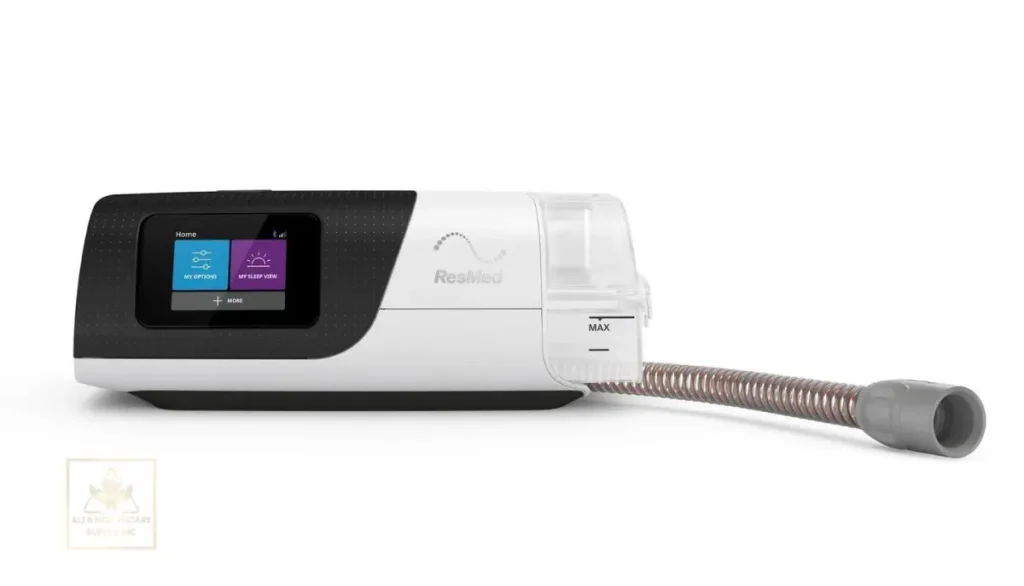
The word “heated” can be slightly misleading if you have never used heated CPAP tubing. The purpose is not simply to make the air hot. Instead, the system is designed to help maintain a comfortable temperature as humidified air travels through the tubing toward the mask.
That can be particularly useful for people who experience:
- Dryness during CPAP therapy
- A dry nose or mouth
- Condensation in the tube or mask
- Uncomfortable cool airflow
- Changes in comfort when bedroom temperature changes
The ClimateLineAir 11 works as part of the overall ResMed humidification system rather than functioning as an independent heating device.
Why Does Heated CPAP Tubing Matter?
A CPAP machine can add moisture to therapy air through its humidifier. However, that warm, humidified air still needs to travel through the tube before reaching your mask.
The environment around the tubing can affect that airflow.
For example, imagine using your CPAP machine in a cool bedroom. The humidified air leaves the machine and travels through tubing exposed to cooler room air. As the air cools, moisture can condense inside the tube.
This is commonly called rainout.
Water droplets may collect inside the tubing or appear around the mask. Depending on the situation, this can be noisy or uncomfortable and may interrupt sleep.
ClimateLineAir 11 is designed to help manage temperature as part of the Climate Control system. ResMed states that Climate Control is intended to maintain temperature and humidity during therapy, helping provide comfortable humidification.
This is one reason the correct heated tube can be an important part of an AirSense 11 setup.
ClimateLineAir™ 11 and AirSense 11 Compatibility
One of the most important things to understand before buying replacement tubing is compatibility.
Not every ResMed ClimateLineAir tube is intended for every ResMed CPAP machine.
The AirSense 11 belongs to ResMed’s Air11 platform. ResMed specifically states that ClimateLineAir 11 is the heated tubing compatible with AirSense 11.
Basic compatibility guide
| ResMed machine | Appropriate tubing |
| AirSense 11 | ClimateLineAir 11 |
| AirCurve 11 | ClimateLineAir 11 |
| AirSense 10 | ClimateLineAir for Air10 |
| AirCurve 10 | ClimateLineAir for Air10 |
ResMed’s current product information identifies ClimateLineAir 11 and ClimateLineAir 11 Oxy as accessories for Air11 devices, including AirSense 11 and AirCurve 11. Air10 devices use the corresponding Air10 ClimateLineAir tubing.
Do not choose a replacement tube based only on the words “ClimateLineAir.”
Check the number associated with the tubing and, most importantly, check the model of your CPAP machine.
What Does the “11” Mean?
The “11” in ClimateLineAir 11 refers to the Air11 generation of ResMed devices.
This distinction is important because ResMed also has ClimateLineAir tubing designed for Air10 machines.
For example:
- ClimateLineAir for Air10 → AirSense 10 / AirCurve 10
- ClimateLineAir 11 → AirSense 11 / AirCurve 11
The tubing may look similar at first glance, but compatibility is not something you should guess.
If your machine is an AirSense 11, look specifically for ClimateLineAir 11 heated tubing.
How Does ClimateLineAir 11 Work?
The process is easier to understand when you think about the complete therapy system.
Step 1: The CPAP machine generates airflow
Your AirSense 11 generates pressurized air according to your prescribed therapy settings.
Step 2: The humidifier adds moisture
When the HumidAir 11 humidifier is being used, moisture is added to the therapy airflow.
Step 3: Air enters the heated tube
The humidified air travels through the ClimateLineAir 11 tubing.
Step 4: The tube helps manage temperature
The ClimateLineAir 11 system uses temperature-sensing technology as part of the Climate Control system.
Step 5: Air reaches the mask
The conditioned airflow continues from the tubing to your compatible CPAP mask.
This system is designed to provide a more controlled temperature and humidity experience during therapy. ResMed describes the ClimateLineAir 11 as having a built-in sensor and explains that, when paired with a compatible HumidAir humidifier and Climate Control Auto, the system can automatically manage humidity and temperature.
ClimateLineAir 11 Built-In Temperature Sensor
One useful feature of ClimateLineAir 11 is its temperature-sensing technology.
ResMed describes the tubing as having a built-in sensor that monitors temperature. When paired with the compatible humidifier and Climate Control Auto, the system can automatically adjust humidity and temperature management.
This helps explain why ClimateLineAir 11 is more than an ordinary CPAP hose.
The tubing is part of the communication between the CPAP machine and the humidification system.
Instead of treating the tube as simply a passage for air, the Climate Control system uses it as part of the overall comfort-management setup.
Climate Control Auto With ClimateLineAir 11
One of the reasons many AirSense 11 users choose heated tubing is access to Climate Control features.
ResMed states that Climate Control Auto is available when ClimateLineAir 11 tubing and the HumidAir 11 tub are attached.
In simple terms, the system is designed to help maintain an appropriate balance between humidity and temperature.
This can be useful if your comfort changes from night to night.
For example, your bedroom might be:
- Warm during summer
- Cool during winter
- More humid on some nights
- Drier when indoor heating is running
Your CPAP environment can change along with the room.
Climate Control is designed to help manage those conditions rather than requiring the user to constantly make manual adjustments.
Manual Climate Control Settings
AirSense 11 users can also have manual control depending on their setup.
ResMed explains that Climate Control can be used in Auto or Manual mode. With Manual settings, temperature and humidity can be adjusted independently.
This can be useful when you already know what feels comfortable.
For example, one person may prefer warmer air, while another may prefer a lower temperature.
There is no single comfort setting that works for every CPAP user.
If you are unsure how to adjust your therapy settings, follow your device instructions or speak with your healthcare professional rather than making changes to prescribed therapy settings on your own.
ClimateLineAir 11 and Dry Nose or Mouth
Dryness is a common concern for people using CPAP therapy.
ResMed explains that humidification can help with symptoms such as dry mouth and nasal congestion. Its AirSense 11 guidance also notes that users experiencing a dry nose or mouth may increase humidity, while moisture appearing in the mask may indicate that humidity should be reduced.
The heated tubing can be part of this humidification system.
However, a dry mouth or nose does not always mean that the tube itself is the problem.
Other factors may include:
- Humidity settings
- Mask fit
- Mouth breathing
- Bedroom conditions
- Nasal congestion
- Individual therapy needs
If dryness continues despite appropriate adjustments, discuss it with your healthcare provider.
Can ClimateLineAir 11 Help With Rainout?
It can be part of a system designed to reduce condensation.
Rainout happens when humidified air cools enough for water to condense inside the tubing or mask.
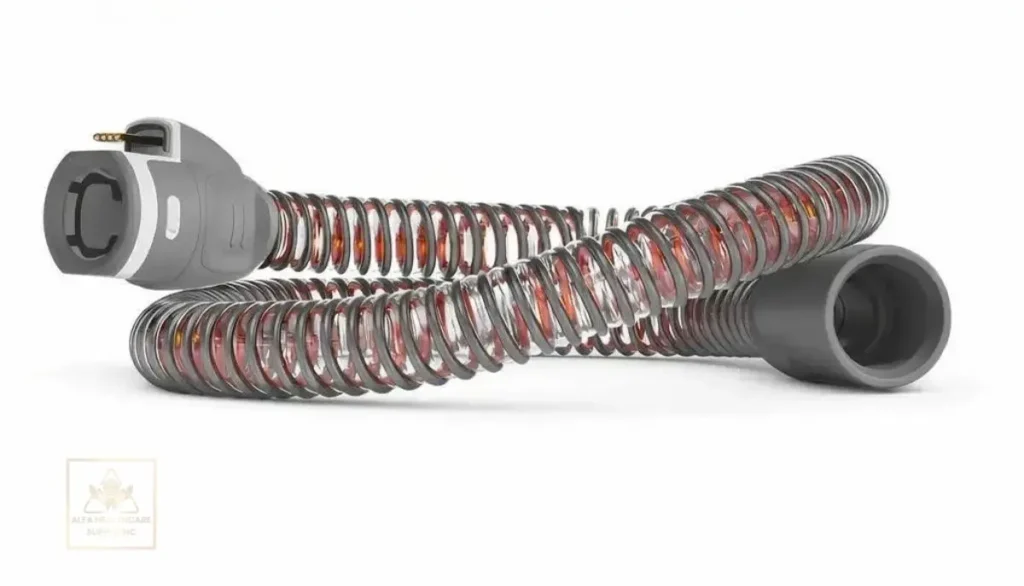
ClimateLineAir 11 is designed to help maintain temperature along the air path. ResMed describes heated tubing and Climate Control as ways to help manage humidification and reduce condensation.
Still, rainout can have multiple causes.
Room temperature, humidity level, tube temperature, and CPAP settings can all affect condensation.
If you notice water in your tube:
- Check your humidity setting.
- Check your temperature setting if using Manual Climate Control.
- Make sure the tubing is connected correctly.
- Consider the temperature of the bedroom.
- Review the setup with your healthcare provider if the problem continues.
Do not assume that simply increasing every setting will solve the issue.
ClimateLineAir 11 Heated Tubing Specifications
ResMed product information lists ClimateLineAir 11 as a heated tube for Air11 devices.
ResMed’s U.S. shop lists the product dimensions as 6.5 feet, with 22 mm cuffs/connectors and a 15 mm inner diameter.
ResMed’s UK product listing gives a tube length of 2 meters, which is consistent with the commonly listed approximate length for this tubing.
Commonly listed details
- Product: ClimateLineAir 11 heated tubing
- Intended platform: ResMed Air11
- Compatible devices: AirSense 11 and AirCurve 11
- Approximate length: 6.5 feet / 2 meters
- Inner diameter: 15 mm
- Cuffs/connectors: 22 mm
- Heated tubing
- Designed for Climate Control functionality when used with compatible humidification
Always check the current product documentation and supplier information for the version being purchased.
ClimateLineAir 11 vs Standard CPAP Tubing
You may wonder why you need heated tubing when a standard CPAP tube can also move air.
The key difference is temperature management.
Standard tubing
A standard tube primarily transports therapy air from the CPAP device to the mask.
ClimateLineAir 11
ClimateLineAir 11 transports therapy air while participating in ResMed’s Climate Control system.
The difference becomes especially relevant when humidification is being used.
A standard tube may be perfectly suitable for some users, while another person may prefer heated tubing because of comfort or condensation concerns.
The appropriate setup depends on the machine, humidifier, therapy requirements, and personal comfort.
ClimateLineAir 11 vs ClimateLineAir for Air10
This is one of the most common areas of confusion.
Both products are called ClimateLineAir, but they are designed for different device generations.
AirSense 10
Uses the appropriate ClimateLineAir tubing designed for the Air10 platform.
AirSense 11
Uses ClimateLineAir 11.
ResMed’s documentation specifically identifies ClimateLineAir 11 as the heated tubing compatible with AirSense 11.
Before placing an order, look at your machine.
If it says AirSense 11, search for ClimateLineAir 11 heated tubing, not simply any ClimateLineAir tube.
What About ClimateLineAir 11 Oxy?
There is also a product called ClimateLineAir 11 Oxy.
This is a different version intended for situations involving supplemental oxygen.
ResMed describes ClimateLineAir 11 Oxy as a variant with a built-in oxygen connector.
That does not mean every AirSense 11 user needs the Oxy version.
If you do not use supplemental oxygen, do not assume that the Oxy version is necessary.
If supplemental oxygen is part of your prescribed therapy, discuss the appropriate equipment with your healthcare provider or DME supplier.
How to Connect ClimateLineAir 11 to AirSense 11
Connecting the tube is straightforward when using the correct equipment.
According to the ResMed ClimateLineAir 11 user guide:
1. Turn on the device
Make sure your AirSense 11 is connected to power.
2. Locate the air outlet
The tubing connects to the air outlet at the rear of the machine.
3. Align the tube
Hold the cuff of the heated tube and line it up with the device outlet.
4. Push it firmly into place
The tube should be securely connected.
The AirSense 11 should briefly display “ClimateLine connected” when the heated tubing is recognized.
5. Connect your mask
Attach the free end of the tubing to the assembled mask.
One important detail from ResMed’s instructions is that the electrical connector end of the heated tubing is designed for the device side and should not be connected to the mask.
How Do You Know the ClimateLineAir 11 Is Connected Correctly?
The AirSense 11 can recognize the heated tube.
After connecting it correctly, the machine can briefly display “ClimateLine connected.”
If your machine does not recognize the tube:
- Stop therapy.
- Check the connection at the machine.
- Make sure the connector is fully inserted.
- Inspect the tube for damage.
- Restart or reconnect according to the device instructions.
- Contact your equipment provider if the problem continues.
Do not force a connector into a port.
How to Clean ClimateLineAir 11 Heated Tubing
Regular cleaning is an important part of CPAP equipment care.
ResMed’s product guidance recommends regular inspection and cleaning of ClimateLineAir 11 tubing. The ResMed shop guidance states that the tubing can be washed weekly in warm water using household dishwashing liquid, rinsed thoroughly, and allowed to dry away from direct heat and sunlight. It also advises that components should not be washed at temperatures above 55°C (131°F).
Simple cleaning routine
Step 1: Disconnect the tube
Remove the tubing from the CPAP device and mask.
Step 2: Wash
Use warm water and an appropriate mild household dishwashing liquid.
Step 3: Rinse
Rinse the tubing thoroughly.
Step 4: Dry
Allow the tubing to air-dry away from direct sunlight and direct heat.
Step 5: Inspect
Look for cracks, holes, tears, or other visible damage before reconnecting it.
Always follow the current user guide supplied with your equipment.
What Should You Avoid When Cleaning Heated Tubing?
Because ClimateLineAir 11 contains electrical components, careful cleaning is important.
Avoid:
- Submerging electrical connectors improperly
- Using very hot water
- Using aggressive chemicals
- Using direct heat to dry the tube
- Leaving the tube wet before reconnecting it
- Pulling forcefully on the connector
The manufacturer’s instructions should take priority over generic CPAP-cleaning advice.
If your particular product documentation gives different instructions, follow the product documentation.
When Should You Replace ClimateLineAir 11 Tubing?
A CPAP tube is a replacement accessory, not something you should expect to keep forever.
Inspect the tube regularly.
Signs that replacement may be appropriate include:
- Cracks
- Holes
- Tears
- Damaged cuffs
- Loose connections
- Visible deterioration
- Persistent air leaks
- Physical damage to the connector
- Problems that continue after checking the setup
ResMed’s product guidance specifically recommends checking ClimateLineAir 11 tubing regularly and replacing it if holes, tears, or cracks are found.
A damaged tube can interfere with your therapy system.
Why Does CPAP Tubing Develop Problems?
CPAP tubing is used every night in many homes. It can be bent, moved, cleaned, connected, disconnected, and stored repeatedly.
Over time, normal wear can occur.
The tubing may be affected by:
- Frequent handling
- Repeated bending
- Cleaning
- Pulling from the mask
- Improper storage
- Accidental crushing
- Pets
- Normal material aging
That is why a quick visual inspection is worthwhile.
You do not need to be an equipment expert to look for obvious physical damage.
Signs Your ClimateLineAir 11 May Need Attention
Sometimes the first sign of a tubing problem is not a visible hole.
You may notice:
- Unexpected air leakage
- A loose connection
- Unusual airflow
- Moisture problems
- The machine not recognizing the heated tube
- Visible damage
- Changes in comfort
These symptoms do not automatically prove that the tube is defective.
For example, an air leak can also come from the mask, while dryness may relate to humidification settings.
Think of your CPAP setup as a system rather than assuming one component is always responsible.
Does ClimateLineAir 11 Make the Air Hot?
Not necessarily.
The purpose of the heated tubing is to help manage temperature as part of the Climate Control system.
ResMed’s healthcare professional information describes temperature adjustment within a range of approximately 16°C to 30°C when using the relevant manual temperature controls.
The goal is comfortable therapy, not maximum heat.
If the airflow feels too warm or too cool, review your device settings and follow your healthcare professional’s guidance.
Can ClimateLineAir 11 Improve CPAP Comfort?
It may help make therapy more comfortable for some users, particularly when humidification and condensation are concerns.
ResMed describes ClimateLineAir 11 as part of its Climate Control solution and says the system is designed to provide comfortable temperature and humidity during therapy.
However, comfort is personal.
One CPAP user may love heated tubing, while another may be comfortable with standard tubing.
The important point is to use equipment that is compatible with your machine and appropriate for your prescribed therapy.
Flexible Design for Nighttime Use
Nobody wants CPAP tubing to feel like a stiff hose pulling against the mask.
ResMed describes ClimateLineAir 11 as having a flexible design intended to support sleeping comfort.
Good tube positioning can also help.
Try to arrange the tubing so it has enough room to move without pulling tightly on the mask.
Many users route the tube upward toward the head of the bed or along a bedside surface, depending on their setup.
The important thing is to avoid sharp bends and unnecessary tension.
Tips for Using ClimateLineAir 11 More Comfortably
Here are several practical habits that can make nighttime CPAP use easier.
1. Check the tube before bedtime
Look for obvious cracks or damage.
2. Avoid sharp bends
Allow the tube to curve naturally.
3. Keep the tube away from excessive heat
Do not place it directly against a heater.
4. Keep connections secure
Check both the machine and mask ends.
5. Use your humidifier correctly
Follow your AirSense 11 instructions.
6. Pay attention to condensation
If water appears in the tube, review humidity and temperature settings.
7. Clean regularly
Follow the manufacturer’s cleaning instructions.
8. Replace damaged tubing
Do not continue using a visibly damaged tube simply because it still appears to deliver air.
Common Mistakes When Buying ClimateLineAir 11 Tubing
A few simple purchasing mistakes are easy to avoid.
Mistake 1: Buying the wrong generation
A ClimateLineAir tube for AirSense 10 is not the same choice as ClimateLineAir 11 for AirSense 11.
Mistake 2: Ignoring the exact machine model
Always verify whether your machine is AirSense 10, AirSense 11, AirCurve 10, or AirCurve 11.
Mistake 3: Assuming every tube has the same connector
CPAP accessories can look similar while having different compatibility requirements.
Mistake 4: Buying Oxy tubing without understanding why
ClimateLineAir 11 Oxy includes an oxygen connector for supplemental oxygen applications. It is not automatically required for every AirSense 11 user.
Mistake 5: Waiting until the tube is completely unusable
Regular inspection can help identify damage before it becomes a bigger inconvenience.
How to Choose the Right ClimateLineAir 11 Tubing
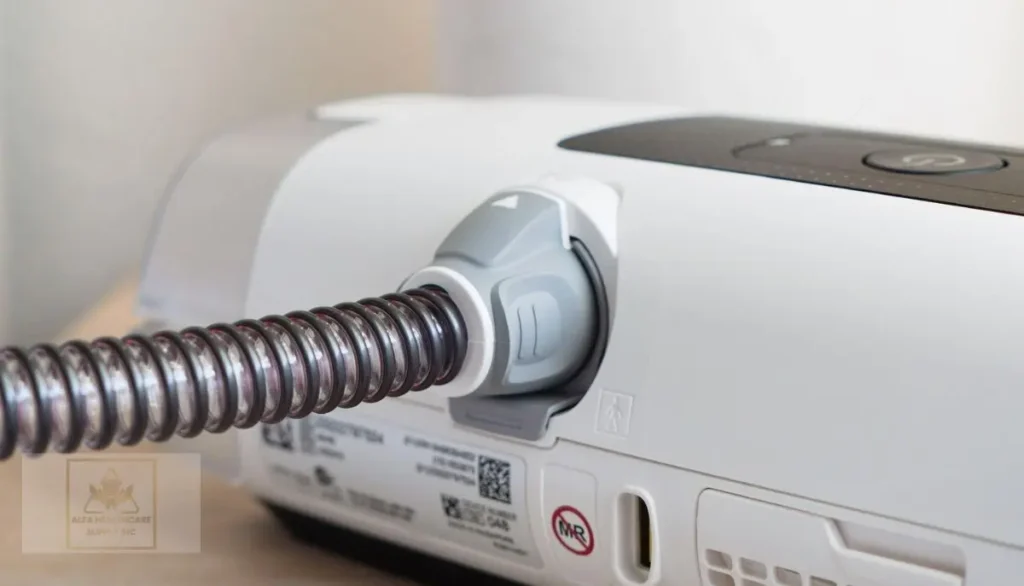
Before purchasing, use this simple checklist.
Check your CPAP machine
Look for the model name.
Confirm the platform
If you have an AirSense 11 or AirCurve 11, ClimateLineAir 11 is the relevant heated tubing family.
Decide whether you need the Oxy version
If supplemental oxygen is prescribed, ask your healthcare provider or DME supplier which configuration is appropriate.
Inspect your current tube
If you are replacing an existing tube, check for cracks, tears, or connector damage.
Confirm product details
Check the current manufacturer’s specifications before ordering.
Ask when uncertain
A medical equipment supplier can help verify compatibility before you purchase.
Why Work With a Medical Supply Provider?
Buying medical equipment is different from buying an ordinary household hose.
The product may look simple, but compatibility can matter.
A medical supply provider can help you check:
- Device model
- Tubing type
- Replacement needs
- Mask compatibility
- Humidification accessories
- Prescription requirements
- Available alternatives
At Alfa Healthcare Supply Inc., we focus on helping patients and caregivers find medical equipment and supplies for home healthcare needs.
Our product categories include respiratory supplies, DME, diabetic supplies, incontinence supplies, orthopedic products, mobility equipment, foot care, and other medical supplies.
For customers who already know they need ClimateLineAir 11, having the exact CPAP machine model available makes the ordering process much easier.
ClimateLineAir 11 for AirSense 11: Quick Facts
| Question | Answer |
| What is it? | Heated CPAP breathing tubing |
| Primary compatible platform | ResMed Air11 |
| Compatible with AirSense 11? | Yes |
| Compatible with AirCurve 11? | Yes |
| Designed for AirSense 10? | No; use the appropriate Air10 ClimateLineAir |
| Approximate length | 6.5 ft / 2 m |
| Inner diameter | 15 mm |
| Cuff/connector diameter | 22 mm |
| Works with Climate Control? | Yes, when used with compatible HumidAir 11 humidification |
| Does it help manage condensation? | It is designed to help reduce condensation as part of the Climate Control system |
| Is it the same as ClimateLineAir 11 Oxy? | No; Oxy includes an oxygen connector |
Specifications are based on current ResMed product and support documentation and can vary by regional product listing.
A Simple Way to Remember It
If you want one easy rule, remember:
AirSense 11 → ClimateLineAir 11.
That simple connection can prevent one of the most common CPAP accessory purchasing mistakes.
If you use an AirSense 11 and want heated humidification, ClimateLineAir 11 is specifically designed for that Air11 platform. When combined with the HumidAir 11 humidifier, it supports ResMed’s Climate Control system for managing temperature and humidity during therapy.
Final Thoughts
CPAP therapy is a nightly routine, so small comfort details can make a meaningful difference in how easy the equipment feels to use.
ClimateLineAir TM 11 heated tubing is not simply a replacement hose. It is a heated component designed specifically for ResMed’s Air11 platform and works with the compatible humidification system to help manage temperature and humidity.
For AirSense 11 users, the most important things to remember are:
- Choose tubing designed for your exact CPAP platform.
- ClimateLineAir 11 is designed for Air11 devices.
- It works with the HumidAir 11 humidifier as part of Climate Control.
- The system can help manage humidity and temperature.
- Heated tubing can help address condensation concerns.
- Inspect the tubing regularly.
- Clean it according to the manufacturer’s instructions.
- Replace tubing when it becomes damaged.
- Ask a healthcare professional or DME supplier if you are unsure about compatibility.
At Alfa Healthcare Supply Inc., we believe medical supplies should be easier to understand. If you are looking for CPAP tubing, respiratory equipment, or other home medical supplies, knowing your exact machine model is the first step toward finding the appropriate accessory.
A few minutes spent checking compatibility can save you the frustration of ordering a tube that does not fit your CPAP machine. For an AirSense 11 setup, look specifically for ClimateLineAir 11 heated tubing and verify the product details before purchasing.
Source note: Product specifications and compatibility information in this article are based primarily on current ResMed documentation and product information, with Alfa Healthcare Supply Inc. information used for supplier context. Product availability, regional labeling, and prescription requirements can vary by location.
Frequently Asked Questions About ClimateLineAir™ 11 Heated Tubing
What is ClimateLineAir TM 11 heated tubing?
ClimateLineAir™ 11 heated tubing is a ResMed heated breathing tube designed for compatible Air11 devices. It works with the humidification system to help manage temperature and humidity during CPAP therapy.
Is ClimateLineAir 11 compatible with AirSense 11?
Yes. ResMed identifies ClimateLineAir 11 as the heated tubing compatible with AirSense 11.
Does ClimateLineAir 11 work with AirCurve 11?
Yes. ResMed lists ClimateLineAir 11 as compatible with Air11 devices, including AirCurve 11.
Can I use ClimateLineAir for Air10 with AirSense 11?
You should use the tubing designed for your machine platform. ResMed identifies ClimateLineAir 11 for Air11 devices and the standard ClimateLineAir family for Air10 devices.
What is the length of ClimateLineAir 11?
ResMed listings identify the tube as approximately 6.5 feet or 2 meters long.
Is ClimateLineAir 11 heated?
Yes. It is heated air tubing designed to work as part of ResMed’s Climate Control humidification system.
Does ClimateLineAir 11 reduce rainout?
It is designed to help manage temperature and reduce condensation when used as part of the appropriate humidification system. However, condensation can have several causes, including humidity and room temperature.
Can I clean ClimateLineAir 11 tubing?
Yes. ResMed’s cleaning guidance recommends washing the tubing with warm water and household dishwashing liquid, rinsing thoroughly, and allowing it to dry away from direct heat and sunlight.
How often should I inspect the tubing?
Inspect it regularly for cracks, holes, tears, and other damage. Replace damaged tubing according to the manufacturer’s guidance.
What does “ClimateLine connected” mean?
When the ClimateLineAir 11 is connected correctly, the AirSense 11 can briefly display “ClimateLine connected,” indicating that the machine has recognized the heated tube.
Does ClimateLineAir 11 include the CPAP machine?
No. It is replacement heated tubing. ResMed’s product listing states that the purchase does not include the CPAP machine or complete humidification system.
What is ClimateLineAir 11 Oxy?
ClimateLineAir 11 Oxy is a version of the heated tubing that includes a built-in oxygen connector for compatible supplemental oxygen applications.
Do I need ClimateLineAir 11 if I use an AirSense 11?
Not every user necessarily needs heated tubing for the same reasons. However, ClimateLineAir 11 is the ResMed heated tubing designed for AirSense 11, and it is required for the AirSense 11 Climate Control Auto feature.
Can I adjust the temperature?
Climate Control can be configured depending on your AirSense 11 setup. Manual Climate Control allows temperature and humidity to be adjusted independently.
ClimateLineAir 11 Heated Tubing With Oxygen Adapter
When you use CPAP therapy every night, the small parts of your equipment can make a surprisingly big difference. The mask gets most of the attention, and the CPAP machine is usually the first thing people think about, but the tubing also plays an important role. It carries the therapy air from your machine to your mask, and the right tubing can make your setup more comfortable and easier to manage.
For people who use a compatible ResMed AirSense 11 or AirCurve 11 device and also have prescribed supplemental oxygen, the ClimateLineAir 11 heated tubing with oxygen adapter can be an important part of the therapy setup.
The ResMed ClimateLineAir 11 Oxy is heated air tubing designed for compatible Air11 devices. It includes an integrated oxygen connector, allowing supplemental oxygen to be introduced into the therapy system when prescribed. ResMed also explains that the tubing can work with the device humidifier to enable the Climate Control feature.
At Alfa Healthcare Supply Inc., we understand that replacing CPAP supplies can sometimes feel confusing. There are different generations of ResMed machines, different tubing options, heated and non-heated tubes, and products that look almost identical.
That is why choosing the correct tubing matters.
This guide explains what the climatelineair 11 heated tubing with oxygen adapter is, how the oxygen connection works, which machines it fits, how it differs from standard ClimateLineAir tubing, how to set it up, cleaning considerations, safety information, and what to check before purchasing.
What is ClimateLineAir 11 Heated Tubing With Oxygen Adapter?
The climatelineair 11 heated tubing with oxygen adapter refers to the ResMed ClimateLineAir 11 Oxy heated air tubing designed for compatible Air11 devices.
In simple terms, it is a heated CPAP tube that connects your compatible ResMed device to your mask and includes a built-in oxygen connector for supplemental oxygen.
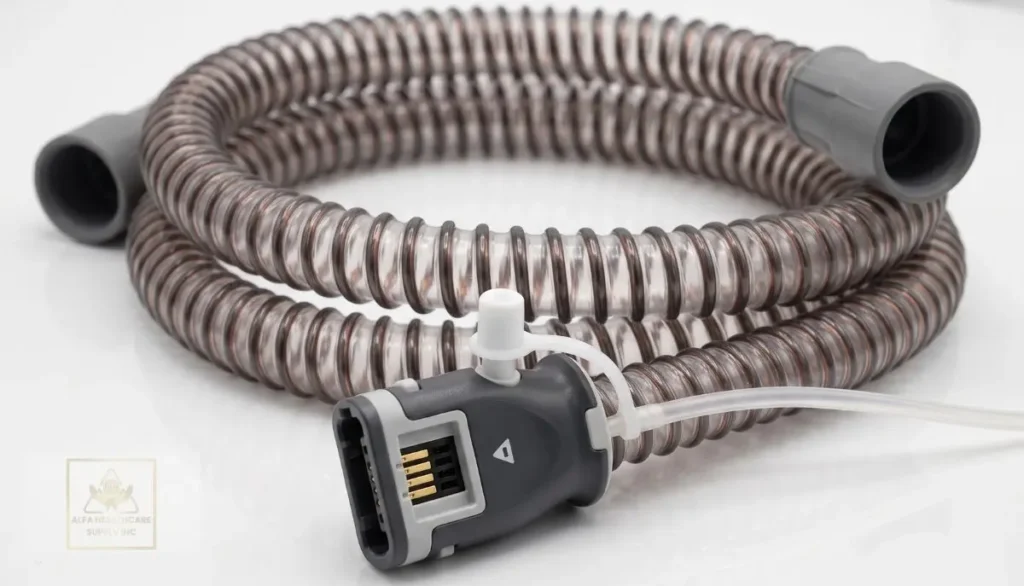
The word “Oxy” is important.
Standard ClimateLineAir 11 tubing provides heated air delivery for compatible Air11 devices. The ClimateLineAir 11 Oxy version adds an integrated oxygen port for people who have a prescribed need for supplemental oxygen. ResMed specifically identifies the ClimateLineAir 11 Oxy as compatible with AirSense 11 and AirCurve 11 devices.
The tubing is therefore more than an ordinary CPAP hose.
It combines:
- Heated air tubing
- Air11 compatibility
- An integrated oxygen connector
- Compatibility with the appropriate ResMed humidification system
- Support for Climate Control when the compatible humidifier is attached
The purpose is to provide a practical connection between your PAP device, mask, and supplemental oxygen setup.
Why Heated CPAP Tubing Matters
A CPAP machine sends pressurized air through tubing to your mask. When humidification is used, that air also contains moisture.
Without appropriate temperature management, moisture can condense inside the tubing. CPAP users often call this rainout.
Rainout can result in water collecting inside the tubing or reaching the mask.
It can be uncomfortable.
You may hear water sounds during the night, feel moisture around the mask, or wake up because of condensation.
Heated tubing is designed to help manage the temperature of the therapy air as it travels through the tube.
ResMed describes ClimateLineAir heated tubing as part of its Climate Control solution. For Air11 devices, ClimateLineAir 11 and ClimateLineAir 11 Oxy are designed to work with compatible Air11 systems.
For someone who uses CPAP every night, comfort is not a small issue.
A tube that works properly with your machine and humidifier can make the entire therapy setup feel easier to use.
What Does the Oxygen Adapter Do?
The integrated oxygen connector is one of the most important features of the ClimateLineAir 11 Oxy.
It provides a connection point for supplemental oxygen tubing when oxygen has been prescribed as part of the patient’s therapy.
This does not mean the ClimateLineAir 11 Oxy creates oxygen.
It does not replace an oxygen concentrator or oxygen supply.
Instead, it provides a designed connection point where supplemental oxygen can enter the PAP therapy system.
ResMed’s documentation describes the ClimateLineAir 11 Oxy as heated air tubing intended to deliver heated air to a compatible mask with or without supplemental oxygen.
That distinction is important.
Think of the system this way:
CPAP device → heated tubing → mask
With prescribed supplemental oxygen, the setup can incorporate:
CPAP device + supplemental oxygen → ClimateLineAir 11 Oxy → mask
The exact oxygen equipment and prescribed flow should always follow the instructions from the patient’s healthcare professional and oxygen equipment provider.
ClimateLineAir 11 vs. ClimateLineAir 11 Oxy
One of the most common purchasing mistakes is confusing the standard ClimateLineAir 11 tube with the ClimateLineAir 11 Oxy tube.
They are very similar.
Both are heated tubing products designed for Air11 devices.
The major difference is the oxygen connector.
| Feature | ClimateLineAir 11 | ClimateLineAir 11 Oxy |
| Heated tubing | Yes | Yes |
| Air11 compatibility | Yes | Yes |
| AirSense 11 compatibility | Yes | Yes |
| AirCurve 11 compatibility | Yes | Yes |
| Humidification support | Yes | Yes |
| Climate Control support with compatible humidifier | Yes | Yes |
| Integrated oxygen connector | No | Yes |
| Supplemental oxygen connection | Not built in | Yes |
ResMed identifies the Oxy version as the variant with a built-in oxygen connector for patients with supplemental oxygen needs.
So the right product depends on your therapy setup.
If you do not use supplemental oxygen, standard ClimateLineAir 11 tubing may be the appropriate accessory.
If supplemental oxygen has been prescribed and your setup calls for an integrated oxygen connection, ClimateLineAir 11 Oxy may be the appropriate tubing.
Is ClimateLineAir 11 Oxy Compatible With AirSense 11?
Yes.
This is one of the most important points when purchasing the product.
ResMed states that ClimateLineAir 11 Oxy and ClimateLineAir 11 heated tubing are compatible with AirSense 11 and AirCurve 11 devices.
However, users should be careful because ResMed also sells ClimateLineAir products for older Air10 devices.
That means the words ClimateLineAir and Oxy alone are not enough to identify the correct generation.
If you have an AirSense 11:
Look for the Air11-compatible version.
If you have an AirSense 10:
Do not automatically purchase the Air11 version.
ResMed identifies ClimateLineAir and ClimateLineAir Oxy products for Air10 devices separately.
Always check your exact machine model before ordering replacement tubing.
What Is the Difference Between AirSense 10 and AirSense 11 Tubing?
This is an important question because the product names can be very similar.
ResMed’s product information separates the tubing by device generation.
Air11 devices, including AirSense 11 and AirCurve 11, use ClimateLineAir 11 and ClimateLineAir 11 Oxy tubing.
Air10 devices, including AirSense 10 and AirCurve 10, use ClimateLineAir and ClimateLineAir Oxy products designed for that platform.
Therefore, do not purchase based only on the word “ClimateLineAir.”
Check the number.
Air11 → ClimateLineAir 11
Air10 → ClimateLineAir for Air10
This simple check can help prevent an incorrect replacement purchase.
Who May Need ClimateLineAir 11 Heated Tubing With Oxygen Adapter?
The climatelineair 11 heated tubing with oxygen adapter may be relevant to people who:
- Use a compatible ResMed AirSense 11 device
- Use a compatible ResMed AirCurve 11 device
- Have been prescribed supplemental oxygen
- Need heated CPAP tubing
- Use humidification with their PAP therapy
- Need to replace an existing ClimateLineAir 11 Oxy tube
- Want an integrated oxygen connection instead of an unrelated tubing configuration
However, not every AirSense 11 user needs the Oxy version.
If you do not use supplemental oxygen, standard ClimateLineAir 11 tubing may be the appropriate choice.
If you have questions about which tubing your prescription or equipment setup requires, contact your healthcare professional or medical equipment supplier.
How Climate Control Works With Heated Tubing
Another reason people choose ClimateLineAir tubing is its relationship with the humidification system.
The AirSense 11 can be used with the HumidAir 11 humidifier. ResMed explains that when the appropriate humidifier and ClimateLineAir heated tubing are connected, Climate Control can be used.
Climate Control is designed to help manage temperature and humidity during therapy.
This can be helpful for people who experience:
- Dry mouth
- Dry nose
- Nasal irritation
- Condensation
- Uncomfortable air temperature
Everyone responds differently to CPAP therapy, so the most comfortable settings can vary.
Do not assume that a higher temperature or higher humidity setting is automatically better.
The goal is comfortable therapy that fits your prescribed treatment.
How the Heated Tubing Helps With Comfort
The tubing is part of the airflow path.
If the air inside the tube becomes significantly cooler than expected, moisture can condense.
Heated tubing helps maintain the temperature of the therapy air as it travels toward the mask.
ResMed describes the ClimateLineAir 11 system as having a built-in sensor designed to monitor temperature. When paired with a compatible HumidAir heated humidifier and the available Climate Control Auto option, the system can automatically adjust humidity.
For the user, the experience can be simple:
Fill the humidifier.
Connect the correct tubing.
Connect the mask.
Start therapy.
The system manages the temperature and humidity within its available settings.
That simplicity can be especially welcome at bedtime.
How to Connect ClimateLineAir 11 Heated Tubing With Oxygen Adapter
Setting up the tubing should be done according to the ResMed user guide for your device and tubing.
The basic connection process is straightforward.
Step 1: Prepare the AirSense 11
Make sure your AirSense 11 is connected to its power supply and turned on.
Step 2: Locate the air outlet
The heated tubing connects to the air outlet at the rear of the device.
Step 3: Align the tubing
Hold the cuff of the heated tubing and align it with the device outlet.
Step 4: Push the cuff into place
Push the tubing cuff firmly onto the outlet.
ResMed’s guide indicates that the device can briefly display “ClimateLine connected” after the tubing is recognized.
Step 5: Connect your mask
Connect the other end of the heated tubing to your assembled compatible mask.
Make sure the connection is secure.
Step 6: Connect supplemental oxygen if prescribed
If your prescribed therapy includes supplemental oxygen, connect the oxygen supply tubing to the integrated oxygen connector according to the equipment instructions.
ResMed’s documentation for the Oxy configuration shows the oxygen connector being used to connect the oxygen supply tubing.
Step 7: Check the tubing position
Before going to sleep, make sure the tubing is arranged comfortably.
It should not be tightly stretched or positioned where it can wrap around your head or neck.
How to Connect Supplemental Oxygen
Supplemental oxygen should only be used when prescribed.
The oxygen connector on ClimateLineAir 11 Oxy is designed to make the connection part of the tubing setup.
ResMed’s general ClimateLineAir Oxy instructions describe removing the cap from the oxygen connector and connecting the oxygen supply tubing securely.
For the Air11 Oxy product, always follow the specific instructions supplied with your equipment.
Important oxygen safety reminder
Supplemental oxygen creates additional fire safety considerations.
ResMed warns that supplemental oxygen must not be used while smoking or around an open flame.
Keep oxygen equipment away from:
- Cigarettes
- Candles
- Gas flames
- Fireplaces
- Sparks
- Other ignition sources
Never change your prescribed oxygen flow on your own.
If your oxygen prescription changes, speak with the healthcare professional managing your therapy.
Can You Use ClimateLineAir 11 Oxy Without Oxygen?
The ClimateLineAir 11 Oxy is designed for use with or without supplemental oxygen. ResMed’s user guide specifically describes its intended use with or without administration of supplemental oxygen.
However, if you are not using oxygen, there may be no reason to select the Oxy version over standard ClimateLineAir 11 tubing.
The important thing is to match the accessory to your actual therapy setup.
If your existing prescription or equipment configuration specifies ClimateLineAir 11 Oxy, use the appropriate product.
If you are unsure, ask your equipment provider.
What Happens If the Oxygen Port Is Not Being Used?
If you have the ClimateLineAir Oxy tubing but are not currently using supplemental oxygen, ResMed’s instructions state that the cap on the oxygen connector should remain firmly attached.
Do not leave the oxygen connector open unnecessarily.
The cap is part of the tubing’s intended configuration when supplemental oxygen is not connected.
Can ClimateLineAir 11 Oxy Be Used With AirCurve 11?
Yes.
ResMed identifies ClimateLineAir 11 and ClimateLineAir 11 Oxy as compatible with AirSense 11 and AirCurve 11 devices.
This means the product is not limited to AirSense 11.
Still, always confirm the exact device and accessory requirements before ordering.
What Are the Benefits of ClimateLineAir 11 Heated Tubing With Oxygen Adapter?
1. Designed for Air11 devices
The tubing is designed specifically for the Air11 platform.
2. Integrated oxygen connection
The Oxy model includes a built-in oxygen connector.
3. Heated airflow
The heated tubing helps maintain the temperature of therapy air.
4. Humidification compatibility
The tubing works with compatible ResMed humidification equipment.
5. Climate Control support
When the appropriate humidifier is connected, the heated tubing allows use of the Climate Control feature.
6. Streamlined equipment setup
For users who require supplemental oxygen, having the oxygen connection integrated into the tubing can make the setup more organized.
7. Designed for nightly use
The tubing is made as a component of a home PAP therapy system, making it suitable for regular therapy when used according to manufacturer instructions.
Signs You May Need to Replace Your CPAP Tubing
CPAP tubing does not necessarily have to be replaced simply because it has been used for a certain number of nights.
Instead, inspect it regularly.
Look for:
- Cracks
- Holes
- Splits
- Damaged cuffs
- Loose connections
- Visible deterioration
- Persistent discoloration
- Unusual leaks
- Physical damage around the connectors
If the tubing is damaged, replacement may be appropriate.
A damaged tube can interfere with the intended therapy airflow.
If you notice an unexpected leak after changing tubing, check all connections before assuming there is a problem with your CPAP machine.
Cleaning ClimateLineAir 11 Oxy Tubing
Cleaning is an important part of CPAP equipment care.
Always follow the cleaning instructions supplied with your specific ResMed equipment.
Do not treat heated tubing like an ordinary piece of household plastic tubing.
The tubing contains components associated with the heated system and electrical connection.
General care principles include:
- Follow the manufacturer’s cleaning instructions.
- Disconnect the tubing as instructed before cleaning.
- Allow tubing to dry completely before reconnecting.
- Do not use harsh chemicals unless specifically approved.
- Do not modify the tubing.
- Inspect the tube after cleaning.
- Replace tubing if it becomes damaged.
If you are uncertain about the correct cleaning method, refer to the ResMed user documentation or contact your equipment supplier.
Do Not Force the Connectors
This sounds simple, but it is an important tip.
If a connector does not fit easily, stop.
Do not push aggressively.
Do not twist or modify the connector.
A wrong tubing model may look similar while having a different connector design.
This is especially relevant when comparing AirSense 10 and AirSense 11 accessories.
Compatibility should always be checked before attempting installation.
Common Buying Mistakes
Mistake 1: Buying an AirSense 10 tube for an AirSense 11
The products may look similar.
The device generations are different.
Mistake 2: Forgetting the oxygen connector
If supplemental oxygen is part of your setup, make sure you are purchasing the Oxy version when required.
Mistake 3: Assuming all ClimateLineAir tubing is interchangeable
It is not safe to assume that products from different ResMed device generations are interchangeable.
Mistake 4: Buying based only on a product photograph
Always read the product name and compatibility information.
Mistake 5: Changing oxygen settings without medical guidance
Changing tubing does not mean you should change your oxygen flow.
Mistake 6: Using damaged tubing
A damaged tube should not simply be taped and returned to service without appropriate evaluation.
What Should You Check Before Ordering?
Before purchasing climatelineair 11 heated tubing with oxygen adapter, take a minute to check your current equipment.
Check your machine
Is it:
- AirSense 11?
- AirCurve 11?
- AirSense 10?
- AirCurve 10?
- Another device?
Check your current tubing
Look at the name printed on the tubing or packaging.
Check whether you use oxygen
If you have prescribed supplemental oxygen, determine whether your setup requires the Oxy version.
Check your humidifier
If you use a HumidAir 11 humidifier, make sure the tubing is compatible with your device configuration.
Check the product description
Confirm that the product is specifically intended for Air11 devices.
Taking these few minutes before ordering can prevent an unnecessary replacement or return.
Why Buying From a Medical Supply Company Can Help
CPAP accessories are not always as simple as they appear.
Two tubes may look almost identical but be designed for different devices.
A medical supply company can help customers identify the correct accessory based on their equipment.
At Alfa Healthcare Supply Inc., our goal is to make medical equipment shopping easier to understand.
When you’re ordering a CPAP accessory, compatibility is one of the first things to consider.
Our healthcare supply offerings include CPAP and other durable medical equipment products for patients and caregivers.
If you are unsure which product is appropriate, having your exact machine model available can make the conversation much easier.
ClimateLineAir 11 Oxy and Everyday CPAP Comfort
CPAP therapy is often described in terms of the machine and mask.
But comfort is really the result of the entire system working together.
The machine needs to deliver therapy.
The humidifier needs to provide the desired moisture.
The tubing needs to carry the airflow.
The mask needs to fit properly.
And if supplemental oxygen is prescribed, the oxygen supply needs to be incorporated correctly.
The climatelineair 11 heated tubing with oxygen adapter is designed to bring several of these needs together in one specialized tubing accessory.
For someone who uses an AirSense 11 and prescribed oxygen, that can make the nightly equipment setup more straightforward.
Final Thoughts
The climatelineair 11 heated tubing with oxygen adapter is designed for a specific purpose: providing heated air tubing for compatible ResMed Air11 devices while offering an integrated connection for supplemental oxygen.
For AirSense 11 users, compatibility is the first thing to verify.
The ClimateLineAir 11 Oxy is different from older ClimateLineAir Oxy tubing made for AirSense 10 systems. ResMed specifically identifies the Air11 Oxy tubing for AirSense 11 and AirCurve 11 devices.
The heated design can support comfortable humidified therapy, while the integrated oxygen connector can simplify an appropriate supplemental oxygen setup.
Before purchasing, check your machine model, confirm whether oxygen is part of your prescribed therapy, and make sure you are selecting the correct Air11-compatible tubing.
At Alfa Healthcare Supply Inc., we understand that choosing medical equipment should not feel unnecessarily complicated. The right information can make it easier to identify the accessory that matches your equipment and therapy needs.
If you are looking for ClimateLineAir 11 heated tubing with oxygen adapter, verify the exact product and compatibility before ordering. A few minutes of checking can help you get the right tubing for your CPAP setup and avoid the frustration of receiving an accessory that does not match your machine.
Frequently Asked Questions
What is ClimateLineAir 11 heated tubing with oxygen adapter?
It is heated tubing for compatible ResMed Air11 devices with an integrated oxygen connector. ResMed identifies the ClimateLineAir 11 Oxy as compatible with AirSense 11 and AirCurve 11 devices.
Does ClimateLineAir 11 Oxy work with AirSense 11?
Yes. ResMed specifically lists ClimateLineAir 11 Oxy as compatible with AirSense 11.
Does ClimateLineAir 11 Oxy have a built-in oxygen port?
Yes. The integrated oxygen connector is the key feature that distinguishes the Oxy version from standard ClimateLineAir 11 tubing.
Can I use the tubing without oxygen?
Yes. ResMed’s intended-use information allows use with or without supplemental oxygen. If you are not prescribed oxygen, standard ClimateLineAir 11 may also be an appropriate option depending on your setup.
Can I use ClimateLineAir 11 Oxy with AirCurve 11?
Yes. ResMed lists both AirSense 11 and AirCurve 11 as compatible devices.
Is ClimateLineAir 11 Oxy the same as ClimateLineAir Oxy for AirSense 10?
No. ResMed distinguishes Air11 tubing from ClimateLineAir products designed for Air10 devices.
Does heated tubing help with rainout?
Heated tubing is designed to help maintain the temperature of humidified therapy air and can help reduce condensation. Room temperature, humidity settings, and other factors can also affect condensation.
Does the oxygen adapter create oxygen?
No. The integrated connector provides a connection point for a separate supplemental oxygen supply. It does not produce oxygen.
Can I change my oxygen flow rate after installing the tubing?
You should not change prescribed oxygen flow without appropriate medical guidance.
Can I use a regular CPAP tube instead?
That depends on your prescribed equipment setup. If your therapy specifically requires the ClimateLineAir 11 Oxy configuration, use the compatible product specified by your healthcare professional or equipment provider.
How do I know which ClimateLineAir tubing I need?
Start with your CPAP machine model. AirSense 11 and AirCurve 11 use the Air11 versions, while AirSense 10 and AirCurve 10 use the Air10 versions identified by ResMed.
What should I do if the tubing does not fit?
Do not force it. Check the exact model and compatibility information. If you are still unsure, contact your medical equipment supplier.
Is supplemental oxygen safe with CPAP?
Supplemental oxygen can be part of prescribed PAP therapy, but it must be used according to medical instructions and oxygen safety precautions. In particular, ResMed warns against using supplemental oxygen while smoking or around an open flame.
How Do I Know If My CPAP Heated Tubing Is Working?
If you use a CPAP machine at night, you may have wondered: how do I know if my CPAP heated tubing is working?
This is a common question, especially when you are new to heated CPAP tubing. Unlike a CPAP machine, heated tubing does not always feel obviously “hot.” Its purpose is usually to keep the air at a comfortable temperature and help reduce condensation, sometimes called rainout, as humidified air travels from the machine toward your mask.
A heated tube may be working correctly even when it only feels slightly warm—or when you do not notice a temperature difference by touch.
The good news is that there are several simple ways to check your tubing.
If you use a compatible ResMed system, for example, the device can recognize compatible heated tubing. ResMed’s ClimateLineAir 11 user guide states that when the tube is connected correctly, “ClimateLine connected” briefly appears on the device screen.
This guide explains what to look for, how heated CPAP tubing works, what symptoms can suggest a problem, and what to do if your tube does not seem to be heating.
What is Heated CPAP Tubing?
Heated CPAP tubing is an air hose designed to deliver pressurized air from your CPAP or bilevel machine to your mask while controlling the temperature of the air traveling through the tube.
A standard CPAP hose simply carries air.
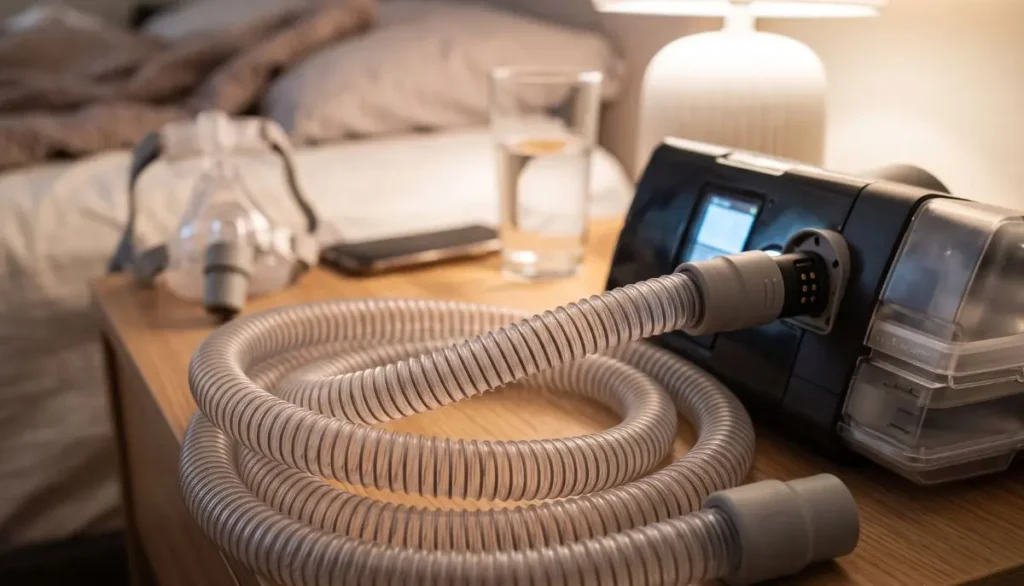
A heated hose contains heating components that allow compatible CPAP equipment to control the temperature of the air. Some systems also use sensors to help regulate the temperature close to the mask.
For example, ResMed describes the ClimateLineAir 11 as a heated breathing tube designed to deliver air to a compatible mask. When used with the appropriate humidifier, it enables the Climate Control feature.
The main reasons people use heated tubing include:
- Reducing condensation inside the tubing
- Helping control “rainout”
- Making humidified CPAP air more comfortable
- Helping maintain a more consistent temperature
- Reducing the chance of cold air reaching the mask
- Working with compatible humidifiers and climate-control systems
Heated tubing is particularly useful for people who use CPAP humidification and notice water collecting in the tubing or mask.
How Do I Know If My CPAP Heated Tubing Is Working?
There are several signs that can help you determine whether your heated CPAP tubing is functioning correctly.
You should not rely on just one test.
Instead, check the machine connection, settings, tubing condition, condensation, and how the air feels during therapy.
Here are the most useful checks.
1. Check Whether Your CPAP Machine Recognizes the Heated Tube
One of the easiest ways to check a compatible heated tube is to look at your CPAP machine after connecting it.
For compatible ResMed Air11 equipment, the ClimateLineAir 11 user guide says to connect the heated tube firmly to the device. When the connection is recognized, “ClimateLine connected” briefly appears on the device screen.
This is important because the tube is not simply a regular hose.
The electrical connector needs to make proper contact with the compatible machine.
What to do
- Turn off your CPAP machine.
- Disconnect the tubing.
- Inspect the connector.
- Reconnect the heated tubing firmly.
- Turn the machine on.
- Watch the display for the appropriate tubing or climate-control indication.
If your machine specifically recognizes the heated tube, that is a strong indication that the electrical connection is functioning.
However, the exact display message depends on your CPAP manufacturer and model.
2. Check the Heated Tubing Setting
Another way to determine whether your heated CPAP tubing is working is to check your machine’s temperature settings.
Some CPAP systems allow you to select a tube temperature.
For example, ResMed systems using compatible ClimateLineAir heated tubing can provide a tube-temperature setting. Depending on the machine and configuration, the temperature may be adjusted within a specified range.
For AirSense 10 and AirCurve systems, ResMed states that tube temperature can be adjusted from approximately 60°F to 86°F (16°C to 30°C) when using the appropriate ClimateLineAir configuration.
On compatible Air11 systems, the default Auto tube temperature is approximately 80°F (27°C), while manual settings can be adjusted between 60°F and 86°F (16°C–30°C).
If you can see a tube-temperature setting on your machine, that is useful evidence that the device has detected compatible heated tubing.
3. Do Not Expect the Tube to Feel Hot
This is one of the most important things to understand.
A functioning heated CPAP tube does not necessarily feel hot.
The goal is generally controlled, comfortable temperature—not a very warm hose.
If you touch the tubing and think:
“It isn’t hot, so it must not be working.”
that conclusion may be incorrect.
Heated tubing is designed to regulate temperature rather than turn the entire hose into a heating element that feels hot to your hand.
ResMed explains that Climate Control is designed to maintain comfortable temperature and humidity while helping prevent condensation.
So, slightly warm or barely noticeable warmth can be completely normal.
4. Look for Less Condensation
One of the most practical signs that heated tubing is doing its job is reduced condensation.
Condensation occurs when warm, humid air cools inside the tubing.
This can create droplets of water.
CPAP users often call this rainout.
You may notice:
- Water droplets inside the hose
- Water in your mask
- A wet feeling around your face
- Gurgling sounds
- Water dripping toward the mask
- Moisture collecting overnight
A heated tube can help maintain the temperature of the air as it travels from the humidifier to the mask.
ResMed says its ClimateLineAir heated tubing works with Climate Control to help maintain temperature and humidity and protect against rainout.
Therefore, if you previously experienced frequent condensation and it improves after using compatible heated tubing, that can be a useful practical sign that the system is functioning.
However, condensation can have several causes, so the absence or presence of rainout should not be used as the only test.
5. Check How the Air Feels at Your Mask
Another simple check is to pay attention to the air reaching your mask.
With the machine running, notice whether the air feels:
- Extremely cold
- Comfortable
- Warmer than before
- Excessively warm
- Unusually inconsistent
A heated tube should normally provide a controlled temperature rather than suddenly becoming very hot.
If the air feels comfortable and your humidification is working properly, your heated tubing may be functioning as intended.
Remember that comfort can be subjective.
One person may prefer warmer air, while another may prefer cooler air.
6. Check Whether Your CPAP Machine Has Climate Control
If you have a compatible ResMed device, check whether the Climate Control feature is available.
Climate Control is designed to coordinate humidification and heated tubing.
ResMed explains that Climate Control can automatically manage humidifier output and heated tubing temperature to maintain a comfortable level of humidity while reducing rainout.
On compatible systems, you may see options such as:
- Climate Control Auto
- Climate Control Manual
- Tube Temperature
- Humidity Level
The exact options depend on the CPAP model and connected equipment.
If the machine does not show the expected heated-tube controls, check whether the tubing is compatible with your specific device.
7. Make Sure the Tube Is Compatible With Your CPAP Machine
Compatibility is extremely important.
Not every heated tube works with every CPAP machine.
For example, ResMed states that the ClimateLineAir 11 is the heated tubing designed for compatible Air11 devices.
Similarly, ClimateLineAir tubing for Air10 systems is intended for compatible AirSense and AirCurve equipment.
Alfa Healthcare Supply Inc. currently lists both ClimateLineAir 11 Heated Tubing for AirSense 11 CPAP and AirCurve 11 BiLevel machines and ClimateLineAir Heated Tubing for AirSense 10 CPAP and AirCurve 10 BiLevel machines in its respiratory supply selection.
Before replacing your tubing, verify:
- Your CPAP model
- Your tubing model
- The manufacturer’s compatibility information
- Whether your machine supports heated tubing
- Whether the humidifier is compatible
Choosing the correct tube is much more important than simply choosing a tube that looks similar.
8. Inspect the Electrical Connector
A heated CPAP tube usually has more than just an air connection.
It may also have an electrical connection that allows the CPAP machine to power and control the heating function.
Carefully inspect the connector for:
- Dirt
- Damage
- Cracks
- Bent parts
- Loose components
- Signs of moisture
- Unusual wear
Never force the connector into the CPAP machine.
If it does not fit naturally, stop and verify compatibility.
The ResMed ClimateLineAir 11 instructions specifically show that the tubing connector needs to be aligned with the appropriate device outlet and pushed firmly into place.
9. Make Sure the Tube Is Fully Connected
A partially connected tube can create problems.
The air connection should be secure at both ends:
CPAP machine → heated tubing → mask
For a compatible ResMed ClimateLineAir 11 system, the manufacturer instructs users to connect the tubing firmly to the machine outlet and then connect the other end to the assembled mask.
A loose connection can cause:
- Air leaks
- Poor therapy comfort
- Unusual noises
- Reduced airflow
- Problems with climate-control functions
If the tube keeps coming loose, inspect the connection and tubing for damage.
10. Check for Holes, Cracks, or Tears
Sometimes the issue is not the heating element at all.
The tubing itself may simply be damaged.
Look carefully along the entire length of the hose.
Check for:
- Small holes
- Cracks
- Splits
- Flattened sections
- Damaged cuffs
- Loose connectors
- Visible wear
ResMed recommends regularly checking heated tubing and replacing it if there are holes, tears, or cracks.
A damaged tube can affect therapy even if the heating function is working.
What Does a Working Heated CPAP Tube Feel Like?
This question is surprisingly common.
There is no single sensation that every user should expect.
A working heated tube may feel:
- Slightly warm
- Neutral
- Comfortably tempered
- Warmer than a standard tube
It does not need to feel hot.
The temperature of the room, humidity level, machine settings, tube temperature setting, and your own sensitivity can all affect how the air feels.
If your machine is maintaining the selected temperature and your therapy is comfortable, the tubing may be functioning normally even if you cannot feel obvious heat.
Why Does My Heated CPAP Tube Not Feel Warm?
There are several possible explanations.
The Temperature Setting May Be Low
If your tube temperature is set to a lower level, you may not notice much warmth.
Some users prefer cooler air.
Others prefer warmer air.
If your machine permits adjustment, follow the manufacturer’s instructions and choose a comfortable setting rather than attempting to make the tubing excessively hot.
The Machine May Be Using Automatic Climate Control
Automatic climate systems may adjust temperature and humidity according to the system’s settings.
This means you may not experience a dramatic temperature change.
ResMed’s Climate Control Auto system, for example, is designed to coordinate the humidifier and heated tubing rather than simply maximize tube heat.
The Tube May Not Be Properly Detected
If the CPAP machine does not recognize the heated tube, the heating function may not operate correctly.
Check the connection first.
Then verify compatibility.
If the machine continues to behave as though a standard tube is connected, consult the user guide for your specific CPAP system.
The Heated Tube May Be Damaged
Heating components or connectors can fail.
If the tube is old, damaged, repeatedly disconnected, or showing visible wear, replacement may be appropriate.
Do not attempt to open or repair the tube yourself.
Medical equipment accessories should be used and maintained according to the manufacturer’s instructions.
What Is Rainout in CPAP Therapy?
Rainout is one of the main reasons people use heated CPAP tubing.
Imagine warm, humid air leaving the humidifier.
As that air travels through a cooler hose, it may cool down.
When moisture condenses, water droplets can form inside the tubing.
That is rainout.
You may hear:
“gurgle, gurgle…”
during the night.
You may also wake up with water in your mask.
This can be annoying and can interfere with comfortable therapy.
Heated tubing helps by keeping the air temperature more consistent as it travels through the hose.
ResMed specifically describes ClimateLineAir heated tubing and Climate Control as tools designed to help manage temperature, humidity, and rainout.
How Do I Know If My Heated Tubing Is Working Without Touching It?
You can check several things without physically testing the temperature.
Look at your CPAP screen
Does your machine recognize the heated tube?
Check the settings
Is tube temperature available?
Observe condensation
Has water in the tubing decreased?
Listen to the system
Are there unusual gurgling sounds?
Check the connection
Is the tube securely connected?
Inspect the tube
Are there cracks, holes, or damaged connectors?
Think about comfort
Does the air reaching your mask feel more comfortable?
Together, these clues provide a much better picture than simply touching the hose.
Can I Test a Heated CPAP Tube by Holding It?
You can feel the outside of the tube, but this is not a precise diagnostic test.
Your hand is not a temperature-measuring instrument, and the outside of the tubing may not feel dramatically warm.
More importantly, do not use unsafe methods to test the heating element.
Avoid:
- Cutting the tubing
- Opening the connector
- Using electrical probes unless specifically instructed by the manufacturer
- Applying external heat
- Putting the tube near a stove or heater
- Submerging electrical connectors
- Attempting to repair internal wiring
The safest approach is to use the CPAP machine’s built-in controls and the manufacturer’s troubleshooting instructions.
Can a Heated Tube Work Without a Humidifier?
This depends on the CPAP system and tubing.
Some heated tubing can physically carry air without humidification, but the benefits of climate control are generally associated with compatible heated humidifier systems.
For example, ResMed states that Climate Control is available when the appropriate heated tubing and humidifier are attached.
Do not assume that every heated tube works the same way.
Always follow the instructions for your specific CPAP machine and tubing.
Why Is My Heated Tube Still Getting Water Inside?
A heated tube can reduce condensation, but it does not guarantee that rainout will never happen.
If you still see water, consider:
- Tube temperature may need adjustment
- Humidity may be too high
- Bedroom temperature may be low
- Tubing may be exposed to cold air
- The tube may not be properly connected
- The tubing may not be compatible
- The climate-control system may be set incorrectly
ResMed recommends, for compatible ClimateLineAir systems, increasing tube temperature when condensation continues. If the air becomes too warm and condensation remains, reducing humidity may help.
Make changes gradually and follow your machine’s instructions.
What If My Nose Feels Dry Even With Heated Tubing?
Heated tubing and humidification are related, but they are not exactly the same thing.
The tube controls or helps maintain air temperature.
The humidifier adds moisture.
If your nose or mouth feels dry, the issue may involve:
- Humidity level
- Mouth breathing
- Mask leak
- Room air
- Therapy settings
- Individual comfort needs
ResMed notes that humidification can help with dryness, while persistent dry mouth may also be associated with mouth leaks.
Do not assume that turning the tube temperature higher will automatically solve every dryness problem.
Heated Tube vs. Standard CPAP Tube
Understanding the difference can make troubleshooting easier.
| Feature | Heated CPAP Tubing | Standard CPAP Tubing |
| Carries CPAP air | Yes | Yes |
| Heating function | Yes, with compatible system | No |
| Helps manage condensation | Can help | Less direct control |
| Temperature control | Available on compatible systems | Generally unavailable |
| Electrical connection | Often yes | Usually no |
| Requires compatibility | Yes | Depends on machine |
| Works with climate-control features | On compatible systems | Generally no |
The key point is simple:
A heated tube is more than a hose. It is an accessory designed to work with compatible CPAP equipment.
How to Check Your CPAP Heated Tubing Step by Step
If you are asking “how do I know if my CPAP heated tubing is working?”, use this quick checklist.
Step 1: Identify Your CPAP Machine
Find the exact model.
Examples include:
- AirSense 10
- AirSense 11
- AirCurve 10
- AirCurve 11
- Other CPAP or bilevel systems
Step 2: Identify Your Tubing
Look at the tubing packaging or markings.
Make sure it is actually a heated tube designed for your machine.
Step 3: Turn the Machine Off
Disconnect the tubing carefully.
Step 4: Inspect the Connector
Look for obvious damage, dirt, moisture, or broken parts.
Step 5: Reconnect the Tube
Attach the correct end to the CPAP machine.
Make sure it is firmly connected.
Step 6: Turn the Machine On
Check the screen for recognition of the heated tube.
On compatible ResMed Air11 equipment, the device briefly displays “ClimateLine connected” when the heated tubing is recognized.
Step 7: Check Tube Temperature
If your machine provides a tube-temperature setting, confirm that it is available.
Step 8: Start Therapy
Put on your mask and begin therapy.
Step 9: Pay Attention to Comfort
Notice whether the air feels comfortable and whether condensation has improved.
Step 10: Check the Tubing the Next Morning
Look for:
- Water droplets
- Cracks
- Damage
- Excessive condensation
- Loose connections
This simple routine can help identify many common problems.
Common Signs Your Heated CPAP Tubing May Need Attention
Your tube may need further inspection if you notice:
1. The CPAP does not recognize the heated tube
This may indicate a compatibility or connection issue.
2. Tube temperature controls disappear
On systems where temperature controls should be available, this can suggest that the machine is not detecting the expected tubing.
3. The tube is visibly damaged
Holes, cracks, and tears are reasons to replace the tubing.
4. Water continues to collect heavily
This can indicate a climate-control, humidity, temperature, room-environment, or equipment issue.
5. The tube disconnects easily
Check the connectors and tubing cuffs.
6. The air becomes uncomfortably hot
Reduce the temperature according to the manufacturer’s instructions.
7. You smell something unusual
Stop using damaged or abnormal equipment and contact the manufacturer or your medical equipment provider for guidance.
Do Not Try to Repair a Heated CPAP Tube Yourself
A standard air hose might look simple, but heated tubing has electrical components.
That means DIY repairs are not a good idea.
Do not:
- Cut the tube
- Tape electrical components
- Open the connector
- Attempt to replace internal heating wires
- Modify the tubing
- Add your own heating device
If the tubing is damaged or appears to malfunction, replacement with a compatible tube is generally safer than attempting an internal repair.
How Should Heated CPAP Tubing Be Cleaned?
Follow the manufacturer’s cleaning instructions for your specific tubing.
For ResMed ClimateLineAir products, ResMed advises washing the air tubing in warm water with household dishwashing liquid, rinsing thoroughly, and allowing it to dry away from direct sunlight and heat. ResMed also advises against washing the tubing in a dishwasher or washing machine.
The electrical connector deserves particular care.
Do not treat the connector like an ordinary washable surface.
Follow the instructions provided with your specific tubing.
How Often Should CPAP Heated Tubing Be Replaced?
There is not one universal replacement schedule that applies to every user and every tube.
Replacement may become necessary when the tubing:
- Develops cracks
- Has holes
- Becomes stiff or brittle
- Shows significant wear
- Has damaged connectors
- No longer connects securely
- Does not function correctly
- Has persistent problems that cannot be resolved through normal setup
Regular inspection is more useful than waiting for a specific number of months.
ResMed specifically recommends checking tubing regularly and replacing it if holes, tears, or cracks are found.
Is a Heated CPAP Tube Supposed to Be Hot?
No.
A heated CPAP tube is generally intended to maintain a controlled and comfortable temperature.
Hot does not automatically mean working.
Likewise, not feeling hot does not automatically mean it is broken.
Your CPAP machine’s settings and compatibility indicators are more useful than using your hand to judge temperature.
If your system has a tube-temperature display, use that feature rather than trying to estimate temperature by touch.
Can I Use Any Heated Tubing With My CPAP?
No.
Heated CPAP tubes are not universally interchangeable.
Compatibility can depend on:
- CPAP manufacturer
- CPAP model
- Humidifier
- Tubing connector
- Climate-control system
- Electrical connection
For example, ResMed identifies ClimateLineAir 11 as the heated tubing compatible with Air11 devices.
This is why it is important to check your exact CPAP model before purchasing replacement tubing.
What Should I Do If My Heated CPAP Tube Is Not Working?
Start with the simple checks.
Check the connection
Make sure both ends are firmly attached.
Check compatibility
Confirm that the tube matches your CPAP machine.
Check the settings
Look for tube-temperature or climate-control options.
Inspect the tubing
Look for cracks, holes, or damaged connectors.
Restart the equipment
Follow your CPAP manufacturer’s normal startup procedure.
Check the user guide
Your device’s instructions are the best source for model-specific troubleshooting.
Contact your equipment supplier
If the tube still does not appear to work, ask your DME supplier or equipment provider to help determine whether the tube or machine requires further evaluation.
When Should You Contact a Healthcare Professional?
A heated tube is mainly a comfort and equipment component, but your overall CPAP therapy is medical treatment.
Contact your healthcare professional if you experience:
- New or worsening breathing problems
- Significant discomfort during therapy
- Persistent symptoms despite using CPAP
- Repeated problems with therapy
- Unexpected pressure-related issues
- Problems that make you stop using CPAP
Do not change prescribed pressure settings on your own simply because the air feels uncomfortable.
For equipment-specific problems, a qualified DME supplier or the CPAP manufacturer can also help.
Choosing Heated CPAP Tubing From a Medical Supply Provider
When replacing your heated CPAP tubing, look beyond price alone.
A reliable medical supply provider should help you identify the correct product for your equipment.
Alfa Healthcare Supply Inc. provides respiratory equipment and medical supplies and lists heated CPAP tubing among its COPD/asthma and respiratory product offerings. The company serves areas including Queens, Brooklyn, the Bronx, Manhattan, Long Island, and Westchester.
Alfa Healthcare Supply Inc. also states that it has more than 25 years of experience and provides respiratory equipment among its healthcare product categories.
When looking for replacement tubing, have your CPAP machine model available. This makes it easier to identify the appropriate tubing rather than guessing based on appearance.
Why Correct Tubing Matters
CPAP therapy is something you may use every night.
That means small equipment problems can become frustrating very quickly.
A poorly fitting tube may cause leaks.
A damaged tube may affect airflow.
A non-compatible tube may not provide the expected climate-control features.
And excessive condensation can make therapy uncomfortable.
The right heated tube, properly connected and used with compatible equipment, can make the CPAP experience more comfortable.
That is why it is worth checking the equipment rather than simply assuming the tube is broken because it does not feel hot.
A Simple 5-Minute Heated Tubing Check
If you want a quick routine before bedtime, try this:
1. Look:
Check the tubing for cracks, holes, or damage.
2. Connect:
Make sure both ends are firmly attached.
3. Confirm:
Check whether your CPAP recognizes the heated tube.
4. Review:
Check the tube-temperature or climate-control setting if available.
5. Observe:
During and after therapy, look for unusual condensation or discomfort.
This simple routine can catch many common equipment problems.
Final Thoughts: How Do I Know If My CPAP Heated Tubing Is Working?
If you have been wondering “how do I know if my CPAP heated tubing is working?”, remember that you do not need to feel obvious heat to prove that it is operating.
Instead, look at the complete picture.
Your CPAP machine should recognize compatible heated tubing when the system supports that feature. Your tube should be properly connected. The appropriate temperature or climate-control settings should be available. The tubing should be free from holes, cracks, and other damage. And, when humidification is being used, heated tubing may help reduce the condensation that causes rainout.
For compatible ResMed equipment, manufacturer documentation provides specific indicators and settings that can help users confirm proper setup.
The most important thing is compatibility. A heated tube is not simply a warmer version of a standard CPAP hose. It is an accessory designed to work with specific equipment.
If you need replacement CPAP tubing, know your exact machine model before ordering. Alfa Healthcare Supply Inc. offers respiratory and CPAP-related medical equipment, including heated tubing options for compatible ResMed systems.
For equipment questions that cannot be resolved through normal setup and manufacturer instructions, contact your DME supplier or healthcare professional rather than attempting to modify the tubing yourself.
A few minutes of checking can help you understand whether your CPAP system is operating as expected—and can make your nightly therapy more comfortable and predictable.
About Alfa Healthcare Supply Inc.
Alfa Healthcare Supply Inc. is a medical equipment and DME supplier serving Floral Park, Queens, and the greater New York area. The company provides respiratory equipment and a broad range of medical supplies for patients, caregivers, and healthcare providers.
Its respiratory product selection includes CPAP-related equipment and accessories, including compatible heated tubing options.
Frequently Asked Questions
How do I know if my CPAP heated tubing is working?
Check whether your CPAP machine recognizes the heated tube, whether the appropriate temperature controls are available, and whether the tubing is securely connected. Also watch for changes in condensation and comfort. Do not rely only on whether the hose feels hot.
Should CPAP heated tubing feel warm?
It may feel slightly warm, but it does not need to feel hot. Heated tubing is designed to regulate temperature rather than produce noticeable heat throughout the entire hose.
Why is my heated CPAP hose cold?
Possible causes include a low temperature setting, automatic climate control, an incompatible tube, a poor connection, or a tubing problem. Check your CPAP’s settings and compatibility information first.
How hot should CPAP heated tubing get?
The correct temperature depends on your CPAP machine and settings. For compatible ResMed systems, tube temperature can be controlled within a specified range, but the exact options depend on the model and configuration.
Can I touch my CPAP tube to see if it is heating?
You can feel the outside of the tube, but this is not a reliable temperature test. A heated tube may only feel mildly warm.
Why does my heated CPAP tube still have water?
Heated tubing helps reduce condensation but may not completely eliminate rainout. Temperature, humidity, room temperature, and climate-control settings can all affect condensation.
Does heated tubing prevent rainout?
It can help reduce rainout when used with a compatible CPAP humidifier and climate-control system. However, condensation can still occur under certain conditions.
Can I use heated tubing with any CPAP machine?
No. Heated tubing is model-specific. Always check the manufacturer’s compatibility information before buying replacement tubing.
How do I know if my ResMed ClimateLineAir is connected?
On compatible ResMed Air11 equipment, the user guide states that “ClimateLine connected” briefly appears on the device screen when the tube is properly recognized.
Can a heated tube stop working?
Yes. Like other equipment accessories, heated tubing can develop wear or damage. Connector problems, physical damage, or equipment compatibility issues can affect operation.
Should I replace a CPAP tube with cracks?
Yes. ResMed advises replacing air tubing if it has holes, tears, or cracks.
Can I repair heated CPAP tubing?
DIY repair is not recommended. Heated tubing contains electrical components, so damaged tubing should generally be replaced with the correct compatible product.
Does heated tubing make CPAP air warmer?
Yes, compatible heated tubing can help control the temperature of the air delivered through the tubing. The exact behavior depends on the CPAP system and settings.
Does heated tubing replace a CPAP humidifier?
No. Heated tubing and humidification perform different functions. A humidifier adds moisture, while heated tubing helps manage the temperature of the air traveling toward the mask.
What if my CPAP says the heated tube is not connected?
Check the tubing connection and confirm that you are using a compatible heated tube. If the problem continues, consult your device manual or contact your equipment provider.
Important: This article is for general educational purposes and is not a substitute for personalized medical advice. Always follow the instructions provided with your CPAP equipment and speak with your healthcare professional for questions about your prescribed therapy.