


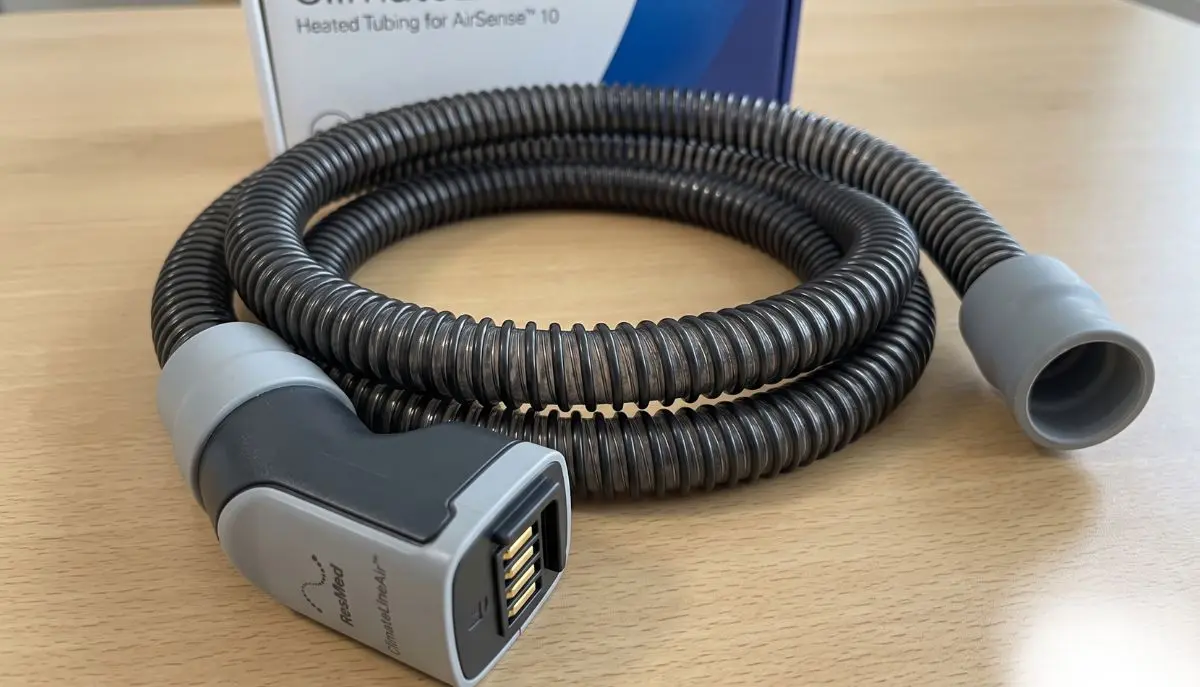
ClimateLineAir Heated Tubing for AirSense 10 CPAP:
Using CPAP every night is about more than simply turning on the machine and putting on a mask. Small details—such as the type of tubing you use—can make a noticeable difference in how comfortable your therapy feels.
The ClimateLineAir heated tubing for AirSense 10 CPAP is designed specifically for ResMed AirSense 10 systems with the HumidAir humidifier. Unlike ordinary CPAP tubing, this heated tube helps maintain the temperature of humidified air as it travels from the machine toward your mask. It is also an important part of ResMed’s Climate Control system.
For many CPAP users, the biggest benefit becomes noticeable on nights when condensation collects inside the tube or mask. That moisture, often called CPAP rainout, can be annoying and may interrupt an otherwise comfortable night of sleep. The ClimateLineAir system is designed to help reduce this problem by keeping the air temperature more consistent as it moves through the tubing.
This guide explains what ClimateLineAir tubing is, how it works, who may benefit from it, how to connect and clean it, and what to check before replacing your existing CPAP tube.
What is ClimateLineAir Heated Tubing for AirSense 10 CPAP?
ClimateLineAir heated tubing for AirSense 10 CPAP is a specialized heated air tube made for ResMed Air10 devices, including the AirSense 10 and AirCurve 10 series.
The tube contains electrical components and a temperature sensor. When connected correctly to a compatible AirSense 10 device and HumidAir humidifier, it works with the machine’s Climate Control system to help maintain comfortable temperature and humidity during therapy.
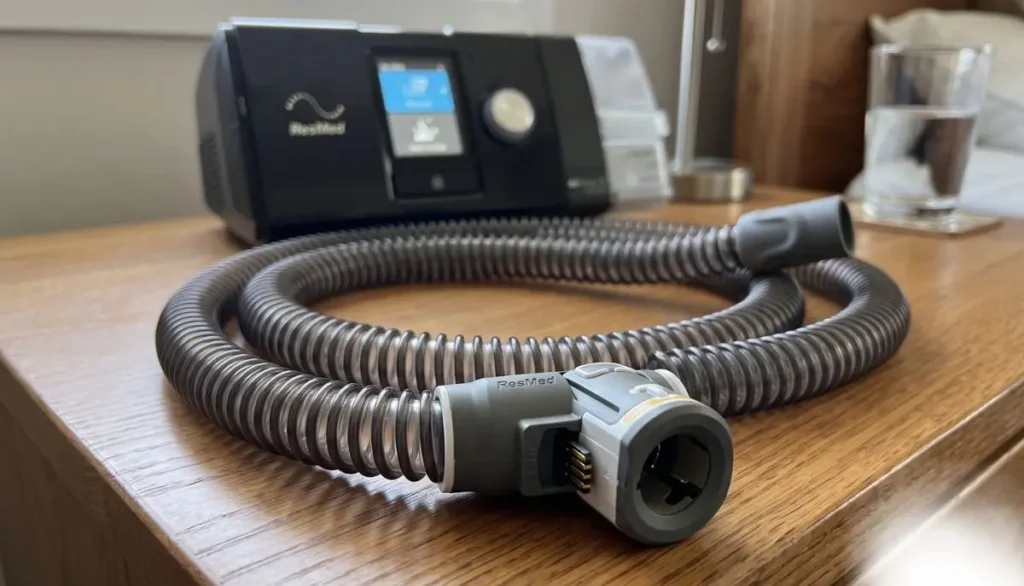
ResMed lists the standard ClimateLineAir tubing at approximately 6 feet 6 inches (2 meters) in length, with a 15 mm inner diameter.
This is different from standard, non-heated CPAP tubing. A conventional tube simply carries air from the CPAP machine to the mask. ClimateLineAir adds temperature control to help maintain the conditions of the humidified airflow.
In simple words
Think of the tube as the final part of the humidification system.
Your AirSense 10 humidifier adds moisture to the air. The heated ClimateLineAir tube then helps keep that warm, humidified air at a more consistent temperature while it travels toward your mask.
That can be especially useful if you notice:
- Water droplets inside your CPAP tubing
- Moisture collecting in your mask
- Air becoming uncomfortably cool
- Dryness despite using humidification
- Condensation during colder nights
Why Does CPAP Tubing Need to Be Heated?
It is natural to wonder why a CPAP tube needs heating in the first place.
The AirSense 10 HumidAir humidifier adds moisture to the pressurized air. As that air travels through tubing, the surrounding room temperature can affect it.
If warm, humidified air moves through a cooler tube, some of the moisture can condense into water droplets.
This is commonly called rainout.
You might notice:
- Water inside the tube
- A damp CPAP mask
- Droplets reaching your face
- Gurgling sounds
- Water collecting around the mask connection
ResMed explains that ClimateLineAir is designed to maintain the temperature of humidified air as it passes through the tube, helping reduce condensation.
The goal isn’t simply to make the tubing warm. The larger goal is to help create a more consistent therapy environment.
How ClimateLineAir Works With AirSense 10
The AirSense 10 can work with several types of tubing, including heated and non-heated options. When ClimateLineAir is connected with the HumidAir humidifier, the system can use ResMed’s Climate Control technology.
The ClimateLineAir tube includes a temperature sensor. The system uses information from the tube to help manage temperature during therapy. ResMed describes the tube as having a built-in sensor that supports temperature control at the mask.
Climate Control Auto
Climate Control Auto is designed to automatically balance temperature and humidity for comfortable therapy.
For many users, this is the easiest option because it minimizes the need to adjust individual settings.
Climate Control Manual
Manual mode gives users more control over temperature and humidity.
This can be useful when environmental conditions or personal comfort preferences change.
For example, if condensation continues despite using ClimateLineAir, ResMed recommends using Climate Control Manual and increasing the tube temperature. If the air becomes too warm and condensation continues, reducing humidity may help.
Always make changes gradually, and follow the instructions provided with your device.
ClimateLineAir vs. Standard CPAP Tubing
One of the most common questions is whether heated tubing is actually necessary.
The answer depends on your equipment and comfort needs.
| Feature | ClimateLineAir Heated Tubing | Standard CPAP Tubing |
| Heated | Yes | No |
| Temperature sensor | Yes | No |
| Designed for Climate Control | Yes | No |
| Helps manage condensation | Yes | Less direct control |
| Designed for AirSense 10 | Yes | Some standard tubes are compatible |
| Humidification support | Works with HumidAir | Can carry humidified air |
| Temperature adjustment | Supported through Climate Control | Not available through the tube |
The heated tube is not simply a replacement for ordinary tubing with a heating element added. It is part of the AirSense 10 Climate Control system.
Key Features of ClimateLineAir Heated Tubing
1. Designed for ResMed Air10 Devices
ClimateLineAir tubing is designed for compatible ResMed Air10 devices, including AirSense 10 and AirCurve 10 machines. It is not intended for AirSense 11 devices. ResMed specifically separates Air10 ClimateLineAir tubing from ClimateLineAir 11 tubing.
This is important when ordering a replacement.
If you own an AirSense 10, make sure the replacement tubing is intended for the Air10 platform.
2. Helps Maintain Air Temperature
The heated tube helps maintain the temperature of humidified air as it travels toward the mask.
This can be particularly helpful when the bedroom is cool.
Instead of warm humidified air cooling significantly as it moves through a conventional tube, ClimateLineAir is designed to help maintain a more consistent temperature.
3. Helps Reduce CPAP Rainout
Rainout is one of the most frustrating problems associated with CPAP humidification.
ClimateLineAir is designed to help prevent humidified air from cooling enough to create excessive condensation inside the tube.
It may not eliminate every possible condensation problem, because room temperature, humidity, CPAP settings, mask design, and sleeping environment can all affect condensation.
4. Supports Climate Control
ClimateLineAir is a key component of the Climate Control system when used with compatible AirSense 10 equipment and HumidAir.
The combination allows the machine to manage temperature and humidity more effectively.
5. Slim and Flexible Design
ClimateLineAir uses a relatively slim 15 mm internal diameter design. ResMed describes its heated tubing as slim and flexible, with features intended to improve comfort and reduce mask drag.
That flexibility can matter when you change sleeping positions during the night.
ClimateLineAir Heated Tubing Specifications
Here are some important specifications for the AirSense 10 ClimateLineAir tube:
- Product: ClimateLineAir heated tubing
- Compatible platform: ResMed Air10
- AirSense compatibility: AirSense 10
- Length: approximately 6 feet 6 inches / 2 meters
- Inner diameter: 15 mm
- Construction: flexible plastic and electrical components
- Temperature sensor: built into the tubing
- Use: compatible with the AirSense 10 Climate Control system when used with the appropriate HumidAir setup
ResMed’s documentation lists a heated-tubing temperature cut-out of 106°F (41°C) or lower.
Specifications can vary by product version and region, so it is always a good idea to check the manufacturer’s current documentation before purchasing a replacement.
Is ClimateLineAir Compatible With AirSense 10?
Yes.
This is one of the main reasons people search for ClimateLineAir heated tubing for AirSense 10 CPAP.
ResMed identifies ClimateLineAir as compatible with AirSense 10 devices. Its official support documentation also states that ClimateLineAir is part of the Climate Control solution for AirSense 10 and AirCurve 10 devices.
However, compatibility should always be checked before ordering.
Important distinction
ClimateLineAir for AirSense 10 is not the same as ClimateLineAir 11 for AirSense 11.
AirSense 10 uses the Air10 version.
AirSense 11 uses the Air11 version.
The connectors and system designs are different, so do not assume that tubing for one generation will work with the other.
How to Connect ClimateLineAir to an AirSense 10
Connecting the tube is straightforward when using the correct equipment.
Step 1: Position the AirSense 10
Place your AirSense 10 on a stable surface near your bed.
If you are using the HumidAir humidifier, make sure it is properly installed.
Step 2: Locate the air outlet
The air tubing connects to the air outlet on the device.
Step 3: Align the connector
Hold the tubing by its cuff and line up the connector with the machine’s air outlet.
Step 4: Push it into place
Push the connector into the outlet until it is properly seated.
ResMed’s ClimateLineAir user guide describes aligning the tubing connector with the device port and pushing it into position until it clicks into place.
Step 5: Connect the mask
Attach the other end of the tubing to your compatible CPAP mask.
Step 6: Check the tubing
Before starting therapy, make sure the tubing is not twisted, sharply bent, or positioned where it could become wrapped around your head or neck.
ResMed specifically warns users to arrange the tubing so that it does not twist around the head or neck.
How Do You Know ClimateLineAir Is Connected?
When the AirSense 10 recognizes the heated tubing, the device can display a ClimateLineAir connection message during setup.
If your machine does not appear to recognize the tube:
- Stop therapy.
- Check the tube connection at the machine.
- Disconnect and reconnect it firmly.
- Inspect the connector for visible damage.
- Make sure you have the correct AirSense 10 ClimateLineAir tube.
- Restart the device.
- Consult the AirSense 10 user guide or your equipment provider if the problem continues.
Do not attempt to repair damaged electrical components inside the tubing.
How to Use Climate Control With AirSense 10
The Climate Control system is designed to make humidification easier.
When ClimateLineAir is connected, the AirSense 10 can use Climate Control Auto or Manual settings depending on your equipment configuration.
If the air feels too dry
ResMed recommends increasing humidity when you experience a dry nose or mouth.
If you notice water in the mask
Excess humidity can contribute to condensation.
ResMed recommends lowering humidity when moisture appears in the mask.
If you have condensation in the tubing
With ClimateLineAir, Climate Control Manual mode can be used to adjust tube temperature. ResMed recommends increasing tube temperature when condensation remains a problem; if the air becomes too warm and condensation continues, humidity may need to be reduced.
Small adjustments are usually better than making large changes all at once.
What Is CPAP Rainout?
CPAP rainout happens when humidified air cools and moisture condenses into water droplets.
Imagine breathing through a warm, humidified stream of air while the tubing sits in a cooler bedroom.
As the air cools, it may no longer hold the same amount of moisture. That moisture can become water inside the tube.
You might hear:
“Gurgle… gurgle…”
Or wake up and find tiny droplets inside your mask.
That is the type of problem ClimateLineAir is designed to help reduce.
ResMed explains that heated tubing helps maintain the temperature of humidified air as it travels toward the mask, reducing the likelihood of condensation.
Does ClimateLineAir Completely Prevent Rainout?
Not necessarily.
ClimateLineAir is designed to help reduce condensation, but no tubing system can guarantee that condensation will never occur.
Factors that can affect rainout include:
- Bedroom temperature
- Bedroom humidity
- Humidifier setting
- Tube temperature
- Mask type
- Tube position
- Individual comfort preferences
- Changes in weather
If you continue experiencing condensation, use the AirSense 10 Climate Control settings according to the manufacturer’s guidance.
How to Clean ClimateLineAir Heated Tubing
Proper cleaning is an important part of maintaining CPAP equipment.
ResMed’s product information recommends weekly cleaning of ClimateLineAir tubing using warm water and mild detergent. The tube should then be rinsed thoroughly and allowed to dry away from direct sunlight and heat.
Simple cleaning routine
- Disconnect the tube from the CPAP machine.
- Disconnect the tube from the mask.
- Wash the tubing in warm water with mild detergent.
- Rinse thoroughly.
- Allow it to air-dry.
- Keep it away from direct sunlight and heat while drying.
- Inspect it before reconnecting.
Avoid
- Dishwashers
- Washing machines
- Strong cleaning chemicals
- Bleach unless specifically directed by the manufacturer
- Excessive heat
- Pulling forcefully on the electrical connector
ResMed specifically advises against washing the tubing in a dishwasher or washing machine.
When Should You Replace ClimateLineAir Tubing?
There isn’t one universal replacement date that applies to every user.
Instead, inspect the tubing regularly.
Replace the tube if you notice:
- Cracks
- Holes
- Tears
- Visible damage
- Damaged connectors
- Persistent problems with the tubing
- Signs that the heated function is no longer operating correctly
ResMed advises regularly checking the tube for damage and replacing it if holes, tears, or cracks are found.
A damaged tube can affect the integrity of your CPAP system.
Signs Your ClimateLineAir Tube May Need Attention
Sometimes the tube does not look obviously damaged, but your therapy experience changes.
You may notice:
More condensation than usual
If rainout suddenly becomes a regular problem, check the tube and Climate Control settings.
The tubing feels different
Cracks, stiffness, unusual wear, or damaged cuffs are reasons to inspect the tube carefully.
Your AirSense 10 does not recognize the tubing
Check the electrical connector and connection point.
Air leakage
Listen for unusual hissing and inspect the tubing for small holes or splits.
Unusual heating behavior
If you suspect the heated function is not working correctly, stop using the damaged tube and contact your CPAP equipment provider or ResMed support.
Do not try to open or electrically repair the tubing yourself.
ClimateLineAir Heated Tubing and Dry Air
Some CPAP users assume that a heated tube is designed only to prevent rainout.
It does more than that.
ClimateLineAir works together with the humidifier and Climate Control system to help maintain comfortable temperature and humidity conditions during therapy. ResMed notes that humidification can help with discomfort such as dry nose, throat, and mouth.
However, heated tubing should not be considered a medical treatment for every cause of dryness.
If you regularly experience severe dryness, nasal blockage, discomfort, or other persistent symptoms, discuss them with your healthcare professional or CPAP provider.
Who May Benefit From ClimateLineAir?
ClimateLineAir may be particularly useful for AirSense 10 users who:
- Use the HumidAir humidifier
- Experience CPAP rainout
- Sleep in a cool bedroom
- Prefer warm humidified airflow
- Want to use Climate Control
- Experience discomfort from cold airflow
- Frequently find moisture inside standard tubing
Not every AirSense 10 user necessarily needs heated tubing.
If standard tubing is comfortable and condensation is not an issue, you may not notice a major difference.
The decision can depend on your equipment configuration and personal comfort.
ClimateLineAir in Cold Weather
Cold bedrooms can make CPAP humidification more challenging.
The air leaving the humidifier may be warm and humid, but the tubing can be exposed to much cooler room air.
That temperature difference can encourage condensation.
ResMed recommends Climate Control with ClimateLineAir as a way to help manage temperature and humidity during changing room conditions.
For people who live in colder climates or keep their bedroom cool at night, heated tubing can therefore become an especially useful comfort accessory.
Can You Use ClimateLineAir Without the HumidAir Humidifier?
ClimateLineAir is designed as part of ResMed’s Climate Control solution and is intended to be used with the appropriate compatible humidification setup.
ResMed’s user guide specifically describes ClimateLineAir used with the HumidAir humidifier to enable Climate Control.
If you want to operate your AirSense 10 without the humidifier, consult the AirSense 10 documentation and your equipment provider for the appropriate tubing configuration.
ClimateLineAir vs. ClimateLineAir Oxy
Another common source of confusion is the difference between standard ClimateLineAir and ClimateLineAir Oxy.
ClimateLineAir
The standard ClimateLineAir is designed for compatible Air10 devices.
ClimateLineAir Oxy
ClimateLineAir Oxy includes a built-in oxygen connector for users who require supplemental oxygen. ResMed lists ClimateLineAir Oxy as a 19 mm diameter tube, compared with the 15 mm inner diameter of standard ClimateLineAir.
If you do not require supplemental oxygen, don’t automatically choose the Oxy version simply because it has a similar name.
Always match the tubing to your specific equipment configuration.
Is ClimateLineAir the Same as ClimateLineAir 11?
No.
This distinction is especially important when shopping for replacement tubing.
AirSense 10
Use the ClimateLineAir tubing designed for the Air10 platform.
AirSense 11
Use the ClimateLineAir 11 tubing designed for the Air11 platform.
ResMed’s current product information specifically identifies ClimateLineAir for AirSense 10 and ClimateLineAir 11 for AirSense 11.
If your CPAP machine says AirSense 10, look for Air10-compatible ClimateLineAir tubing.
How Long Is ClimateLineAir Tubing for AirSense 10?
The standard ClimateLineAir tube is approximately 6 feet 6 inches (2 meters) long.
ResMed’s AirSense 10 documentation lists:
- Length: 2 m / 6’6″
- Inner diameter: 15 mm
This length provides enough reach for typical bedside CPAP setups while maintaining a relatively slim design.
Is ClimateLineAir Tubing Flexible?
Yes.
The ClimateLineAir is designed using flexible materials and electrical components. ResMed describes the tubing as slim and flexible, with the design intended to support sleeping comfort and reduce mask drag.
Still, avoid sharply folding or crushing the tubing.
A smooth path from the CPAP machine to your mask is preferable.
Tips for a More Comfortable AirSense 10 Setup
A heated tube is only one part of a comfortable CPAP setup.
Keep the CPAP machine on a stable surface
A bedside table or suitable CPAP stand can help keep the tubing path organized.
Avoid unnecessary bends
Sharp bends can interfere with airflow.
Keep the tube away from your neck
Arrange it so it does not wrap around your head or neck.
Keep the humidifier at the correct level
Follow the AirSense 10 instructions for your humidifier.
Make small setting changes
If you need to adjust humidity or temperature, small changes can make it easier to find a comfortable setting.
Inspect the tube regularly
A few seconds of inspection can help identify cracks, tears, or connector damage before they become bigger problems.
Buying ClimateLineAir Heated Tubing for AirSense 10
When purchasing replacement tubing, don’t choose based only on the words “heated CPAP tube.”
Check the following:
1. Machine compatibility
Confirm that the tubing is designed for ResMed AirSense 10/Air10 devices.
2. Heated tubing type
Make sure it is actually ClimateLineAir heated tubing if you need Climate Control compatibility.
3. Connector compatibility
The connector must match the AirSense 10 device.
4. Tube length
Standard ClimateLineAir tubing is approximately 2 meters long.
5. Oxygen requirements
If supplemental oxygen is part of your therapy, confirm whether you need the ClimateLineAir Oxy version.
6. Condition
For replacement tubing, choose a new, undamaged tube from a reputable medical equipment supplier.
ResMed currently lists ClimateLineAir heated tubing for Air10 devices as a replacement accessory and identifies it as compatible with AirSense 10 and AirCurve 10 machines.
Why Buy CPAP Supplies From a Medical Supply Company?
CPAP equipment is part of an ongoing healthcare routine.
A medical supply company can help customers identify compatible replacement parts rather than simply choosing an item based on a product photo.
At Alfa Healthcare Supply Inc., customers can explore CPAP and DME supplies through a medical equipment supplier serving customers in New York and surrounding communities.
For a product such as ClimateLineAir, compatibility is particularly important because AirSense 10 and AirSense 11 use different tubing generations.
Before ordering, it is helpful to have your exact CPAP model available.
ClimateLineAir AirSense 10 Troubleshooting Checklist
If your heated tubing is not working as expected, go through this simple checklist:
Tube not recognized?
→ Check the connection at the machine.
Water in the tube?
→ Check Climate Control and humidity settings.
Water in the mask?
→ Consider reducing humidity.
Air feels too warm?
→ Review temperature settings.
Air feels too cold?
→ Check the tube temperature setting if using Manual mode.
Tube has cracks?
→ Replace it.
Connector looks damaged?
→ Stop using the damaged tubing and contact your equipment supplier.
Still having problems?
→ Consult your AirSense 10 user guide, healthcare professional, equipment provider, or ResMed support.
A Simple Way to Think About ClimateLineAir
CPAP comfort can sometimes feel like solving a small puzzle.
You have the machine.
You have the humidifier.
You have the tubing.
You have the mask.
And then there are the settings.
If the air is too dry, you may notice irritation.
If there is too much moisture, you may notice water.
If the room is cold, the air inside the tubing can cool as it travels toward the mask.
ClimateLineAir is designed to help bring these pieces together.
It isn’t a replacement for your CPAP machine or humidifier. Instead, it acts as an important connection between the humidification system and your mask.
Final Thoughts
The ClimateLineAir heated tubing for AirSense 10 CPAP is more than an ordinary replacement tube. It is a purpose-built accessory designed to work with ResMed AirSense 10 and AirCurve 10 systems and the Climate Control humidification system.
Its heated design helps maintain the temperature of humidified air as it travels toward your mask. This can help reduce condensation, support comfortable humidification, and make nightly CPAP therapy more pleasant for users who experience cold airflow or rainout.
The most important thing when replacing your tubing is compatibility. If you have an AirSense 10, look specifically for ClimateLineAir tubing made for the Air10 platform. Do not confuse it with ClimateLineAir 11 tubing for the AirSense 11.
Regular cleaning and inspection also matter. Wash the tube as recommended, allow it to dry properly, and replace it if you find cracks, holes, tears, or other damage.
For CPAP users, comfort often comes down to small improvements. The right tubing may be one of those small changes that makes your nightly routine feel simpler and more comfortable.
About Alfa Healthcare Supply Inc.
Alfa Healthcare Supply Inc. is a medical equipment and DME supplier serving customers with a range of home medical equipment and healthcare supplies. For CPAP replacement parts, customers should verify their exact machine model before ordering to ensure the accessory is appropriate for their equipment.
Visit Alfa Healthcare Supply Inc.
Frequently Asked Questions About ClimateLineAir Heated Tubing for AirSense 10 CPAP
1. What is ClimateLineAir heated tubing for AirSense 10 CPAP?
ClimateLineAir is heated CPAP tubing designed for compatible ResMed Air10 devices, including AirSense 10. It helps maintain the temperature of humidified air traveling from the machine to the mask and works with the Climate Control system.
2. Does ClimateLineAir fit AirSense 10?
Yes. ResMed identifies ClimateLineAir as compatible with AirSense 10 devices.
3. Is ClimateLineAir compatible with AirSense 11?
The AirSense 11 uses ClimateLineAir 11 tubing. ClimateLineAir for Air10 is designed for AirSense 10 and should not be treated as interchangeable with Air11 tubing.
4. Does heated CPAP tubing help prevent rainout?
It is designed to help reduce condensation by maintaining the temperature of humidified air as it moves through the tube.
5. How long is AirSense 10 ClimateLineAir tubing?
The standard ClimateLineAir tube is approximately 6 feet 6 inches, or 2 meters, long.
6. What is the inner diameter of ClimateLineAir?
The standard ClimateLineAir has a 15 mm inner diameter.
7. How often should I clean ClimateLineAir?
ResMed’s product information recommends weekly cleaning with warm water and mild detergent, followed by thorough rinsing and air drying away from direct sunlight and heat.
8. Can I put ClimateLineAir in a dishwasher?
No. ResMed specifically advises against cleaning the tubing in a dishwasher or washing machine.
9. What should I do if there is water inside my CPAP tube?
Check your Climate Control settings and room conditions. ResMed recommends using Climate Control Manual and increasing tube temperature if condensation continues; if the air becomes too warm and condensation remains, humidity may need to be reduced.
10. What if my ClimateLineAir tube has a crack?
Replace damaged tubing. ResMed recommends replacing the tube when holes, tears, or cracks are found.
11. Does ClimateLineAir make the air hot?
The system is designed to provide a comfortable temperature rather than simply making the air as hot as possible. The tube’s temperature sensor works with Climate Control to manage temperature.
12. Is ClimateLineAir the same as regular CPAP tubing?
No. ClimateLineAir contains electrical components and a temperature sensor and is designed to work with ResMed’s Climate Control system.
13. Can I use ClimateLineAir with an AirCurve 10?
Yes. ResMed identifies ClimateLineAir as compatible with AirCurve 10 as well as AirSense 10 devices.
14. Does ClimateLineAir Oxy have the same design?
ClimateLineAir Oxy is a related heated tube with a built-in oxygen connector for supplemental oxygen. It has different specifications, including a 19 mm diameter.
15. Do I need ClimateLineAir if I don’t have rainout?
Not necessarily. Some users are comfortable with standard tubing. ClimateLineAir may be useful if you want heated tubing, Climate Control functionality, or better control of condensation and humidified airflow.
Medical note: This article is for general product and equipment information and does not replace instructions from your healthcare professional, CPAP equipment provider, or ResMed documentation.