


For people who use insulin pens every day, choosing the right pen needle can make a real difference. A needle may be small, but when it becomes part of your daily diabetes routine, details such as gauge, length, comfort, sterility, compatibility, and price all matter.
If you are searching for the pro comfort insulin pen needles 32g 6mm price, you are probably looking for more than just a number. You may also want to know what 32G means, what 6mm means, whether these needles fit your insulin pen, how many needles come in a box, whether they are sterile, and whether they are suitable for your regular insulin injections.
The Pro Comfort Insulin Pen Needles 32G 6mm are designed for people who use compatible insulin pen devices and need a convenient option for routine insulin administration. Their thin 32-gauge design and 6mm length are intended to support subcutaneous insulin delivery while providing a practical balance between needle size and everyday usability.
At Alfa Healthcare Supply Inc., the Pro Comfort Insulin Pen Needles 32G 6mm are currently listed at $15.95. The product is available through the company’s diabetic supplies category.
In this guide, we will explain the product in easy-to-understand language so you can make a more informed purchasing decision.
What are Pro Comfort Insulin Pen Needles 32G 6mm?
Pro Comfort Insulin Pen Needles 32G 6mm are disposable needles designed to attach to compatible insulin pen devices for insulin injections.
The name contains two important specifications:
- 32G = the needle gauge
- 6mm = the needle length
The 32G specification indicates a relatively thin needle. The 6mm measurement describes the physical length of the needle.
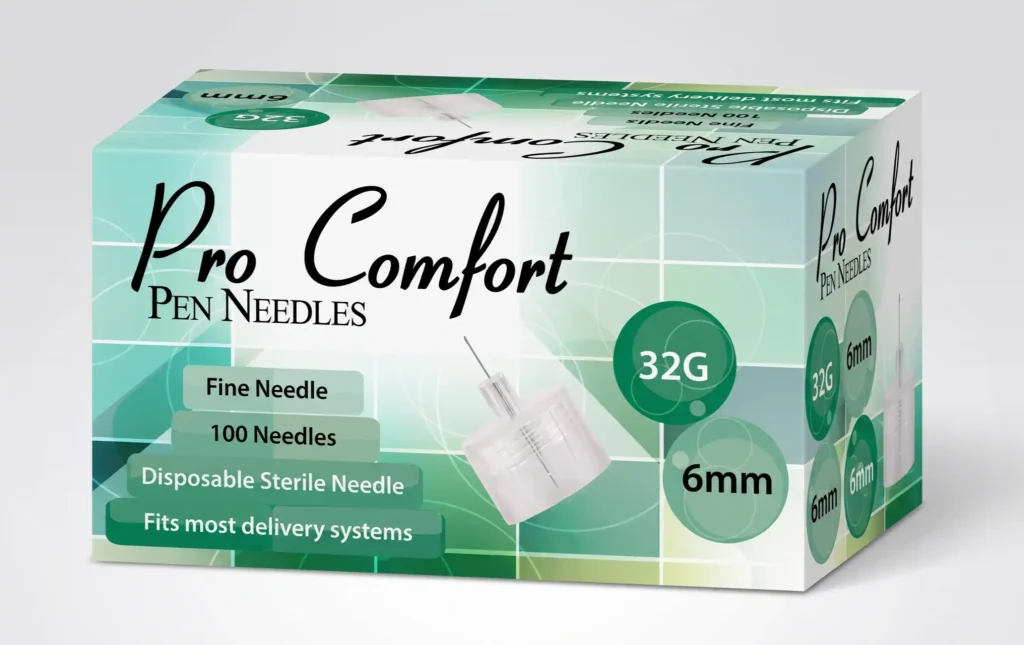
These needles are designed for insulin pen therapy rather than conventional syringe-based insulin administration. They are intended for single use and should be disposed of properly after an injection.
For someone managing diabetes every day, a pen needle needs to be simple and dependable. The goal is not simply to find the smallest needle available. It is to find a needle that is compatible with the insulin pen, appropriate for the person’s injection routine, and recommended by their healthcare professional.
Pro Comfort Insulin Pen Needles 32G 6mm Price
One of the most common questions shoppers have is:
How much do Pro Comfort Insulin Pen Needles 32G 6mm cost?
At the time of this article’s publication, Alfa Healthcare Supply Inc. lists Pro Comfort Insulin Pen Needles 32G 6mm at $15.95.
Prices can change because of promotions, inventory, packaging, supplier costs, and other factors. Therefore, customers should always check the current product page before placing an order.
The listed product is positioned as a practical option for people looking for insulin pen needles for routine diabetes care.
When comparing prices, don’t look only at the sticker price. Consider:
- Number of needles included
- Needle gauge
- Needle length
- Sterile packaging
- Single-use design
- Compatibility with your insulin pen
- Shipping or delivery costs
- Insurance or coverage requirements
- Current promotions or discounts
A slightly lower price does not always mean a better value if the needle size or compatibility is not right for your insulin pen.
What Does 32G Mean?
The “G” in 32G stands for gauge.
Gauge is used to describe the thickness of a needle. Generally, as the gauge number increases, the needle becomes thinner.
A 32G insulin pen needle is therefore a relatively thin needle designed to support a more comfortable injection experience.
This can be especially important for people who inject insulin regularly. If someone takes insulin multiple times a day, the injection experience can become an important part of their daily routine.
However, comfort is personal. A needle that feels comfortable to one person may feel different to another person.
It is also important to understand that needle gauge is only one factor. Needle length, injection technique, injection site, skin condition, and individual circumstances can all influence the experience.
What Does 6mm Mean?
The 6mm refers to the length of the needle.
A 6mm needle is longer than a 4mm or 5mm pen needle, but shorter than many older insulin needle options.
The appropriate needle length can depend on individual factors and clinical recommendations. Patients should not automatically change needle length simply because another size appears more comfortable or less expensive.
If you are unsure whether a 6mm needle is appropriate for you, speak with your doctor, diabetes educator, pharmacist, or other qualified healthcare professional.
Your healthcare professional can help determine the appropriate needle size and injection technique for your situation.
Why Choose a 32G 6mm Insulin Pen Needle?
There are several reasons someone may consider a 32G 6mm insulin pen needle.
1. Thin Needle Design
The 32G design provides a thin needle profile that can help support a comfortable injection experience.
For people who inject insulin regularly, reducing unnecessary discomfort can make the daily routine easier.
2. 6mm Needle Length
The 6mm length provides an option for people who have been instructed to use this needle length for insulin injections.
It is important to follow professional guidance rather than choosing needle length based solely on appearance.
3. Designed for Insulin Pens
These needles are made for use with compatible insulin pen devices.
Pen needles can make insulin administration more convenient compared with carrying a separate syringe and vial in some situations.
4. Sterile and Single Use
The Pro Comfort product is designed as a sterile, single-use disposable needle.
Using a new needle for each injection supports good hygiene and helps avoid problems associated with reusing needles.
5. Convenient for Everyday Diabetes Management
A small, individually protected pen needle can be convenient to store at home, carry when traveling, and keep available for routine insulin injections.
Key Features of Pro Comfort Insulin Pen Needles 32G 6mm
Here is a simple overview of the main product characteristics:
32-Gauge Needle
The 32G needle is designed to provide a thin profile for insulin injections.
6mm Length
The 6mm needle length offers a specific option for people whose healthcare professional recommends this size.
Sterile Construction
The needles are individually sterilized and packaged for hygienic use.
Single-Use Design
Each needle is intended for one injection and should not be reused.
Compatible With Many Insulin Pens
The product is designed for use with most standard insulin pen devices, but compatibility should always be confirmed before purchasing.
Protective Packaging
Protective packaging helps maintain sterility before use and makes individual needles easier to handle.
Everyday Convenience
The compact format can make pen needles convenient for home use and travel.
Who May Consider Pro Comfort Insulin Pen Needles 32G 6mm?
These pen needles may be considered by people who use insulin pens and have been advised to use a compatible 6mm needle.
They may be useful for:
- Adults using insulin pens
- People managing diabetes with daily insulin injections
- People who prefer pen-based insulin delivery
- Individuals looking for a thin-gauge pen needle
- People whose healthcare professional recommends a 6mm needle
- Caregivers assisting someone with insulin administration
The right product depends on the individual’s diabetes treatment plan.
A pen needle is not a replacement for medical advice. If you are starting insulin therapy or changing your needle size, ask your healthcare provider which option is appropriate.
Pro Comfort 32G 6mm vs. Other Pen Needle Sizes
Insulin pen needles are available in several lengths and gauges.
For example, shoppers may see:
- 32G 4mm
- 32G 5mm
- 32G 6mm
- 31G 5mm
- 31G 6mm
- Other gauge and length combinations
So why choose 6mm?
The answer depends on the individual.
A longer needle is not automatically better, and a shorter needle is not automatically better. The correct choice depends on factors such as your healthcare provider’s recommendation, injection technique, insulin pen, and individual needs.
If you are already using a needle size successfully, talk with your healthcare professional before switching.
Is a 32G 6mm Needle Comfortable?
Comfort is one of the main reasons people search for thin insulin pen needles.
The 32G design is intended to provide a fine needle profile, which can help support a comfortable injection experience.
But there is no single needle size that feels exactly the same for everyone.
Some people may barely notice an injection, while others may experience more sensitivity. Factors such as injection location, technique, skin condition, and repeated injections in the same area can affect comfort.
Good injection habits can therefore be just as important as choosing a needle.
Why Single-Use Pen Needles Matter
It can be tempting to reuse a needle, particularly when someone is trying to save money.
However, insulin pen needles are designed for single use.
Reusing a needle can cause several concerns, including:
- Increased discomfort
- Reduced needle sharpness
- Hygiene concerns
- Possible needle damage
- Greater risk of problems at the injection site
For these reasons, follow the manufacturer’s instructions and your healthcare professional’s recommendations regarding needle use and disposal.
Never share insulin pen needles with another person.
How to Use an Insulin Pen Needle Safely
The exact process can vary depending on your insulin pen and prescribed insulin. Always follow the instructions supplied with your specific pen.
A general routine may include:
Step 1: Wash Your Hands
Clean hands help support good injection hygiene.
Step 2: Prepare Your Insulin Pen
Check the pen and insulin according to your healthcare professional’s instructions.
Step 3: Attach a New Pen Needle
Use a new sterile needle for the injection.
Step 4: Remove the Protective Caps
Follow the instructions for your specific pen needle.
Step 5: Prepare the Pen
Your insulin pen instructions may require a priming or safety-check step before the dose.
Step 6: Select the Injection Site
Use an injection site recommended by your healthcare professional.
Step 7: Give the Insulin
Use the injection technique you have been taught.
Step 8: Remove the Needle
After completing the injection, remove the needle according to your pen manufacturer’s instructions.
Step 9: Dispose of the Needle Properly
Place the used needle into an appropriate sharps container.
Never leave a used pen needle attached to the insulin pen unless the manufacturer specifically instructs otherwise.
Where Should Insulin Be Injected?
Insulin is commonly injected into subcutaneous tissue.
Common injection areas may include:
- Abdomen
- Thigh
- Upper arm
- Buttocks
However, injection-site recommendations can vary.
Your healthcare professional can teach you where and how to inject your specific insulin.
One important habit is to rotate injection locations rather than repeatedly using the exact same spot.
Repeated injections in one area can contribute to changes in the fatty tissue under the skin, which may affect insulin absorption.
Why Rotating Injection Sites Matters
Imagine using the same tiny spot on your skin several times a day, every day.
Over time, that area can become irritated or develop changes in the underlying tissue.
Rotating injection sites gives previously used areas time to recover.
Your healthcare team can help you create a simple rotation pattern that works with your daily routine.
For many people, a simple organized rotation system can make diabetes care easier to manage.
How to Store Pro Comfort Insulin Pen Needles
Proper storage helps protect unused needles before use.
Keep unused pen needles:
- In their original packaging
- In a clean, dry location
- Away from moisture
- Away from excessive heat
- Away from children and pets
- Protected from contamination
Do not use a needle if the packaging is damaged, opened, or appears contaminated.
Always check the manufacturer’s instructions for specific storage recommendations.
How Should Used Pen Needles Be Disposed Of?
Used insulin pen needles should be treated as sharps.
Do not throw loose used needles into a regular household trash can.
Instead, place used needles into an appropriate sharps disposal container and follow your local disposal requirements.
Keep sharps containers out of reach of children and pets.
If you are unsure about local disposal rules, ask your pharmacy, healthcare provider, or local waste authority.
Safe disposal protects not only you but also family members, caregivers, sanitation workers, and other people who may encounter household waste.
How to Choose the Right Insulin Pen Needle
Buying insulin pen needles may seem simple, but there are several details worth checking.
Check the Gauge
Confirm whether your healthcare professional recommends 32G or another gauge.
Check the Length
Make sure the needle length matches your prescribed or recommended size.
Check Pen Compatibility
Not every needle should be assumed to work with every insulin pen. Verify compatibility before ordering.
Check the Packaging
Look for sterile, sealed packaging.
Check the Quantity
Compare how many needles are included in each package.
Check the Price
When searching for the pro comfort insulin pen needles 32g 6mm price, compare the current product price and total cost before completing your order.
Consider Your Routine
If you use insulin several times a day, having an adequate supply can help prevent running out unexpectedly.
Is $15.95 a Good Price for Pro Comfort 32G 6mm Pen Needles?
The current Alfa Healthcare Supply listing shows a price of $15.95 for Pro Comfort Insulin Pen Needles 32G 6mm.
Whether that is the right value for you depends on package quantity, shipping, insurance coverage, promotions, and the price of comparable products.
When evaluating value, avoid comparing two products based only on the displayed price.
Instead, compare:
Total cost ÷ number of needles = approximate cost per needle.
This can make price comparisons easier.
You should also compare the actual specifications. A 32G 6mm needle should be compared with another 32G 6mm product when you want a like-for-like comparison.
Why Buy Diabetes Supplies From a Medical Supply Store?
A medical supply store can be a convenient source for everyday diabetes products.
People may purchase items such as:
- Insulin pen needles
- Blood glucose test strips
- Blood glucose meters
- Lancets
- Continuous glucose monitoring supplies
- Other diabetic care products
For someone managing diabetes, convenience matters. Running out of essential supplies can create unnecessary stress.
A reliable supplier can make it easier to maintain a regular supply of products that are part of your diabetes routine.
Buying Pro Comfort Insulin Pen Needles From Alfa Healthcare Supply Inc.
Alfa Healthcare Supply Inc. offers medical supplies for customers looking for products for diabetes care and other healthcare needs.
The Pro Comfort Insulin Pen Needles 32G 6mm product is listed under the company’s diabetic supplies category.
The current listed price is $15.95.
Customers should review the product page for current pricing, availability, ordering information, and any applicable shipping or delivery details before purchasing.
For questions about whether a specific needle is appropriate for your medical needs, consult a qualified healthcare professional.
What Makes the 32G 6mm Combination Different?
The combination of gauge and length is important.
32G describes the needle’s thinness.
6mm describes its length.
Together, these specifications identify a particular pen needle configuration.
Someone who has previously used a 32G 6mm needle may specifically search for the same specifications because they already know that size works with their insulin routine.
Others may be researching needle options for the first time.
If you are new to insulin injections, don’t select a needle solely because it is thin or because it has a lower price. Ask your healthcare professional what size is appropriate.
Common Mistakes to Avoid When Buying Pen Needles
Mistake 1: Looking Only at Price
The cheapest product is not necessarily the best choice.
Always consider compatibility, size, packaging, and quantity.
Mistake 2: Ignoring Needle Length
A 32G needle can come in different lengths. Make sure the length is correct for your needs.
Mistake 3: Assuming Every Needle Fits Every Pen
Many pen needles are designed for broad compatibility, but you should still verify that the product works with your insulin pen.
Mistake 4: Reusing Needles
Pen needles are designed for single use. Use a new needle for each injection.
Mistake 5: Forgetting Sharps Disposal
Used needles should be disposed of safely using an appropriate sharps container.
Mistake 6: Changing Needle Size Without Advice
If you want to move from 4mm to 6mm, or from 6mm to another size, discuss the change with your healthcare professional.
Pro Comfort Insulin Pen Needles 32G 6mm: Quick Summary
| Feature | Details |
| Product | Pro Comfort Insulin Pen Needles |
| Gauge | 32G |
| Length | 6mm |
| Type | Insulin pen needle |
| Use | Insulin injections with compatible pen devices |
| Design | Thin, sterile, single-use |
| Package | 100 needles |
| Current Alfa listed price | $15.95 |
| Category | Diabetic Supplies |
A Practical Way to Think About Pen Needle Price
When someone searches “pro comfort insulin pen needles 32g 6mm price,” the price is obviously important. But diabetes supplies are part of an ongoing routine, so the best buying decision involves more than finding the lowest number.
Think about the complete picture:
Right size + compatible pen + sterile packaging + appropriate quantity + reasonable total cost = better purchasing decision.
If you have used 32G 6mm needles before and your healthcare professional has confirmed that this size is appropriate, choosing the same configuration can simplify your shopping.
If you are unsure, ask before switching.
A few minutes of professional guidance can prevent confusion later.
Why Comfort Matters in Diabetes Care
Diabetes management can involve many small daily tasks.
- Checking glucose.
- Taking medication.
- Preparing meals.
- Monitoring activity.
- Taking insulin.
- Keeping supplies organized.
None of these tasks may seem overwhelming on their own, but together they can become a significant part of everyday life.
That is why small improvements can matter.
A pen needle that is easy to handle, properly packaged, and appropriate for your insulin pen can make one part of the routine feel simpler.
The goal is not to make diabetes disappear. The goal is to make necessary diabetes care easier to manage consistently.
Final Thoughts: Is Pro Comfort 32G 6mm Right for You?
The Pro Comfort Insulin Pen Needles 32G 6mm are designed for people who use compatible insulin pens and need a thin, sterile, single-use needle for insulin administration.
Their 32G gauge provides a thin needle profile, while the 6mm length provides a specific needle option for people whose healthcare professional recommends that size.
For shoppers comparing the pro comfort insulin pen needles 32g 6mm price, Alfa Healthcare Supply Inc. currently lists the product at $15.95.
Before ordering, check the current price, package quantity, availability, and compatibility with your insulin pen.
Most importantly, choose your needle size based on your healthcare professional’s recommendation rather than price alone.
For someone who relies on insulin every day, the right supplies can bring a little more convenience and confidence to an already busy routine.
If you are looking for Pro Comfort Insulin Pen Needles 32G 6mm, Alfa Healthcare Supply Inc. provides a convenient medical-supply option for customers seeking diabetic care products.
Your diabetes supplies should work with your routine—not make your routine harder.
Frequently Asked Questions About Pro Comfort Insulin Pen Needles 32G 6mm
What is the Pro Comfort insulin pen needles 32G 6mm price?
The current price listed by Alfa Healthcare Supply Inc. is $15.95. Prices can change, so check the product page for the latest price before ordering.
What does 32G mean?
32G refers to the gauge of the needle. Gauge describes needle thickness. A 32G needle is a relatively thin insulin pen needle.
What does 6mm mean?
6mm refers to the length of the needle.
Are Pro Comfort 32G 6mm needles sterile?
Yes. The product is designed as a sterile, single-use insulin pen needle.
Can Pro Comfort 32G 6mm needles be reused?
No. They are intended for single use. A new needle should be used for each injection according to safe-use recommendations.
How many needles come in a box?
The registered Pro Comfort 6mm product is identified as a 100-count box of individually wrapped sterile needles.
Are Pro Comfort 32G 6mm needles compatible with insulin pens?
The product is designed to be compatible with most standard insulin pen devices. However, always confirm compatibility with your specific pen before purchasing.
Are 32G 6mm needles comfortable?
The thin 32G design is intended to support a comfortable injection experience. However, comfort varies from person to person.
Are 6mm needles better than 4mm needles?
Not necessarily. Different people may require different needle lengths. Your healthcare professional can recommend the appropriate size for your injection technique and individual needs.
Can I travel with insulin pen needles?
People commonly carry diabetes supplies when traveling, but you should keep needles protected in their original packaging and follow applicable transportation and disposal rules.
How should used insulin pen needles be disposed of?
Place used needles into an appropriate sharps container and follow local disposal guidelines.
Should I leave the needle attached to my insulin pen?
Follow the instructions provided with your specific insulin pen and pen needle. In general, removing the needle after use is important to help protect the pen and maintain safe handling.
Where can I buy Pro Comfort Insulin Pen Needles 32G 6mm?
They are available through medical supply retailers, including Alfa Healthcare Supply Inc., subject to current inventory and ordering requirements.
FreeStyle Lite Blood Glucose Monitoring System
If you are new to checking your blood glucose at home, using a blood glucose meter can feel confusing at first. You may wonder where to put the test strip, how much blood is needed, when to test, or what to do if the meter displays an unexpected result.
The good news is that the FreeStyle Lite Blood Glucose Monitoring System is designed to make blood glucose testing straightforward. Once you understand the basic steps, testing can become a simple part of your daily routine.
This guide explains freestyle lite blood glucose monitoring system how to use, including preparing the meter, using FreeStyle Lite test strips, obtaining a blood sample, understanding the result, avoiding common mistakes, storing your supplies, and knowing when to contact a healthcare professional.
Important: This article is for general educational information and does not replace the instructions supplied with your meter or advice from your healthcare professional. Always follow the current product instructions for your specific FreeStyle Lite system.
What is the FreeStyle Lite Blood Glucose Monitoring System?
The FreeStyle Lite system is a blood glucose monitoring system designed to measure glucose from a small sample of capillary whole blood. According to Abbott’s user information, the system uses a very small blood sample of approximately 0.3 microliters. The meter is intended for testing blood glucose and should be used with compatible FreeStyle Lite test strips and appropriate FreeStyle control solution.
Unlike a continuous glucose monitoring system such as FreeStyle Libre, the FreeStyle Lite meter is a blood glucose meter. It requires a blood sample for each test.
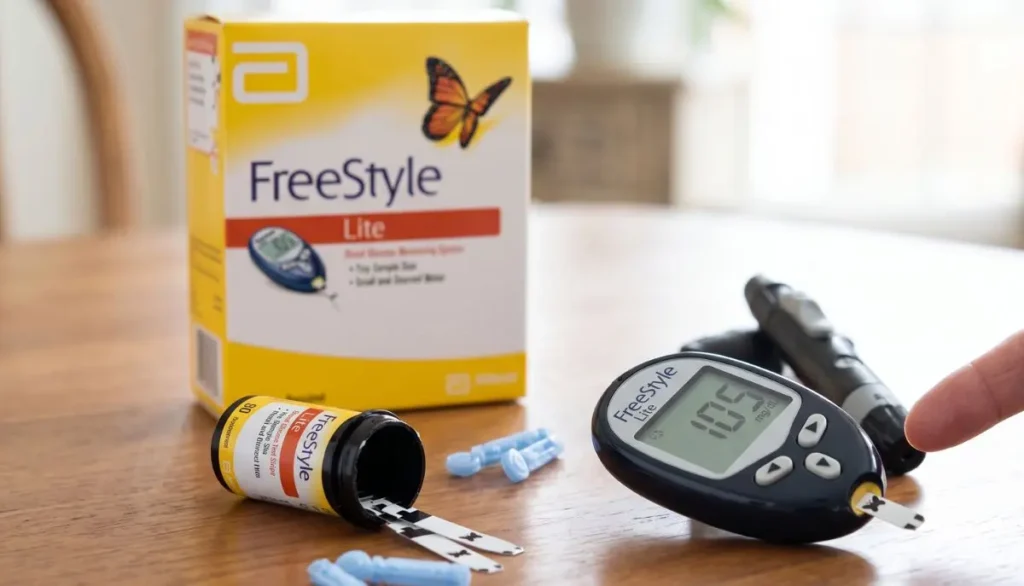
This distinction is important.
A CGM sensor measures glucose in interstitial fluid, while a traditional blood glucose meter measures glucose in a blood sample. Abbott explains that blood glucose and sensor glucose can differ slightly because they measure glucose in different body fluids and at different points in time.
For someone learning how to check glucose at home, the FreeStyle Lite system can provide a practical way to obtain an individual blood glucose reading.
What Do You Need Before Testing?
Before learning freestyle lite blood glucose monitoring system how to use, gather everything you need.
Typically, you will need:
- FreeStyle Lite blood glucose meter
- FreeStyle Lite test strips
- A compatible lancing device
- A fresh sterile lancet
- Alcohol wipe, if recommended by your healthcare professional
- Tissue or cotton
- A sharps container for used lancets
- FreeStyle control solution when performing a control-solution check
The FreeStyle Lite meter should be used with FreeStyle Lite test strips. Abbott’s instructions specifically warn that using other test strips or control solutions with the meter can result in inaccurate readings.
Before starting, check the expiration date on your test strips. Do not use expired strips because they may produce inaccurate results. Test strips should also remain in their original container and should be protected from heat, moisture, and direct sunlight.
FreeStyle Lite Blood Glucose Monitoring System How to Use: Step-by-Step
Let’s walk through the process in simple terms.
Step 1: Wash and Dry Your Hands
Start with clean hands.
Wash your hands with soap and water and dry them completely. Clean, dry hands help reduce the chance that food, sugar, lotion, or other substances on your fingers will affect the sample.
This is an easy step to overlook, especially when you are in a hurry.
However, if you are checking glucose after eating, washing your hands is particularly important because traces of food can potentially contaminate your fingertips.
If you cannot wash your hands, follow the cleaning instructions provided with your meter and testing supplies.
Step 2: Prepare the Lancing Device
Load a new sterile lancet into your lancing device according to its instructions.
Do not reuse lancets.
Using a fresh lancet can help maintain cleanliness and may make obtaining a blood sample more comfortable.
Set the lancing device according to the instructions supplied with the device. The appropriate depth can vary depending on the person and the lancing device.
If you regularly experience difficulty getting enough blood, ask your healthcare professional about the appropriate technique rather than repeatedly increasing the depth yourself.
Step 3: Remove a FreeStyle Lite Test Strip
Take one FreeStyle Lite test strip from its original container.
Close the container promptly after removing the strip.
This matters because exposure to moisture and environmental conditions can affect test strips.
Abbott’s instructions recommend keeping FreeStyle Lite test strips in their original vial, not transferring them to another container, and tightly closing the vial after removing a strip.
Check the strip before use. Do not use a strip if it appears damaged or if it is expired.
Step 4: Insert the Test Strip Into the Meter
Insert the top end of the FreeStyle Lite test strip into the test strip port.
The meter turns on when the test strip is inserted. The strip should be inserted with the appropriate printed side facing up, as shown in the manufacturer’s instructions.
Once the meter is ready, you should see the appropriate blood-drop/test-strip indication on the display.
This is your signal that the meter is ready for the blood sample.
Step 5: Obtain a Small Blood Sample
Use your lancing device to obtain a small blood sample.
The FreeStyle Lite system is designed to use a very small sample—approximately 0.3 μL.
The manufacturer’s information describes several possible testing areas, including:
- Fingers
- Forearm
- Upper arm
- Hand
- Thigh
- Calf
However, alternative-site testing is not appropriate in every situation. Abbott specifically recommends using a fingertip when testing for hypoglycemia or when a person has hypoglycemia unawareness.
If you are unsure which testing site is appropriate for you, ask your healthcare professional.
For many people, the fingertip is the simplest and most reliable place to start.
Step 6: Apply the Blood to the Test Strip
Once you have a blood drop, carefully apply it to one sample area of the FreeStyle Lite test strip.
Do not apply blood to both sample areas.
Abbott’s instructions indicate that the blood or control solution should be applied to one sample area only. If additional sample is needed during the permitted filling period, it should be applied to the same sample area.
You do not need to cover the strip with a large amount of blood.
The system is designed to work with a small sample.
If you repeatedly have trouble producing enough blood, speak with your healthcare professional about proper lancing technique.
Step 7: Wait for the Blood Glucose Result
After the meter receives the appropriate blood sample, it processes the test and displays your blood glucose result.
Take a moment to read the number carefully.
Depending on your meter settings and location, glucose may be displayed in different units, such as:
- mg/dL
- mmol/L
Do not assume that a number is normal or abnormal without considering the units and the target range given to you by your healthcare professional.
Step 8: Record or Review Your Result
Keeping track of your glucose readings can help you and your healthcare professional identify patterns.
Depending on your individual diabetes management plan, you may record:
- Date
- Time
- Blood glucose result
- Before or after a meal
- Exercise
- Medication or insulin
- Illness or stress
- Other relevant circumstances
The FreeStyle Lite system includes memory functions and can provide historical information, including averages over different periods. The manufacturer’s manual includes sections covering meter memory and 7-, 14-, and 30-day averages.
A single glucose result provides useful information, but patterns over time can often provide a clearer picture.
Step 9: Remove and Dispose of the Used Test Strip
After the test is complete, remove the used test strip from the meter.
Dispose of it appropriately according to your local recommendations.
Do not reuse a test strip.
Lancets should also be disposed of in an appropriate sharps container rather than being left loose in household waste.
Safe disposal is an important part of home glucose monitoring that is sometimes forgotten.
When Should You Test Your Blood Glucose?
There is no single testing schedule that is right for everyone.
Your healthcare professional may recommend testing:
- Before meals
- After meals
- Before bedtime
- Before or after physical activity
- When you feel symptoms of low or high blood glucose
- During illness
- Before driving
- When changing medication
- At other specific times
Your testing schedule should be based on your diabetes type, medication, insulin use, glucose patterns, and healthcare plan.
For example, someone using insulin may have different testing requirements from someone managing diabetes through lifestyle changes alone.
The goal is not simply to collect as many numbers as possible. The goal is to obtain useful information that supports safer diabetes management.
How Much Blood Does the FreeStyle Lite Meter Need?
One of the useful features of the FreeStyle Lite system is its small sample requirement.
The system uses approximately 0.3 microliters of blood for a test.
Even though the required sample is small, it is important to apply the sample correctly.
If the meter does not receive enough blood, do not simply smear blood around the strip.
Instead, follow the manufacturer’s instructions for adding additional blood to the same sample area when permitted.
What If You Don’t Get Enough Blood?
Sometimes you may prick your finger and get a very small blood drop.
This can happen for several reasons.
For example:
- Your hands may be cold.
- The lancing depth may not be appropriate.
- You may not have prepared the finger correctly.
- You may have used too little pressure or an ineffective technique.
- The lancet may be dull from previous use.
Start with clean, warm hands.
Avoid aggressively squeezing the finger because this can be uncomfortable and may interfere with proper sampling.
If obtaining blood samples continues to be difficult, ask your healthcare professional or diabetes educator to demonstrate a suitable technique.
Can You Test on Different Parts of the Body?
The FreeStyle Lite system’s manufacturer’s information identifies several possible testing areas, including the forearm, upper arm, hand, thigh, calf, and fingers.
However, alternative-site testing needs additional consideration.
A fingertip is especially important when you need information about your current glucose level during suspected hypoglycemia or when symptoms do not match what you expect.
Always follow the instructions for your particular meter and the testing guidance provided by your healthcare professional.
What Does a LO or HI Result Mean?
Sometimes a glucose meter can display an indication such as LO or HI instead of a standard number.
These readings require attention.
Do not simply ignore them or repeatedly test without considering how you feel.
If the reading seems inconsistent with your symptoms, repeat the test using a new test strip and a proper blood sample according to the manufacturer’s instructions.
If you have symptoms of severe low or high blood glucose, follow the emergency or treatment plan provided by your healthcare professional.
If you are uncertain about what a LO or HI reading means for your specific meter, consult the product instructions or contact your healthcare provider.
What If the Result Doesn’t Match How You Feel?
This is an important question.
Suppose you feel shaky, sweaty, weak, confused, or otherwise unwell, but your meter reading does not seem to match your symptoms.
Do not automatically assume that the meter is correct or that your symptoms are unrelated to glucose.
First, check the testing process:
- Wash and dry your hands.
- Use a new test strip.
- Obtain an appropriate blood sample.
- Repeat the test.
- Follow your healthcare professional’s instructions.
If the reading still does not make sense, seek professional advice.
Your symptoms and glucose reading should both be taken seriously.
How to Perform a Control Solution Test
A control solution test can be useful when you want to confirm that your meter and test strips are functioning properly.
The manufacturer’s manual explains that control solution contains a known amount of glucose and can be used to check the performance of the meter and test strips.
You may consider a control solution test when:
- You question your results.
- You open a new package of test strips.
- You suspect the meter or strips may not be working correctly.
- You want to practice the testing procedure without using blood.
Follow the exact control-solution instructions supplied with your FreeStyle Lite system.
Remember that a control-solution result should not be interpreted as a blood glucose result.
Common Mistakes to Avoid With FreeStyle Lite
Even when a glucose meter is simple to operate, small mistakes can affect testing.
1. Using expired test strips
Always check the expiration date.
Expired strips may produce inaccurate results.
2. Leaving the strip vial open
Close the vial immediately after removing a strip.
3. Using the wrong test strips
Use the test strips specified for your meter.
Abbott warns that using incompatible strips can result in inaccurate readings.
4. Testing with dirty hands
Food, sugar, lotion, and other substances can potentially affect the sample.
Wash and dry your hands before testing.
5. Reusing lancets or strips
Use a new lancet for each test and never reuse test strips.
6. Applying blood incorrectly
Apply the sample to the designated sample area according to the manufacturer’s instructions.
7. Ignoring unusual results
If a reading is unexpectedly high, unexpectedly low, or inconsistent with how you feel, follow your healthcare professional’s instructions and repeat the test when appropriate.
How Should FreeStyle Lite Test Strips Be Stored?
Proper storage is essential.
According to Abbott’s FreeStyle Lite information, test strips should be:
- Kept in their original vial
- Stored in a cool, dry location
- Protected from direct sunlight
- Protected from heat
- Used within the specified temperature range
- Kept away from excessive moisture
The manufacturer’s information lists a storage range of approximately 4°C to 30°C (40°F to 86°F) for the test strips and an operating range of approximately 4°C to 40°C (40°F to 104°F) for the FreeStyle Lite system.
Always check the current instructions supplied with your specific product because packaging and regional instructions can vary.
FreeStyle Lite vs. FreeStyle Libre: Are They the Same?
No.
This is one of the most common points of confusion.
FreeStyle Lite is a traditional blood glucose meter. You use a test strip and a blood sample to obtain a glucose reading.
FreeStyle Libre is a continuous glucose monitoring system that uses a sensor worn on the body. Abbott describes FreeStyle Libre systems as using sensors to track glucose and provide readings through a compatible app or reader.
For example:
| Feature | FreeStyle Lite | FreeStyle Libre |
| Testing method | Blood sample | Sensor-based glucose monitoring |
| Test strip | Yes | No fingerstick test strip for routine sensor readings |
| Lancet | Used for blood testing | Not routinely required for sensor readings |
| Wearable sensor | No | Yes |
| Main purpose | Individual blood glucose checks | Continuous/ongoing glucose monitoring |
| Device format | Blood glucose meter | Sensor + compatible app/reader |
Choosing between glucose-monitoring options depends on your diabetes management needs, healthcare recommendations, lifestyle, coverage, and personal preferences.
Tips for Making Glucose Testing Easier
Testing regularly can become repetitive, but a few simple habits can make the experience easier.
Keep your supplies together
Store your meter, test strips, lancets, and lancing device in one convenient location.
Create a routine
Testing at the same general times recommended by your healthcare professional can make it easier to remember.
Keep extra supplies available
Running out of test strips can interrupt your monitoring routine.
Protect your test strips
Heat, moisture, and improper storage can affect them.
Keep track of patterns
Instead of focusing on one isolated number, look for patterns related to meals, exercise, medication, sleep, illness, and other factors.
Ask questions
If you are unsure about your testing technique, ask your healthcare professional or diabetes educator to watch you perform a test.
Sometimes one small correction can make home testing much easier.
How Can Alfa Healthcare Supply Inc. Help?
At Alfa Healthcare Supply Inc., we understand that medical supplies are not just products sitting on a shelf. They are tools people depend on as part of their everyday health routines.
For someone managing diabetes, having appropriate glucose-monitoring supplies available when needed can make daily testing more convenient.
Alfa Healthcare Supply Inc. provides medical supplies and healthcare equipment and serves customers looking for dependable home healthcare products.
You can visit the Alfa Healthcare Supply website to explore available diabetes and medical supply products:
When purchasing blood glucose monitoring supplies, always verify that the test strips are compatible with your specific meter.
Final Thoughts: Making Blood Glucose Testing Part of Your Routine
Learning freestyle lite blood glucose monitoring system how to use does not have to be complicated.
The basic process is simple:
Wash and dry your hands → prepare the lancing device → insert a compatible test strip → obtain a blood sample → apply the sample correctly → wait for the result → record the reading → safely dispose of used supplies.
The most important part is consistency. Use the correct test strips, store them properly, check expiration dates, keep your hands clean, and follow the testing schedule recommended by your healthcare professional.
Remember that a glucose meter is a tool—not a replacement for professional diabetes care. Your healthcare professional can help you understand your personal glucose targets and what actions to take when readings are higher or lower than expected.
For people who rely on regular blood glucose testing, having dependable supplies and understanding how to use them correctly can make everyday diabetes management feel a little less stressful.
Alfa Healthcare Supply Inc. is committed to helping patients and caregivers find medical supplies for everyday healthcare needs. Visit the website to explore available diabetes and home medical supply products.
Frequently Asked Questions About FreeStyle Lite
How do I use the FreeStyle Lite blood glucose meter?
Insert a compatible FreeStyle Lite test strip into the meter, obtain a small blood sample using a lancing device, apply the blood to the appropriate sample area on the strip, and wait for the meter to display the result. Always follow the manufacturer’s instructions for your specific system.
How much blood does FreeStyle Lite need?
The FreeStyle Lite system is designed to use approximately 0.3 microliters of blood.
Can I use other test strips with FreeStyle Lite?
You should use the test strips specified for your FreeStyle Lite meter. Abbott warns that using other test strips may result in inaccurate readings.
Should I wash my hands before using FreeStyle Lite?
Yes. Clean, dry hands are recommended before blood glucose testing. Washing your hands can help remove substances that could interfere with the sample.
Can I use FreeStyle Lite without pricking my finger?
The FreeStyle Lite is a blood glucose meter, so it requires a blood sample. Some versions of the manufacturer’s instructions identify alternative testing sites, but fingertip testing is particularly recommended when testing for hypoglycemia or when hypoglycemia unawareness is present.
How often should I check my blood sugar?
Your healthcare professional should determine how often you need to test. The recommended frequency depends on factors such as your diabetes type, medications, insulin use, glucose control, and treatment plan.
What should I do if my reading seems wrong?
Wash and dry your hands and repeat the test using a new test strip and a proper blood sample. If the result remains unexpected or does not match how you feel, contact your healthcare professional and follow your diabetes management plan.
Can FreeStyle Lite test strips expire?
Yes. Do not use test strips beyond their expiration date because they may provide inaccurate results.
How should I store FreeStyle Lite test strips?
Keep them in their original vial, tightly closed, and store them according to the temperature and storage requirements provided by the manufacturer. Protect them from heat, moisture, and direct sunlight.
Is FreeStyle Lite the same as FreeStyle Libre?
No. FreeStyle Lite is a blood glucose meter that uses test strips and a blood sample. FreeStyle Libre is a sensor-based glucose monitoring system. Abbott describes FreeStyle Libre as using a wearable sensor to track glucose and provide readings through a compatible app or reader.
Do I need a prescription to use a blood glucose meter?
Requirements can vary depending on the product, location, insurance plan, and supplier. Check the specific product requirements and consult your healthcare provider or supplier if you are unsure.
Medical Disclaimer
This article provides general educational information and is not medical advice. Product instructions can vary by model, region, and product version. Always read the instructions supplied with your FreeStyle Lite meter and test strips. If you have questions about your glucose readings, testing schedule, symptoms, or diabetes treatment, consult a qualified healthcare professional. If you experience symptoms of a medical emergency, seek immediate medical attention.
If you use a blood glucose meter at home, running out of test strips can quickly become stressful. You may start wondering: can you buy CONTOUR NEXT test strips over the counter, or do you need a prescription from your doctor?
The good news for many people in the United States is that blood glucose testing supplies for home use can generally be purchased without a prescription. MedlinePlus explains that blood glucose testing kits can be purchased from a pharmacy without a prescription. The FDA also recognizes over-the-counter blood glucose monitoring systems for home use.
However, there is an important detail: not every test strip works with every glucose meter. If you have a CONTOUR NEXT meter, you should purchase compatible CONTOUR NEXT test strips rather than choosing strips simply because they look similar or are inexpensive.
In this guide, we will explain whether CONTOUR NEXT test strips can be purchased over the counter, where you can find them, whether you need a prescription, how to choose the correct strips, how to store them safely, and what to check before placing an order.
Can You Buy CONTOUR NEXT Test Strips Over the Counter?
Yes, CONTOUR NEXT blood glucose test strips for home blood glucose monitoring can generally be purchased over the counter in the United States without a prescription.
Home blood glucose monitoring products are designed for people to use outside a clinical setting. FDA guidance specifically addresses self-monitoring blood glucose systems intended for over-the-counter home use.
The FDA’s database also lists the CONTOUR NEXT EZ Blood Glucose Monitoring System as a glucose monitoring device cleared for home use.
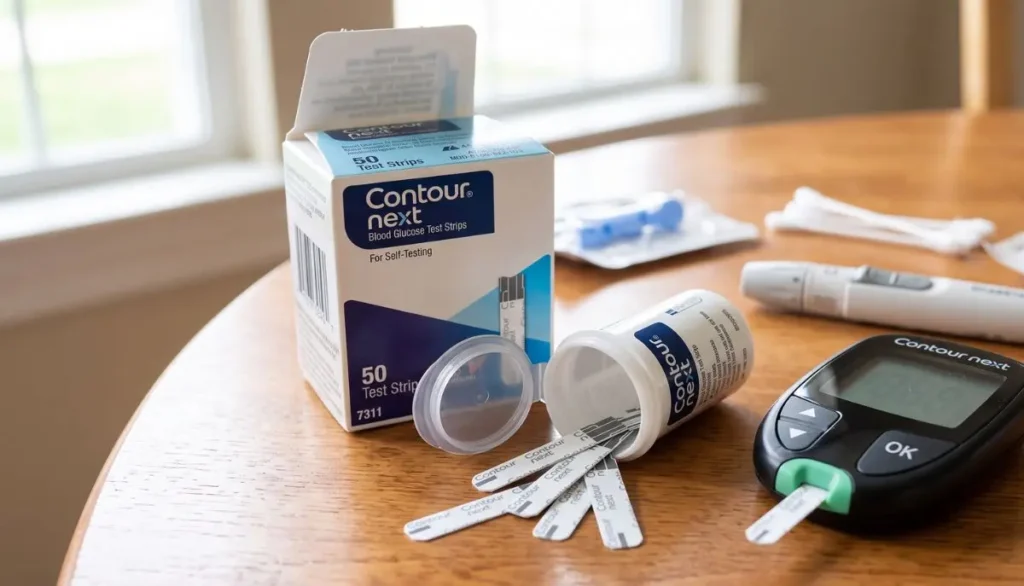
That means people who already use a compatible CONTOUR NEXT blood glucose meter can typically purchase replacement test strips without visiting a doctor’s office simply to obtain a prescription.
Still, your healthcare provider may recommend a particular meter or testing schedule based on your individual diabetes management plan.
The important difference between OTC and prescription coverage
Buying a product over the counter and getting the product paid for by insurance are two different things.
You may be able to purchase CONTOUR NEXT test strips without a prescription, but your insurance company may have its own requirements if you want the strips covered under your benefits.
For example, an insurance plan may require:
- A prescription
- Documentation of diabetes
- A preferred glucose meter
- A specific brand of test strips
- A particular pharmacy or DME supplier
- Prior authorization in some situations
Therefore, if you are paying out of pocket, you may be able to purchase compatible strips directly. If you are trying to use insurance coverage, check the requirements of your specific plan.
What Are CONTOUR NEXT Test Strips?
CONTOUR NEXT test strips are disposable strips designed to work with compatible CONTOUR NEXT blood glucose meters.
A typical blood glucose test involves placing a small blood sample onto the test strip. The meter analyzes the sample and displays a blood glucose reading.
The CONTOUR NEXT family includes different meter models, so it is important to verify compatibility before purchasing replacement strips.
For example, CONTOUR NEXT meters may include models such as:
- CONTOUR NEXT ONE
- CONTOUR NEXT GEN
- CONTOUR NEXT EZ
- Other compatible CONTOUR NEXT systems
Features can vary between models, so always follow the instructions supplied with your particular meter.
Alfa Healthcare Supply Inc. also provides information about using CONTOUR NEXT systems and emphasizes the importance of using compatible strips with the appropriate meter.
Why Compatibility Matters
Imagine buying a new pack of test strips, opening the package, and discovering that they do not work with your meter.
That can be frustrating—and unnecessary.
Blood glucose meters and test strips are designed as systems. A strip from one manufacturer or product family should not automatically be assumed to work with another meter.
Before purchasing, check:
- The exact name of your glucose meter
- The name printed on the test-strip box
- The manufacturer’s compatibility information
- The instructions for your meter
- The expiration date
- Whether the package is sealed and undamaged
The FDA recommends using new test strips authorized for sale in the United States and warns consumers about the risks associated with previously owned or unauthorized test strips.
Do You Need a Prescription for CONTOUR NEXT Test Strips?
For typical home use, you generally do not need a prescription to purchase blood glucose test strips over the counter.
MedlinePlus states that people can purchase blood glucose testing kits from a pharmacy without a prescription.
However, there is a difference between:
Buying the strips yourself:
You can generally purchase compatible home-use test strips without a prescription.
Getting the strips through insurance:
Your insurance provider may have separate requirements.
This distinction is important because people sometimes hear that a product is “prescription only” when the actual issue is insurance reimbursement.
If you are unsure, you can ask your insurance company, pharmacist, healthcare provider, or medical supply supplier whether a prescription is needed for coverage.
Where Can You Buy CONTOUR NEXT Test Strips?
CONTOUR NEXT test strips may be available through several types of sellers, depending on location and availability.
You may find them through:
- Pharmacies
- Medical supply stores
- DME suppliers
- Healthcare supply websites
- Authorized retailers
- Online medical supply stores
When shopping online, don’t choose a seller based only on the lowest price.
Look for a supplier that provides clear product information and sells new, sealed medical supplies.
Buying CONTOUR NEXT Test Strips from Alfa Healthcare Supply Inc.
Alfa Healthcare Supply Inc. offers diabetic supplies, including CONTOUR NEXT Test Strips. The company’s diabetic supplies category currently lists CONTOUR NEXT Test Strips with an online price of $69.00; prices and availability can change, so customers should verify the current listing before ordering.
Alfa Healthcare Supply Inc. serves customers looking for medical and diabetic supplies and provides online ordering options through its website.
For customers who want to purchase replacement strips, checking the exact product listing and confirming compatibility with the meter is a smart step before completing an order.
Are CONTOUR NEXT Test Strips Available Without Going to a Doctor?
In many cases, yes.
If you already have a compatible CONTOUR NEXT glucose meter and simply need replacement strips, you generally do not need a doctor’s appointment just to purchase the strips for home use.
This can make routine diabetes management more convenient.
For someone who checks blood glucose regularly, running out of strips can interrupt a familiar routine. Having a reliable source for replacement supplies can make everyday testing less stressful.
However, if your healthcare professional has specifically prescribed a particular meter or testing system, follow their recommendations.
Can You Buy CONTOUR NEXT Test Strips Online?
Yes, compatible CONTOUR NEXT test strips may be available online from medical supply retailers and other sellers.
Online ordering can be useful because it may allow you to:
- Compare product information
- Check package quantities
- Review current pricing
- Order from home
- Arrange delivery
- Reorder before you run out
But online convenience should not replace product safety.
The FDA recommends purchasing new, unopened test-strip containers rather than previously owned strips.
When purchasing online, look carefully at the product title, manufacturer information, package size, expiration date information when provided, and seller details.
What Should You Check Before Buying CONTOUR NEXT Test Strips?
Before clicking “Buy,” take a moment to check the following.
1. Check your meter model
Look at your glucose meter.
You may see a model name such as CONTOUR NEXT ONE, CONTOUR NEXT GEN, or CONTOUR NEXT EZ.
Write down the exact model if necessary.
2. Confirm strip compatibility
Make sure the strips are intended for your meter.
Don’t assume all glucose strips are interchangeable.
3. Check the package size
Different packages may contain different numbers of test strips.
For example, you may encounter packages with different quantities depending on the product and seller.
Choose a quantity that matches how frequently you test.
4. Check the expiration date
Expired test strips should not be used.
Alfa Healthcare Supply’s educational guidance also recommends checking the expiration date before using a CONTOUR NEXT test strip.
5. Look for sealed packaging
Avoid products with damaged packaging, opened containers, or questionable storage history.
6. Purchase from a reputable source
A legitimate medical supply provider can provide clearer product information and help you choose compatible supplies.
Why You Should Avoid Used or Previously Owned Test Strips
You may occasionally find unusually cheap glucose test strips online or from private sellers.
A very low price can be tempting.
But cheaper is not always safer.
The FDA specifically warns consumers about previously owned test strips. The agency recommends purchasing new, unopened vials and avoiding pre-owned strips.
Why does this matter?
Test strips can be affected by:
- Moisture
- Heat
- Improper storage
- Damaged packaging
- Expiration
- Contamination
- Unknown storage conditions
A package that has been sitting in an unsuitable environment may not perform as expected.
When you’re using a blood glucose meter to make decisions about your health, saving a few dollars isn’t worth unnecessary uncertainty.
How Should CONTOUR NEXT Test Strips Be Stored?
Proper storage is an important part of maintaining your testing supplies.
Always follow the storage instructions provided with your specific CONTOUR NEXT test strips.
As a general habit:
- Keep strips in their original container.
- Close the container promptly after removing a strip.
- Keep strips away from moisture.
- Avoid excessive heat.
- Do not use damaged strips.
- Check the expiration date.
- Keep supplies in an appropriate, dry location.
One small habit can make a difference: take out the strip you need and close the container immediately.
Avoid leaving a container open while you do other things.
How Do You Use CONTOUR NEXT Test Strips?
The exact procedure depends on the CONTOUR NEXT meter model, so the meter’s user guide should always be your primary reference.
A typical testing routine includes the following steps.
Step 1: Wash your hands
Wash your hands with soap and water.
Then dry them completely.
This is important because substances on your fingers can affect the blood sample.
The FDA recommends washing and drying your hands before testing and following the meter’s instructions carefully.
Step 2: Prepare your supplies
Have your:
- CONTOUR NEXT meter
- Compatible test strip
- Lancing device
- New lancet
- Tissue or gauze
ready before you begin.
Step 3: Insert the test strip
Insert the compatible test strip into the meter according to the instructions for your specific model.
The meter should indicate when it is ready for the blood sample.
Step 4: Obtain a blood sample
Use the lancing device according to its instructions.
Do not share lancets or blood-testing equipment with another person.
Step 5: Apply the blood sample
Apply the blood sample to the test strip as directed by your meter’s instructions.
Step 6: Wait for the result
The meter processes the sample and displays your blood glucose reading.
Record or review the reading according to your diabetes management plan.
What If Your CONTOUR NEXT Meter Says There Is an Error?
An error message does not necessarily mean that your meter is broken.
Common possibilities include:
- The strip was not inserted correctly.
- The blood sample was insufficient.
- The strip was damaged.
- The strip was expired.
- The strip was stored incorrectly.
- The meter needs attention.
- The wrong strip was used.
- There is another issue described in the meter’s user guide.
If you receive an unexpected error, check your meter’s instructions before repeating the test.
If problems continue, contact the manufacturer’s support service or speak with your healthcare professional.
Can You Use Any Blood Glucose Test Strip With a CONTOUR NEXT Meter?
No.
This is one of the most important points to remember.
You should use test strips specifically designed for your particular CONTOUR NEXT meter.
Different glucose meters use different technologies and strip designs.
For example, a generic glucose test strip is not automatically compatible with a CONTOUR NEXT meter simply because it measures blood glucose.
Think of the test strip as part of the meter system rather than a universal accessory.
Are CONTOUR NEXT Test Strips Covered by Insurance?
Insurance coverage varies.
Some people may purchase diabetes testing supplies through insurance, while others may buy them directly.
Coverage can depend on:
- Your insurance company
- Your plan
- Your diagnosis
- Your benefit category
- Your preferred supplier
- Your prescribed meter
- Whether your plan requires a prescription
If you want insurance to pay for your test strips, contact your insurer before placing an order.
Ask:
“Are CONTOUR NEXT test strips covered under my plan, and do I need a prescription or preferred supplier?”
This simple question can help you avoid an unexpected out-of-pocket expense.
What If Your Insurance Does Not Cover CONTOUR NEXT Test Strips?
If your plan does not cover the product, you may still be able to purchase compatible strips yourself if they are available for OTC sale.
Before switching meters just because of price, consider the full cost of the system.
Look at:
- Meter cost
- Test-strip cost
- Number of tests per day
- Lancet cost
- Availability of replacement supplies
- Insurance coverage
- Ease of use
A meter that appears inexpensive may become more expensive if its strips cost more over time.
How Many CONTOUR NEXT Test Strips Do You Need?
There is no single number that is right for everyone.
Your healthcare professional may recommend testing:
- Once a day
- Several times a day
- Before meals
- After meals
- At bedtime
- At specific times based on medication
- At other times based on your diabetes care plan
The number of strips you need depends on your individual testing schedule.
If you test several times each day, buying a larger package may be convenient. If you test less frequently, a smaller package may be sufficient.
Do not change your testing schedule simply to save test strips without discussing it with your healthcare professional.
Can You Buy CONTOUR NEXT Test Strips at a Pharmacy?
Many pharmacies sell blood glucose meters and replacement testing supplies.
Availability can vary by pharmacy, location, and inventory.
If you want to purchase from a local pharmacy, you can call ahead and ask whether they carry the specific CONTOUR NEXT test strips that match your meter.
This is particularly useful if you need strips immediately.
For online purchases, medical supply stores may offer another convenient option.
Is Buying CONTOUR NEXT Test Strips Online Safe?
Buying online can be convenient, but the seller matters.
Before ordering, look for:
- A professional medical supply website
- Clear product descriptions
- Secure checkout
- Contact information
- Clear shipping information
- New, sealed products
- Transparent pricing
- Appropriate product identification
The FDA recommends using new test strips authorized for sale in the United States and warns against previously owned strips.
If an online listing looks suspiciously cheap or does not clearly identify the product, be cautious.
What Makes a Good Medical Supply Supplier?
A good supplier should make it easier—not harder—to understand what you’re purchasing.
Look for a supplier that provides:
Clear product information
The product page should identify the test strip and provide useful information about compatibility and package quantity.
Straightforward ordering
The ordering process should be easy to understand.
Customer support
A medical supply company should provide a way for customers to ask questions about products and orders.
Safe product sourcing
For medical products, quality and authenticity matter.
Reliable delivery
People who rely on glucose testing supplies don’t want to discover that their order has been unexpectedly delayed after they have already run out.
Why Buying the Right Strips Matters for Diabetes Management
Blood glucose testing is not simply about getting a number on a screen.
For many people, glucose readings are part of a larger daily routine that may include:
- Food choices
- Physical activity
- Medication
- Insulin
- Sleep
- Stress management
- Healthcare appointments
That makes reliable testing supplies important.
A test strip is a small item, but it plays a meaningful role in the testing process.
Using the correct, properly stored, unexpired strips helps support proper use of your glucose meter.
The FDA notes that accuracy and safe use depend on factors including the quality of the meter and strips and how well the test is performed.
What Can Affect a Blood Glucose Test?
Several factors can influence testing.
These can include:
- Dirty hands
- Wet fingers
- Incorrect testing technique
- Expired strips
- Improperly stored strips
- Damaged strips
- Problems with the meter
- Certain health conditions
- Other factors described in the device instructions
This is why a careful testing routine matters.
If a glucose reading does not match how you feel or seems unexpectedly high or low, don’t automatically assume that the number is correct or incorrect.
Follow your healthcare professional’s instructions for checking unexpected readings.
What Should You Do If Your Reading Seems Wrong?
If a blood glucose result seems unusual, consider whether there could have been a testing problem.
You can check:
- Were your hands clean and dry?
- Was the strip expired?
- Was the strip container properly closed?
- Was the strip stored correctly?
- Did you use the correct strip?
- Did you follow the meter’s instructions?
- Was enough blood applied?
If you remain concerned, follow the guidance provided by your healthcare professional.
The FDA also recommends discussing glucose-meter technique with a healthcare provider if you are unsure how to test correctly.
CONTOUR NEXT Test Strips and Everyday Convenience
One of the biggest advantages of OTC access is convenience.
If you use a CONTOUR NEXT meter regularly, you don’t necessarily want to schedule a medical appointment every time you need a new box of strips.
Being able to purchase compatible replacement strips from a pharmacy or medical supply provider can make routine diabetes care easier.
The key is planning ahead.
Instead of waiting until the final few strips, check your supply regularly.
A simple reminder on your phone or calendar can help:
“Check glucose supplies.”
It takes only a minute, but it can prevent the frustration of running out unexpectedly.
How to Plan Your Test-Strip Supply
A practical approach is to look at your typical testing routine.
For example, if your healthcare professional has instructed you to test multiple times each day, estimate how many strips you use in a week.
Then consider:
Daily use × number of days = approximate supply needed
Your actual needs may vary, so follow your healthcare professional’s testing plan.
Also remember that test strips have expiration dates. Buying an extremely large quantity may not be helpful if you cannot use the strips before they expire.
A Simple Buying Checklist
Before purchasing your next box of CONTOUR NEXT test strips, use this quick checklist:
✓ Confirm your meter model
✓ Confirm test-strip compatibility
✓ Check package quantity
✓ Check expiration information
✓ Choose new, unopened strips
✓ Buy from a reputable supplier
✓ Compare your insurance requirements if applicable
✓ Review the current price
✓ Check shipping and delivery information
✓ Order before your current supply runs out
This small checklist can make buying diabetes testing supplies much easier.
Final Thoughts: Can You Buy CONTOUR NEXT Test Strips Over the Counter?
So, can you buy CONTOUR NEXT test strips over the counter?
Yes—in the United States, compatible blood glucose test strips for home use can generally be purchased without a prescription. Blood glucose testing kits are commonly available through pharmacies and medical supply retailers, and FDA guidance recognizes OTC home-use blood glucose monitoring systems.
The bigger question is not simply whether you can buy the strips. It is whether you are buying the right strips from a reliable source.
Always confirm that the test strips are compatible with your CONTOUR NEXT meter. Choose new and unopened products, check expiration information, store the strips correctly, and follow the instructions for your specific glucose meter.
If you are purchasing through insurance, remember that OTC availability does not necessarily mean insurance will cover the product. Insurance policies can have their own requirements.
For people who rely on regular blood glucose testing, having a dependable supply of compatible test strips can make daily diabetes management feel a little more organized and less stressful.
Alfa Healthcare Supply Inc. provides diabetic supplies, including CONTOUR NEXT Test Strips, through its online medical supply store.
Whether you purchase from a pharmacy or a medical supply company, take a few moments to confirm the product before ordering. The right strip, the right meter, and proper storage all contribute to a safer and more dependable testing routine.
Frequently Asked Questions
1. Can you buy CONTOUR NEXT test strips over the counter?
Yes. For home blood glucose monitoring in the United States, CONTOUR NEXT-compatible test strips can generally be purchased without a prescription. MedlinePlus states that blood glucose testing kits can be purchased from pharmacies without a prescription.
2. Do I need a prescription to buy CONTOUR NEXT test strips?
Generally, no for OTC home use. However, insurance coverage may have separate requirements, so check with your insurance provider if you want reimbursement or coverage.
3. Can I buy CONTOUR NEXT test strips online?
Yes. Compatible CONTOUR NEXT test strips may be available through online pharmacies and medical supply stores. Choose a reputable seller and look for new, unopened products.
4. Does every CONTOUR NEXT meter use the same test strips?
You should not assume that every model is identical. Check your specific meter model and the manufacturer’s compatibility information before purchasing.
5. Can I use another brand’s test strips in my CONTOUR NEXT meter?
Do not assume another brand’s strips will work. Use test strips intended for your meter according to the manufacturer’s instructions.
6. Can I buy used CONTOUR NEXT test strips?
It is strongly recommended that you do not buy previously owned test strips. The FDA recommends new, unopened test-strip vials and warns about the risks of previously owned strips.
7. What should I do if my test strips are expired?
Do not use expired strips. Purchase a new supply and follow the storage instructions provided with the product.
8. Can insurance pay for CONTOUR NEXT test strips?
Possibly. Coverage depends on your insurance plan and its requirements. Contact your insurance company to determine whether the strips are covered and whether a prescription or preferred supplier is required.
9. Where can I buy CONTOUR NEXT test strips?
You may find them at pharmacies, medical supply stores, DME suppliers, and online medical supply retailers. Alfa Healthcare Supply Inc. currently lists CONTOUR NEXT Test Strips in its diabetic supplies category.
10. How should I store CONTOUR NEXT test strips?
Follow the manufacturer’s storage instructions. Keep the strips in their original container, protect them from moisture and excessive heat, and close the container promptly after removing a strip.
11. How do I know which strips fit my meter?
Check the exact model name printed on your meter and compare it with the test-strip packaging and compatibility information.
12. Should I buy extra test strips?
Keeping an appropriate backup supply can be helpful if you test regularly. However, avoid purchasing more than you can reasonably use before the expiration date.
Important health note: This article is for general educational information and does not replace medical advice. Always follow the instructions supplied with your glucose meter and test strips and speak with your healthcare professional about your individual blood glucose testing plan.
CONTOUR NEXT ONE Blood Glucose Monitoring System Reviews
When you are checking your blood glucose regularly, the meter you use becomes part of your daily routine. A blood glucose meter should be easy to use, provide dependable readings, require a reasonable amount of blood, and make it simple to keep track of your results.
That is why many people searching for a home glucose meter come across the CONTOUR NEXT ONE Blood Glucose Monitoring System.
In this detailed guide, we take a closer look at CONTOUR NEXT ONE blood glucose monitoring system reviews, including its accuracy, ease of use, test strips, Bluetooth connectivity, smartLIGHT feature, Second-Chance Sampling, advantages, limitations, and what real-world users say.
The CONTOUR NEXT ONE is manufactured by Ascensia Diabetes Care and is an FDA-cleared over-the-counter blood glucose monitoring system. The FDA’s records identify the CONTOUR NEXT ONE as a blood glucose monitoring system, and an updated 2026 FDA submission continues to list the CONTOUR NEXT ONE among the manufacturer’s blood glucose monitoring systems.
For people comparing glucose meters, the most important question is simple:
Is the CONTOUR NEXT ONE a good blood glucose meter?
For many users, it can be a strong option, particularly if accuracy, a small blood sample, straightforward testing, and smartphone connectivity are important. However, no meter is perfect for every person. Test-strip cost, app preferences, battery issues, and individual experiences can affect whether it is the right choice.
What is the CONTOUR NEXT ONE Blood Glucose Monitoring System?
The CONTOUR NEXT ONE is a blood glucose meter designed to measure glucose from a small capillary blood sample.
Unlike a continuous glucose monitor (CGM), it does not continuously measure glucose under the skin. Instead, you use a CONTOUR NEXT test strip and a finger-stick blood sample to obtain an individual glucose reading.
The meter can also connect wirelessly to a compatible smartphone or tablet through Bluetooth and transfer readings to the CONTOUR Diabetes app. The FDA documentation describes this wireless communication and app integration as one of the system’s key features.
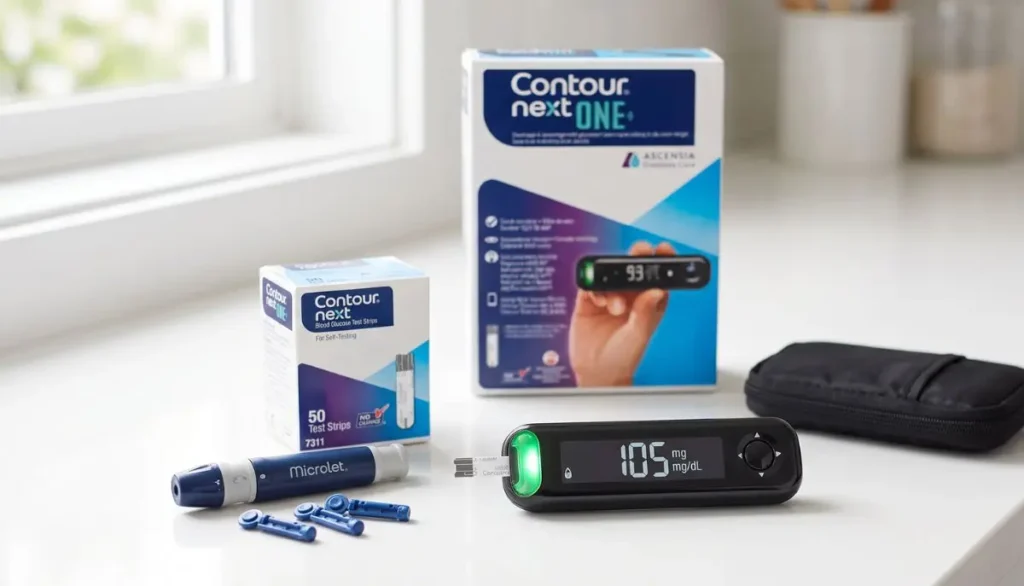
This makes the meter useful for people who want a traditional finger-stick glucose meter while also having the option of digital record keeping.
Key features at a glance
The CONTOUR NEXT ONE offers several features that distinguish it from a basic glucose meter:
- No-coding technology
- SmartLIGHT target-range indicator
- Second-Chance Sampling
- Bluetooth connectivity
- CONTOUR Diabetes app integration
- Small blood sample requirement
- Use with CONTOUR NEXT blood glucose test strips
- Compact design
- Before-meal and after-meal testing options
- Digital glucose result storage and tracking
The current manufacturer’s information specifically describes smartLIGHT as a feature that provides immediate color-based feedback and Second-Chance Sampling as a way to add more blood to the same strip when the first sample is insufficient.
CONTOUR NEXT ONE Blood Glucose Monitoring System Reviews: Our Overall Impression
When looking at CONTOUR NEXT ONE blood glucose monitoring system reviews, it is important not to judge the meter based on one positive or negative review.
A better approach is to look at several areas:
- Accuracy
- Ease of use
- Blood sample requirements
- Test-strip design
- Smart features
- Smartphone connectivity
- Long-term usability
- Cost of testing
- User satisfaction
- Potential disadvantages
On those points, the CONTOUR NEXT ONE has several meaningful strengths.
Its biggest advantage is its combination of established glucose-meter technology with useful digital features. It can work as a straightforward standalone meter, but users who enjoy smartphone tracking can connect it to the CONTOUR Diabetes app.
That flexibility is valuable.
Some people simply want to test their blood sugar and see the number. Others want to track readings over time, identify patterns, and share information with their healthcare team.
The CONTOUR NEXT ONE can support both approaches.
How Accurate Is the CONTOUR NEXT ONE?
Accuracy is probably the most important part of any CONTOUR NEXT ONE blood glucose monitoring system review.
A meter can have a beautiful screen and a convenient app, but if its readings are not sufficiently accurate, those features mean very little.
The CONTOUR NEXT ONE has undergone formal accuracy testing.
A published clinical evaluation examined the system using multiple CONTOUR NEXT test-strip lots. In laboratory testing, 600 out of 600 combined results met the ISO 15197:2013 analytical accuracy criteria. In the clinical study involving people with diabetes, 99.4% of subject self-test results met the ISO criteria, while 99.7% of results obtained by study staff met the criteria.
These results are important because they are based on structured testing rather than customer opinions.
The manufacturer’s technical information also describes testing involving 372 lay users and comparisons against a laboratory reference method.
What does that mean for everyday users?
It means the meter has demonstrated strong performance under controlled testing conditions.
However, it is important to remember that no home blood glucose meter should be expected to produce exactly the same number as a laboratory blood test every time.
Your result can be affected by factors such as:
- Incorrect hand washing
- Food or sugar residue on fingers
- An inadequate blood sample
- Improper strip storage
- Expired or damaged strips
- Testing technique
- Temperature and environmental conditions
- Differences between capillary and laboratory samples
So, if you occasionally see a small difference between two glucose readings, that does not automatically mean that the meter is defective.
What Do Users Say in CONTOUR NEXT ONE Reviews?
Real-world reviews are useful because they show what happens outside a controlled clinical environment.
Overall, online feedback about the CONTOUR NEXT ONE is mixed but includes many positive comments about ease of use, portability, accuracy, and the small amount of blood required.
For example, recent customer feedback includes users describing the meter as easy to use and accurate, while another customer reported being satisfied with its small blood requirement and comfortable use. At the same time, some reviewers have reported concerns about inconsistent readings, error messages, or reliability over time.
This is a useful reminder:
A product can perform well in clinical testing while individual customers can still experience problems.
That is true for almost every home medical device.
A 2026 community discussion also praised the CONTOUR NEXT ONE for accuracy while criticizing the ongoing cost of test strips.
Another diabetes forum discussion described the meter as repeatable and accurate from the user’s experience but raised concerns about the cost of strips and dissatisfaction with the companion app.
Therefore, when reading reviews, consider the entire picture rather than focusing only on five-star or one-star ratings.
CONTOUR NEXT ONE Accuracy: What Makes It Different?
One feature that has helped the CONTOUR NEXT family develop a reputation for accuracy is its test-strip technology and glucose calculation system.
FDA documentation for the CONTOUR NEXT ONE describes a revised glucose calculation algorithm intended to improve accuracy compared with the earlier CONTOUR NEXT system.
The system is also designed to work specifically with CONTOUR NEXT blood glucose test strips.
That last point is important.
Always use the correct test strips
The CONTOUR NEXT ONE meter is designed for use with CONTOUR NEXT test strips.
The manufacturer’s quick-reference guide specifically states that the meter uses CONTOUR NEXT blood glucose test strips.
Do not assume that any glucose test strip will work with the meter.
Using the correct strip is essential for proper testing.
What Is SmartLIGHT?
One of the most recognizable features of the CONTOUR NEXT ONE is smartLIGHT.
Instead of showing only a number, the meter can provide a color indication related to the user’s configured target range.
According to the manufacturer:
- Green = within target
- Amber = above target
- Red = below target
The smartLIGHT feature can also be switched off if the user does not want to use it.
Why is smartLIGHT useful?
Imagine that you test your blood glucose early in the morning.
Instead of having to remember a target range immediately, the meter gives you an additional visual indication.
For some users, that makes glucose monitoring easier to understand.
It is especially helpful for people who prefer visual information instead of relying only on numbers.
However, the light is not a substitute for understanding your personal glucose targets. Your healthcare professional should help determine what ranges are appropriate for you.
What Is Second-Chance Sampling?
Another practical feature discussed in CONTOUR NEXT ONE blood glucose monitoring system reviews is Second-Chance Sampling.
Sometimes a person inserts a test strip and does not apply enough blood.
With some traditional meters, an insufficient sample means throwing away the strip and starting again.
The CONTOUR NEXT ONE offers Second-Chance Sampling, which allows the user to apply additional blood to the same test strip when the initial sample is insufficient.
Why does this matter?
Test strips can become expensive, especially for people who test several times every day.
If the system lets you add more blood to the same strip instead of immediately discarding it after an insufficient sample, it can reduce unnecessary strip waste.
It can also make testing less frustrating.
Is the CONTOUR NEXT ONE Easy to Use?
For most users, one of the strongest points of the system is its relatively straightforward testing process.
The general process involves:
- Wash and dry your hands.
- Prepare the lancing device.
- Insert a CONTOUR NEXT test strip.
- Obtain a blood sample according to the meter’s instructions.
- Apply the blood to the strip.
- Wait for the glucose result.
- Record or review the result.
- Dispose of the used lancet safely.
The meter’s quick-reference materials show the strip port, sample tip, control buttons, and smartLIGHT indicator.
Why hand washing matters
One of the simplest ways to improve glucose-testing technique is also one of the easiest to overlook.
Before testing, wash your hands and dry them completely.
If your fingers contain food residue, particularly sugary substances, the result can potentially be affected.
Good testing technique matters just as much as choosing a quality meter.
CONTOUR NEXT ONE and Bluetooth Connectivity
If you like tracking your health information on your phone, the CONTOUR NEXT ONE has an important advantage.
The meter can automatically transfer glucose results to a compatible smartphone or tablet through Bluetooth using the CONTOUR Diabetes app.
The idea is simple:
Test → transfer → track → review.
Instead of manually writing every result in a notebook, connected data can make long-term tracking easier.
This can be useful when you want to look for patterns related to:
- Meals
- Exercise
- Medication
- Time of day
- Before-meal readings
- After-meal readings
- Daily glucose trends
However, smartphone connectivity is not necessary to use the meter as a traditional glucose monitor.
That is another advantage.
CONTOUR NEXT ONE Pros
After reviewing the available clinical information, manufacturer documentation, and user feedback, here are some of the main advantages.
1. Strong accuracy evidence
Clinical and laboratory evaluations have demonstrated strong compliance with ISO 15197:2013 accuracy criteria.
2. SmartLIGHT feature
The color-based indicator gives users an additional visual way to understand whether a reading is inside, above, or below their configured target range.
3. Second-Chance Sampling
The ability to add more blood to the same strip after an insufficient initial sample can help reduce wasted strips.
4. Bluetooth connectivity
Users can transfer readings wirelessly to a compatible smartphone or tablet using the CONTOUR Diabetes app.
5. Compact design
The small meter is convenient for people who need to carry glucose-monitoring supplies during the day.
6. No coding
The system uses no-coding technology, reducing one step that was required with some older glucose meters.
7. Established product family
The CONTOUR NEXT ONE has been reviewed through the FDA’s 510(k) process, with the original CONTOUR NEXT ONE 510(k) decision dating to 2016.
CONTOUR NEXT ONE Cons
A fair review should also discuss the limitations.
1. Test-strip expense
One of the most frequently mentioned concerns in user discussions is the ongoing cost of test strips.
The meter itself may not be the biggest long-term expense.
If you test multiple times every day, test strips can become the larger recurring cost.
2. App experience may vary
Some users enjoy smartphone connectivity, while others have reported frustration with the companion app or prefer using the meter without Bluetooth.
If you do not care about digital tracking, you can simply use the meter as a standalone device.
3. Individual users report errors
Some recent customer reviews mention error messages or concerns about inconsistent readings.
These reports should not automatically override controlled accuracy evidence, but they are still worth considering.
If you repeatedly receive unexpected results, follow the manufacturer’s troubleshooting guidance and speak with your healthcare professional when appropriate.
4. It requires finger-stick testing
Unlike a CGM, the CONTOUR NEXT ONE does not continuously monitor glucose.
You must obtain a blood sample whenever you want a reading.
CONTOUR NEXT ONE vs. a Continuous Glucose Monitor
It is easy to compare a blood glucose meter with a CGM, but they serve different purposes.
CONTOUR NEXT ONE
- Uses a blood sample
- Gives an individual glucose reading
- Requires test strips
- Can connect to a smartphone
- Generally used for spot checks
- Does not continuously measure glucose
CGM
- Uses a sensor worn on the body
- Measures glucose continuously or at frequent intervals
- Provides trends and alerts depending on the system
- Does not require a finger-stick for every reading
- Uses a sensor that must be replaced periodically
Neither approach is automatically better for everyone.
Some people use a CGM as their primary glucose-monitoring method and keep a traditional blood glucose meter available for situations where they need or prefer a finger-stick measurement.
Your healthcare professional can help determine which approach fits your diabetes management plan.
Who Might Like the CONTOUR NEXT ONE?
The CONTOUR NEXT ONE may be a good choice for people who want:
- A compact blood glucose meter
- A traditional finger-stick testing system
- Strong published accuracy evidence
- A no-coding design
- A visual target-range indicator
- Second-Chance Sampling
- Bluetooth connectivity
- Smartphone-based glucose tracking
- A meter that can also be used without relying on a smartphone
It may be particularly appealing to people who want a balance between simple testing and modern digital tracking.
Who Might Want Something Different?
The CONTOUR NEXT ONE may not be ideal for everyone.
You may prefer another system if:
- Your insurance plan strongly favors another test-strip brand.
- You want continuous glucose monitoring rather than finger-stick testing.
- You dislike smartphone-connected devices.
- You are looking for the lowest possible ongoing strip cost.
- You prefer a meter with a different display or button layout.
The best glucose meter is not necessarily the one with the most features.
It is the one you can use correctly and consistently.
How to Get the Most Reliable CONTOUR NEXT ONE Results
Even an accurate meter depends on proper testing technique.
Here are several practical habits that can help.
Wash your hands
Wash with soap and water and dry thoroughly before testing.
Check the test strips
Keep strips properly stored and follow the manufacturer’s storage instructions.
Do not use strips that are damaged or otherwise unsuitable.
Check expiration information
Pay attention to the expiration information provided for your test strips.
Use enough blood
Follow the instructions for obtaining and applying the appropriate sample.
If the first sample is insufficient, Second-Chance Sampling may allow you to add more blood to the same strip.
Follow the meter instructions
Read the user guide before beginning if you are new to the device.
Pay attention to unexpected readings
If a result does not match how you feel or seems unusually different from your typical readings, consider repeating the test using proper technique and consult your healthcare professional when necessary.
Do not make medication changes solely because of one unexpected home meter reading unless your healthcare plan specifically instructs you to do so.
Are CONTOUR NEXT ONE Reviews Mostly Positive?
The answer is more nuanced than simply saying “yes.”
There are many positive user experiences, especially around:
- Accuracy
- Ease of testing
- Small blood sample
- Portability
- Smartphone connectivity
At the same time, negative reviews exist.
Some customers report:
- Error messages
- Concerns about inconsistent readings
- App frustrations
- Device reliability problems
- High test-strip costs
Recent customer reviews demonstrate this range of experiences, with some users calling the meter easy and accurate while others report significant frustrations.
That is why CONTOUR NEXT ONE blood glucose monitoring system reviews should be read as part of a larger evaluation, not as a substitute for clinical evidence.
Is the CONTOUR NEXT ONE FDA Cleared?
Yes.
The FDA database lists the CONTOUR NEXT ONE Blood Glucose Monitoring System under the over-the-counter blood glucose monitoring system classification. The original CONTOUR NEXT ONE 510(k) record shows a decision date of November 17, 2016.
More recently, an FDA 510(k) record dated August 27, 2026 lists the CONTOUR NEXT ONE alongside other CONTOUR blood glucose monitoring systems in a newer submission from Ascensia Diabetes Care.
FDA clearance does not mean a device will produce identical results to a laboratory analyzer in every situation. It means the device has gone through the applicable regulatory review process for its intended use.
Why Buy Your Diabetes Supplies From a Medical Supply Company?
Choosing a glucose meter is only one part of diabetes care.
You may also need:
- Blood glucose test strips
- Lancets
- Lancing devices
- Alcohol prep pads
- Glucose tablets
- Diabetes footwear
- Other diabetes supplies
A medical supply company can make it easier to find related products in one place.
Alfa Healthcare Supply Inc. provides medical equipment and healthcare supplies and serves customers looking for diabetes-related products and other home medical supplies.
For people comparing glucose-monitoring products, it is useful to consider not only the meter price but also the availability and ongoing cost of compatible supplies.
Final Verdict: Is the CONTOUR NEXT ONE Worth Considering?
After looking at clinical evidence, manufacturer information, FDA records, and real-world reviews, the CONTOUR NEXT ONE Blood Glucose Monitoring System has a compelling combination of accuracy evidence, ease-of-use features, and digital connectivity.
Its strongest points include:
- Strong clinical accuracy results
- No-coding technology
- SmartLIGHT visual feedback
- Second-Chance Sampling
- Bluetooth connectivity
- CONTOUR Diabetes app integration
- Compact design
- Established FDA regulatory history
The biggest considerations are the recurring cost of compatible test strips, the fact that it requires finger-stick testing, and the fact that individual experiences with the meter and app can differ.
For someone who wants a traditional glucose meter with modern features, the CONTOUR NEXT ONE is certainly worth considering.
But remember one important point:
A glucose meter is a tool, not a replacement for professional diabetes care.
Use your readings as part of your overall diabetes-management plan, follow your healthcare professional’s recommendations, and discuss unusual or concerning readings with them.
If you are comparing diabetes supplies, Alfa Healthcare Supply Inc. can also be a useful place to explore blood glucose monitoring products and other medical supplies.
Frequently Asked Questions About CONTOUR NEXT ONE
Is the CONTOUR NEXT ONE a good glucose meter?
The CONTOUR NEXT ONE has strong clinical and laboratory accuracy evidence and offers useful features such as smartLIGHT, Second-Chance Sampling, no coding, and Bluetooth connectivity.
Whether it is the right meter for you depends on your testing needs, preferred features, insurance coverage, and ongoing test-strip cost.
Is CONTOUR NEXT ONE accurate?
Clinical evaluations found that a very high percentage of tested results met ISO 15197:2013 accuracy criteria. In one published study, 99.4% of patient self-test results met the specified criteria.
Does CONTOUR NEXT ONE require coding?
No. The system is designed as a no-coding blood glucose meter. The manufacturer’s quick-reference guide identifies the meter as “NO CODING.”
What test strips does CONTOUR NEXT ONE use?
The CONTOUR NEXT ONE uses CONTOUR NEXT blood glucose test strips.
Can CONTOUR NEXT ONE connect to a phone?
Yes. It can wirelessly transfer glucose readings to a compatible smartphone or tablet through the CONTOUR Diabetes app.
What does the smartLIGHT mean?
The smartLIGHT gives color feedback based on the configured target range. Green indicates within target, amber indicates above target, and red indicates below target.
What is Second-Chance Sampling?
It allows the user to apply additional blood to the same test strip if the first blood sample is insufficient, potentially helping reduce strip waste.
Can I use CONTOUR NEXT ONE without the app?
Yes. Bluetooth and the app are optional features. The meter can be used for traditional blood glucose testing without relying on smartphone tracking.
Is CONTOUR NEXT ONE a CGM?
No. It is a blood glucose meter. It requires a blood sample for each test rather than continuously monitoring glucose through a wearable sensor.
Why might my CONTOUR NEXT ONE reading look different from another meter?
Different glucose meters can produce somewhat different readings within their accepted performance ranges. Testing technique, hand cleanliness, strip condition, sample size, and other factors can also influence results.
If you repeatedly receive unexpected results, review your testing technique and contact your healthcare professional.
Are CONTOUR NEXT test strips expensive?
The cost varies by package size, retailer, insurance coverage, location, and other factors. Some users specifically mention test-strip cost as a disadvantage in reviews.
The best device is ultimately the one that fits your testing routine, your budget, your healthcare plan, and your ability to use it consistently.
Medical Disclaimer
This article is intended for general educational and informational purposes. It is not medical advice and does not replace guidance from a physician, diabetes educator, pharmacist, or other qualified healthcare professional. Blood glucose targets vary from person to person. Do not change insulin, medication, diet, or treatment based solely on information in this article. Always follow the instructions supplied with your glucose meter and test strips and consult your healthcare professional with questions about your diabetes care.
How Accurate Is the FreeStyle Lite Glucose Meter? If you use a blood glucose meter at home
If you use a blood glucose meter at home, one of the most important questions is simple: how accurate is the FreeStyle Lite glucose meter?
For people managing diabetes, a glucose number is more than just a number on a screen. It can influence meals, exercise, medication decisions, and conversations with a healthcare professional. That is why accuracy matters.
The FreeStyle Lite Blood Glucose Monitoring System, made by Abbott Diabetes Care, is an FDA-cleared over-the-counter blood glucose monitoring system. FDA records identify the FreeStyle Lite system as a blood glucose monitoring device for home use.
Available evidence suggests that the FreeStyle Lite can provide reliable blood glucose measurements when it is used correctly with the appropriate FreeStyle Lite test strips. However, like every blood glucose meter, it is not expected to produce exactly the same number as a laboratory test every time.
This guide explains how accurate is the FreeStyle Lite glucose meter, what can affect its readings, how to improve testing accuracy, and what to do when a result does not seem right.
How Accurate Is the FreeStyle Lite Glucose Meter?
The FreeStyle Lite has demonstrated good analytical and clinical performance in published evaluations. One study of the FreeStyle Lite reported good precision and accuracy, including repeatability and strong linearity across its measuring range.
An independent SKUP evaluation also found that the FreeStyle Lite achieved the applicable ISO 15197 quality goal under standardized testing conditions and produced accurate results when used by people with diabetes.
A separate multicenter study comparing several blood glucose meters found that the FreeStyle Lite met the ISO requirements used in that study, with 95% or more of its results falling within the specified combined accuracy limits.
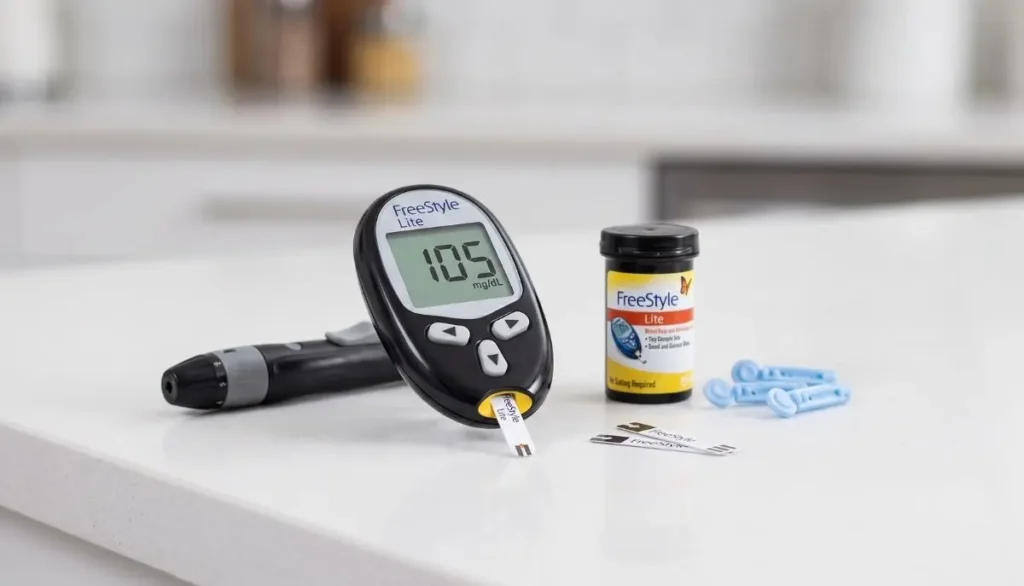
So, the FreeStyle Lite is generally considered an accurate home blood glucose meter when properly maintained and used according to its instructions.
But accuracy is not only about the meter itself.
The test strip, blood sample, storage conditions, hand cleanliness, temperature, testing technique, and other factors can all affect the final reading.
What Does “Accurate” Mean for a Glucose Meter?
Before discussing the FreeStyle Lite specifically, it helps to understand what glucose-meter accuracy means.
Many people assume that if their actual blood glucose is 120 mg/dL, the meter should display exactly 120 mg/dL.
In real-world glucose monitoring, that is not how meter accuracy is evaluated.
Home blood glucose meters are compared with reference laboratory methods. International standards establish acceptable limits for differences between meter readings and reference values.
For example, the older ISO 15197 criteria used in evaluations of glucose meters required a large majority of measurements to fall within specified limits of the comparison method. The SKUP evaluation describes the ISO requirement as 95% of individual results being within ±0.83 mmol/L at lower glucose concentrations or within ±20% at higher concentrations.
This means that small differences between a home meter and a laboratory result do not automatically mean the meter is malfunctioning.
For example, if one test produces 120 mg/dL and another method produces a somewhat different result, that difference needs to be interpreted in context.
FreeStyle Lite Accuracy: What Research Shows
Several pieces of evidence help answer the question, “How accurate is the FreeStyle Lite glucose meter?”
1. Published analytical performance
A published evaluation of the FreeStyle Lite found good analytical performance.
The study reported:
- Good repeatability
- Average standard deviation of approximately 3.4 mg/dL at glucose concentrations below 100 mg/dL
- Average coefficient of variation of approximately 4.3% at glucose concentrations of 100 mg/dL or higher
- Strong linearity across the meter’s measuring range
- Accuracy maintained across an operating temperature range of 4°C to 40°C
The researchers concluded that the system demonstrated good analytical performance and clinical accuracy.
That is useful information because repeatability matters. A meter should not produce dramatically different results every time you perform a properly conducted test under the same conditions.
2. Independent evaluation
The FreeStyle Lite has also been evaluated independently.
The SKUP evaluation found that the FreeStyle Lite achieved the relevant ISO 15197 quality goal under standardized and optimal measurement conditions. It also reported that the meter produced accurate results when operated by people with diabetes.
This is particularly relevant for home users because testing in a person’s home can be different from testing under laboratory conditions.
Real-world users may have:
- Different hand-washing habits
- Different testing techniques
- Different temperatures
- Different blood sample sizes
- Different levels of familiarity with the meter
Correct technique therefore remains important.
What Are the Main FreeStyle Lite Specifications?
The FreeStyle Lite is designed to make blood glucose testing relatively simple.
FDA documentation for the FreeStyle Lite/Freedom Lite system lists several specifications, including:
- Blood sample: approximately 0.3 µL
- Testing time: approximately 5 seconds
- Glucose measurement range: 20–500 mg/dL
- Calibration: none
- Hematocrit range: 15%–65%
- Operating temperature: approximately 4°C–40°C
- Memory: up to 400 blood glucose and control-solution results in the documented system
The American Diabetes Association’s consumer guide also lists the FreeStyle Lite as requiring no coding, using a small blood sample, and providing results in approximately five seconds.
These features can make the system convenient for regular home monitoring.
Why Can Your FreeStyle Lite Reading Be Different From a Laboratory Result?
Even an accurate glucose meter can produce a result that differs from a laboratory blood glucose measurement.
There are several reasons.
1. Blood glucose changes constantly
Glucose is not a fixed number.
Your blood glucose can change because of:
- Food
- Physical activity
- Stress
- Medication
- Insulin
- Illness
- Hormonal changes
- Time of day
If you test your blood glucose at home and then have a laboratory test later, the two measurements may not represent exactly the same moment.
This is one reason why comparing a home reading with a laboratory result requires context.
2. Dirty Hands Can Affect Results
One of the simplest causes of inaccurate glucose readings is contaminated fingers.
If you have recently handled:
- Fruit
- Food
- Sugar
- Juice
- Candy
- Lotion
- Skin-care products
residue can potentially affect the blood sample.
For the most reliable result, wash your hands with soap and water and dry them thoroughly before testing.
Clean hands are one of the easiest ways to improve the quality of your blood glucose measurements.
3. Test Strip Problems Can Affect Accuracy
The meter and test strips work together.
Using the wrong test strips, damaged strips, improperly stored strips, or expired strips can affect results.
The FreeStyle Lite documentation specifically states that the meter should be used with FreeStyle Lite test strips and the appropriate FreeStyle control solution. Other products may produce inaccurate results.
Always check:
- The strip expiration date
- The condition of the packaging
- Storage conditions
- Whether the strip vial has been properly closed
- Whether the strip is intended for your FreeStyle Lite system
4. Temperature Can Matter
Blood glucose meters have specified operating temperature ranges.
FDA documentation for the FreeStyle Lite system lists an operating temperature range of approximately 4°C to 40°C (40°F to 104°F).
Very hot or very cold environments may affect testing.
For example, leaving your meter in a hot vehicle or exposing test strips to unsuitable temperatures may compromise testing performance.
When possible, keep the meter and strips within their recommended storage and operating conditions.
5. Not Enough Blood
The FreeStyle Lite uses a very small blood sample.
That is convenient, but the sample still needs to be sufficient for the test strip.
If there is not enough blood, the test may produce an error or an unreliable result.
Follow the instructions supplied with your meter and test strip. Allow the strip to properly draw in the blood rather than trying to force additional blood onto it.
6. Testing Technique Matters
A glucose meter can only measure the sample that you give it.
Good testing technique includes:
- Wash and dry your hands.
- Prepare the meter and test strip.
- Insert the appropriate test strip.
- Obtain a blood sample according to the manufacturer’s instructions.
- Apply the blood to the test strip correctly.
- Wait for the meter to display the result.
- Record or review the result when appropriate.
Small mistakes can sometimes create confusing readings.
Is the FreeStyle Lite More Accurate Than Other Glucose Meters?
It is difficult to say that one glucose meter is universally “the most accurate.”
Different meters may perform differently depending on:
- Test-strip manufacturing
- Measurement technology
- Testing conditions
- User technique
- Study design
- Blood glucose concentration
A multicenter study comparing several commercially available blood glucose systems found that the FreeStyle Lite performed well against the study’s reference criteria.
However, this does not mean every reading will match another meter or laboratory test exactly.
The more useful question is:
Is the FreeStyle Lite sufficiently accurate and consistent for appropriate home blood glucose monitoring when used correctly?
The available evidence indicates good performance.
How to Check the Accuracy of Your FreeStyle Lite
If you are concerned about your meter, a control-solution test can be useful.
Control solution testing checks whether the meter and test strips are functioning together as expected.
The FreeStyle Lite user documentation describes control-solution testing as a way to check the meter and strips.
You may consider performing a control-solution test when:
- You open a new vial of strips
- You suspect the strips may be damaged
- Your readings seem unusual
- You think the meter may not be working correctly
- You want to verify the system after a storage or handling problem
Compare the control-solution result with the acceptable range printed on the test-strip packaging or supplied documentation.
If the result is outside the expected range, do not simply assume that your blood glucose has changed.
Investigate the testing system first.
What If My FreeStyle Lite Reading Looks Wrong?
Sometimes the most important question is not whether the meter is generally accurate, but whether your specific reading makes sense.
Suppose you normally see readings around 100–140 mg/dL but suddenly receive an unexpected result.
Before reacting, consider:
- Did you wash your hands?
- Was the test strip expired?
- Was the strip stored correctly?
- Was enough blood applied?
- Was the meter within its operating temperature range?
- Did you accidentally use a different strip?
- Is the result consistent if you repeat the test correctly?
If the reading does not match how you feel or seems inconsistent with your usual results, follow the manufacturer’s troubleshooting instructions and consider repeating the test with a new strip.
When Should You Repeat a Glucose Test?
A repeat test may be reasonable when:
- The number seems unexpectedly high or low.
- The result does not match your symptoms or expectations.
- You suspect your hands were contaminated.
- The blood sample was questionable.
- The test strip may have been compromised.
- The meter displayed an error.
However, do not repeatedly test simply to obtain a number you prefer.
If you receive a result that is dangerously low or high, follow the diabetes management plan provided by your healthcare professional rather than delaying appropriate care while repeatedly checking the meter.
Does the FreeStyle Lite Require Coding?
One useful feature of the FreeStyle Lite is that it is designed as a no-coding meter.
The American Diabetes Association consumer guide lists “No Coding Required” as a key specification.
No-coding technology can simplify testing because the user does not have to manually enter a code for each new strip lot.
That may also reduce one possible source of user error.
How Much Blood Does the FreeStyle Lite Need?
The documented FreeStyle Lite system uses approximately 0.3 microliters of blood.
That is a very small sample.
For many people, a smaller blood requirement can make routine testing more comfortable and convenient.
The important point, however, is not to focus only on the sample size.
A correct sample is still essential.
How Fast Does the FreeStyle Lite Give a Result?
The FreeStyle Lite is designed to provide a glucose result in approximately five seconds.
Fast results can be helpful during everyday testing because users do not have to wait long to see the measurement.
But speed should never replace correct technique.
A fast incorrect test is less useful than a properly performed test.
Can the FreeStyle Lite Be Used for Diabetes Diagnosis?
No.
A home glucose meter is intended to help people monitor blood glucose; it should not be used as the sole method for diagnosing diabetes.
The FreeStyle Lite documentation states that the system is intended for self-testing and monitoring and is not intended for diagnosis or screening of diabetes.
If you are concerned about diabetes or have repeatedly abnormal glucose readings, speak with a qualified healthcare professional.
Factors That Can Influence Blood Glucose Meter Results
Here is a simple overview:
| Factor | Possible Effect |
| Dirty hands | May interfere with the sample |
| Expired strips | May produce inaccurate results |
| Improper strip storage | May affect performance |
| Extreme temperatures | May affect testing |
| Insufficient blood | Can cause errors or unreliable testing |
| Incorrect testing technique | Can affect the result |
| Damaged strips | May affect accuracy |
| Meter problems | May cause inconsistent readings |
| Rapidly changing glucose | Different tests may naturally differ |
| Certain medical or chemical factors | May interfere with some glucose systems |
This is why glucose-meter accuracy depends on both device performance and user technique.
FreeStyle Lite Accuracy and Test Strip Storage
Test strips deserve special attention.
According to FreeStyle Lite documentation, test strips should be stored within their specified temperature range and protected from unsuitable environmental conditions.
Do not leave the strip container open unnecessarily.
Moisture and environmental exposure can damage glucose test strips.
A simple habit can help:
Take out one strip, use it, and close the container promptly.
That small step helps protect the remaining strips.
Why Consistency Is Also Important
Accuracy and consistency are related, but they are not exactly the same thing.
Imagine a meter that produces:
- 118 mg/dL
- 121 mg/dL
- 119 mg/dL
under similar testing conditions.
Those results are reasonably consistent.
Now imagine:
- 105 mg/dL
- 148 mg/dL
- 119 mg/dL
with the same blood sample and similar conditions.
That would raise more questions.
Published research on FreeStyle Lite has reported good repeatability and precision, supporting its ability to provide consistent measurements under appropriate conditions.
Can Two FreeStyle Lite Readings Be Different?
Yes.
Blood glucose itself can change, and measurement variation is also possible.
For example, if you test before eating and then test again after eating, you should not expect the numbers to be identical.
Even two measurements taken close together may not match perfectly.
The goal of a glucose meter is not to provide a laboratory-perfect number to the last digit. Its purpose is to provide useful information about blood glucose for diabetes management.
FreeStyle Lite and Alternative Testing Sites
Some versions of the FreeStyle Lite system support testing from locations other than the fingertip.
FDA documentation for the system lists capillary and venous whole blood and identifies alternative sites such as the upper arm and palm for the documented system.
However, alternative-site testing may not always be appropriate.
For example, when glucose is changing quickly or when low blood glucose is suspected, fingertip testing may be preferred according to the manufacturer’s instructions. The user manual specifically advises finger testing when testing for hypoglycemia or when a person has hypoglycemia unawareness.
Always follow the instructions applicable to your particular meter and test strips.
What Makes a Glucose Meter Reliable?
A reliable glucose monitoring system combines several things:
1. A well-designed meter
The FreeStyle Lite has been evaluated for analytical and clinical performance.
2. Appropriate test strips
Use the test strips specified for the meter.
3. Proper storage
Protect strips from inappropriate temperature, moisture, and environmental exposure.
4. Correct testing technique
Wash your hands, use an appropriate blood sample, and follow the instructions.
5. Regular quality checks
Control-solution testing can help identify problems with the meter or strips.
6. Clinical context
A glucose number should be considered alongside symptoms, medications, meals, activity, and your healthcare professional’s guidance.
FreeStyle Lite: Pros and Limitations
Advantages
The FreeStyle Lite offers several practical features:
- Small blood sample
- Approximately five-second testing
- No coding required
- Portable design
- Backlit display
- Test-strip port light
- Memory for previous readings
- Multiple testing sites in applicable versions
These features can make regular blood glucose monitoring easier.
Limitations
No home glucose meter is perfect.
Potential limitations include:
- Results can vary from laboratory measurements.
- Incorrect technique can affect readings.
- Test strips must be stored correctly.
- Expired or damaged strips can create problems.
- Extreme temperatures can affect testing.
- Some substances or medical conditions can interfere with glucose testing.
Therefore, a good meter still requires good testing habits.
How to Get the Most Accurate FreeStyle Lite Results
Here is a simple routine you can follow.
Step 1: Wash your hands
Use soap and water and dry thoroughly.
Step 2: Check your test strip
Make sure it is the correct strip and has not expired.
Step 3: Check the environment
Make sure the meter is being used within its specified operating conditions.
Step 4: Prepare the meter
Insert the test strip according to the manufacturer’s instructions.
Step 5: Obtain an appropriate blood sample
Use the lancing device correctly.
Step 6: Apply blood correctly
Allow the strip to absorb the appropriate sample.
Step 7: Wait for the result
Do not remove the strip prematurely.
Step 8: Consider the number in context
Think about when you last ate, exercised, took medication, or used insulin.
Step 9: Repeat if appropriate
If the reading seems unexpectedly abnormal or inconsistent, follow the manufacturer’s troubleshooting guidance.
Step 10: Contact your healthcare professional when necessary
Especially if readings are repeatedly outside your expected range or do not match how you feel.
Is the FreeStyle Lite Accurate Enough for Everyday Use?
For many people, the answer is yes, when used correctly.
The FreeStyle Lite has FDA clearance and published evaluations showing good analytical performance and compliance with applicable accuracy criteria used in those studies.
But it is important to understand what “accurate” means.
A glucose meter is not a substitute for a laboratory analyzer.
Instead, it is a practical tool designed to provide useful blood glucose information at home.
That information can help people recognize trends, understand how meals and activity affect glucose, and follow a diabetes-management plan.
When Should You Talk to a Healthcare Professional?
You should consider contacting your healthcare professional if:
- Your readings are repeatedly much higher or lower than expected.
- Your meter readings do not seem to match how you feel.
- You repeatedly receive unexpected results.
- You are unsure how to interpret your readings.
- You are experiencing symptoms of very high or very low blood glucose.
- You are considering changing medication or insulin based on your readings.
Do not make major medication changes based solely on an unexpected home meter reading unless your healthcare professional has given you specific instructions for doing so.
Final Thoughts: How Accurate Is the FreeStyle Lite Glucose Meter?
So, how accurate is the FreeStyle Lite glucose meter?
The evidence indicates that the FreeStyle Lite has good accuracy and analytical performance when used correctly. Published evaluations have reported good precision, clinical accuracy, and performance against applicable ISO criteria.
At the same time, no home glucose meter should be expected to produce exactly the same result as a laboratory test every time.
The biggest difference often comes down to proper testing habits.
Clean hands.
Fresh, properly stored test strips.
Correct blood sampling.
Appropriate storage and temperature.
Following the manufacturer’s instructions.
These simple habits can make your results more dependable.
For people living with diabetes, a glucose meter is not simply another piece of medical equipment. It can become part of the daily routine—something you rely on before breakfast, after meals, during exercise, or whenever you want to understand what your blood glucose is doing.
Choosing a reliable system and using it correctly can make that routine easier and more useful.
About Alfa Healthcare Supply Inc.
Alfa Healthcare Supply Inc. provides medical supplies and durable medical equipment for patients, caregivers, and healthcare needs. The company offers products across categories such as diabetes supplies, home care, orthopedic products, incontinence supplies, and other medical equipment.
For customers looking for blood glucose monitoring products and related diabetes supplies, you can visit the Alfa Healthcare Supply Inc. website for available products and purchasing information.
Frequently Asked Questions: How Accurate Is the FreeStyle Lite Glucose Meter?
How accurate is the FreeStyle Lite glucose meter?
The FreeStyle Lite has demonstrated good analytical and clinical performance in published evaluations. Independent testing has also found that it met applicable ISO accuracy criteria used in those evaluations.
Can the FreeStyle Lite give false readings?
Any blood glucose meter can produce an inaccurate or misleading result if the test is performed incorrectly or if the test strips are expired, damaged, contaminated, or improperly stored. Environmental conditions and other factors can also affect results.
How can I check whether my FreeStyle Lite is working correctly?
Use the appropriate FreeStyle control solution according to the manufacturer’s instructions. Compare the result with the acceptable range provided with the test strips or control solution.
Does FreeStyle Lite require coding?
No. The FreeStyle Lite is designed as a no-coding blood glucose meter.
How much blood does FreeStyle Lite need?
The documented system uses approximately 0.3 µL of blood.
How fast does FreeStyle Lite provide results?
The meter provides results in approximately five seconds.
Can I use expired FreeStyle Lite test strips?
You should not use expired test strips. The FreeStyle Lite documentation warns that expired or unsuitable strips can produce inaccurate results.
Why is my FreeStyle Lite reading different from another glucose meter?
Different meters can produce somewhat different readings because they use different systems, strips, calibration methods, and measurement technologies. Your blood glucose may also be changing between tests.
Why is my FreeStyle Lite reading different from a laboratory result?
A home meter and laboratory analyzer use different measurement systems. In addition, glucose can change between the time of the two tests. A difference does not automatically mean your meter is defective.
Can I use FreeStyle Lite for diagnosing diabetes?
No. The system is intended for blood glucose monitoring rather than diagnosing or screening for diabetes.
Medical Disclaimer: This article is intended for general educational purposes and is not a substitute for professional medical advice, diagnosis, or treatment. Always follow the instructions supplied with your specific FreeStyle Lite meter and test strips and speak with your healthcare professional about questions concerning your blood glucose results or diabetes treatment.
Do You Need a Dexcom G7 Receiver?
If you are considering the Dexcom G7 continuous glucose monitoring (CGM) system, one of the first questions you may have is: do you need a Dexcom G7 receiver?
The short answer is not necessarily. The Dexcom G7 system can display glucose information through the Dexcom G7 mobile app on a compatible smartphone, or through a Dexcom G7 receiver. You can also use both options in situations where that fits your routine and care plan.
For many people, this choice comes down to something very practical: Do I want to use my phone for glucose monitoring, or would I rather have a separate device?
There isn’t one option that is right for everyone. Factors such as your smartphone compatibility, insurance coverage, diabetes management setup, personal preferences, and other connected devices can all play a role in determining which choice works best for you.
In this guide from Alfa Healthcare Supply Inc., we will explain what the Dexcom G7 receiver does, when you may need one, how it compares with using a smartphone, and what to consider before choosing a display device.
Important: This article is for general educational information and does not replace advice from your doctor, diabetes care team, pharmacist, or the manufacturer’s instructions.
What is the Dexcom G7?
The Dexcom G7 is a continuous glucose monitoring system designed to provide ongoing glucose information without requiring you to manually check your glucose every time you want a reading.
The system uses a wearable sensor to measure glucose in interstitial fluid. The information is then sent wirelessly to a compatible display device, such as the Dexcom G7 mobile app or Dexcom G7 receiver.
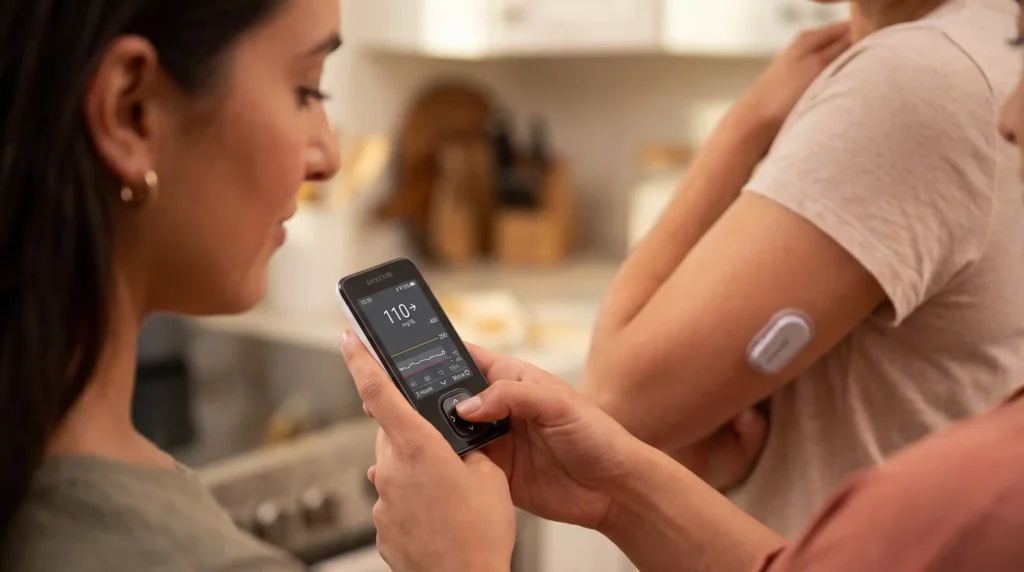
Instead of repeatedly reaching for a traditional glucose meter, a person using a CGM can see glucose readings, trends, and alerts through their selected display device.
The Dexcom G7 system includes:
- A wearable sensor
- A sensor applicator
- An overpatch, when instructed
- A compatible display device
- The Dexcom G7 mobile app or Dexcom G7 receiver as the display option
Dexcom states that the system requires a compatible display device. That display can be the G7 mobile application on a compatible iOS or Android device or the G7 receiver.
This is an important distinction.
You need a display device, but you do not automatically need a separate receiver.
Do You Need a Dexcom G7 Receiver?
No, not everyone needs a Dexcom G7 receiver.
If you have a compatible smartphone, you may be able to use the Dexcom G7 mobile app as your primary display device.
Dexcom specifically says users have the option to use:
- Only the Dexcom G7 app
- Only the Dexcom G7 receiver
- Both the app and receiver
This gives users some flexibility when setting up their CGM routine.
For someone who already carries a compatible smartphone everywhere, using the app may be convenient. There is no need to carry another dedicated device simply to view glucose information.
On the other hand, some people prefer a dedicated receiver because it separates glucose monitoring from their everyday phone.
That simple separation can make diabetes management feel easier and more predictable.
When Might You Want a Dexcom G7 Receiver?
Although a receiver isn’t automatically required for every user, there are several situations where having one may be helpful.
1. You Don’t Have a Compatible Smartphone
One of the most obvious reasons to consider a receiver is that your smartphone may not be compatible with Dexcom G7.
Dexcom regularly updates its list of compatible smart devices. If your phone isn’t supported, a Dexcom receiver can provide another way to view your CGM information.
Before purchasing or starting the system, check the current compatibility information for your specific smartphone.
2. You Prefer a Dedicated Medical Device
Some people simply don’t want their glucose information tied to their personal smartphone.
A dedicated receiver can provide a straightforward alternative.
For example, you may prefer:
- A separate screen for glucose readings
- Fewer distractions
- A device dedicated to diabetes management
- A simpler routine
- Less dependence on your personal phone
For some users, this can be particularly helpful when they don’t want text messages, social media, calls, or other phone notifications mixed into their glucose-monitoring routine.
3. Your Insurance Requires a Receiver
Insurance coverage is one of the most important considerations.
For example, Dexcom states that Medicare requires use of a receiver for CGM coverage. Dexcom’s provider information says Medicare patients are required to use the receiver, and its Medicare guidance specifies that the receiver is required for all patients under this coverage pathway.
That means the answer to “do you need a Dexcom G7 receiver?” may be different depending on how your CGM is being covered.
Insurance requirements can change and may differ by plan, so check with your insurance provider, Medicare guidance, healthcare provider, or medical equipment supplier before making assumptions about coverage.
Can You Use Dexcom G7 With Just Your Phone?
Yes.
If your smartphone is compatible with the Dexcom G7 system, you can use the Dexcom G7 mobile app as your display device.
Dexcom says the G7 system can use a compatible smart device with the Dexcom G7 app.
This can be a convenient option because most people already carry their smartphone.
Your phone can potentially provide access to glucose information and other compatible Dexcom features without requiring you to carry a separate receiver.
However, smartphone compatibility is important.
Don’t assume that every iPhone or Android phone will work.
Phone models, operating systems, and compatibility requirements can change. Always check the current Dexcom compatibility information before relying on your phone as your CGM display.
Dexcom G7 Receiver vs. Smartphone: What’s the Difference?
The basic purpose of both devices is similar: they provide a place where you can view information from your Dexcom G7 system.
But the everyday experience can be different.
| Feature | Dexcom G7 Receiver | Compatible Smartphone |
| Displays glucose information | Yes | Yes |
| Dedicated medical device | Yes | No |
| Requires compatible smartphone | No | Yes |
| Easy to carry separately | Yes | Usually |
| Smartphone apps/features | Limited | Yes |
| Phone calls and notifications | No | Yes |
| May be useful without a compatible phone | Yes | No |
| Can be preferred for a separate glucose display | Yes | Depends on user |
| Insurance requirements may apply | Yes | Requirements vary |
The best choice depends on your circumstances rather than simply choosing the device with the most features.
Is the Dexcom G7 Receiver Better Than the App?
Not necessarily.
“Better” depends on what you value.
If you enjoy using your smartphone and already have a compatible model, the Dexcom G7 app may be the simplest choice.
If you prefer a dedicated device, the receiver may be more comfortable.
Think about your daily routine.
Do you always have your phone nearby?
Do you want diabetes information on the same screen as your other apps?
Would you rather have a separate device?
Do you find smartphones confusing or distracting?
Your answers can make the decision much easier.
Benefits of Using the Dexcom G7 Receiver
A dedicated receiver can have several practical advantages.
Dedicated Display
The receiver is designed specifically for the Dexcom system. You don’t need to open your regular phone every time you want to check your glucose information.
No Personal Smartphone Required
If you don’t have a compatible smartphone, the receiver can provide a display option for the CGM system.
Simple Routine
Some people prefer having one device specifically for glucose monitoring. This can reduce the feeling of mixing diabetes management with everyday smartphone activities.
Useful for Certain Insurance Situations
As discussed earlier, Medicare coverage has specific receiver requirements. Always verify your own coverage requirements before ordering equipment.
A Separate Backup Approach
Some users appreciate having a separate device rather than depending entirely on their personal smartphone.
However, “backup” should not be interpreted as meaning that every person should automatically purchase both. Your healthcare and insurance requirements should guide that decision.
Benefits of Using the Dexcom G7 App
The smartphone approach can also be very convenient.
You May Carry Your Phone Anyway
If you already carry your compatible phone throughout the day, using the app means fewer separate devices.
Familiar Technology
Many people are already comfortable using smartphone apps.
Connected Features
The Dexcom ecosystem can provide additional connected features through compatible apps and services. Dexcom states that G7 works with Dexcom Clarity and Follow.
Fewer Things to Carry
For someone who likes to travel light, using a smartphone can eliminate the need to carry a separate receiver.
Can You Use Both the Dexcom G7 Receiver and Phone?
Yes, Dexcom says users can use the app, receiver, or both.
However, using both does not automatically mean that both are necessary.
Whether both are appropriate depends on your specific setup, healthcare needs, compatible devices, insurance requirements, and other connected diabetes technology.
If you are using an insulin pump or another automated insulin delivery system, pay especially close attention to the manufacturer’s compatibility instructions.
What If You Use an Insulin Pump?
This is an important consideration that can easily be overlooked.
CGM systems can interact with insulin pumps and automated insulin delivery systems, and those systems may have their own compatibility requirements.
For example, Dexcom states that Omnipod 5 requires the Dexcom G7 mobile app rather than the Dexcom G7 receiver for its setup and automated mode.
This means you should not assume that choosing a receiver is always the best option simply because you prefer a dedicated device.
If you use an insulin pump, ask your diabetes care team which display configuration is compatible with your particular system.
Can You Use a Dexcom G6 Receiver With Dexcom G7?
This is another common question.
Do not assume that your old Dexcom G6 receiver will work with G7.
Dexcom states that G6 components are not universally compatible with the G7 system, and the older G6 receiver may not work with G7.
Dexcom has also described different generations of receivers, including a newer receiver that may be upgraded for G7 compatibility in certain circumstances.
Therefore, if you are switching from G6 to G7, check the exact receiver model rather than relying on its appearance or assuming that all Dexcom receivers are interchangeable.
When in doubt, verify compatibility with Dexcom or your healthcare provider before starting a new sensor.
Do You Need a Receiver If You Have an iPhone?
Not automatically.
A compatible iPhone can potentially be used with the Dexcom G7 app.
The important word is compatible.
Having an iPhone doesn’t automatically mean that every iPhone model and software configuration is supported.
Check Dexcom’s current compatibility list before starting your system.
The same principle applies to Android phones. Dexcom says G7 supports many popular Android devices as well as current Apple devices, while compatibility can change as new devices and software versions become available.
Do You Need a Receiver If You Have an Android Phone?
Again, not necessarily.
If your Android device meets the current Dexcom compatibility requirements, you may be able to use the Dexcom G7 app.
If it isn’t compatible, a receiver may be a practical alternative.
Rather than buying a receiver simply because you have Android, check your exact phone model and operating system against the current Dexcom compatibility information.
What Should You Consider Before Buying a Dexcom G7 Receiver?
Before purchasing a receiver, consider these questions.
1. Is Your Phone Compatible?
If yes, you have the option of using the Dexcom G7 app.
2. Does Your Insurance Require a Receiver?
This is especially important for Medicare beneficiaries.
3. Do You Prefer a Separate Device?
Some people feel more comfortable separating glucose monitoring from their personal smartphone.
4. Do You Use an Insulin Pump?
Check compatibility requirements before selecting your display device.
5. Do You Need Simplicity?
A dedicated receiver may appeal to someone who doesn’t want to navigate a smartphone.
6. Do You Travel Frequently?
Consider which device fits more naturally into your travel routine.
7. What Does Your Healthcare Team Recommend?
Your diabetes care team can help you determine which configuration is appropriate for your individual circumstances.
A Simple Example
Imagine two people starting Dexcom G7.
Person A: The Smartphone User
Sarah carries a compatible smartphone everywhere.
She is comfortable with apps and wants fewer devices in her bag.
For Sarah, the Dexcom G7 app may be a convenient display option.
Person B: The Dedicated-Device User
John has a compatible phone but prefers keeping glucose monitoring separate from his personal phone.
A dedicated receiver may make more sense for his daily routine.
Person C: Medicare User
Michael is using Medicare coverage for his CGM.
Because Medicare has specific receiver requirements, he needs to follow the applicable coverage rules rather than assuming the smartphone alone is sufficient.
These examples show why there isn’t one universal answer to do you need a Dexcom G7 receiver.
Does the Receiver Replace the Dexcom G7 Sensor?
No.
The receiver and sensor serve different purposes.
The sensor collects glucose information.
The display device shows the information to you.
A Dexcom G7 system needs the sensor and at least one compatible display device. The display can be the mobile app or receiver.
Think of it this way:
Sensor = collects information
Receiver/app = displays information
You cannot simply purchase a receiver and expect it to function as a complete CGM system by itself.
Is the Dexcom G7 Receiver Necessary for Everyone?
No.
This is probably the most important takeaway from this article.
For many users, a compatible smartphone and Dexcom G7 app can serve as the display device.
For other users, a receiver may be preferred or required.
Your decision may depend on:
- Smartphone compatibility
- Insurance coverage
- Medicare requirements
- Personal preference
- Diabetes technology
- Insulin pump compatibility
- Your healthcare team’s recommendation
Dexcom itself describes the G7 receiver as an optional display option for patients using a compatible smartphone, while also noting specific insurance circumstances where a receiver is required.
Why a Dedicated Receiver Can Make Sense for Some Families
Diabetes management can involve a lot of technology.
There may be a CGM sensor, smartphone, glucose meter, insulin supplies, pump, medication, and other equipment.
For some families, having a dedicated receiver makes the setup easier to understand.
For example, a parent or caregiver may prefer having a device specifically associated with glucose monitoring rather than handing over a personal smartphone.
Likewise, someone who is less comfortable with smartphone apps may find a dedicated medical device easier to use.
Technology should make diabetes management more manageable—not more stressful.
What About Children?
Dexcom G7 is indicated for people as young as 2 years old, according to Dexcom’s provider information.
For children, families should consider the complete monitoring arrangement, including:
- The child’s age
- Smartphone availability
- Caregiver involvement
- Compatibility
- Alerts
- Connected monitoring
- School routines
- Insurance requirements
- Healthcare provider recommendations
Parents and caregivers should follow the manufacturer’s instructions and their child’s diabetes care plan.
Is a Smartphone Always the Most Convenient Option?
Not necessarily.
Smartphones are incredibly useful, but they also bring distractions.
A phone can ring during a glucose check.
Notifications can appear.
The battery can run low.
A software update can change the user experience.
And sometimes, people simply want one device that is dedicated to one task.
That’s where a receiver can have a practical advantage.
On the other hand, carrying an additional device can also be inconvenient.
The right choice is the one that fits your lifestyle and medical requirements.
Important Safety Reminder About CGM Readings
A CGM is a powerful diabetes management tool, but it is still important to pay attention to how you feel and follow the instructions provided with your system.
Dexcom notes that fingerstick blood glucose testing may be necessary for treatment decisions when symptoms or expectations do not match CGM readings.
If you experience symptoms that don’t match the displayed glucose information, follow your healthcare provider’s instructions and the Dexcom instructions for use.
Do not make major changes to insulin or other diabetes treatment simply because of information in an online article.
Where Can You Get a Dexcom G7 Receiver?
If you have determined that a receiver is appropriate for your situation, speak with your healthcare provider, insurance provider, or authorized medical equipment supplier about availability and coverage.
Alfa Healthcare Supply Inc. provides medical supply and durable medical equipment services and can be a resource for patients looking for diabetes-related medical equipment.
For product availability, insurance questions, delivery options, and specific equipment requirements, contact the supplier directly and provide your prescription or insurance information when requested.
Final Thoughts: Do You Need a Dexcom G7 Receiver?
So, do you need a Dexcom G7 receiver?
For many people, no.
If you have a compatible smartphone, the Dexcom G7 app can provide your glucose information without requiring a separate receiver.
But a receiver can still be a valuable option if:
- You don’t have a compatible smartphone
- You prefer a dedicated medical device
- You don’t want to use your personal phone
- Your insurance requires a receiver
- Your healthcare team recommends one
- Your particular diabetes technology setup calls for it
The most important thing is not choosing the device with the longest feature list. It’s choosing a setup that you can comfortably and consistently use as part of your diabetes management routine.
At Alfa Healthcare Supply Inc., we understand that medical equipment isn’t simply about products—it is about helping people find equipment that fits into real life. If you are considering a Dexcom G7 receiver, take the time to check compatibility, coverage, and your personal needs before making a decision.
Frequently Asked Questions About Do You Need a Dexcom G7 Receiver?
1. Do you need a Dexcom G7 receiver?
Not everyone needs one. A compatible smartphone running the Dexcom G7 app can be used as the display device. A receiver is another available option.
2. Can Dexcom G7 work without a receiver?
Yes. If you have a compatible smartphone, you can use the Dexcom G7 app as the display device.
3. Can I use only the Dexcom G7 receiver?
Yes. Dexcom states that users can use only the receiver as their display option.
4. Can I use both the receiver and smartphone?
Yes. Dexcom says you can use both the app and receiver.
5. Does Medicare require a Dexcom receiver?
Dexcom states that Medicare requires use of the receiver for CGM coverage. Specific coverage rules should always be verified for your situation.
6. Can I use my Dexcom G6 receiver with G7?
Do not assume so. Dexcom states that G6 components are not generally compatible with G7, although certain newer receiver hardware may have upgrade compatibility. Verify the exact receiver model.
7. Do I need a receiver if I have an iPhone?
Not necessarily. If your iPhone is compatible with Dexcom G7, you may use the Dexcom G7 app instead.
8. Do I need a receiver if I have Android?
Not necessarily. Many Android devices are compatible, but you should check the current Dexcom compatibility list for your exact device.
9. Is a Dexcom receiver better than using a phone?
Neither option is automatically better. The receiver provides a dedicated display, while a smartphone can be convenient if you already carry a compatible device.
10. Can I use the receiver with an insulin pump?
It depends on the specific pump and integration. Some systems have specific display requirements. For example, Dexcom says Omnipod 5 requires the Dexcom G7 mobile app rather than the receiver.
11. Does the receiver replace the Dexcom G7 sensor?
No. The receiver is a display device. The sensor collects the glucose information.
12. Should I buy a receiver before starting Dexcom G7?
First check your smartphone compatibility, insurance requirements, diabetes technology setup, and healthcare provider’s recommendation. You may not need to purchase one separately.
If you are using a continuous glucose monitoring (CGM) system, you may have wondered: freestyle libre 3 reader device how long does it last?
It is a very reasonable question. When you depend on a glucose monitoring device every day, you want to know how long the reader will work, how often you need to charge it, how much glucose information it can store, and whether the reader needs to be replaced as often as the sensor.
The good news is that the FreeStyle Libre 3 Reader is designed to be reused, unlike the disposable sensor. These are two different parts of the system, and each has a different expected usage period.
According to Abbott information, the FreeStyle Libre 3 Reader has a rechargeable lithium-ion battery with approximately 4 days of typical battery life. The reader can also store approximately 90 days of glucose history.
The FreeStyle Libre 3 Sensor has a different lifespan. A standard FreeStyle Libre 3 Sensor is designed to be worn for up to 14 days. After the sensor’s wear period ends, it stops collecting glucose data and should be replaced.
For someone new to CGM technology, this can sound confusing. Why does the sensor last 14 days while the reader lasts much longer? And if the reader battery lasts around four days, does that mean you need a new reader every four days?
No.
The four-day figure refers to the reader’s rechargeable battery life, not the useful life of the entire reader.
This guide from Alfa Healthcare Supply Inc. explains what you should know about the FreeStyle Libre 3 Reader, its battery, storage capacity, sensor lifespan, charging habits, maintenance, and when it may be time to consider replacing the device.
What is the FreeStyle Libre 3 Reader?
The FreeStyle Libre 3 Reader is a handheld device designed to work with compatible FreeStyle Libre 3 system components.
Instead of relying only on a smartphone, some users may prefer having a dedicated reader for glucose monitoring. A handheld reader can be useful for people who want a separate device specifically for checking glucose.
The reader communicates with the compatible sensor and provides glucose information on its screen. Depending on the system configuration and labeling in your region, it can provide glucose readings, trends, alarms, and other information.
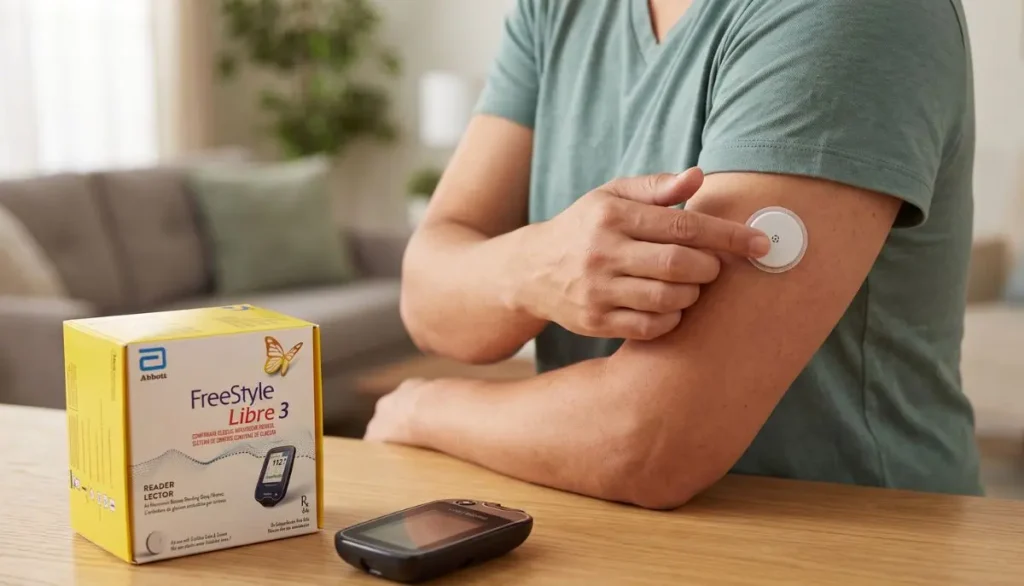
Abbott’s product information describes the FreeStyle Libre 3 Reader as a handheld device with a color touchscreen and the ability to store approximately 90 days of glucose history.
That stored information can be useful because glucose management is not always about one number.
A single glucose reading tells you what is happening at one moment. Looking at your glucose history can help you and your healthcare professional identify patterns over time.
For example, you may notice that glucose tends to change after meals, during exercise, overnight, or around certain daily activities.
Freestyle Libre 3 Reader Device How Long Does It Last?
The answer depends on what you mean by “last.”
There are three different questions people commonly ask:
- How long does the reader battery last?
- How long does the reader store glucose data?
- How long can the reader itself be used before replacement?
These should not be confused.
1. Reader battery life
Abbott’s FreeStyle Libre 3 documentation specifies approximately 4 days of typical use for the rechargeable reader battery.
This does not mean the reader needs to be thrown away after four days.
The battery is rechargeable. When the battery gets low, you recharge the reader using the supplied charging equipment according to the applicable instructions.
Think of it like a smartphone.
A smartphone may need charging every day or several days, but you do not replace the phone every time the battery reaches 0%.
The same basic idea applies to the rechargeable reader.
2. Reader data storage
The FreeStyle Libre 3 Reader can hold approximately 90 days of glucose information. Abbott’s support information confirms that the reader stores up to 90 days of data.
This is particularly useful when you want to look back at your glucose history rather than only today’s numbers.
3. Sensor wear time
The sensor is different from the reader.
A standard FreeStyle Libre 3 Sensor is designed for up to 14 days of wear. After that period, the sensor automatically ends and should be removed and replaced according to the manufacturer’s instructions.
So, in simple terms:
Reader: rechargeable and reusable.
Reader battery: approximately 4 days of typical use before recharging.
Reader memory: approximately 90 days of glucose history.
FreeStyle Libre 3 Sensor: up to 14 days.
That distinction answers one of the most common questions about the system.
Does the FreeStyle Libre 3 Reader Need to Be Replaced Every 14 Days?
No.
The 14-day period applies to the standard FreeStyle Libre 3 Sensor, not the reader.
The sensor is the small wearable component that is placed on the body. It is designed for a limited wear period and is then replaced.
The reader is a reusable electronic device.
This means you can continue using the same compatible reader with new sensors, provided the reader remains functional and is compatible with the sensor/system you are using.
Abbott’s documentation describes the reader as having a rechargeable lithium-ion battery, while the sensor has its own power source and defined wear period.
This is an important distinction for people purchasing their first CGM system.
You generally should not think of the reader as a “14-day device.”
Instead, think of the reader as the reusable part of the system and the sensor as the replaceable part.
How Often Do You Need to Charge the FreeStyle Libre 3 Reader?
The FreeStyle Libre 3 Reader has approximately four days of typical battery life, according to Abbott documentation.
Actual battery performance can vary depending on how the device is used.
For example, battery consumption can be affected by how frequently you use the reader, how often the screen is active, and other operating conditions.
The easiest approach is to make charging part of your normal routine.
Practical charging habits
You might consider charging your reader:
- When you receive a low-battery notification
- Before traveling
- Before a long day away from home
- At a convenient regular time
- Whenever the battery level is getting low
Abbott’s support information also advises users to charge the reader when they receive a Low Battery alert so that alarms are not missed.
That is especially important for people who rely on glucose alarms.
A simple habit can prevent an avoidable problem: don’t wait until the reader completely runs out of power if you know you will need it.
How Long Does the FreeStyle Libre 3 Reader Store Glucose Data?
One of the helpful features of the reader is its ability to store approximately 90 days of glucose information.
This is much longer than the 14-day wear period of an individual standard FreeStyle Libre 3 Sensor.
Why is that useful?
Imagine you are trying to understand why your glucose levels have been changing over several weeks.
Looking only at today’s readings may not give you enough information.
Having stored historical information can make it easier to review trends and discuss them with your healthcare professional.
The reader may therefore become more useful over time because it is not only showing you a current glucose result. It can also help you review historical information, depending on the features available on your particular system and software.
What Is the Difference Between Reader Storage and Sensor Storage?
This is another area where confusion is common.
The sensor and the reader have separate memory capabilities.
The FreeStyle Libre 3 Sensor is designed to collect and store glucose information during its wear period. Abbott documentation indicates up to 14 days for the standard FreeStyle Libre 3 Sensor.
The reader, on the other hand, can store approximately 90 days of glucose history.
So the two numbers are not competing with each other.
They describe different components.
Easy example
Suppose you start a new sensor on Monday.
That sensor can be used for up to 14 days.
After the sensor ends, you replace it with another compatible sensor.
Your reusable reader continues to be used with the system.
The reader’s larger storage capacity allows you to maintain a longer history than the life of a single sensor.
How Long Does a FreeStyle Libre 3 Sensor Last?
The standard FreeStyle Libre 3 Sensor is designed to last up to 14 days.
Abbott states that the sensor is designed to provide glucose monitoring for this period.
At the end of the wear period, the reader notifies the user that the sensor has ended. Abbott’s support information explains that the sensor automatically stops collecting glucose data after 14 days and should be removed.
This is different from the reader.
You replace the sensor regularly.
You recharge and continue using the reader.
What About the FreeStyle Libre 3 Plus Sensor?
It is also important not to confuse the standard FreeStyle Libre 3 Sensor with the FreeStyle Libre 3 Plus Sensor.
Abbott documentation states that the FreeStyle Libre 3 Plus Sensor can provide up to 15 days of wear, while the standard FreeStyle Libre 3 Sensor provides up to 14 days.
Availability, indications, compatibility, and labeling can vary by market, so users should always check the product information applicable to their location and device.
The important point is that changing the sensor does not mean you automatically need a new reader.
Can You Keep Using the Same FreeStyle Libre 3 Reader?
Generally, the reader is intended to be a reusable component rather than a disposable 14-day product.
If your reader is working properly and remains compatible with your system, you can continue using it with compatible sensors.
However, electronic devices can eventually develop problems.
A reader may need attention if you notice:
- The screen is not responding properly
- The device repeatedly shuts down
- The battery does not hold a charge as expected
- Charging problems occur
- The device becomes physically damaged
- The reader does not communicate properly with a compatible sensor
- The reader gives unexpected errors
If your reader appears damaged, do not continue using a device that may be unsafe.
Abbott safety information advises users not to use a reader if it appears damaged because it may result in no readings or create other safety concerns.
When in doubt, consult the manufacturer’s instructions or contact Abbott support.
How Can You Make Your FreeStyle Libre 3 Reader Last Longer?
Although no electronic device lasts forever, good care can help you avoid unnecessary problems.
1. Keep the reader dry
The reader is an electronic device, so it should be protected from unnecessary moisture.
Do not treat the reader like the wearable sensor.
The sensor has specific water-resistance characteristics, but that does not mean the handheld reader should be exposed to water.
2. Avoid extreme temperatures
Temperature can affect electronic devices and batteries.
Abbott’s safety information provides specific storage and operating temperature requirements for the reader.
Avoid leaving the reader in a hot vehicle or exposing it to extreme environmental conditions.
3. Use the appropriate charging equipment
Use the charging cable and power adapter specified for the reader and follow Abbott’s instructions.
Avoid damaged charging cables.
4. Keep the screen clean
A clean screen makes the reader easier to use and can help you see glucose information clearly.
Follow the manufacturer’s cleaning instructions rather than using harsh chemicals or excessive liquid.
5. Protect the reader from drops
A reader can look small and simple, but it contains electronic components.
A protective case may be helpful if appropriate for the device.
6. Don’t ignore repeated errors
One temporary error may not mean that the reader has failed.
However, repeated problems deserve attention.
If the device repeatedly fails to operate correctly, contact the manufacturer or your healthcare provider rather than repeatedly attempting to fix it yourself.
What Should You Do When the Reader Battery Is Low?
A low battery does not mean the reader has reached the end of its life.
It usually means the rechargeable battery needs to be charged.
Abbott specifically advises users to charge the reader when they receive a Low Battery alert, particularly to help ensure alarms are not missed.
A practical routine is to check the battery level before leaving home.
This is especially useful if you are going to work, school, traveling, exercising, or spending a long day away from a convenient power source.
It is a small habit that can make glucose monitoring less stressful.
Can You Use the FreeStyle Libre 3 Reader While It Is Charging?
Follow the manufacturer’s instructions for your specific reader and charging setup.
The most important point is to charge the device safely and use the supplied or approved charging accessories as directed.
If you are unsure about charging behavior, consult the current FreeStyle Libre 3 Reader user manual rather than relying on advice from an unrelated device.
Product instructions can change as manufacturers update systems, so the manual supplied with your reader should be treated as an important source of information.
Does the Reader Battery Last as Long as the Sensor?
No.
This is one of the easiest ways to understand the system.
The sensor has a defined wear period.
The reader has a rechargeable battery.
For the standard FreeStyle Libre 3 system:
- Sensor wear: up to 14 days
- Reader battery: approximately 4 days of typical use
- Reader data storage: approximately 90 days
Therefore, you may charge the reader several times during the life of one sensor.
That is completely normal.
Why Does the Reader Need to Be Recharged?
The reader is a small electronic computer.
It has a rechargeable lithium-ion battery that powers the display, processing, communication, and other functions.
Abbott’s specifications identify the reader’s power source as a lithium-ion rechargeable battery.
The battery allows you to use the device without keeping it connected to a power source all the time.
When the battery gets low, you recharge it.
This is similar to other rechargeable electronic devices you may already use.
Does Frequent Charging Damage the Reader?
Rechargeable batteries naturally experience wear over time.
However, normal charging according to the manufacturer’s instructions is part of ordinary use.
You should not avoid charging the reader because you are worried that routine charging means the reader is “wearing out” immediately.
Instead, follow Abbott’s charging instructions and pay attention to changes in battery behavior.
For example, if a reader that normally lasts around several days suddenly loses power much faster than expected, that may be worth investigating.
A significant change in battery performance can be a reason to contact the manufacturer or supplier for guidance.
What If the FreeStyle Libre 3 Reader Stops Working?
If your reader stops working, first consider simple possibilities such as:
- Low battery
- Charging issue
- Temporary software or communication issue
- Sensor compatibility issue
- Physical damage
Do not attempt to open or repair the reader yourself.
If the problem continues, contact the manufacturer or your healthcare professional for appropriate assistance.
If you depend on the reader for glucose monitoring, it is also sensible to know what backup glucose-monitoring method has been recommended for you.
For people using CGM technology, having a backup plan can provide peace of mind.
Reader vs. Sensor: A Simple Comparison
| Feature | FreeStyle Libre 3 Reader | FreeStyle Libre 3 Sensor |
| Purpose | Displays and stores glucose information | Measures glucose |
| Reusable? | Yes, designed as a reusable reader | No, disposable |
| Battery | Rechargeable lithium-ion | Built-in sensor power source |
| Typical battery/wear period | About 4 days per charge | Up to 14 days |
| Data storage | About 90 days | Up to 14 days |
| Replacement | Not routinely replaced every 14 days | Replaced after wear period |
| Main role | Reads/displays glucose information | Collects glucose information |
The figures above are based on Abbott’s published product and support information.
How the FreeStyle Libre 3 System Fits Into Everyday Life
One of the biggest advantages of CGM technology is that glucose monitoring can become part of a normal daily routine.
Instead of constantly thinking about when to check your glucose, the system can provide ongoing information through its compatible sensor and reader or smartphone, depending on your setup.
The reader can help you see what your glucose is doing and review historical information.
For many people, that can make glucose monitoring feel less like a series of isolated tests and more like a picture of their day.
You may start noticing patterns.
Maybe your glucose changes after breakfast.
Maybe exercise affects your readings differently in the morning than in the evening.
Maybe your overnight glucose pattern looks different from your daytime pattern.
Those observations can become useful discussion points with your healthcare professional.
However, CGM information should not replace professional medical advice.
Your healthcare professional can help you understand what your glucose patterns mean for your individual situation.
Is the FreeStyle Libre 3 Reader Worth Having?
For people who prefer a dedicated handheld glucose reader, the FreeStyle Libre 3 Reader can offer several practical benefits.
Dedicated device
You do not necessarily need to depend entirely on your everyday smartphone when a compatible reader is part of your monitoring setup.
Rechargeable
The reader uses a rechargeable battery rather than being thrown away after a single sensor period.
Large data storage
Approximately 90 days of glucose history can be stored on the reader.
Portable
The handheld format makes it practical to carry a dedicated glucose-monitoring device.
Helpful for reviewing trends
Historical glucose information can provide more context than looking at a single reading.
How to Get the Most From Your Reader
A few simple habits can make daily use easier.
Charge before the battery gets critically low
If you receive a low-battery warning, charge the reader.
Check the reader before travel
Don’t discover that the battery is nearly empty when you are already away from home.
Keep your reader clean and protected
Avoid drops, excessive moisture, extreme temperatures, and other preventable damage.
Understand your sensor schedule
Remember that replacing a sensor does not mean replacing your reader.
Keep track of your glucose history
The reader can hold approximately 90 days of data, so you have an opportunity to review longer-term information.
Follow current manufacturer instructions
Always use the current instructions supplied with your specific product.
Common Mistakes to Avoid
Mistake 1: Thinking the reader only lasts 14 days
The 14-day figure refers to the standard sensor, not the rechargeable reader.
Mistake 2: Thinking four days means the reader must be replaced
The approximately four-day figure refers to typical battery life between charges.
The reader is rechargeable.
Mistake 3: Waiting until the battery is completely dead
If you receive a low-battery alert, charging the device promptly can help prevent missed alarms or interruptions.
Mistake 4: Treating the reader like the sensor
The wearable sensor and handheld reader have different designs and care requirements.
Mistake 5: Ignoring physical damage
If the reader appears damaged, follow Abbott’s safety guidance and seek appropriate assistance.
Final Thoughts: Freestyle Libre 3 Reader Device How Long Does It Last?
So, freestyle libre 3 reader device how long does it last?
The simplest answer is:
The FreeStyle Libre 3 Reader is rechargeable and reusable. Its battery provides approximately 4 days of typical use per charge, while the reader can store approximately 90 days of glucose history. The standard FreeStyle Libre 3 Sensor, by comparison, is designed for up to 14 days of wear.
That difference is important.
You are not buying a reader that gets thrown away every two weeks. The reader is the reusable handheld part of the system. The sensor is the component that is routinely replaced.
For everyday diabetes management, understanding this distinction can make the system much easier to use and can help you plan for charging, sensor replacement, and glucose-data review.
If you are purchasing or using a FreeStyle Libre system, always check the instructions and labeling for your specific model and region because product features, compatibility, indications, and availability can change.
At Alfa Healthcare Supply Inc., the goal is to make medical supply information easier to understand so patients, caregivers, and families can make informed decisions and feel more comfortable using their healthcare equipment.
If you have questions about glucose monitoring supplies, CGM accessories, or other diabetes-management products, speak with your healthcare professional and use the manufacturer’s current product instructions as your primary guide.
Frequently Asked Questions About FreeStyle Libre 3 Reader Device How Long Does It Last
How long does the FreeStyle Libre 3 Reader battery last?
The FreeStyle Libre 3 Reader has approximately 4 days of battery life with typical use, according to Abbott’s product documentation. It has a rechargeable lithium-ion battery, so it can be charged and used again.
Does the FreeStyle Libre 3 Reader last 14 days?
No. The 14-day period applies to the standard FreeStyle Libre 3 Sensor. The reader is a reusable device with a rechargeable battery.
How often do I need to charge the FreeStyle Libre 3 Reader?
Battery life is approximately four days under typical use, so charging frequency depends on how you use the device. Charge the reader when the battery is low and follow the manufacturer’s charging instructions.
How much data does the FreeStyle Libre 3 Reader store?
The reader stores up to approximately 90 days of glucose information.
How long does a FreeStyle Libre 3 Sensor last?
The standard FreeStyle Libre 3 Sensor is designed to be worn for up to 14 days. After the wear period ends, the sensor stops collecting glucose data and should be replaced.
Do I need a new reader every time I change my sensor?
No. The reader is designed to be reusable. A compatible sensor is replaced according to its wear period, while the reader can continue to be used if it is functioning correctly and compatible with the system.
What happens when the FreeStyle Libre 3 Sensor reaches 14 days?
The reader notifies you that the sensor has ended. Abbott states that the sensor automatically stops collecting glucose data after the 14-day period and should be removed.
What should I do if my reader battery is low?
Recharge the reader according to Abbott’s instructions. Abbott recommends charging the reader when the Low Battery alert appears so that alarms are not missed.
Can the reader store more than one sensor’s data?
The reader can store approximately 90 days of glucose history, which is considerably longer than the 14-day wear period of an individual standard FreeStyle Libre 3 Sensor.
Does the FreeStyle Libre 3 Plus Sensor last longer?
Yes. Abbott documentation states that the FreeStyle Libre 3 Plus Sensor is designed for up to 15 days, compared with up to 14 days for the standard FreeStyle Libre 3 Sensor.
When should I replace my FreeStyle Libre 3 Reader?
The reader is not routinely replaced after a set number of days in the same way as the disposable sensor. If it becomes damaged, stops functioning properly, develops charging problems, or otherwise fails to operate as expected, contact Abbott or your healthcare provider for guidance.
Medical disclaimer: This article is intended for general educational purposes and is not a substitute for medical advice, diagnosis, or treatment. Do not make changes to medication, insulin, or diabetes treatment based solely on information in this article. If your glucose readings do not match how you feel or you are concerned about a reading, follow your healthcare professional’s instructions for confirming glucose and obtaining medical advice.
How Accurate Are CONTOUR NEXT Test Strips?
If you use a blood glucose meter regularly, accuracy matters. A reading that is close to your actual blood glucose level can help you make better day-to-day decisions, while an unexpected or incorrect reading can create confusion.
One question many people ask is: how accurate are CONTOUR NEXT test strips?
CONTOUR NEXT test strips are designed to work with compatible CONTOUR NEXT blood glucose meters and have been evaluated against laboratory reference methods. Manufacturer information reports that CONTOUR NEXT test strips can provide readings within ±10% of laboratory measurements, while specific CONTOUR NEXT systems have demonstrated accuracy beyond the minimum requirements of the ISO 15197:2013 standard.
However, accuracy is not determined by the test strip alone. The meter, blood sample, testing technique, strip storage, temperature, and other factors can influence the result.
Below is a detailed, easy-to-understand guide for people who want to know more about CONTOUR NEXT test strip accuracy and proper blood glucose testing.
What are CONTOUR NEXT Test Strips?
CONTOUR NEXT test strips are disposable strips used with compatible CONTOUR NEXT blood glucose meters to measure glucose in a small blood sample.
The basic process is simple:
- Wash and dry your hands.
- Insert a test strip into the compatible meter.
- Use a lancing device to obtain a blood drop.
- Apply the blood to the test strip.
- The meter analyzes the sample.
- Your blood glucose result appears on the screen.
Although the process takes only a few seconds, small details can affect the result.
For someone checking glucose every day, having a testing system that is easy to use and consistent can make a meaningful difference.
So, How Accurate Are CONTOUR NEXT Test Strips?
The short answer is that CONTOUR NEXT test strips are designed to provide highly accurate blood glucose measurements when used correctly with a compatible CONTOUR NEXT meter.
According to Ascensia Diabetes Care, CONTOUR NEXT test strips are designed to provide readings within ±10% of laboratory measurements.
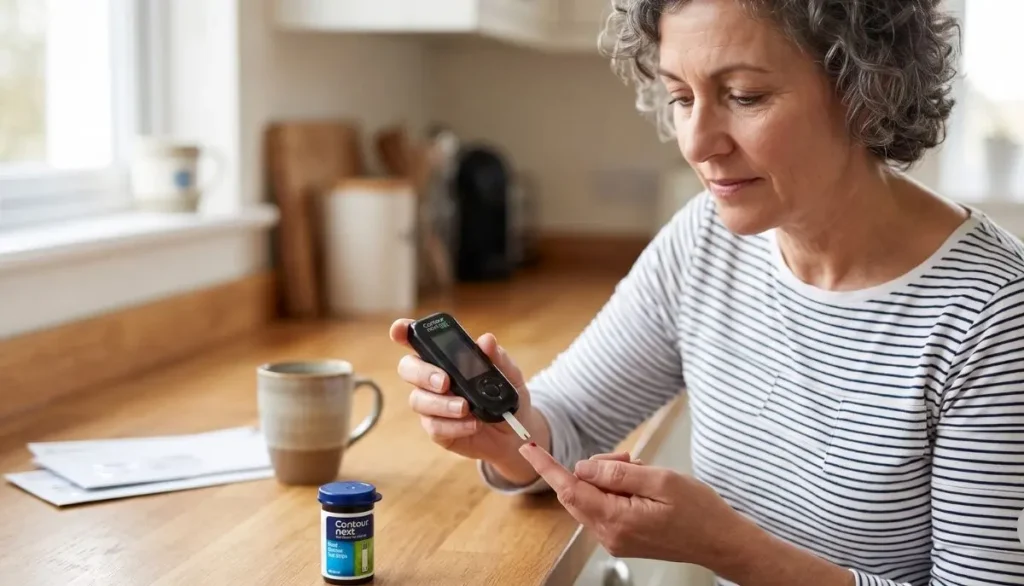
Specific CONTOUR NEXT systems have also performed strongly in accuracy studies.
For example, research evaluating the CONTOUR NEXT ONE system found that 100% of 600 laboratory results across three test-strip lots met the ISO 15197:2013 analytical accuracy criteria. In the clinical portion of the study, 99.4% of patient self-test results met the relevant ISO accuracy criteria.
Another study comparing CONTOUR NEXT with several blood glucose monitoring systems found that CONTOUR NEXT produced the lowest mean absolute difference and mean absolute relative difference across the overall glucose range studied.
These results are encouraging, but it is important to understand what “accurate” means for a home glucose meter.
What Does ±10% Accuracy Mean?
When you see an accuracy statement such as ±10%, it does not mean that every single reading will be exactly the same as a laboratory result.
For example, imagine that a laboratory reference measurement is:
150 mg/dL
A reading that is approximately 10% higher or lower could be around:
- 135 mg/dL
- 150 mg/dL
- 165 mg/dL
The actual allowable range depends on the particular accuracy standard, glucose concentration, testing system, and study.
The ISO 15197:2013 minimum accuracy criteria require at least 95% of measurements to fall within:
- ±15 mg/dL when glucose is below 100 mg/dL, or
- ±15% when glucose is 100 mg/dL or higher,
compared with the reference method.
Therefore, a home blood glucose meter should not be expected to reproduce a laboratory value perfectly every time.
What Is ISO 15197:2013?
If you are researching how accurate are CONTOUR NEXT test strips, you may come across the term ISO 15197:2013.
ISO 15197:2013 is an international standard covering requirements for blood glucose monitoring systems used for self-testing.
The standard establishes accuracy criteria that blood glucose monitoring systems should meet.
Importantly, accuracy studies do not simply ask whether two numbers look similar. They use defined testing procedures and compare meter results against a reference measurement method.
CONTOUR NEXT systems have been evaluated against these types of requirements, and several published studies have reported results exceeding the minimum ISO accuracy criteria.
This is one reason consumers should look beyond marketing claims when choosing a blood glucose monitoring system.
What Research Says About CONTOUR NEXT Accuracy
Published research provides additional information about the performance of CONTOUR NEXT systems.
A study published in Journal of Diabetes Science and Technology evaluated the CONTOUR NEXT ONE system using laboratory and clinical testing.
In the laboratory study, all 600 results from three test-strip lots met the ISO 15197:2013 analytical accuracy requirements.
Among people with diabetes in the clinical study:
- 99.4% of patient self-test results met the ISO accuracy criteria.
- 99.7% of results obtained by study staff met the criteria.
- 97.2% of palm-site results met the criteria.
- 100% of venous results met the criteria.
These findings demonstrate strong performance under the conditions studied.
However, this does not mean that every CONTOUR NEXT test strip reading will be identical to a laboratory reading.
Why Can Your Meter Reading Be Different From a Lab Result?
It is completely understandable to become concerned when a home meter reading does not match a laboratory glucose result.
But the two measurements are not necessarily performed under identical conditions.
Several factors can contribute to differences.
1. Blood glucose changes quickly
Your blood glucose level can change between the time you test at home and the time your blood is tested in a laboratory.
Eating, exercising, taking medication, experiencing stress, or simply waiting can change your glucose level.
Therefore:
Home reading at 8:00 AM: 142 mg/dL
Laboratory sample at 8:30 AM: 130 mg/dL
This does not automatically mean that the meter is inaccurate.
2. Your blood sample matters
A blood glucose meter requires an adequate blood sample.
If the sample is too small or does not properly enter the strip, the measurement may not be reliable.
CONTOUR NEXT systems include Second-Chance Sampling, which can allow additional blood to be applied to the same strip when the initial sample is insufficient. Manufacturer information says this feature can help reduce the need for another fingerstick and reduce strip waste.
3. Dirty hands can affect testing
This is one of the easiest things to overlook.
If your fingers contain food residue, sugar, lotion, or other substances, the blood sample may be affected.
For example, handling fruit or something sweet and then testing without washing your hands could potentially influence the reading.
A simple routine helps:
Wash → dry → test.
Does Strip Storage Affect Accuracy?
Yes.
Test strips are sensitive medical testing supplies and should be stored according to the manufacturer’s instructions.
Exposure to inappropriate conditions can affect strip performance.
Good habits include:
- Keep strips in their original container when applicable.
- Follow the storage temperature instructions.
- Keep strips away from excessive moisture.
- Do not use damaged strips.
- Check the expiration date.
- Close the strip container properly after removing a strip.
- Avoid leaving strips exposed to the environment unnecessarily.
Always follow the specific instructions supplied with your CONTOUR NEXT test strips because storage requirements can vary by product and market.
Why Should You Use the Correct Meter With CONTOUR NEXT Test Strips?
A test strip is designed to work with a particular testing system.
CONTOUR NEXT test strips should be used with compatible CONTOUR NEXT meters according to the product instructions.
Do not assume that two strips that look similar are interchangeable.
Using an incompatible strip can lead to an error or an unreliable result.
When purchasing replacement strips, check:
Meter model → Compatible strip → Correct product → Expiration date
This simple check can prevent unnecessary problems.
Does the Amount of Blood Matter?
Yes.
Blood glucose strips need enough blood to perform the test properly.
If there is not enough blood, the meter may display an error or, depending on the situation, the testing process may not work as intended.
The Second-Chance Sampling feature available with certain CONTOUR NEXT systems allows additional blood to be applied to the same strip within the specified time when the first sample is insufficient. Research has found that accuracy was maintained with sample reapplication under the conditions studied.
This can be particularly helpful for people who sometimes have difficulty getting an adequate blood drop.
Can Temperature Affect Blood Glucose Testing?
Environmental conditions can affect blood glucose testing systems.
Very high or very low temperatures may influence how a meter or test strip performs.
For this reason, follow the temperature and environmental conditions listed in the product instructions.
If you are testing in unusual conditions, such as outdoors during extreme weather, do not assume that the result should be interpreted exactly like a reading taken under normal conditions.
What Can Cause an Unexpected CONTOUR NEXT Reading?
Sometimes the number on the screen simply does not make sense.
For example, perhaps you normally see readings around 110–140 mg/dL but suddenly see 250 mg/dL without an obvious explanation.
Before immediately assuming the meter or strip is defective, consider:
- Did you wash and completely dry your hands?
- Did you use an adequate blood sample?
- Is the strip expired?
- Was the strip stored correctly?
- Is the strip compatible with your meter?
- Did you accidentally contaminate the fingertip?
- Are you feeling unwell?
- Could your glucose genuinely have changed?
- Was the test performed according to the meter instructions?
If a result does not match how you feel or seems unusually different from your normal pattern, repeat the test according to the manufacturer’s instructions and follow your healthcare professional’s guidance.
If you have symptoms of severe high or low blood glucose, seek appropriate medical help rather than relying on repeated home testing alone.
Are CONTOUR NEXT Test Strips Accurate for Low Blood Sugar?
Accuracy becomes especially important when glucose levels are low.
Research evaluating CONTOUR NEXT found strong performance in low glucose ranges. In one comparative study, CONTOUR NEXT had a mean absolute difference of 2.03 mg/dL in the studied range below 70 mg/dL, and it had a lower mean absolute relative difference than the other systems evaluated in that range except one.
Still, no home blood glucose meter should be treated as an infallible laboratory instrument.
If your result suggests significant hypoglycemia and you have symptoms, follow the hypoglycemia plan provided by your healthcare professional.
What About High Blood Glucose Readings?
High glucose levels also need to be interpreted carefully.
At higher glucose concentrations, ISO 15197:2013 uses a percentage-based accuracy criterion rather than a fixed ±15 mg/dL criterion.
For example, a difference of 15 mg/dL means something very different at:
80 mg/dL
than at:
300 mg/dL.
That is why percentage-based accuracy becomes important at higher glucose levels.
If you repeatedly receive unexpectedly high results, follow your healthcare professional’s instructions and consider checking the meter and testing process.
CONTOUR NEXT Test Strips and Laboratory Results
A laboratory blood glucose test and a home glucose meter serve related but different purposes.
A laboratory analyzer generally uses a more controlled testing environment and reference methodology.
A home glucose meter is designed for convenient self-monitoring.
The goal of a quality home glucose meter is not to make every result identical to the laboratory number. Instead, the system is evaluated to determine whether its results fall within accepted accuracy limits.
Published studies have found that CONTOUR NEXT systems perform strongly against laboratory reference methods.
Are CONTOUR NEXT Test Strips Better Than Other Strips?
It is difficult to say that one blood glucose test strip is universally “the best” for every person.
Different meters have different features, costs, insurance coverage, availability, connectivity, and user preferences.
However, CONTOUR NEXT has a strong published accuracy record.
A study comparing six blood glucose monitoring systems found CONTOUR NEXT had the lowest mean absolute difference and mean absolute relative difference across the overall glucose range evaluated.
That is useful information when comparing blood glucose monitoring options.
But the best system for you is also one that you can consistently use correctly and obtain reliably.
Tips for Getting the Most Accurate CONTOUR NEXT Results
Even a highly accurate test strip can produce a poor result if testing technique is inconsistent.
Here are some practical tips.
1. Wash your hands
Use soap and water when possible.
2. Dry your hands completely
Water remaining on your finger can dilute the blood sample.
3. Use a fresh strip
Do not use a damaged or expired strip.
4. Check the strip container
Store the strips according to their instructions.
5. Use enough blood
Make sure the sample is adequate for the test.
6. Follow the meter instructions
Do not improvise the testing process.
7. Use compatible strips
Confirm that your strips match your meter model.
8. Avoid squeezing excessively
Follow your lancing-device instructions for obtaining a blood sample.
9. Keep your meter clean
Follow the manufacturer’s cleaning instructions.
10. Pay attention to unusual readings
If a number looks very different from your normal pattern, investigate rather than automatically assuming it is correct or incorrect.
Can You Trust CONTOUR NEXT Test Strips?
For most people using a compatible meter correctly, CONTOUR NEXT test strips provide a reliable tool for self-monitoring blood glucose.
The evidence is particularly encouraging because accuracy has been assessed through laboratory and clinical studies rather than relying solely on consumer impressions.
The CONTOUR NEXT family has also been reported to exceed the minimum accuracy requirements of ISO 15197:2013.
Still, remember:
Accurate does not mean perfect.
A blood glucose meter is a monitoring tool, not a laboratory analyzer.
Why Proper Testing Technique Matters So Much
Imagine two people using the same box of test strips.
Person A:
- Washes their hands.
- Dries them completely.
- Uses a fresh strip.
- Gets an adequate blood sample.
- Follows the meter instructions.
Person B:
- Handles food.
- Does not wash their hands.
- Uses a strip that has been improperly stored.
- Struggles to obtain enough blood.
- Does not follow the instructions.
Even though both people use the same brand of test strips, their testing conditions are very different.
This is why strip quality and user technique work together.
What Is Second-Chance Sampling?
One useful feature associated with certain CONTOUR NEXT meters is Second-Chance Sampling.
It is designed to recognize when the initial blood sample is insufficient and allows more blood to be applied to the same strip within the specified time.
That can provide a practical benefit because it may help you avoid:
- Another fingerstick
- Throwing away a strip unnecessarily
- Starting the test over
Research involving CONTOUR NEXT ONE found that accuracy was maintained when additional blood was applied under the study conditions.
For people who test frequently, this can make everyday testing a little less frustrating.
CONTOUR NEXT Accuracy and Real-Life Diabetes Management
Blood glucose testing is not just about getting a number.
For many people, each reading is part of a larger picture.
You may use glucose readings to understand how your blood sugar responds to:
- Meals
- Physical activity
- Medication
- Insulin
- Sleep
- Stress
- Illness
- Daily routines
Reliable measurements can make these patterns easier to recognize.
But one number should not always be viewed in isolation.
Your healthcare professional can help you understand your glucose targets and what your results mean in the context of your diabetes management plan.
How Often Should You Check Your Blood Sugar?
There is no single testing schedule that works for everyone.
Your testing frequency can depend on:
- Type of diabetes
- Medication
- Insulin use
- Blood glucose control
- Pregnancy
- Healthcare professional recommendations
- Risk of hypoglycemia
- Use of a CGM or other glucose technology
Follow the testing schedule recommended for your individual situation.
A blood glucose meter is most useful when the readings are collected consistently and interpreted appropriately.
When Should You Repeat a CONTOUR NEXT Test?
You may want to repeat a test according to your meter’s instructions when:
- The result seems unexpectedly high.
- The result seems unexpectedly low.
- The number does not match how you feel.
- You suspect contamination of the blood sample.
- The initial sample was insufficient.
- There was an error during testing.
Do not repeatedly test simply because you dislike a result.
Instead, follow proper testing procedures and your healthcare professional’s recommendations.
Does CONTOUR NEXT Accuracy Mean You Should Change Medication?
No.
A glucose meter result should not automatically lead to changing insulin, diabetes medication, or other treatment unless you have been instructed to do so.
Your healthcare professional can help you establish appropriate glucose targets and treatment decisions.
If your glucose readings consistently fall outside your recommended range, discuss the pattern with your healthcare team.
Buying CONTOUR NEXT Test Strips
When purchasing CONTOUR NEXT test strips, consider more than just price.
Check:
- Compatibility with your meter
- Number of strips in the package
- Expiration date
- Packaging condition
- Proper storage
- Authenticity
- Insurance or coverage requirements
- Availability of replacement strips
Buying from a reputable medical supply source can also help provide confidence that you are receiving the intended product.
For people looking for diabetes testing supplies, Alfa Healthcare Supply Inc. provides medical supply products and serves customers looking for dependable healthcare equipment and supplies.
You can visit Alfa Healthcare Supply Inc. to explore available diabetes and medical supply products.
CONTOUR NEXT Test Strips: Accuracy at a Glance
| Question | Answer |
| Are CONTOUR NEXT strips accurate? | Yes, they are designed for highly accurate blood glucose testing when used correctly with compatible meters. |
| Do they meet ISO standards? | CONTOUR NEXT systems have demonstrated performance exceeding ISO 15197:2013 minimum requirements. |
| Are readings identical to laboratory results? | Not necessarily. Home meters have an allowable measurement variation. |
| Can testing technique affect results? | Yes. Hand cleanliness, blood sample size, storage, and technique can matter. |
| Can expired strips affect testing? | They may; always follow the product instructions and expiration information. |
| Can strips be used with any meter? | No. Use them only with compatible meters. |
| Does Second-Chance Sampling improve convenience? | It can help when the initial blood sample is insufficient on compatible systems. |
| Should unexpected results be ignored? | No. Follow proper testing procedures and seek professional advice when appropriate. |
Final Thoughts: How Accurate Are CONTOUR NEXT Test Strips?
So, how accurate are CONTOUR NEXT test strips?
The available evidence indicates that CONTOUR NEXT systems provide highly accurate blood glucose measurements when used correctly. Manufacturer data reports readings within ±10% of laboratory measurements for CONTOUR NEXT test strips, while published research has shown strong performance against ISO 15197:2013 accuracy requirements.
Perhaps the most important point is that accuracy is a combination of good technology and good testing habits.
Using the right strip with the right meter, storing the strips properly, washing your hands, getting an adequate blood sample, and following the manufacturer’s instructions can all help you obtain dependable results.
For someone managing diabetes day after day, that consistency matters. A glucose number is more useful when you can feel confident that it was obtained correctly.
CONTOUR NEXT test strips can be an important part of that everyday routine, but your healthcare professional remains the best source for interpreting your glucose readings, setting personal targets, and making treatment decisions.
Frequently Asked Questions About How Accurate Are CONTOUR NEXT Test Strips
1. How accurate are CONTOUR NEXT test strips?
CONTOUR NEXT test strips are designed to provide highly accurate glucose readings when used with a compatible meter. Ascensia reports readings within ±10% of laboratory measurements for the CONTOUR NEXT test strip product, while individual CONTOUR NEXT systems have demonstrated performance beyond ISO 15197:2013 minimum accuracy requirements.
2. Are CONTOUR NEXT test strips reliable?
Yes. Published clinical and laboratory studies have demonstrated strong accuracy for CONTOUR NEXT systems. One study found 100% of 600 laboratory results across three strip lots met the relevant ISO analytical accuracy criteria.
3. Can CONTOUR NEXT readings be different from a lab test?
Yes. A home glucose meter and laboratory analyzer can produce different results. Blood glucose can also change between the two tests.
4. Why did my CONTOUR NEXT reading suddenly change?
Possible reasons include a genuine change in blood glucose, testing technique, contaminated hands, inadequate sample, strip storage conditions, or other factors. Follow the meter instructions and repeat testing when appropriate.
5. Do CONTOUR NEXT strips expire?
Yes. Check the expiration information on your specific package and follow the manufacturer’s instructions.
6. Can I use CONTOUR NEXT test strips with another glucose meter?
Only use the strips with meters specifically designed to work with them. Check the meter and strip documentation before testing.
7. Are CONTOUR NEXT test strips good for daily testing?
They are designed for blood glucose self-monitoring and have demonstrated strong accuracy in clinical and laboratory evaluations. Your healthcare professional can advise you on how frequently you should test.
8. What should I do if my reading does not match how I feel?
Follow the testing instructions and consider repeating the test when appropriate. If you have concerning symptoms or a potentially dangerous glucose result, follow your diabetes care plan and seek medical advice promptly.
9. Does washing my hands really matter?
Yes. Washing and thoroughly drying your hands before testing is a simple way to reduce the chance that substances on your fingers will affect the sample.
10. How can I get the most accurate CONTOUR NEXT result?
Use an unexpired compatible strip, store it properly, wash and dry your hands, obtain an adequate blood sample, and follow your meter’s instructions carefully.
Medical disclaimer: This article is for general educational purposes and is not a substitute for professional medical advice, diagnosis, or treatment. Always follow the instructions supplied with your specific glucose meter and test strips and consult your healthcare professional for individual diabetes-management decisions.
Easy Comfort Twist Top Lancets 30G:
Checking blood glucose can become a regular part of everyday life for people managing diabetes. While the glucose meter gets most of the attention, the small lancet used to obtain a blood sample is just as important for a smooth testing routine.
If you are looking for a simple, reliable option, easy comfort twist top lancets 30g may be worth considering. These lancets are designed for fingerstick blood sampling and feature a 30-gauge needle, twist-top design, and a smooth tri-bevel point. The product is listed as a sterile, single-use blood lancet and is designed to work with most commonly used lancing devices.
For someone who checks blood glucose regularly, small details can make a noticeable difference. A lancet that is easy to prepare, comfortable to use, and simple to dispose of can help make routine testing feel less stressful.
In this guide, we will explain what easy comfort twist top lancets 30g are, how they work, what 30G means, how to use them, how to choose the right lancet, and why proper single-use practices matter.
What are Easy Comfort Twist Top Lancets 30G?
Easy Comfort Twist Top Lancets 30G are small, sterile, single-use lancets designed to help obtain a small capillary blood sample for blood glucose testing.
The product is manufactured by Home Aide Diagnostics, Inc., and the device information identifies it as a 30-gauge blood lancet intended for single use. The product listing also identifies a twist-top design, comfort-depth penetration, and a smooth tri-bevel point.
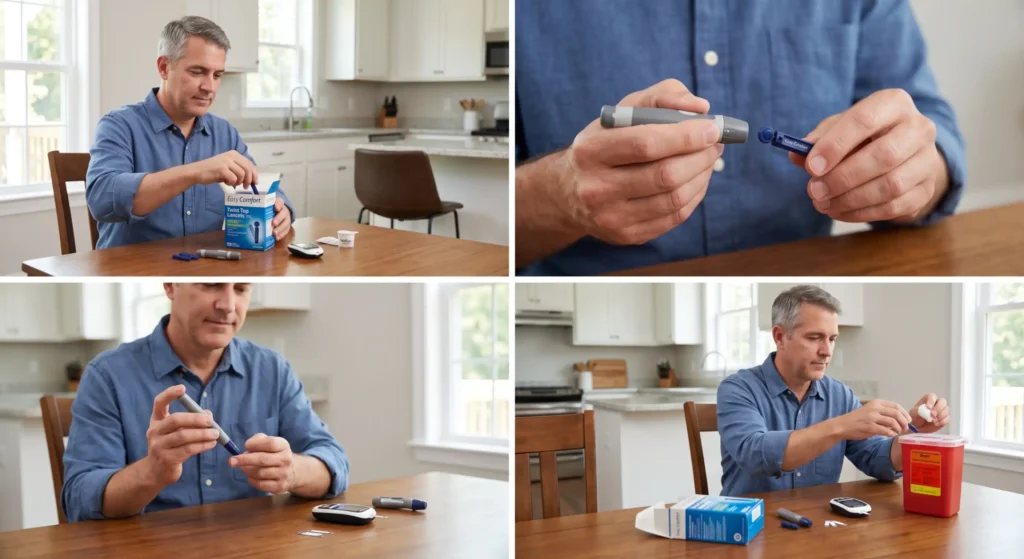
The lancet itself is only one part of the testing process. It is normally inserted into a compatible lancing device. The device then helps control the puncture so that a small drop of blood can be collected and applied to a compatible glucose test strip.
This simple process can become part of a daily routine:
- Wash and dry your hands.
- Prepare your glucose meter and test strip.
- Insert a new lancet into the lancing device.
- Adjust the lancing device according to its instructions.
- Obtain a blood sample.
- Apply the blood to the test strip.
- Read the glucose result.
- Remove and safely dispose of the used lancet.
Always follow the instructions supplied with your specific glucose meter, test strips, and lancing device.
What Does 30G Mean on a Lancet?
One of the most common questions people have when shopping for lancets is: What does 30G mean?
The “G” stands for gauge, which describes the thickness of the lancet needle. A 30-gauge lancet is relatively fine and is commonly used for blood glucose testing.
However, gauge is only one part of comfort.
The experience of fingerstick testing can also depend on:
- Lancing device settings
- Puncture depth
- Individual skin characteristics
- Testing technique
- The location of the fingerstick
- How frequently the same area is used
- Whether a fresh lancet is used
- Personal sensitivity
That means choosing a 30G lancet does not guarantee that every person will experience testing in exactly the same way.
The easy comfort twist top lancets 30g product is specifically identified as a 30-gauge lancet, with a smooth tri-bevel point and comfort-depth penetration.
Why Choose a 30G Lancet?
A 30G lancet offers a balance between a fine needle and the ability to obtain a blood sample when used correctly.
Many people want a lancet that feels as gentle as possible because fingerstick testing may happen several times throughout the day.
The goal is not simply to make one test easier. It is to create a testing routine that feels manageable over time.
For example, someone who checks glucose regularly may become frustrated if every fingerstick feels unnecessarily uncomfortable. Using an appropriate lancet and the correct lancing technique may make the routine easier to maintain.
The Easy Comfort product information describes the 30G lancet as having:
- 30-gauge construction
- Twist-top design
- Single-use application
- Sterile tips
- Smooth tri-bevel point
- Comfort-depth penetration
The official U.S. device database also lists the Easy Comfort Twist Top Lancets 30G as a single-use blood lancet and identifies the device as commercially distributed.
Key Features of Easy Comfort Twist Top Lancets 30G
When comparing lancets, it helps to look beyond the name.
1. 30-Gauge Needle
The 30G specification indicates the gauge of the lancet. It is designed for routine capillary blood sampling.
2. Twist-Top Design
The twist-top design helps with removing the protective portion of the lancet before placing it into a compatible lancing device.
For many people, simple preparation is important because glucose testing is already a repetitive task.
3. Single-Use Design
These lancets are intended for single use. After a lancet has been used, it should not be reused.
Using a fresh lancet for each test supports good hygiene and helps avoid unnecessary exposure to a previously used needle.
4. Sterile Tip
The product is listed as having sterile tips. Sterility is particularly important because the lancet penetrates the skin.
5. Smooth Tri-Bevel Point
The product specifications describe a smooth tri-bevel point. This design is intended to provide a precise point for skin penetration.
6. Compatible With Many Lancing Devices
Current product information describes the Easy Comfort Twist Top Lancets 30G as compatible with most lancing devices. However, compatibility should always be confirmed with your particular lancing device before use.
How Do Easy Comfort Twist Top Lancets 30G Work?
A lancet does not measure glucose by itself.
Instead, it creates a small puncture in the skin so that a drop of capillary blood can be collected. That blood is then tested using a glucose meter and compatible test strip.
Think of the process as three connected parts:
Lancet → Blood sample → Glucose meter
The lancet creates the sample.
The test strip receives the sample.
The glucose meter analyzes the sample and displays a reading.
This is why selecting the correct lancet is only one part of creating a dependable blood glucose testing routine.
How to Use Easy Comfort Twist Top Lancets 30G
Always follow the instructions provided with your lancing device and glucose meter. General fingerstick steps may include the following.
Step 1: Wash Your Hands
Wash your hands with soap and warm water, then dry them thoroughly.
Clean hands are important for a good testing routine. Wet fingers can also affect the blood sample or the testing process.
Step 2: Prepare Your Equipment
Have your glucose meter, test strip, lancing device, and new easy comfort twist top lancets 30g ready.
Having everything prepared before the fingerstick can make testing faster and more organized.
Step 3: Prepare a New Lancet
Remove the protective covering from a new lancet according to the product instructions.
Do not use a lancet if its sterile packaging or protective seal appears damaged.
Step 4: Insert the Lancet
Place the lancet into your compatible lancing device.
Follow the manufacturer’s instructions for inserting and securing the lancet.
Step 5: Adjust the Lancing Device
Many lancing devices allow the user to adjust penetration depth.
Start with the setting recommended by your device instructions. If the sample is insufficient, the device instructions may explain how to adjust the depth.
Avoid using a deeper setting than necessary.
Step 6: Choose a Testing Site
For many traditional blood glucose tests, the side of a fingertip is commonly used.
Using the side rather than repeatedly puncturing the center of the fingertip may be more comfortable for some people.
Rotate testing sites when appropriate and follow your healthcare professional’s recommendations.
Step 7: Obtain the Blood Sample
Use the lancing device according to its instructions.
Try not to squeeze the finger excessively. If you regularly have difficulty getting enough blood, discuss your technique or device settings with your healthcare professional.
Step 8: Test the Blood
Apply the blood sample to the test strip as directed by the glucose meter manufacturer.
Wait for the meter to provide the result.
Step 9: Dispose of the Used Lancet
Remove the used lancet carefully and dispose of it in an appropriate sharps container or according to local disposal requirements.
Do not leave used lancets loose where another person could accidentally contact them.
Can You Reuse Easy Comfort Twist Top Lancets 30G?
No. Easy Comfort Twist Top Lancets 30G are intended for single use.
After a lancet has been used, it should be discarded appropriately.
It may be tempting to reuse a lancet, particularly when someone tests several times a day. However, a used lancet is no longer a fresh sterile device.
A new lancet for each fingerstick is the safer routine.
The device information identifies this product as a single-use blood lancet.
Why Proper Lancet Disposal Matters
Lancets are small, but they are still sharp medical devices.
After use, they should not be thrown loosely into a household wastebasket where children, pets, family members, caregivers, or sanitation workers could accidentally encounter them.
Use an appropriate sharps container or follow your local healthcare waste-disposal guidance.
When the container is full, follow the disposal instructions applicable to your area.
If you are uncertain about how to dispose of used lancets, ask your healthcare provider, pharmacist, or local waste-management authority.
Easy Comfort Twist Top Lancets 30G and Blood Glucose Meters
A common misconception is that a lancet and glucose meter need to be from the same brand.
The lancet is generally used with a lancing device, while the blood sample is tested using a blood glucose meter and compatible test strip.
The important compatibility question is therefore whether the lancet fits the lancing device.
Product information for Easy Comfort Twist Top Lancets 30G describes them as universal lancets compatible with many commonly used lancing devices. Even so, users should check the instructions for their particular device before purchasing or using a lancet.
Are 30G Lancets Comfortable?
Comfort is personal.
Two people can use the same lancet and describe the experience differently.
The Easy Comfort product specifications describe the lancets as having comfort-depth penetration and a smooth tri-bevel point, and product listings describe the design as intended to support comfortable blood sampling.
However, it is important not to promise that any lancet will be completely painless.
Your comfort can depend on your skin, testing technique, lancing depth, finger location, frequency of testing, and individual sensitivity.
If fingerstick testing consistently hurts, consider discussing your technique and equipment with a healthcare professional.
Tips for More Comfortable Fingerstick Testing
A few simple habits may make routine testing easier.
Rotate Your Fingers
Try not to repeatedly puncture exactly the same location.
Rotating suitable testing sites can help prevent one area from becoming unnecessarily irritated.
Use the Side of the Finger
For many people, the side of the fingertip may feel more comfortable than the center.
Follow the testing instructions provided by your meter and healthcare professional.
Do Not Use Excessive Pressure
If you need to squeeze your finger very hard to obtain a sample, check whether the lancing depth or technique needs adjustment.
Keep Your Hands Warm
Cold fingers can sometimes make obtaining a blood sample more difficult.
Warm your hands naturally before testing rather than using extreme heat.
Use a Fresh Lancet
A fresh, sterile lancet should be used for each test.
Keep Your Hands Clean and Dry
This simple step supports a consistent testing routine.
Easy Comfort Twist Top Lancets 30G vs. Other Gauges
Lancets are available in different gauges, including 28G, 30G, 32G, and 33G.
Generally, a higher gauge number indicates a finer needle. But “thinner” does not automatically mean “better” for everyone.
The right choice depends on the user’s needs and the amount of blood required by the testing system.
For example, someone may prefer a finer lancet for comfort, while another person may need a different gauge or depth setting to obtain an adequate sample.
The Easy Comfort range includes different lancet configurations, and current device listings identify the Twist Top version specifically as 30G.
If you are unsure which gauge is appropriate, ask your healthcare provider or pharmacist.
How Many Lancets Come in a Box?
Packaging can vary, so it is important to check the specific product listing before ordering.
Current listings identify Easy Comfort Twist Top Lancets 30G in both 50-count and 100-count packaging. The U.S. device database also lists versions with 50 sterile tips and 100 sterile tips.
For people who test frequently, package size can be an important purchasing consideration.
Before ordering, check:
- Gauge
- Quantity
- Product name
- Packaging
- Compatibility
- Expiration information
- Sterile packaging condition
How Often Should You Change a Lancet?
The recommended practice is to use a new lancet for each fingerstick.
Although some people may reuse lancets because it seems convenient or economical, the Easy Comfort Twist Top Lancets 30G are labeled for single use.
A fresh lancet also supports a cleaner and more consistent testing routine.
If you find that changing lancets frequently becomes inconvenient, keeping a sufficient supply at home can make the process easier.
What Should You Look for When Buying Lancets?
Choosing a lancet is not just about finding the lowest price.
Consider the following factors.
Gauge
Choose the gauge that works for your testing needs and lancing device.
Compatibility
Confirm that the lancet fits your lancing device.
Packaging
Check the quantity and packaging before ordering.
Sterility
Make sure the packaging is intact and the product has not been damaged.
Ease of Use
A simple twist-top design can be convenient for routine preparation.
Cost
Compare the cost per lancet rather than looking only at the total package price.
Availability
If you test frequently, choose a product that you can reliably keep in stock.
Where Can You Buy Easy Comfort Twist Top Lancets 30G?
Alfa Healthcare Supply Inc. offers diabetic supplies through its online medical supply store. Its diabetic supplies category currently lists Easy Comfort Twist Top Lancets 30G, with the website displaying a price of $2.99 at the time of the current page crawl. Prices and availability can change, so customers should check the product page before ordering.
For people looking for diabetic supplies, having access to commonly used testing accessories can make it easier to keep a complete glucose-monitoring routine at home.
When ordering, verify that you are selecting the correct gauge and package size.
Why Keeping Extra Lancets at Home Can Be Helpful
Blood glucose testing is often routine.
Running out of lancets unexpectedly can interrupt that routine.
Keeping an appropriate supply available can be useful, especially for people who test regularly.
A simple home diabetes-testing kit may include:
- Blood glucose meter
- Compatible test strips
- Easy Comfort Twist Top Lancets 30G
- Lancing device
- Alcohol prep supplies when recommended
- Sharps container
- Backup batteries for the meter when applicable
Your exact supplies will depend on your diabetes-management plan.
Easy Comfort Twist Top Lancets 30G for Everyday Diabetes Care
Managing diabetes involves many small decisions.
Which meter should you use?
Which test strips fit your meter?
How often should you test?
Where should you keep your supplies?
Which lancets feel comfortable?
These details may seem minor individually, but together they can affect how easy it feels to maintain a daily routine.
That is why a simple product such as a lancet deserves attention.
Easy Comfort Twist Top Lancets 30G are designed around a straightforward idea: provide a sterile, single-use 30-gauge lancet with a twist-top format for routine blood sampling. The manufacturer/device information identifies the product’s 30G gauge, smooth tri-bevel point, comfort-depth penetration, and single-use design.
Are Easy Comfort Twist Top Lancets 30G Right for Everyone?
Not necessarily.
The best lancet depends on the person’s lancing device, testing requirements, comfort preferences, and healthcare recommendations.
A 30G lancet may be a good option for many routine fingerstick users, but that does not mean it is the best choice for every person.
If you have difficulty obtaining a blood sample, experience repeated pain, or have questions about your testing technique, speak with your healthcare professional.
Do not change your diabetes treatment based solely on information from an online article.
Important Safety Tips
When using easy comfort twist top lancets 30g, remember these basic safety practices:
- Use a new lancet for each test.
- Do not share lancets or lancing devices with another person.
- Check the packaging before use.
- Do not use a product if the sterile packaging is damaged.
- Follow the instructions for your lancing device.
- Dispose of used lancets safely.
- Keep unused medical supplies away from children and pets.
- Store supplies according to the manufacturer’s instructions.
- Ask a healthcare professional if you are unsure about your testing technique.
Never share a lancing device with another person, even if the lancet itself is changed.
Final Thoughts
Small healthcare products can make a big difference in everyday routines.
For people who regularly perform fingerstick blood glucose testing, choosing a lancet that is simple to prepare, appropriately sized, and comfortable enough for regular use can help make testing feel less difficult.
Easy Comfort Twist Top Lancets 30G offer a 30-gauge, twist-top, single-use design with a smooth tri-bevel point and comfort-depth penetration. The product is listed in U.S. device records as a 30G single-use blood lancet, while current product listings identify both 50-count and 100-count packaging.
If you are considering these lancets, remember to check compatibility with your lancing device and choose the package size that fits your testing routine.
Alfa Healthcare Supply Inc. currently lists Easy Comfort Twist Top Lancets 30G among its diabetic supplies, making them an option for customers looking for everyday blood glucose testing accessories.
Most importantly, diabetes care is personal. There is no single testing routine that works perfectly for everyone. Your healthcare professional can help you choose the glucose meter, test strips, lancing device, lancet gauge, and testing schedule that fit your individual needs.
Frequently Asked Questions About Easy Comfort Twist Top Lancets 30G
What are Easy Comfort Twist Top Lancets 30G?
Easy Comfort Twist Top Lancets 30G are sterile, single-use blood lancets designed to obtain a small capillary blood sample for glucose testing. They use a 30-gauge needle and twist-top design.
What does 30G mean?
30G refers to the gauge of the lancet needle. It describes the needle’s thickness.
Are Easy Comfort Twist Top Lancets reusable?
No. They are intended for single use and should be discarded after use.
Do Easy Comfort Twist Top Lancets 30G fit most lancing devices?
Product listings describe them as compatible with most lancing devices. However, compatibility should be confirmed with your particular device before use.
Are Easy Comfort Twist Top Lancets 30G sterile?
Yes. Device information lists the product as having sterile tips and identifies the product as a single-use blood lancet.
How many lancets are in a box?
Packaging can vary. Current listings show both 50-count and 100-count versions of Easy Comfort Twist Top Lancets 30G.
Are 30G lancets painful?
Comfort varies from person to person. The product is designed with a smooth tri-bevel point and comfort-depth penetration, but individual experiences can differ.
Can I use the same lancet several times?
The product is intended for single use. A fresh lancet should be used for each fingerstick.
Where can I buy Easy Comfort Twist Top Lancets 30G?
Alfa Healthcare Supply Inc. currently lists Easy Comfort Twist Top Lancets 30G in its diabetic supplies category.
How should used lancets be discarded?
Used lancets should be placed in an appropriate sharps container or disposed of according to local medical-waste disposal requirements.
What if I cannot get enough blood?
Check your lancing device instructions and make sure your hands are clean and dry. If you regularly have trouble obtaining a sample, ask your healthcare professional about your lancing depth and technique.
Can I use Easy Comfort Twist Top Lancets with my glucose meter?
The lancet is used with a lancing device rather than directly with the glucose meter. Check that the lancet is compatible with your lancing device and that your test strip is compatible with your meter.
Medical Disclaimer: This article is for general educational and informational purposes only. It does not replace medical advice, diagnosis, or treatment from a qualified healthcare professional. Always follow the instructions provided with your medical devices and consult your healthcare provider if you have questions about blood glucose testing, lancet use, or diabetes management.